Resources
Performance Max for Lead Generation: Controls, Risks, and Strategic Alternatives
Performance Max has reshaped Google advertising, but deploying it for high-value service inquiries without strict constraints often depletes media budgets on low-intent interactions. When marketing directors in healthcare, professional services, and multi-location businesses launch performance max campaigns using default settings, the automated bidding system frequently optimizes for cheap form completions rather than qualified revenue. Protecting customer acquisition economics requires understanding the algorithmic mechanics of Google, deploying protective account boundaries, and identifying when standard search campaigns remain the superior operational choice.
By Mike Hulick, Founder, Marketing Powered

How performance max campaigns work in lead generation
To evaluate automated campaign performance, marketing executives must examine the technical mechanics governing cross-network bidding. Performance Max operates as an automated, goal-based campaign structure that unifies ad placement across YouTube, the Display Network, Google Search, Google Discover, Gmail, and Google Maps within a single campaign architecture, as documented by Google Ads Help. Rather than allowing media managers to bid on discrete keywords with manual cost controls, the system relies on machine learning models to allocate budget dynamically across these diverse channels.
For e-commerce retailers, this multi-channel machine learning framework functions with relative efficiency. An online store provides real-time transactional feedback: a customer clicks an ad, purchases an inventory item with a credit card, and passes verified revenue directly back to Google Ads via transaction webhooks. The algorithm immediately registers the cash value, calculates return on ad spend (ROAS), and calibrates bidding to seek out identical buying behaviors across ad formats.
Lead generation campaigns operate under a completely different economic reality. When service-based businesses deploy pmax campaigns, the front-end conversion event is typically a contact form submission, an inbound phone call, or a consultation scheduling request. The bidding system treats every form submission as an equivalent success signal by default unless explicitly configured otherwise. If a bot completes a web form using fabricated contact information, or an individual seeking free advice submits an inquiry, the platform registers a successful conversion.
Because Google aims to maximize conversion actions within your target cost per acquisition (CPA), the bidding engine seeks the path of least algorithmic resistance. High-intent search queries on Google Search are competitive and carry high cost per click (CPC) rates. Conversely, mobile application banner clicks and remnant display inventory cost pennies per impression. When an automated campaign discovers that low-cost display inventory produces cheap form completions, it aggressively routes media spend away from high-intent search queries and into low-quality network placements. The marketing dashboard reports falling acquisition costs, while the intake staff struggles with uncontactable leads and disconnected phone numbers.

The core risks: spam loops, brand cannibalization, and wasted budget
Deploying performance max lead generation without strict boundaries exposes organizations to three severe financial risks: self-reinforcing spam loops, brand cannibalization, and traffic misdirection.
The spam feedback loop is the most damaging operational hazard in automated lead generation. When programmatic scrapers or low-intent web users trigger conversion tags on an unauthenticated landing page, the bidding algorithm interprets that submission as a high-value signal. The machine learning model identifies the demographic profile, device type, network placement, and contextual environment where the click occurred. It then allocates more capital to find similar users on the same channels. This creates a destructive algorithmic spiral: automated placements generate fake leads, the algorithm rewards those placements with more budget, and marketing spend shifts rapidly away from prospective buyers into fraud-heavy display inventory.
Brand cannibalization is the second failure mode. Performance Max campaigns bid across all search inventory by default, including queries containing your organization's exact legal and commercial brand names. Branded search terms naturally convert at exceptionally high rates because prospective clients searching your name already know your business. Without manual intervention, automated campaigns bid heavily on your brand keywords, claim credit for high-converting traffic that traditional search or direct navigation would have secured at lower cost, and report misleading efficiency metrics. Marketing leadership observes an apparently stellar cost per acquisition inside Google Ads, unaware that the campaign merely poached existing brand awareness while generating negligible incremental patient or client volume.
The third risk involves final URL expansion. When enabled, this feature gives Google permission to replace your designated landing page URL with any alternate page on your primary domain that the algorithm deems relevant to the search query. In regulated industries and multi-location operations, this leads to catastrophic user journeys. Prospect inquiries intended for a specialized clinical service line or a specific regional facility get routed to general employment portals, provider bio directories, or archived blog articles. Instead of directing prospects into a focused conversion funnel equipped with compliance tracking and specialized intake routing, ad spend drives traffic to informational pages lacking clear calls to action.
Performance max best practices: critical controls before spending
Marketing leaders should not activate automated campaigns without strict technical parameters. Implementing verified performance max best practices establishes defensible guardrails that mitigate click fraud, prevent brand poaching, and force the bidding engine to pursue legitimate prospective clients.
First, implement brand exclusions at the campaign level. Google provides dedicated brand settings that allow advertisers to prevent Performance Max from serving on branded search queries, as explained by Google Ads Help on Brand Settings. By applying a curated brand list to the campaign, you force the algorithm to seek net-new prospective clients on non-branded search terms. Branded search demand should remain isolated inside a dedicated standard Search campaign operating under manual or target impression share bidding, where cost per click remains minimal and messaging stays tightly controlled.
Second, establish account-level negative keyword lists. While standard negative keyword management is constrained within automated campaign settings, advertisers can block unwanted queries across all campaigns, including Performance Max, by deploying account-level negative lists, as outlined by Google Ads Help on Negative Keywords. Build extensive negative lists that exclude terms signaling low intent, price hunting, employment inquiries, and irrelevant service variants. Review search term insights weekly to identify non-converting query themes and add them directly to your account-level exclusion lists.
Third, disable Final URL Expansion and Asset Generation within the campaign settings. Turn off automated URL expansion so every dollar spent drives traffic directly to purpose-built, high-converting landing pages. Turn off automated text and image creation to ensure Google does not generate ad copy or visual assets that deviate from clinical standards, legal guidelines, or brand voice requirements. Every headline, description, image, and video asset should be designed, approved, and loaded directly by your marketing team.
Fourth, secure your front-end lead forms against automated submission. Deploy invisible reCAPTCHA v3 or Cloudflare Turnstile on all form endpoints to eliminate automated bot fills before they trigger conversion pixels. For high-volume lead funnels, require multi-step verification, work email validation, or phone verification via short messaging service (SMS) before logging a primary conversion event in Google Ads. Preventing spam at the technical submission layer stops the algorithm from ingesting false optimization signals.
Free Audit
Want a straight read on where your budget is leaking?
Pmax vs search: evaluating intent and channel selection
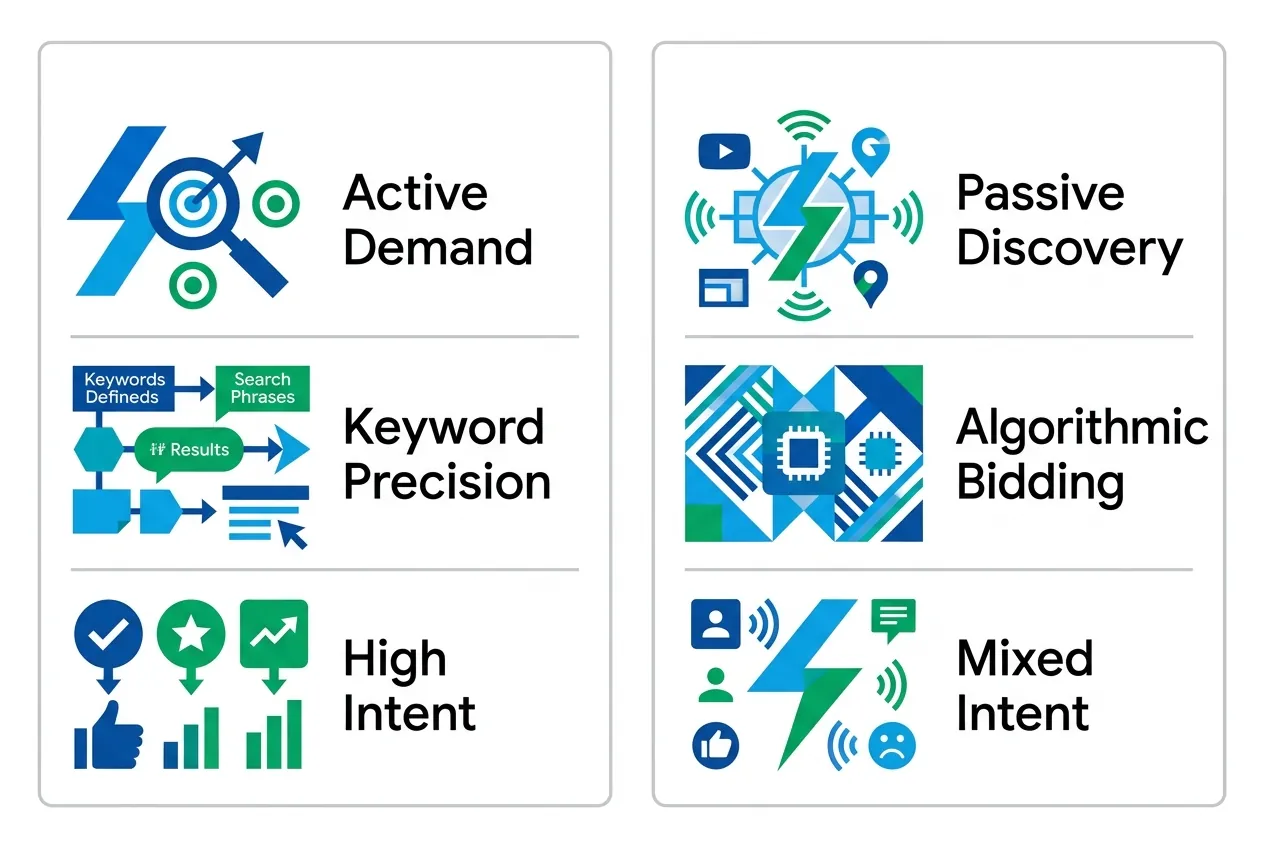
Understanding the operational differences between pmax vs search enables leadership teams to allocate paid media budgets with technical precision. Standard Google Search captures active, articulated demand. Performance Max blends active demand capture with passive, interruption-based demand generation.
- Inventory Scope. Standard Google Search: Google Search and verified Search Partners only. Performance Max Campaigns: Search, Display, YouTube, Gmail, Discover, Maps.
- Targeting Precision. Standard Google Search: Exact, phrase, and controlled broad match keywords. Performance Max Campaigns: First-party audience signals, search themes, algorithmic discovery.
- Negative Matching. Standard Google Search: Granular campaign and ad-group negative keyword lists. Performance Max Campaigns: Account-level negative lists or platform representative requests.
- Placement Governance. Standard Google Search: Search query reports with exact matching transparency. Performance Max Campaigns: Aggregated channel reporting with limited placement-level metrics.
- Lead Quality Control; Standard Google Search: High intent; tied directly to specific active search queries; Performance Max Campaigns: Mixed intent; vulnerable to low-grade display and video clicks
- Optimization Signal. Standard Google Search: Front-end conversion or offline qualified lead imports. Performance Max Campaigns: Requires verified offline conversion data to prevent spam loops.
- Best Operational Fit. Standard Google Search: Direct capture of urgent, high-intent service inquiries. Performance Max Campaigns: Broad scaling across complex, mature conversion funnels.
Standard Search remains the undisputed foundation for high-intent lead generation. When an individual enters a query like "commercial litigation attorney in Chicago" or "adolescent mental health clinic Dallas", they express explicit commercial or clinical intent at that exact moment. A standard search campaign allows you to place a highly relevant, compliant message directly in front of that searcher, apply exact negative matches to filter irrelevant variants, and review every single query that triggers an ad.
Performance Max dilutes that focus. While it accesses search inventory, it continuously cross-sells impressions on YouTube and the Display Network. In professional services and healthcare, passive discovery rarely yields immediate, qualified inquiries. An individual browsing an entertainment video on YouTube or reading a mobile gaming blog is rarely prepared to complete an intake evaluation for medical treatment or engage a professional advisory firm. Allocating precious media dollars to standard Search ensures capital remains concentrated on individuals actively searching for immediate solutions.
Signal governance in sensitive healthcare and regulated verticals
Operating paid media within healthcare, mental health, and regulated professional services introduces rigorous regulatory, privacy, and platform constraints. Advertisers cannot simply apply consumer retail advertising tactics to clinical environments.
Google enforces strict limits regarding user privacy and health conditions. Under the Google Ads Personalized Advertising Policy, advertisers are explicitly prohibited from using remarketing lists, retargeting pixels, or sensitive personal health classifications to target consumers. This means automated campaigns cannot deploy behavioral retargeting or target users based on perceived physical or mental health conditions. If your organization operates in behavioral health or addiction treatment, campaigns must also maintain active LegitScript certification and comply with stringent vertical verification procedures to serve ads.
Because retargeting is prohibited in sensitive health verticals, acquisition strategies must succeed on first-touch conversion mechanics and qualified intent capture. When configuring audience signals for Performance Max in regulated environments, use first-party Customer Match lists strictly within platform policies. Google allows first-party Customer Match data to serve as an audience signal rather than a direct targeting parameter, subject to eligibility criteria detailed in the Google Ads Customer Match Policy.
Signal governance also demands that conversion tracking never exposes protected health information (PHI) to third-party ad pixels. Firing standard conversion pixels containing user names, email addresses, phone numbers, or specific treatment terms violates state and federal health privacy regulations. Instead, regulated organizations must deploy server-side tracking, anonymized identifiers, and secure offline conversion measurement to inform Google's bidding models without compromising patient confidentiality.
When to avoid Performance Max entirely
Automated campaigns offer powerful scaling capabilities under specific operational conditions, but deploying them in the wrong context guarantees wasted capital. Marketing leadership should completely avoid Performance Max when any of the following operational realities apply:
- Monthly media spend is under $10,000 per location. Performance Max requires massive volumes of conversion data to calibrate its neural networks accurately. Google recommends generating at least 30 to 50 conversions per month per campaign. If your media budget only supports 15 to 20 qualified inquiries monthly, the algorithm lacks the statistical volume necessary to optimize bidding. A structured standard Search campaign will yield significantly higher return on investment at lower spend levels.
- Offline conversion tracking is not implemented. If your organization optimizes purely for unauthenticated website form fills without passing verified pipeline data back to Google, avoid PMax entirely. Offline conversion imports (OCI) are non-negotiable for service lead generation. Unless you can programmatically feed qualified leads, booked consultations, and verified revenue back into the ad account via click identifier (GCLID) or enhanced conversion data, PMax will optimize for the lowest-common-denominator submission.
- Your sales or intake team cannot process high-volume, variable-intent inquiries. Standard search generates a lower volume of higher-intent prospects. Performance Max often generates a larger volume of mixed-intent inquiries. If your intake coordinators or business development representatives waste hours chasing unqualified leads, your total customer acquisition cost will skyrocket despite an apparently low platform CPA.
- Immediate, high-urgency demand capture is the sole objective. If prospective clients only seek your service during an acute crisis or specific operational need, display and video impressions are economically inefficient. Stick to exact-match and focused phrase-match standard Search campaigns to ensure every available dollar targets active searchers.

Email Us
Prefer to send the context directly?
How Marketing Powered structures accountable paid media
Marketing Powered builds and manages paid acquisition systems designed specifically for commercial accountability, multi-location operations, and highly regulated service sectors. We approach Google Ads from the perspective of marketing leadership that reports on qualified opportunities and booked revenue rather than unverified platform conversions.
Our operational foundation reflects deep executive experience: our founder is a former healthcare chief marketing officer who led marketing for a treatment network that expanded from 3 to 24 locations, managed $1.5 to $2M per month in Google Ads across 11+ behavioral and mental health accounts, and serves as a court-certified expert witness in advertising strategy. We have been AI-native since 2022, building systems that are LegitScript-aware and HIPAA-aware. We specifically engineer campaigns for Google's sensitive healthcare vertical, where retargeting is not permitted and first-touch conversion architecture determines profitability.
Our methodology rejects vanity metrics and automated black boxes. We configure paid media infrastructure through three rigorous disciplines:
First, we engineer offline conversion imports and downstream pipeline tracking. Rather than allowing Google to optimize for raw form submissions, we connect CRM and intake platforms to the ad network. Bidding algorithms optimize on qualified leads, verified patient admissions, or retained client contracts. Attribution is tracked to admission and actual business outcomes, not merely initial web inquiries.
Second, we protect capital with aggressive account governance. We establish comprehensive account-level negative keyword libraries, enforce strict brand exclusions, disable automated URL expansion, and isolate search inventory. When automated campaign types are tested, they run alongside tightly managed Search campaigns under controlled budget allocations with statistical performance gates.
Third, we maintain owned, local AI infrastructure for HIPAA-aware inference. This allows our team to analyze call transcripts, extract operational insights, process campaign data, and optimize conversion funnels without exposing sensitive consumer or patient information to third-party cloud models.
To explore our complete paid acquisition framework and vetting criteria, review our comprehensive guides on Healthcare PPC: structuring paid search for qualified patient demand, examine the standards for healthcare ppc services: what a specialist partner delivers and how to vet one, and evaluate what to look for when choosing a Google ads agency: what a specialist partner delivers and how to vet one.
Questions, Answered.
Performance Max typically requires an initial learning period of 4 to 6 weeks, assuming the campaign generates a minimum of 30 to 50 conversion actions per month. During this learning window, the algorithm tests creative asset combinations across various networks and audiences. However, if your conversion events are front-end web form submissions without offline qualification signals, the campaign may optimize quickly toward automated spam or low-intent display clicks rather than viable commercial prospects.
Yes, you can run both campaign types simultaneously, but you must prevent audience overlap and keyword cannibalization. Google's ad serving logic dictates that an exact-match keyword in a standard Search campaign will take priority over a Performance Max campaign if the search query is identical to the exact match keyword, provided the account has sufficient ad rank. To prevent PMax from poaching high-value search queries, keep your highest-intent queries in standard Search on exact match, apply brand exclusion lists to PMax, and add your core non-brand search terms as account-level negative keywords where appropriate.
Search themes are optional directional inputs that allow advertisers to tell Google's algorithm what topics and queries your target audience searches for. Unlike standard keywords, search themes do not restrict your ad serving to specific matches; instead, they serve as signals to guide the machine learning model toward relevant search queries. In regulated service verticals, use search themes sparingly to point the algorithm toward commercial service categories while using account-level negative keywords to block low-intent and non-converting variants.
Eliminating fake leads requires a multi-layered defense. First, install invisible reCAPTCHA v3 or Cloudflare Turnstile directly on your landing page forms to prevent automated submission scripts. Second, switch your campaign bidding strategy away from simple "Maximize Conversions" to "Maximize Conversion Value" powered by offline conversion imports, ensuring Google only optimizes toward phone calls and leads verified by your CRM. Third, request that your Google account representative apply campaign-level negative placement exclusions to block known low-quality mobile apps and display websites. Request a paid media audit
Ready to see where your marketing can improve?
Request a free audit of your paid media, landing pages, attribution, and measurement setup. You'll get a straight assessment of where the opportunities are.
or email us at info@marketingpowered.ai