Resources
ChatGPT for Marketing: Where It Helps, Where It Fails and How to Govern It
Deploying chatgpt for marketing has shifted rapidly from an experimental curiosity to daily office practice across growth teams. Marketing departments routinely turn to conversational interfaces to generate outlines, rephrase copy, and synthesize raw notes. Yet marketing executives in regulated sectors face a stark operational divide between rapid text completion and the disciplined requirements of governed, revenue-accountable growth.
By Mike Hulick, Founder, Marketing Powered

The Operator Reality of ChatGPT for Marketing
Every commercial marketing department experiences pressure to cut production cycles and demonstrate operational efficiency with generative artificial intelligence. When teams open a standard conversational interface, the immediate impression is one of immense speed. A writer can generate twenty ad variants in seconds, or an analyst can paste messy notes and receive a bulleted summary instantly.
That initial speed often masks an operational trap. A conversational large language model is fundamentally an autoregressive probability engine. It predicts the most statistically plausible sequence of words based on the massive datasets on which it was trained. It does not possess strategic intent, commercial judgment, or an understanding of your unit economics. Treating a public chatbot as an automated marketing department confuses syntactic fluency with commercial strategy.
When marketing teams confuse drafting speed with strategic velocity, brand standards erode. Competitors with access to the exact same public foundational models generate identical value propositions, the same headline cadences, and the same formulaic thought leadership. At the same time, growth leaders in healthcare, financial services, and multi-location professional services face strict regulatory boundaries. In these environments, deploying public language tools without data isolation, deterministic verification, and clear attribution systems introduces severe risk without delivering an enduring competitive edge.
To understand how artificial intelligence reshapes leadership decisions, teams should evaluate AI marketing: what it changes for strategy, teams and budgets across their broader operational model.

Where It Accelerates Execution: Drafting, Reframing, and Structured Prompts
Conversational models deliver clear, measurable value when applied to defined, low-risk execution tasks governed by strict boundaries. In a production environment, the model should not function as the strategist. It should serve as an execution amplifier for human experts who have already defined the positioning, the argument, and the factual constraints.
Repurposing First-Party Source Material for Marketing Content
One of the most defensible applications is transforming verified, primary-source executive thinking into derivative assets. When subject matter experts record technical walkthroughs, clinical explanations, or client case reviews, those transcripts contain original insights. Using chatgpt for marketing content works well when the model is restricted strictly to the provided transcript text.
The software can extract core arguments, draft social summaries, reformat spoken dialogue into structured subheads, and assemble initial email newsletters. Because the underlying facts, voice, and narrative originate entirely from your internal expert, the model functions as an automated production assistant rather than an unguided writer.
Building Rigorous Systems with ChatGPT for Marketing Prompts
Unstructured, conversational prompting produces generic, hollow prose. When an operator simply types a loose request, the model falls back to generic training distributions. High-performing teams approach chatgpt for marketing prompts as deterministic system configurations rather than casual questions.
A defensible prompt structure requires explicit operational controls:
- Role and domain constraints: Define the exact commercial context, target audience seniority, and technical register.
- Negative constraints: Provide an explicit exclusion list of banned buzzwords, repetitive transitions, and emotional hyperbole.
- Structural rules: Dictate heading formats, sentence length variance, and paragraph limits.
- Few-shot exemplar grounding: Supply two or three approved historical copy examples to lock in brand tone.
- Source boundary enforcement: Instruct the model to rely solely on user-provided documentation, barring it from introducing external trivia.
When configured with these parameters, prompt chains reliably produce structured ad variations, meta descriptions, and multi-channel outlines that align with brand guidelines.
Where Public Models Fail: Hallucinations, Dilution, and Research Limits
Despite the utility of prompt-driven drafting, public conversational models break down when tasked with analytical rigor, factual authority, and independent discovery. Growth leaders who rely on public tools for foundational planning encounter three major structural points of failure.
The Breakdown of ChatGPT for Marketing Research
Teams often attempt to use chatgpt for marketing research to analyze competitive landscapes, locate industry statistics, or map buyer behavior. This practice is inherently risky. Standard language models do not run real-time market analysis unless tethered to live, authoritative verification systems. Instead, they synthesize probabilistic text patterns that resemble market research.
This dynamic leads directly to factual hallucinations. Models readily fabricate market share figures, invent survey results, and attribute manufactured quotes to real industry publications. Relying on conversational research without primary source validation corrupts strategic planning and exposes organizations to reputational damage. The Federal Trade Commission cautions businesses against unsubstantiated AI claims, emphasizing that marketing assertions must be grounded in verified fact rather than automated assumption.
Brand Homogenization and Search Visibility Loss
Public language models naturally regress toward the statistical mean. Left without rigorous human intervention, content generated by conversational interfaces exhibits recognizable stylistic patterns: balanced sentence lengths, predictable transition phrases, and superficial lists.
Search engines have adjusted their evaluation systems to devalue low-effort, automated content that lacks primary insight. Google Search Central guidance on AI-generated content clarifies that search algorithms reward original, high-utility material while penalizing automated publishing designed primarily to manipulate rankings. When every competitor in a vertical uses identical tools to rewrite the same top-ranking articles, the entire search ecosystem suffers from informational sameness.
Context Window Degradation in Long Workflows
While modern model context windows have expanded dramatically, long conversational threads still suffer from attention degradation. As a marketing team iterates inside an extended chat session, earlier instructions, brand rules, and structural constraints fade from focus. The model begins contradicting earlier outputs, introducing unauthorized claims, and dropping negative constraints. Production marketing operations require deterministic programmatic controls, not drifting chat threads.
Free Audit
Want a straight read on where your budget is leaking?
The Strategic Disconnect: Why Strategy Cannot Be Outsourced to a Chatbot
A language model operates without commercial accountability. It does not monitor customer acquisition costs, manage margin pressures, or navigate the operational constraints of facility intake desks. Consequently, turning to chatgpt for marketing strategy yields disconnected lists of standard tactics rather than actionable commercial positioning.
True marketing strategy requires choosing what not to do. It demands identifying narrow market segments, assessing capital efficiency across channels, and understanding competitive vulnerabilities. A chat interface will suggest running paid search, launching podcasts, publishing daily social updates, and sponsoring events simultaneously. It provides an exhaustive catalog of potential activities without the economic framework needed to allocate capital prudently.
For multi-location organizations and regulated healthcare providers, commercial strategy must be tied directly to capacity and pipeline economics. Marketing Powered's founder operated as a healthcare CMO who led marketing for a treatment network that grew from 3 to 24 locations, managing $1.5 to $2M per month in Google Ads across 11+ behavioral and mental health accounts. Strategy at that scale is defined by unit economics, call center scheduling friction, payor mix viability, and verified intake attribution, none of which can be resolved by prompting a conversational model.
When evaluating external guidance on these challenges, growth executives should review AI marketing agency: how to evaluate one beyond the label to separate surface tool users from technical operators.

Data Sovereignty and Compliance: The Hidden Cost of Public LLMs
The most pressing risk of unstructured team usage across commercial chat interfaces is the quiet loss of proprietary data control. When employees copy and paste customer survey transcripts, internal financial margins, upcoming product launch roadmaps, or patient intake logs into consumer-grade interfaces, that confidential corporate intelligence enters a third-party server environment.
The Boundary Between Consumer and Enterprise Data Handling
Many marketing teams remain unaware of the operational distinction between public consumer products and enterprise agreements. According to the OpenAI enterprise privacy terms, data submitted through enterprise services and API endpoints is not used to train future foundation models by default. Conversely, standard consumer-tier interfaces retain user submissions for model training unless users actively navigate privacy menus to opt out.
Relying on staff to manage individual browser-level settings is not a viable compliance strategy for an enterprise. A single pasted document containing client identifiable information or internal margin structures can trigger vendor agreement breaches, customer contract violations, and regulatory scrutiny.
Operating Under Strict Regulatory Boundaries
In regulated verticals like behavioral health, addiction medicine, hospital care, and legal services, privacy requirements are structural. In healthcare, marketing systems must navigate strict statutory standards alongside platform-specific limitations. For instance, the Google Ads personalized advertising policy explicitly prohibits personalized targeting, remarketing lists, and historical audience tracking for sensitive health categories.
Marketing Powered has been AI-native since 2022, building systems specifically for Google's sensitive healthcare vertical where retargeting is prohibited. In these environments, compliance requires LegitScript awareness, HIPAA awareness, and complete data boundary integrity. Feeding patient inquiries, clinical outcomes, or sensitive intake details into open, multi-tenant conversational models violates the baseline principles of patient data stewardship. Defensible marketing operations demand systems engineered around verified admissions and closed revenue, not unmonitored chat prompts.
Moving from Rented Prompts to Owned AI Infrastructure
Forward-looking marketing organizations are shifting away from superficial chat prompts toward sovereign, owned artificial intelligence stacks. The strategic objective is simple: own the process intelligence, own the data privacy boundary, and retain the intellectual property generated by your marketing operations.
The Limits of Renting Commodity Intelligence
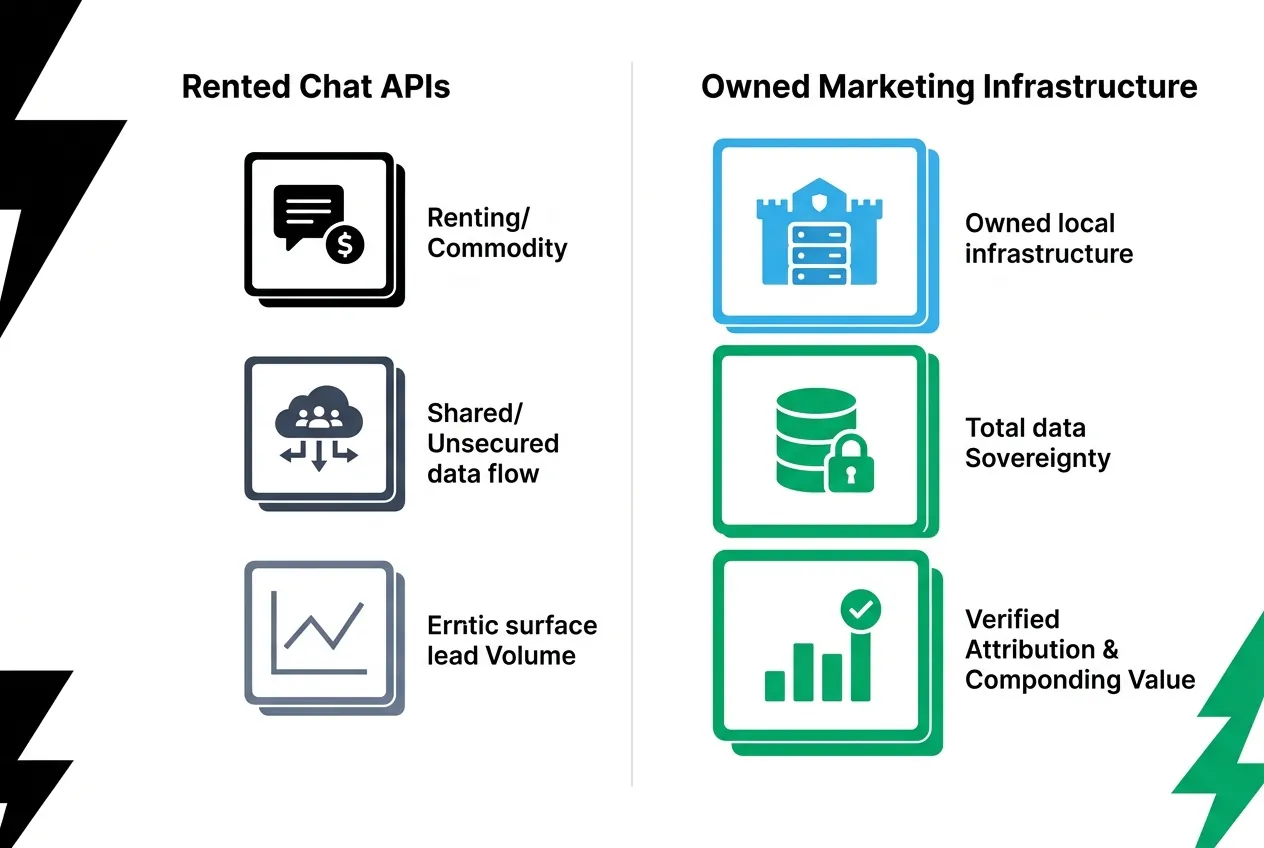
When an enterprise builds its marketing workflows entirely around rented commercial interfaces, it builds on shifting ground. The third-party model provider can alter safety thresholds, modify underlying weights, adjust pricing tiers, or alter terms of service at any moment. Furthermore, renting commodity endpoints yields zero compounding enterprise value. The prompts your team refines inside a public browser tab do not form an enduring asset.
Real organizational leverage comes from owning your infrastructure. By deploying local inference and self-hosted models, organizations maintain complete data sovereignty. Proprietary customer records, pricing models, confidential strategic plans, and healthcare intake notes remain inside an isolated computing perimeter.
How Marketing Powered Deploys Owned Marketing Systems
Marketing Powered solves this architectural challenge by implementing specialized AI systems and AI-native marketing operations on owned infrastructure. Rather than routing sensitive marketing data through public multi-tenant APIs, we maintain owned, local AI infrastructure for HIPAA-aware inference.
This sovereign approach provides distinct operational advantages:
- Absolute data isolation: Proprietary customer research, intake conversations, and strategic plans never leave controlled hardware, eliminating the risk of external model training.
- Deterministic data retrieval: We link language models directly to verified first-party documentation through retrieval systems that eliminate ungrounded hallucinations.
- Closed-loop commercial attribution: We engineer conversion systems that track acquisition spend directly through intake to verified admissions or sales outcomes, rather than stopping at surface-level lead generation.
- Channel-specific compliance: Workflows are engineered to operate strictly within the boundaries of LegitScript frameworks and platform advertising policies for sensitive verticals.
Organizations exploring this architectural shift can examine our dedicated specialized AI systems and marketing operations to understand how owned infrastructure protects margins and ensures compliance.
To see how specialized search systems surface authoritative brands in the age of conversational queries, explore our analysis of a generative engine optimization agency: what a specialist partner delivers and how to vet one.
Email Us
Prefer to send the context directly?
An Executive Governance Framework for Marketing AI
To capture the drafting efficiencies of generative models without compromising data security or brand reputation, CMOs and growth leaders should institute a formal operational governance framework.
1. Establish Tiered Tooling Permissions
Segment AI applications into distinct security tiers based on data sensitivity:
- Public Tier (Zero Sensitive Data): Standard public conversational interfaces permitted solely for broad brainstorming, syntactic refactoring, or public code debugging. No customer names, internal metrics, or non-public copy may enter this tier.
- Commercial API Tier (Contractually Protected): Enterprise agreements with explicit data privacy clauses guaranteeing that customer inputs are excluded from model training. Suitable for processing anonymized campaign data and approved marketing drafts.
- Sovereign Tier (Owned Local Infrastructure): Self-hosted, locally run models deployed behind enterprise firewalls. Mandatory for processing customer identifiers, protected health information, proprietary financial margins, and confidential positioning playbooks.
2. Mandate Source-Grounded Drafting
Prohibit the open-ended generation of factual claims, market statistics, or technical guidance. Require content teams to supply explicit, verified source material (such as approved research reports, verified case documentation, or recorded internal expert interviews) inside every generation prompt. If a factual statement cannot be traced directly to an internal primary source or verified third-party documentation, it cannot be published.
3. Implement Multi-Stage Human Quality Assurance
Never allow automated systems to publish directly to public channels or CRM workflows. Every generative asset must pass through a defined human editorial gate:
- Factual Verification: An editor cross-checks every statistic, date, quote, and regulatory claim against approved primary documentation.
- Voice and Differentiation Audit: The asset is evaluated against competitor content to ensure it does not repeat formulaic, statistically averaged phrasing.
- Compliance Review: Regulated claims are audited against platform-specific advertising rules, statutory privacy requirements, and industry-specific substantiation standards.
Questions, Answered.
ChatGPT is a general-purpose conversational interface optimized for broad dialogue and rapid text generation. Enterprise marketing systems, by contrast, integrate deterministic business rules, private data retrieval mechanisms, closed-loop attribution tracking, and dedicated compliance boundaries. While ChatGPT assists with ad-hoc drafting, enterprise systems automate complex operational workflows without exposing sensitive company intelligence to external multi-tenant models.
Search engines do not penalize content solely because artificial intelligence assisted in its creation. However, automated content that lacks primary expertise, relies on recycled web copy, or fabricates factual claims will fail modern search quality standards. Unedited conversational copy tends to regress toward generic language that fails to provide original utility, causing organic rankings and user engagement to decline over time.
Organizations must establish an explicit acceptable-use policy supported by technical boundaries. Teams should restrict the use of consumer-tier chat interfaces on corporate networks, deploy enterprise-tier solutions with signed data-retention opt-outs, and implement local, owned infrastructure for sensitive workloads. Furthermore, employees must receive operational training regarding what constitutes confidential data, including customer records, pricing models, and protected health information.
Prompt engineering refers to the tactical structuring of text inputs supplied to a third-party model interface to achieve a cleaner output. Owned AI architecture refers to the end-to-end technical infrastructure: owning the underlying compute hardware, hosting private open-weights models, governing local vector databases, and engineering deterministic workflows that safeguard proprietary data while connecting marketing spend directly to commercial outcomes. Talk with Marketing Powered about owning your marketing AI stack
Ready to see where your marketing can improve?
Request a free audit of your paid media, landing pages, attribution, and measurement setup. You'll get a straight assessment of where the opportunities are.
or email us at info@marketingpowered.ai