Resources
Intake Automation: Routing and CRM Workflows That Stop Lead Leakage
High-intent customer acquisition often breaks down immediately after a prospect submits a form or places an inbound call. When intake automation is absent, manual handoffs and delayed response times cause qualified demand to evaporate before operational teams can intervene. Building structured routing, qualification, and CRM workflows stops pipeline leakage and protects marketing return on ad spend across complex, multi-location organizations.
By Mike Hulick, Founder, Marketing Powered

The Economic Cost of Delayed Response and Manual Handoffs
Customer acquisition programs rarely fail exclusively at the ad account level. Marketing leadership frequently diagnoses declining efficiency as an issue with targeting, creative fatigue, or bidding thresholds. Yet an audit of the post-click pipeline often reveals that the actual point of failure is operational latency. A high-intent buyer or patient visits a landing page, evaluates the service, and submits an inquiry, only for that record to sit unassigned in a shared email inbox or an unmonitored spreadsheet.
Every minute of delay degrades conversion probability. Landmark research published by the Harvard Business Review shows that organizations contacting prospective customers within an hour of receiving an inquiry are nearly seven times more likely to qualify the lead than those waiting just an hour longer, and more than sixty times more likely than firms waiting twenty-four hours or more. The degradation begins within minutes: reaching out within five minutes versus thirty minutes yields a massive increase in successful contact and qualification rates.
When response times lag, paid media economics collapse. If a specialized campaign produces inquiries at $150 per submission, but internal response times average four hours, contact rates drop precipitously. A front-desk coordinator or admissions representative calling back hours later reaches voicemail rather than an engaged prospect. By that point, the prospect has returned to search results, contacted a competitor, or reconsidered the decision entirely.
The financial consequence is an artificially inflated cost per acquisition. The marketing department claims success by reporting a stable cost-per-lead (CPL), while executive leadership experiences shrinking margins and stagnant top-line revenue. Bridging this disconnect requires examining the systemic pipeline rather than treating conversion as a purely front-end exercise. Connecting front-end campaigns to conversion rate optimization for lead generation: a system, not a list of tests, requires treating the intake handoff as a core component of conversion rate optimization.

Mapping the Intake Process to Identify Points of Failure
Eliminating leakage requires an exhaustive diagnostic audit of the existing intake process. In multi-location healthcare systems, behavioral health networks, and professional services practices, inquiries enter through multiple channels simultaneously. Prospective clients submit contact forms, start web chats, schedule appointments through self-service calendars, and dial dynamic call tracking numbers. Without an intentional intake architecture, these fragmented streams create operational friction.
The standard inquiry journey typically contains four acute leakage points:
- Unassigned Inbound Queues: Form submissions routed to generic distribution lists (info@company.com or intake@facility.com) lack individual accountability. When multiple staff members share responsibility for a queue, ownership diffuses, and records sit unaddressed during peak inquiry volumes.
- After-Hours and Weekend Abandonment: Paid campaigns run twenty-four hours a day, capturing high-intent searchers during evenings and weekends. If intake staffing operates strictly on standard business hours without automated triage, after-hours inquiries face a latency penalty of twelve to forty-eight hours.
- Information Bottlenecks and Manual Data Entry: When intake personnel spend their initial call gathering basic administrative information, demographic profiles, or insurance coverage details, throughput slows. Staff members spend valuable time acting as manual data entry clerks rather than addressing the prospective client's immediate needs.
- Duplicate Record Collisions: Inquiries that re-engage across multiple touchpoints—such as an initial web submission followed by a phone call two days later—often create duplicate CRM records. Without automated identity deduplication, disparate staff members engage the same individual with conflicting context, frustrating the prospect and wasting operational capacity.
Auditing this path requires tracking time-stamped milestones from the initial landing page submission through CRM entry, first rep assignment, initial contact attempt, and formal qualification. Quantifying the delta between timestamp zero (inquiry generation) and timestamp one (first human outreach) provides the baseline metric necessary to engineer a leak-proof intake pipeline.
Rule-Based Lead Routing Across Distributed and Multi-Location Teams
Once an inquiry enters the system, manual assignment represents an unnecessary risk. Rule-based lead routing distributes prospective clients to the right personnel instantly, factoring in operational variables that static round-robin distribution ignores.
Effective lead routing architecture evaluates several criteria in real time:
- Geographic Jurisdiction and Licensing: In healthcare, telemedicine, and legal services, professionals must be licensed in the state where the client resides. Automated routing parses the prospect's location or IP data, directing the inquiry exclusively to qualified, licensed staff.
- Clinical or Service Specialization: High-value inquiries vary by complexity. A hospital network handling routine outpatient consultations requires a different intake skill set than one managing acute inpatient admissions. Intake rules inspect submitted intent signals to direct complex cases to senior triage personnel.
- Capacity and Working Availability: Distributing leads evenly across a roster without accounting for live availability creates bottlenecks. Intelligent routing systems cross-reference staff calendars, shift schedules, and active caseloads, bypassing representatives who are currently on active calls, out of the office, or at capacity.
- Payer and Demographic Parameters: For organizations operating under specific commercial payer networks, routing logic can instantly screen self-reported insurance information, directing in-network inquiries to immediate intake reps while routing out-of-network prospects to specialized financial counselors.
By engineering deterministic routing logic, organizations replace subjective manual sorting with automated precision. Staff members receive notifications via SMS, email, or internal CRM tasks containing complete contextual data the moment a lead arrives, enabling informed, empathetic outreach within seconds of submission.
Free Audit
Want a straight read on where your budget is leaking?
CRM Automation and Closed-Loop Attribution from Click to Outcome
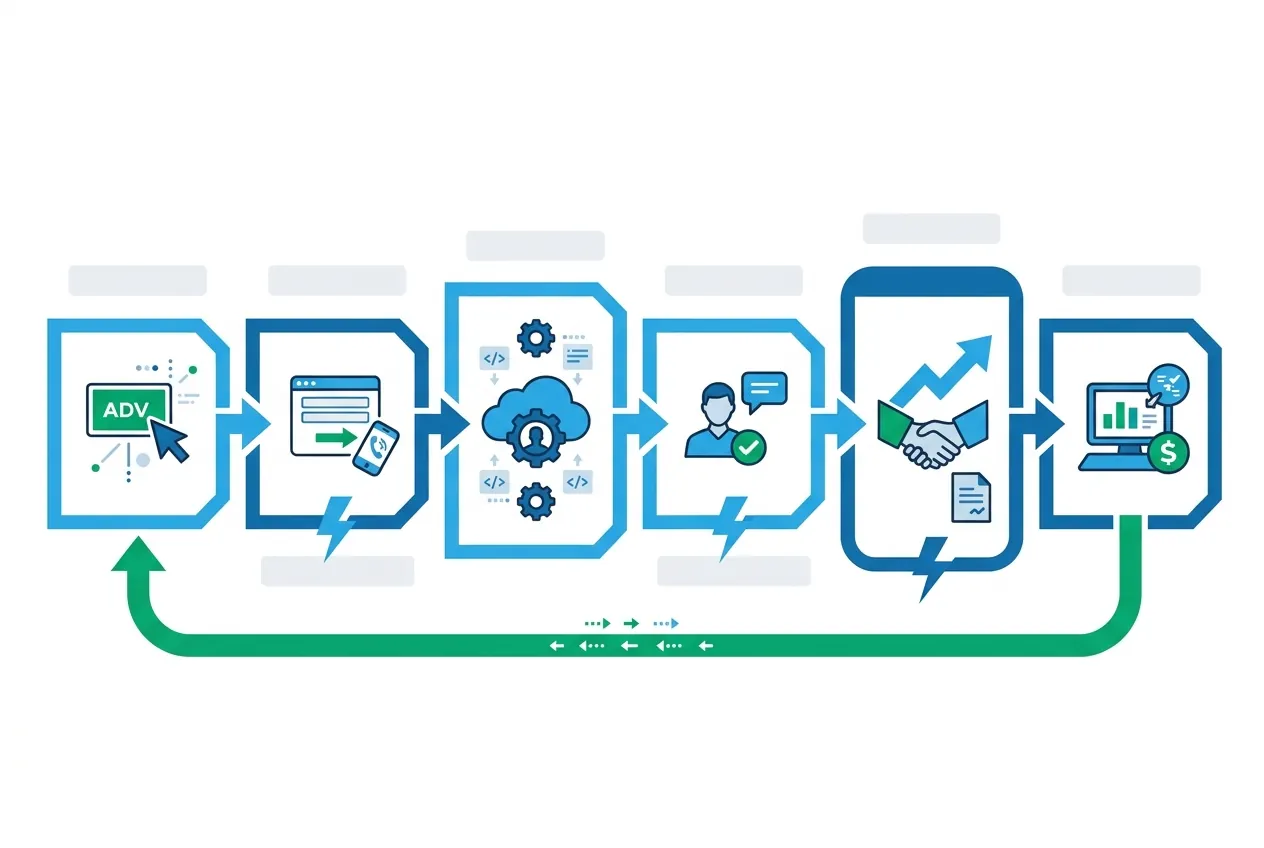
Intake systems do not exist in isolation; they must integrate directly with the central CRM to establish closed-loop attribution. High-performing customer acquisition requires connecting ad spend directly to admitted patients, signed retainers, or contracted revenue rather than stopping at the raw lead stage.
Executing this connection requires crm automation that preserves tracking parameters across the entire user lifecycle.
When a visitor clicks a Google Search ad, the platform appends unique tracking parameters, such as the Google Click Identifier (GCLID), alongside standard UTM parameters. High-integrity landing pages capture these parameters dynamically via script and store them within session storage. When the user completes an intake form or dials a dynamic tracking phone number, those attribution parameters pass seamlessly through hidden fields into the intake automation pipeline.
The CRM must persist these identifiers through every subsequent operational stage:
- Lead Creation: The contact record is generated with upstream marketing identifiers intact (campaign ID, ad group, keyword match type, and GCLID).
- Opportunity Stage Progression: As intake staff complete initial consultations, clinical assessments, or discovery calls, stage updates trigger automated data syncs.
- Outcome Settlement: When the prospect converts into an admitted patient or signed client, the CRM writes back the conversion event, transaction value, and final timestamp.
- Offline Conversion Ingestion: Using automated API pipelines, the CRM passes the final business outcome back to the ad platforms.
Closing this loop transforms bidding intelligence. When ad networks optimize only for raw form submissions, algorithmic bidding models prioritize users who fill out forms easily, regardless of whether they qualify commercially. When crm automation feeds verified admissions or signed contracts back into ad bidding engines, the algorithms adjust bidding strategies toward high-value audiences who actually generate top-line revenue. This data architecture underpins what a specialized conversion rate optimization agency delivers when auditing commercial acquisition economics.
Patient Intake Automation in Regulated and Privacy-Sensitive Sectors
Automating intake workflows in regulated sectors like healthcare, behavioral health, and legal representation requires balancing operational speed with strict privacy governance. Organizations cannot deploy third-party consumer automation tools without scrutinizing data transmission pathways and regulatory compliance.
In healthcare acquisition, platform policies impose rigorous constraints. The Google Ads Policy on Personalized Advertising explicitly prohibits remarketing and personalized targeting based on personal health conditions, clinical treatments, or sensitive medical history. When a patient visits a landing page and fails to convert, an advertiser cannot simply serve retargeting ads to draw them back into the funnel. The initial intake interaction represents the primary opportunity to secure the relationship, making rapid, friction-free patient intake automation vital.
Furthermore, healthcare organizations must observe data governance standards regarding tracking technologies. Guidance issued in the HHS Office for Civil Rights Bulletin underscores that tracking technologies deployed on patient-facing web pages and intake portals must not disclose protected health information (PHI) to unauthorized third parties without appropriate agreements and safeguards.
Designing compliant patient intake automation involves four foundational architectural rules:
- Separation of Anonymous and Identifiable Data: Marketing click identifiers (such as GCLIDs) must be handled carefully. Upstream marketing pipelines should capture traffic parameters, but once a user inputs sensitive clinical criteria, the data must transition into secure, HIPAA-aware infrastructure governed by formal Business Associate Agreements (BAAs).
- Controlled Administrative Intake: Pre-intake forms should collect administrative and logistical data—such as preferred contact time, general department interest, and basic contact information—while reserving sensitive clinical disclosures for secure, human-led intake calls.
- Server-Side Data Pipelines: Direct, client-side browser scripts that broadcast user activities to third-party ad networks must be replaced with audited, server-side data routing that sanitizes private identifiers before transmission.
- Sovereign and Encrypted Record Handling: CRM systems housing patient records must implement role-based access control, encryption in transit and at rest, and audit logs tracking every staff interaction with prospective patient records.
When built under these parameters, patient intake automation accelerates access to care without violating regulatory boundaries or exposing the organization to legal liabilities.
Engineering Operational Workflows That Balance Automation and Human Empathy
A common objection from clinical and executive leadership is that automation dehumanizes high-touch consultations. In behavioral health, senior living, and complex professional services, prospective clients frequently reach out during periods of emotional stress or financial crisis. A cold, automated autoresponder or an aggressive commercial bot damages trust at the most vulnerable point in the relationship.
Intake automation should never replace human empathy; it exists to protect human empathy. When intake staff spend half their working hours chasing missed callbacks, manually entering form data, and retyping insurance numbers, they experience cognitive fatigue. By the time they connect with a prospect, their capacity for patient, active listening is compromised.
Automation handles mechanical, administrative tasks instantly so human specialists can focus entirely on supportive communication:
- Immediate Contextual Acknowledgment: Rather than sending an impersonal, generic receipt, automated messaging confirms receipt with clear operational expectations: "We received your inquiry. A specialist from our admissions department is reviewing your details and will call from our main line within ten minutes."
- Self-Service Scheduling Integration: High-intent users who prefer immediate certainty can access real-time calendar availability to select a dedicated consultation time, eliminating the frustration of back-and-forth phone tag.
- Pre-Call Notification Briefings: Automated workflows parse form details and push an operational summary directly to the representative's screen prior to dialing. The intake rep enters the call knowing the prospect's name, preferred service, location, and specific inquiries, allowing them to lead with compassion rather than administrative interrogation.
By eliminating operational friction behind the scenes, automation creates the space required for meaningful, trust-building human conversations.

Email Us
Prefer to send the context directly?
How Marketing Powered Deploys Full-Funnel Intake Automation
Marketing Powered approaches intake automation as an engineering discipline directly tied to paid media efficiency. Acquisition models cannot rely on superficial lead counts; operational systems must deliver qualified inquiries that transition reliably into closed outcomes.
Our methodology is grounded in direct operator leadership. The firm's founder is a former healthcare Chief Marketing Officer who directed marketing operations for a treatment network that expanded from 3 to 24 locations, managing $1.5 to $2M per month in Google Ads across 11+ behavioral and mental health accounts. As a court-certified expert witness in advertising strategy, our leadership designs marketing systems that withstand legal, regulatory, and financial scrutiny.
Marketing Powered has been AI-native since 2022, building systems that are LegitScript-aware and HIPAA-aware. We engineer intake workflows specifically tailored for Google's sensitive healthcare vertical, where retargeting is strictly prohibited, meaning every first-touch visit must be maximized. Our technical architecture includes owned, local AI infrastructure for HIPAA-aware inference, ensuring sensitive data processing remains sovereign and controlled.
When deploying full-funnel intake and landing page optimization systems, we execute across four operational phases:
- Pipeline and Data Audit: We trace every touchpoint from ad impression to closed admission, mapping data drop-offs, untracked call flows, and manual delays across your existing CRM stack.
- Friction-Free Landing Page Architecture: Working in tandem with specialized landing page optimization agency practices, we design intake forms and dynamic call touchpoints that capture high-intent inquiries while preserving upstream tracking parameters.
- Automated Triage and Intelligent Routing: We configure custom CRM workflows that parse geographic parameters, service complexity, and staff availability, routing leads to internal teams in seconds.
- Closed-Loop Conversion Integration: We establish end-to-end attribution pipelines where conversions are tracked to final admission or closed revenue, feeding downstream value data back into Google Ads bidding engines to train algorithms on real enterprise outcomes.
This operational integration ensures your media spend directly feeds a disciplined revenue engine, systematically eliminating lead leakage while providing marketing leadership with defensible business economics.
Questions, Answered.
Marketing automation typically focuses on top-of-funnel email nurturing, scheduled promotional newsletters, and broad lead-scoring sequences across long buying cycles. Intake automation, by contrast, operates at the sharp end of the conversion funnel. It focuses on the immediate operational handoff: validating submitted data, checking duplicate records, routing inquiries to specific personnel within seconds, and synchronizing offline CRM outcomes with paid acquisition platforms.
Intake automation directly protects ad spend by reducing lead response latency. When inbound leads are contacted within five minutes rather than hours later, qualification rates increase significantly. By ensuring that expensive paid media clicks convert into answered calls, scheduled consultations, and completed sales, automation lowers your realized customer acquisition cost. Furthermore, passing verified sales or admissions back to ad networks enables automated bidding algorithms to optimize for revenue rather than cheap, unqualified clicks.
Yes, provided the technical architecture is specifically configured for sensitive data handling. Compliant workflows separate anonymous marketing data (such as campaign IDs) from identifiable health disclosures. Direct tracking pixels from consumer social networks must not be embedded on private intake portals. By using server-side data processing, encrypted storage, and HIPAA-aware CRM platforms supported by Business Associate Agreements, organizations can automate operational handoffs safely.
When implemented correctly, intake automation accelerates human contact rather than blocking it. Automation should handle operational tasks like record deduplication, notification alerts, and representative assignment instantly in the background. Instead of forcing prospects through rigid automated chatbots, intelligent intake pipelines clear administrative hurdles so that human specialists can initiate personal, empathetic contact within minutes of submission. Schedule a strategy call with Marketing Powered
Ready to see where your marketing can improve?
Request a free audit of your paid media, landing pages, attribution, and measurement setup. You'll get a straight assessment of where the opportunities are.
or email us at info@marketingpowered.ai