Resources
Call Tracking: How It Works and What to Measure Beyond Call Volume
Call tracking bridges the gap between digital marketing investments and offline phone conversations by attributing inbound calls to specific campaigns, ads, and keyword searches. When properly integrated into intake operations and analytics platforms, it transforms the telephone from an unmeasured channel into an accountable driver of business pipeline. Yet treating raw call volume as the ultimate measure of acquisition success routinely leads marketing teams to waste capital on unqualified inquiries.
By Mike Hulick, Founder, Marketing Powered

How Dynamic Number Insertion Connects Web Sessions to Call Tracking Numbers

What Is Call Tracking and How Does Call Tracking Software Work?
At its core, call tracking software assigns unique telephone numbers to distinct marketing touchpoints so an organization can determine which channels generate incoming phone calls. When an individual dials one of these numbers, the telephony platform logs the call metadata (including caller ID, time of day, geographic location, and call duration) before routing the caller to the intended destination, such as a centralized call center, an intake desk, or a local office.
Behind that simple forwarding mechanism lies a dual-layer architecture: telephony infrastructure and web analytics. In traditional offline media, tracking relies on static call tracking numbers. A healthcare provider or professional services firm prints one distinct local or toll-free number on a highway billboard, a different number on a direct mail flyer, and a third number on a print publication. When someone calls the billboard number, the telephony server immediately credits that specific physical asset with the inquiry.
In digital environments, however, static tracking provides insufficient visibility. Modern buyers navigate complex digital journeys across organic search, paid search ads, local map packs, and social media. To attribute digital touchpoints accurately, call tracking software uses dynamic number pools managed by cloud telephony networks. These platforms interface directly with website visitor sessions, assigning unique phone numbers on the fly to capture rich attribution parameters, including source, medium, campaign name, ad group, and specific search keywords.
By connecting telephony events with digital session data, organizations replace guesswork with verified source tracking. This foundation allows leadership to evaluate whether their acquisition spend generates meaningful telephone conversations or merely burns intake resources on misdialed queries.
Dynamic number insertion, commonly abbreviated as DNI, is the core technology that makes digital call attribution possible at a granular level. Without DNI, digital marketers can only view channel-level aggregates, unable to connect a high-value inbound call to a specific keyword, ad copy variant, or ad spend click identifier.
The process operates through a lightweight JavaScript snippet placed on a website. When a visitor lands on a web page, the script executes in the user's browser, reading the visitor's session parameters. These parameters include referral URLs, UTM tracking parameters, and platform-specific click identifiers such as Google Click IDs (GCLID), WBRAID, or GBRAID.
Simultaneously, the script requests a temporary, dedicated phone number from a preconfigured pool of call tracking numbers hosted by the telephony provider. The script then executes a Document Object Model (DOM) replacement on the page, swapping the default corporate telephone number with the assigned tracking number for the duration of that visitor's session.
To maintain 1:1 attribution accuracy, dynamic number pools must be sized appropriately according to concurrent site traffic. If a website averages twenty concurrent visitors during peak traffic periods, a pool of four tracking numbers will cause attribution collisions: two different visitors browsing the site at the exact same moment might see the identical tracking number. When one of them dials, the software cannot definitively determine which visitor session placed the call.
Properly configured dynamic number pools maintain an active lease on each displayed number while the visitor browses. If the visitor dials the number displayed on their screen, the software matches the inbound call with the active session cookie. It captures the exact landing page, referring URL, campaign identifier, and click ID, and records this attribution record in the telephony database before handing the call off to the primary telephone exchange. Once the visitor leaves the site and the session timeout expires (typically after 15 to 30 minutes of inactivity), that tracking number returns to the available pool, ready to be assigned to the next visitor.
Why Raw Call Volume Distorts Marketing Performance
A common error in digital marketing is treating every inbound phone call as a successful conversion. Marketing dashboards frequently celebrate spikes in total call volume, presenting cost-per-call drops as evidence of campaign efficiency. In commercial reality, a phone call is merely an open telecommunication channel, not a customer acquisition event.
When agencies and marketing departments optimize campaigns solely for raw call volume, they create severe operational and financial distortions. A surge in phone volume often consists of existing customers seeking customer support, vendors pitching services, billing inquiries, misdials from broad-match keyword targeting, or low-intent consumers who did not read the website copy.
This creates a hidden operational cost. Intake specialists, intake nurses, and inside sales representatives have finite capacity. When marketing floods the intake queue with unqualified calls, hold times increase for genuine, high-intent prospects. Staff members spend valuable hours explaining that the business does not offer the low-cost service a caller assumed was available, leading to employee fatigue and missed opportunities.
Worse, optimizing for call volume creates an algorithmic trap within programmatic ad platforms. Advertising networks rely on machine learning models to identify users likely to complete designated conversion actions. If you configure Google Ads or Meta Ads to register a conversion whenever a phone call lasts longer than 30 or 60 seconds, the ad platform interprets that threshold as a complete commercial success. The algorithmic bidding engine then hunts for more users with similar demographic and behavioral profiles: individuals who are quick to dial a phone number and stay on the line for a minute, regardless of whether they have the intent, budget, or medical criteria to become a patient or client.
The business ends up paying advertising platforms to acquire the cheapest, least qualified callers in the market. True performance marketing requires breaking this feedback loop by measuring what happens after the call is answered.
Free Audit
Want a straight read on where your budget is leaking?
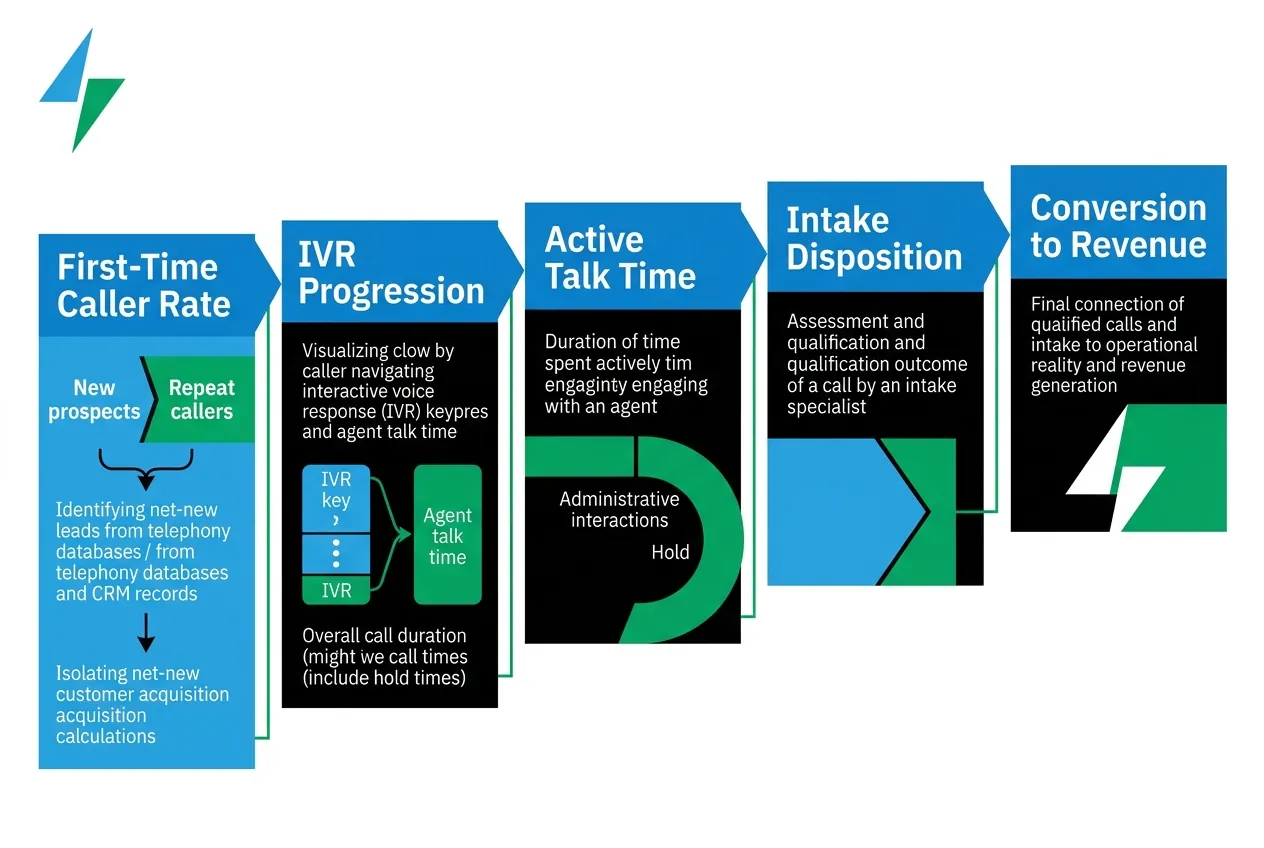
Five Essential Call Tracking Metrics to Measure Beyond Volume
To align marketing expenditure with operational reality and revenue generation, growth leaders must replace raw call tallies with metrics that assess caller qualification, operational intake flow, and downstream financial yield.
1. First-Time Caller Rate
A significant percentage of inbound calls to any mature business originate from repeat callers, existing clients, billing queries, or administrative vendors. If your marketing campaigns register these as new leads, your reported acquisition costs are artificially depressed.
Tracking the first-time caller rate isolates net-new prospects from known contacts. Advanced call tracking platforms evaluate the incoming caller ID against historical telephony databases and connected CRM records. If the phone number matches an existing customer record or a number that dialed within the previous 90 days, the platform flags the interaction as a repeat call. Net-new customer acquisition calculations must be based strictly on verified first-time callers.
2. Qualified Call Duration and IVR Progression
Raw call duration is a deceptive metric. A four-minute phone call might represent an in-depth intake assessment with an ideal prospect, or it might represent an irate caller placed on hold for three minutes before hanging up in frustration.
Instead of relying on crude total duration thresholds, sophisticated operators track interactive voice response (IVR) keypresses and active agent talk time. Did the caller navigate past the initial greeting and press option 1 for new patient admissions? Did the conversation with an intake specialist last past the minimum threshold required to complete a screening? Monitoring how callers navigate automated routing trees provides clear insight into whether the traffic arriving from specific ad groups possesses legitimate commercial intent.
3. Intake Disposition and Lead Quality Scoring
The most critical operational metric in call attribution is the agent disposition. Immediately following a call, the intake representative or sales agent should log a structured outcome in the telephony interface or CRM.
Standardized disposition categories include:
- Qualified New Prospect
- Unqualified: Clinical or Service Mismatch
- Unqualified: Out of Service Area / Geographic Mismatch
- Unqualified: Financial / Insurance Mismatch
- Administrative / Billing / Existing Client
- Vendor / Spam / Wrong Number
Tracking campaigns by their qualification percentage reveals performance variations that raw call counts conceal. For example, a campaign generating 100 calls at a $40 cost-per-call with an 80% unqualified rate yields 20 qualified opportunities at an actual cost of $200 per qualified lead. Conversely, a campaign generating 40 calls at an $80 cost-per-call with a 75% qualification rate produces 30 qualified opportunities at an actual cost of $106.67. The second campaign appears twice as expensive on a surface-level call volume dashboard, but it delivers 50% more qualified pipeline at roughly half the true cost.
4. Cost Per Qualified Opportunity (CPQO)
Cost per lead (CPL) is an incomplete marketing metric that encourages short-term volume over business value. Cost per qualified opportunity (CPQO) shifts the financial focus to true pipeline acquisition.
To calculate CPQO, divide total channel spend by the number of callers who meet verified qualification criteria:
CPQO = (Total Channel Spend) ÷ (Number of Qualified Opportunities)
By evaluating campaigns on CPQO, marketing leaders can aggressively cut spend on keywords that produce cheap, unqualified rings and redirect media budgets toward queries that consistently engage the intake team in substantive intake screenings.
5. Downstream Revenue and Admissions Attribution
The ultimate measure of call attribution is verified revenue, signed contracts, or completed admissions. Connecting an initial website visit to a final transaction requires passing telephony data directly into customer relationship management software and operational billing systems.
When an intake representative converts a qualified caller into an active opportunity, the CRM retains the initial attribution metadata: the original GCLID, campaign name, keyword, and landing page variant. When that opportunity closes, whether three days or four months later, the realized contract value or patient admission ties directly back to the original acquisition source. This closed-loop visibility allows organizations to calculate actual Return on Ad Spend (ROAS) based on collected revenue rather than estimated pipeline.
Implementing Call Tracking for Marketing Across Ad Platforms and CRMs
Building a closed-loop attribution architecture requires integrating three distinct systems: the web analytics layer, the telephony platform, and the enterprise CRM.
First, the call tracking platform must be configured to pass incoming call records into the CRM in real time via secure application programming interfaces (APIs) or webhooks. When a phone call arrives, the telephony system queries the CRM. If a contact with that phone number already exists, the platform logs the call as a new activity on the existing record. If the phone number is new, the system generates a new lead record, pre-populating fields with the caller's geographic location, referring channel, UTM parameters, and ad identifiers.
Second, the intake team must use standardized disposition fields within the CRM. If intake specialists do not consistently record call outcomes, the attribution chain breaks at the human handoff point. Requiring a disposition before an agent can close an interaction ensures clean data hygiene.
Third, qualified dispositions and closed revenue events must be fed back into ad networks using offline conversion imports. According to documentation on Google Ads Call Assets, tracking call conversions can occur directly through call assets or website call conversions via forwarding numbers. However, importing offline conversion events allows marketing teams to go substantially further.
By uploading offline conversion data containing the original GCLID, timestamp, and adjusted conversion value, marketing teams instruct Google's Smart Bidding algorithms to optimize for actual revenue outcomes. Instead of instructing the platform to maximize generic call volume, the bidding engine is trained on high-margin commercial outcomes.
In broad strategies outlined in our foundational guide, Marketing attribution: a practical guide for teams that need real answers, building this closed-loop data pipe is the single most effective way to eliminate media waste and align marketing spend with commercial growth.
Email Us
Prefer to send the context directly?
Regulatory Compliance and Patient Privacy in Healthcare Call Attribution
Implementing call tracking within regulated industries, particularly healthcare and behavioral health networks, introduces operational and legal constraints that do not exist in standard e-commerce environments. Organizations must navigate strict privacy laws, including the Health Insurance Portability and Accountability Act (HIPAA), while configuring their tracking stacks.
In healthcare environments, the combination of an individual's IP address, web browsing behavior, and phone number can constitute Protected Health Information (PHI). In December 2022, the US Department of Health and Human Services (HHS) Office for Civil Rights issued an important bulletin regarding online tracking technologies, later updated with further clarification: HHS Guidance on Online Tracking Technologies. The guidance emphasizes that covered entities and business associates cannot disclose PHI to tracking technology vendors without a valid Business Associate Agreement (BAA) or appropriate patient authorization.
Standard, off-the-shelf marketing trackers frequently route visitor data through third-party servers that do not sign BAAs or lack privacy-compliant data pipelines. If a website visitor visits a page detailing treatment for a specific medical condition, and an unmanaged script transmits that URL along with the visitor's IP address and telephony session to an ad platform, the provider faces serious regulatory exposure.
Furthermore, major advertising platforms enforce strict restrictions on marketing sensitive services. For instance, Google Ads Policy on Personalized Advertising strictly prohibits remarketing, audience targeting, and interest-based profiling based on personal hardship, physical or mental health conditions, and clinical treatments. Healthcare marketers cannot simply build retargeting audiences of users who called their facility but did not schedule an appointment.
Operating compliantly requires rigorous architectural controls:
- Business Associate Agreements: Ensure that telephony and tracking vendors sign a formal BAA before routing any healthcare-related calls or handling user session data.
- Server-Side Tracking and PHI Redaction: Deploy server-side tagging containers to strip sensitive personal identifiers, query parameters, and specific medical condition slugs from web requests before sending attribution signals to third-party ad networks.
- Call Recording Safeguards: If call recording is enabled for quality assurance, automatic redaction must be configured to prevent the storage of Social Security numbers, credit card details, and sensitive clinical intake notes. In some jurisdictions, two-party consent announcements must play before any recording begins.
- Local Data Governance: Telephony logs and transcripts must reside within access-controlled environments that enforce strict role-based permissions and audit logging.
Maintaining marketing accountability does not require compromising patient privacy. It requires a deliberate, engineered tracking infrastructure that respects regulatory boundaries while capturing the commercial data points required to steer marketing investments.

How Marketing Powered Builds Accountable Attribution Systems
Marketing Powered is an operator-led marketing firm built specifically to solve attribution breakdowns in complex, multi-location, and highly regulated industries. We approach call tracking not as an isolated software install, but as an integral component of our comprehensive data and analytics architecture.
Our leadership brings direct executive experience managing complex acquisition networks. Our founder is a former healthcare Chief Marketing Officer who directed marketing operations for a treatment network that scaled from 3 to 24 locations, managing $1.5 to $2M per month in Google Ads across 11+ behavioral and mental health accounts. Having served as a court-certified expert witness in advertising strategy, our team operates with an acute awareness of platform policy, regulatory exposure, and the operational demands of high-volume intake environments.
We do not evaluate campaign success based on vanity metrics like ring counts or gross call duration. Our attribution frameworks are engineered to track performance downstream to the point of verified patient admission or closed commercial revenue. We build custom data pipelines that bridge digital clicks, dynamic call tracking pools, CRM intake dispositions, and core operational records.
Being AI-native since 2022, we deploy owned, local computing infrastructure for privacy-aware inference and analytics. This technical framework allows us to process, analyze, and extract insights from high-volume operational data without transmitting sensitive operational records or PHI to public third-party cloud models.
Whether operating within Google's sensitive healthcare verticals, where retargeting is strictly prohibited and LegitScript certification is required, or managing acquisition for multi-location professional service practices, we design attribution architectures that provide board-level visibility. We show you exactly which marketing dollars generate qualified pipeline, where your intake handoffs break down, and how to allocate capital to maximize true commercial return.
Organizations evaluating outside expertise can explore our approach across our dedicated call tracking services and specialized marketing attribution agency solutions.
Questions, Answered.
Call tracking software identifies campaign sources using either static or dynamic tracking numbers. For offline campaigns, distinct static phone numbers are printed on specific assets (such as direct mail or print ads). For online campaigns, dynamic number insertion (DNI) technology uses a JavaScript snippet to assign a unique phone number from a pool to an individual website visitor session. When the visitor calls the number shown on their screen, the software matches that inbound call to the visitor's browsing session, capturing the referring channel, campaign, ad group, and keyword.
Dynamic number insertion is a technology that automatically swaps the phone number displayed on a website based on how the visitor arrived at the site. A lightweight script reads the visitor's referral source, UTM parameters, or ad click identifiers (such as a GCLID) and displays a unique tracking number tied to that specific session. This allows businesses to track phone calls down to the exact keyword and digital ad that generated the inquiry.
Measuring call duration alone is unreliable because it does not distinguish between productive sales conversations and operational delays. A four-minute phone call may consist entirely of an existing customer waiting on hold to speak with a billing representative, an unqualified applicant asking about job openings, or an individual misdialing from an irrelevant search query. Relying on duration thresholds trains ad bidding algorithms to optimize for callers who remain on the line, regardless of whether they have commercial intent.
Yes, but it requires specific legal and technical safeguards. Healthcare providers and business associates must ensure their call tracking vendor executes a Business Associate Agreement (BAA). The tracking implementation must be designed to avoid transmitting Protected Health Information (PHI) to unauthorized third parties or ad networks. Best practices include using server-side tagging to redact sensitive parameters, implementing automated redaction on call recordings, and ensuring telephony data is securely stored with restricted access.
Passing offline call conversions back to Google Ads closes the feedback loop between the intake desk and the advertising algorithm. Instead of counting every phone call as a successful lead, marketers upload CRM disposition data (such as "Qualified Lead" or "Admitted Patient") paired with the original click identifier (GCLID). Google's Smart Bidding models use this qualified outcome data to optimize ad delivery, allocating media spend toward user segments that generate actual business revenue rather than cheap, unqualified calls. Book an attribution audit with Marketing Powered
Ready to see where your marketing can improve?
Request a free audit of your paid media, landing pages, attribution, and measurement setup. You'll get a straight assessment of where the opportunities are.
or email us at info@marketingpowered.ai