Capabilities
Private AI Marketing Systems for Peptide Businesses
Private AI peptide marketing changes who controls your data and where processing happens. It does not change what is lawful to claim, which platforms will accept your ads, or whether your product is eligible for a given channel. This page is a scoping guide for building one reviewed workflow properly, not a pitch for autonomous marketing software.

Choose one bounded workflow before buying anything
Start where the output is reviewable. Competitive and ingredient research, reporting and reconciliation across ad platforms and CRM, and drafting content that a named person approves before publication are all workflows with a clear input, a clear output and an obvious failure signal.
Broad autonomy across ad accounts, claims language and customer communication is where peptide sellers get exposed, because the error surface is wide and nobody sees the mistake until a platform or a regulator does. A bounded scope also makes the engagement measurable.
You can compare hours spent, error rates found in review and decisions actually improved, rather than taking a vendor's word that the system is working.

Map authorized data before any system is built
Sort your data into three tiers before anyone connects an API. Public and licensed research, your own confidential business data such as spend, margin and repeat purchase rates, and health-adjacent customer data each deserve different handling.
The third tier is wider than most operators assume: the FTC treats health information as anything that conveys or supports an inference about a person's health, including browsing, location and purchase data, and its obligations reach companies that are not covered by HIPAA at all (FTC business guidance).
Decide what each tier may be used for, who may access it and how long it is retained. Related reading: Owned AI Marketing Systems for Regulated Healthcare.
Define system and vendor boundaries in writing
State plainly which processing runs on infrastructure under direct control and which necessarily leaves it. Marketing Powered operates owned, local AI infrastructure for HIPAA-aware inference, and has been AI-native since 2022, but no honest operator claims every workload stays offline.
Ad platforms, analytics, call tracking, email and CRM are third-party systems by definition, and each one is a data boundary with its own contract. Write the map down: system, data tier it touches, processor, retention, and who can revoke access. A sanitized architecture diagram is a reasonable deliverable to ask for. Configuration details are covered in Customizable AI for Marketing Workflows.
Free Audit
Want a straight read on where your budget is leaking?
Set human approval points that have names attached
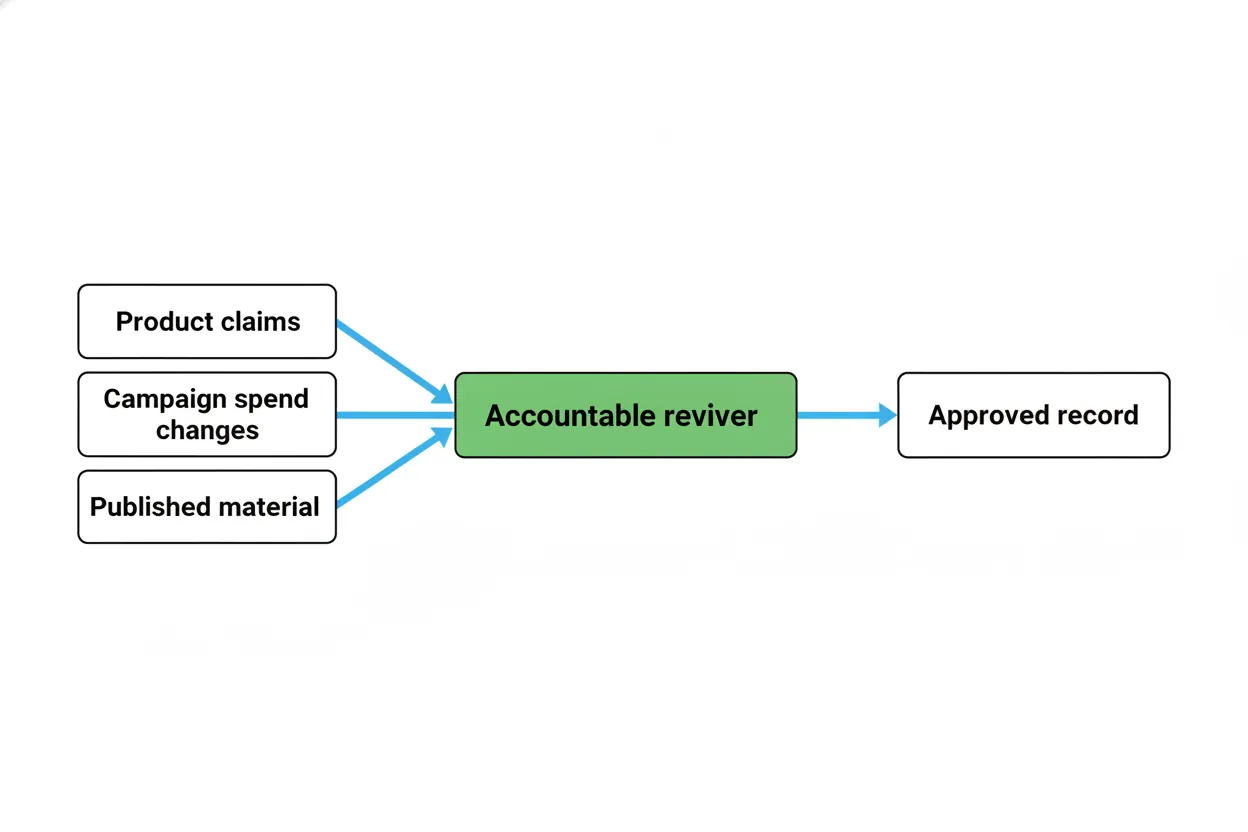
Three decisions should never clear automatically: product and benefit claims, anything published or sent, and changes to live campaign spend or targeting. Each needs a named accountable reviewer, a record of what was approved and a version the reviewer can point to later.
This is ordinary risk governance, consistent with the voluntary NIST AI Risk Management Framework and its generative AI profile, which help organizations identify generative AI risks and choose management actions (NIST). Claim review matters most. FTC staff guidance states advertisers must have adequate substantiation for objective product claims before an ad runs (FTC Health Products Compliance Guidance). Our Healthcare Marketing Compliance Checklist covers the review mechanics.
Test failure modes before the system touches production
Build a permissioned evaluation set from non-sensitive examples and run the workflow against it. Look for three failure classes: factual errors such as invented studies or overstated benefits, privacy exposure such as sensitive fields appearing in prompts or exports, and process breakdowns such as outputs skipping review or stale data reaching a report.
Score the results, document them and re-test after any configuration change. Platform eligibility is a separate test. Google Ads publishes a non-exhaustive list of unapproved pharmaceuticals and supplements it does not accept under its healthcare and medicines policy (Google Ads policy), and certification questions are addressed in LegitScript Certification: Cost, Rules and Timeline.
Define ownership and exit terms up front
A service engagement and a software transfer are different purchases, and conflating them is how buyers end up with nothing portable. In a service engagement, you own your data and the documentation produced for you, while the vendor retains its own tooling and methods. In a transfer, you receive the configuration, prompts, evaluation set and operating instructions and take on maintenance.
Decide which you are buying, then write down who holds the data, who holds the workflow documentation, what is returned or deleted at termination, and in what format. Further context: Healthcare Marketing Agency: Vetting & Strategy Guide, Healthcare Paid Media: Search, Social and Attribution, and the Marketing Powered Security Overview.

Email Us
Prefer to send the context directly?
Questions executives ask before scoping
Does private hosting make a workflow compliant automatically?
No. Running inference on controlled infrastructure changes who handles data during processing. It does not alter advertising law, platform rules or product status. Obligations depend on your organization and your specific data use, and HIPAA, the FTC Act and breach notification rules cover different parties (FTC). Treat infrastructure control as one input to governance, not a substitute for legal review.
Which data may enter the system?
Public and licensed research can usually enter freely. Confidential business data enters under access controls and retention limits. Health-adjacent customer data enters only where there is a lawful basis, a documented purpose and a contractual boundary, and often it should not enter at all when aggregated or de-identified inputs answer the same question.
Can AI approve medical claims or advertising appeals?
No. A model can draft, summarize prior approvals and flag risky language. Approval is an accountable human act, because substantiation requires judgment about evidence quality and the consequences of a wrong claim fall on the business, not the tool.
How is an agency service different from transferred software ownership?
A service delivers operated outcomes with the vendor maintaining the system. A transfer delivers artifacts you own and run yourself. Pricing, support, continuity and exit obligations differ in each case, so the contract should name which one you bought.
What proof should establish the system actually works?
Ask for a demonstrated run on a permissioned evaluation set, the documented approval chain with named reviewers, access and retention controls in writing, and a sanitized data-flow diagram. Vendor assertions and dashboard screenshots are not evidence of governance.
More Services
Ready to see where your marketing can improve?
Request a free audit of your paid media, landing pages, attribution, and measurement setup. You'll get a straight assessment of where the opportunities are.
or email us at info@marketingpowered.ai