Capabilities
First-Party Measurement for Peptide Marketing
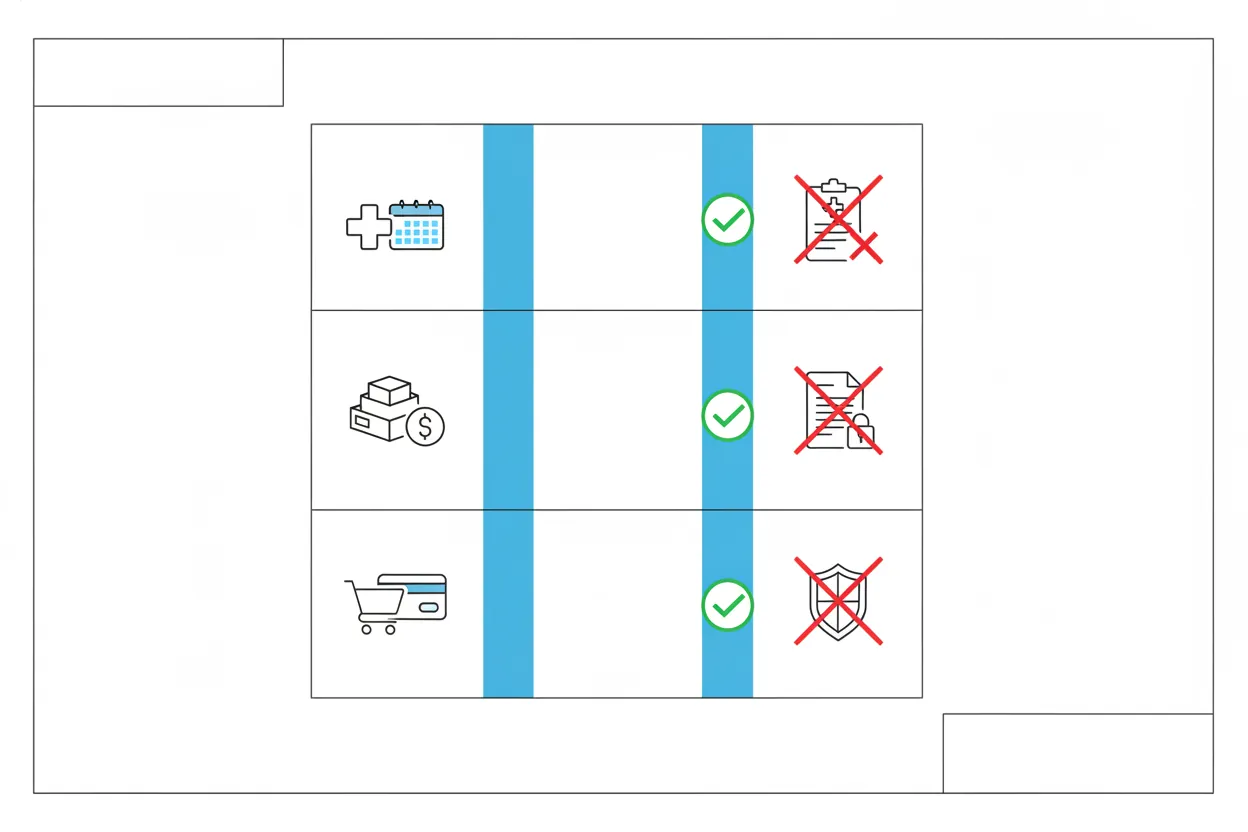
Most peptide companies run three businesses at once: clinic consultations, B2B quoting to labs and practices, and lawful ecommerce checkout. Each produces a different outcome, a different sensitivity profile and a different set of rules about what a platform may receive, so peptide marketing attribution breaks when all three are collapsed into one generic conversion. This service designs the measurement architecture around those differences before any pixel, server event or dashboard is trusted for spending decisions.

Define each business outcome before any tag fires
Start with the people and the moment, not the tracking stack. A clinic outcome is a consultation that an intake coordinator would accept as suitable: scheduled, reachable, within service area and within scope of what the provider actually offers. A B2B outcome is a quote request a sales lead would work, with an account, a volume and a stated use.
An ecommerce outcome is a completed, lawful purchase that survives fraud and refund review. Write those definitions down, name the system of record for each, and name the person who signs off. Peptide marketing measurement that begins with available fields instead of accepted outcomes will optimize toward volume the business cannot fulfill.
Map data flows and permissions field by field
Inventory what already moves. For every form, call, chat, cart and CRM sync, list the identifiers collected, the health-adjacent fields present, the vendors receiving them and the contractual basis for each transfer.
This matters because HHS guidance states that regulated entities must ensure tracking technology vendors have signed a business associate agreement and that an applicable permission exists before PHI is disclosed, and that website banners asking users to accept or reject cookies do not constitute a valid HIPAA authorization (HHS).
The same guidance notes it is insufficient for a vendor to promise it will strip or de-identify PHI after receipt (HHS). The general method behind this inventory is described on our analytics and attribution page.
Design a minimal event model around the outcome
Build the event from the outcome definition, then add only the fields a decision actually requires. A consultation event can carry a hashed internal identifier, a source, a timestamp and a qualification flag without carrying a condition, a product name or free-text notes. Quote events can carry account type and deal stage without carrying clinical context.
Default to exclusion: if no one can name the decision a field improves, it stays in the system of record and out of marketing destinations. This is the same discipline covered in privacy-first marketing, applied to three funnels that share one tag manager and one CRM.
Free Audit
Want a straight read on where your budget is leaking?
Separate internal reporting from ad platform feedback
These are two questions, and conflating them causes both broken reporting and policy exposure. Internal visibility answers what happened. Platform feedback asks what a destination is permitted to receive.
Meta began rolling out proactive restrictions on September 2, 2025 for custom conversions that may suggest information not allowed under its terms, including conversions suggesting specific health conditions, with blocked conversions unusable in new campaigns and a review route in Ads Manager or Events Manager if a business believes the flag is an error (Meta).
Microsoft tells advertisers not to use sensitive data or categories prohibited under applicable law when creating remarketing lists (Microsoft Advertising). Google's sensitive healthcare vertical does not permit retargeting. Renaming an event does not change what it reveals.
Pair the event dictionary with a documented review, using the healthcare marketing compliance checklist as the operational companion.

Reconcile records carefully and state the limits
Reconciliation is where credibility is earned. Compare ad platform counts, analytics counts and the system of record on the same window, then document the gaps: joins that fail when a buyer calls from a different number, delays when a quote closes weeks after the click, duplicates when a patient books twice, and sessions with no usable identifier because consent was declined.
Report a defensible range rather than invented precision, and label any illustrative example as illustrative. Keep channel eligibility work, including LegitScript certification questions, on a separate track from measurement, because an account that can run is not the same as an event that may be sent.

Build operating decisions from validated outcomes
The output is a decision model, not a dashboard tour. Each business line gets a validated acquisition cost based on accepted outcomes, a known coverage rate for matched records and an explicit statement of what is estimated. Budget then moves on observed qualified demand rather than platform-reported conversions alone.
Marketing Powered's founder managed $1.5 to $2M per month in Google Ads across 11+ behavioral and mental health accounts and tracked attribution to admission rather than to lead, which is the same structural idea applied here to consultations, accepted RFQs and purchases. Related work: healthcare marketing agency, paid media and our security overview.
More Services
Ready to see where your marketing can improve?
Request a free audit of your paid media, landing pages, attribution, and measurement setup. You'll get a straight assessment of where the opportunities are.
or email us at info@marketingpowered.ai