Capabilities
Choosing a Mental Health Marketing Agency: What Specialist Partners Must Deliver
Selecting a specialized mental health marketing agency requires looking beyond standard cost-per-click metrics and high-volume form fills. In behavioral healthcare, effective growth depends on navigating platform advertising restrictions, protecting patient privacy under federal guidelines, and connecting marketing spend directly to clinical admissions. When campaigns optimize solely for cheap lead volume, intake coordinators spend their shifts sorting through unviable inquiries while facilities struggle with census stability.

Why behavioral healthcare marketing demands specialization
Generalist marketing agencies usually approach behavioral health like standard consumer lead generation. They configure paid campaigns to capture the lowest-cost form submission, celebrate high inquiry volumes in monthly reports, and leave clinical intake teams to manage the fallout. In a mental health clinic, partial hospitalization program, or residential facility, that disconnect creates immediate operational drag.
Intake coordinators sit with phones ringing off the hook, but the callers need clinical levels of care the facility does not provide, hold out-of-network benefits the center cannot accept, or seek crisis stabilization services outside the program scope. Every unqualified contact burns clinical labor, delays responses to clinically appropriate patients, and obscures campaign performance. When marketing teams treat all inquiries as equal conversions, automated bidding algorithms optimize toward individuals who are least likely to admit.
Specialized behavioral healthcare marketing requires an understanding of clinical levels of care, commercial insurance verification workflows, and geographic licensure limits. A competent partner designs campaigns around clinical alignment, payer mix requirements, and bed utilization targets rather than top-of-funnel lead counts. To understand how clinical intake alignment fits into a broader organizational growth model, review our comprehensive guide on behavioral health marketing: an operator's guide to ethical growth.

What specialist mental health marketing companies must deliver
High-performing mental health marketing companies operate as technical partners connected directly to intake operations. Rather than reporting on isolated platform metrics, a specialist partner aligns systems across three operational areas:
Full-funnel attribution tracked to admission, not just lead
In consumer marketing, a form submission or phone call marks the primary conversion event. In behavioral health, that initial contact is merely step one of an extensive admissions chain:
- Initial ad click or organic search visit
- Confidential phone inquiry or encrypted chat submission
- Verification of benefits (VOB) and financial clearance
- Clinical pre-assessment and level-of-care determination
- Formal intake scheduling and confirmed admission
When attribution stops at the initial inquiry, operators cannot identify which campaigns, search queries, or creative assets generate admitted patients. An ad group producing twenty inquiries at $50 each appears twice as efficient as an ad group producing ten inquiries at $100 each. If the second ad group generates three admitted patients with appropriate commercial coverage while the first produces zero admits due to out-of-network mismatch, the cheaper campaign actually drains capital.
A specialist partner integrates call tracking, customer relationship management (CRM) systems, and electronic health record (EHR) intake stages so marketing spend is measured against qualified inquiries and confirmed admissions.
Regulatory compliance and patient privacy infrastructure
Healthcare providers operate under strict patient privacy standards. Standard marketing analytics setups that pass page URLs, user identifiers, or form metadata to third-party ad networks create serious regulatory liability.
Under the HHS guidance on online tracking technologies, covered entities cannot deploy unvetted third-party tracking pixels on patient-facing pages where protected health information, including IP addresses tied to health inquiries, could be exposed without appropriate agreements. A specialist partner builds compliant tracking architecture using server-side event filtering, strict data sovereignty protocols, and verified business associate agreements.
Google Ads rules for sensitive healthcare categories
Advertising mental health services requires strict adherence to search and social ad policies. Major digital advertising platforms treat mental health, psychiatric conditions, and substance use disorders as sensitive categories, imposing severe restrictions on targeting and ad messaging.
Under the Google Ads personalized advertising policy, advertisers cannot run personalized ads or remarketing campaigns based on health conditions, mental health struggles, or addiction. Providers cannot drop a retargeting pixel on a depression treatment page and serve follow-up display ads to that visitor across the web. Generalist agencies accustomed to running standard remarketing funnels often find their campaigns throttled or accounts suspended for policy violations.
Furthermore, programs providing co-occurring addiction treatment face additional platform verification requirements. To run search ads for substance use treatment, providers must complete mandatory vetting through LegitScript addiction treatment certification and obtain explicit advertising authorization under the Google Ads healthcare and medicines policy.
Experienced agencies understand how to structure compliant search campaigns using intent-rich search queries, compliant landing page messaging, and medical-policy adherence. For an operational breakdown of compliant search execution, explore our analysis on addiction treatment marketing: what works now and what gets accounts suspended.
Free Audit
Want a straight read on where your budget is leaking?
How to evaluate the best mental health marketing agency
When evaluating potential agency partners, executive leadership should conduct rigorous operational due diligence. Ask specific technical and procedural questions during the evaluation process:
- Attribution tracking: Does the agency track performance solely to leads and calls, or do they integrate directly with your intake CRM to track cost per verification of benefits and cost per admitted patient?
- Privacy architecture: How does the agency handle conversion tracking on booking pages, self-assessments, and contact forms? Do they deploy raw third-party pixels, or do they use secure, server-side data infrastructure aligned with federal privacy rules?
- Sensitive category experience: How does the team structure non-remarketing funnels to capture and convert high-intent patients without violating platform prohibitions on personalized health advertising?
- Intake collaboration: How frequently does the agency review inquiry disposition data with your intake and admissions directors to adjust keyword targeting and negative keyword lists?
- Account governance: Does your facility retain full administrative ownership of ad accounts, search consoles, tracking containers, and conversion assets if the agency engagement ends?
For an extended procurement checklist before executing a vendor contract, consult our guide on an addiction treatment marketing agency: how to vet one before you sign.

Mental health marketing services built for admissions economics
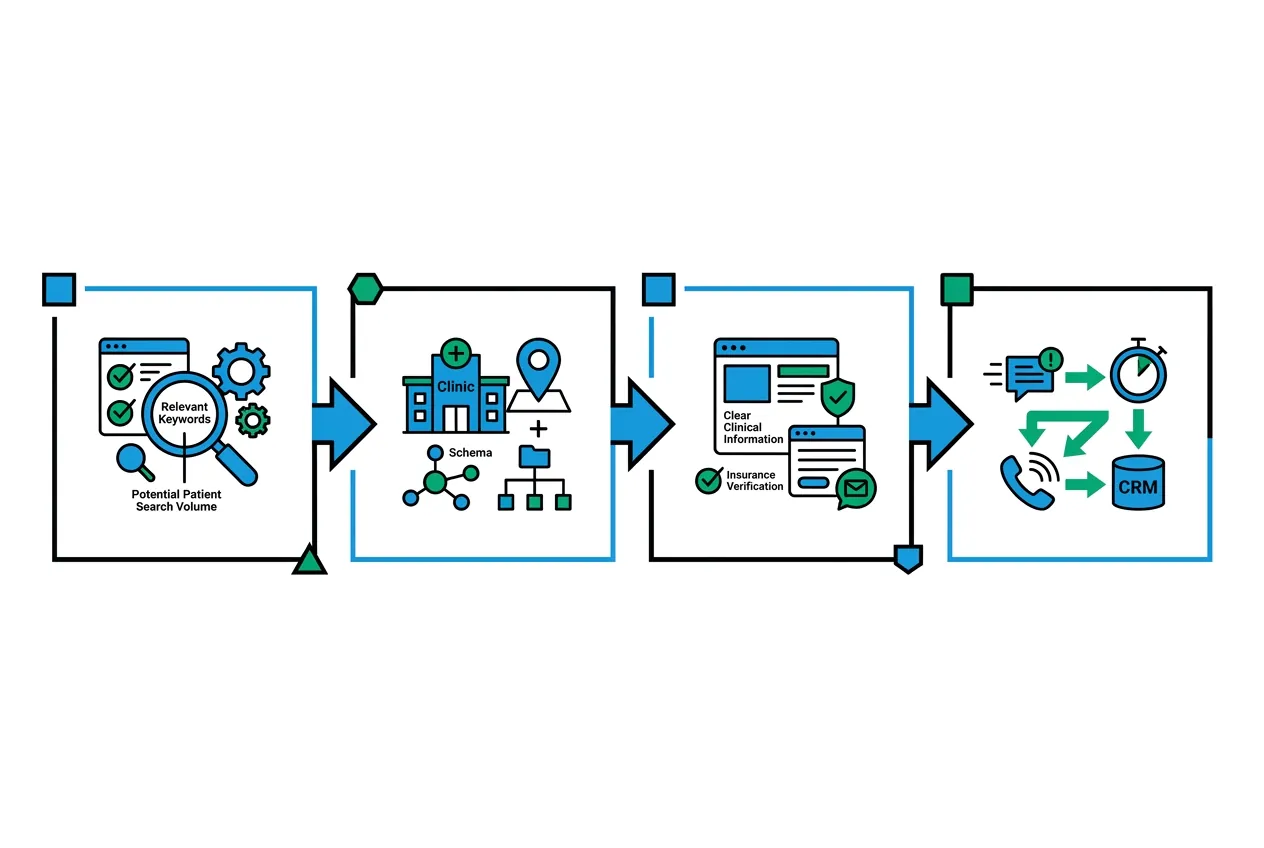
Comprehensive mental health marketing services should balance rapid patient acquisition with sustainable, long-term brand authority. A balanced digital acquisition engine combines four key disciplines:
- Compliant paid search acquisition: Capturing high-intent searches from patients and families actively seeking treatment options, managed with strict bid management, continuous negative keyword maintenance, and medical policy alignment.
- Clinical and local search optimization: Optimizing Google Business Profiles, local citations, and medical schema across outpatient clinic locations, ensuring programs appear in local map packs and organic search results for condition-specific queries.
- High-converting, empathetic web experiences: Building fast, accessible landing environments that provide clear clinical information, verify insurance acceptance, and present simple, confidential paths to reach intake coordinators via phone or secure messaging.
- Intake speed-to-lead automation: Integrating intake systems to ensure coordinators receive immediate, structured inquiry notifications, helping teams review benefits and schedule clinical assessments before prospective patients reach out to competing programs.
The Marketing Powered approach to behavioral healthcare growth
Marketing Powered provides specialized, operator-led growth systems designed specifically for treatment centers, behavioral health networks, and psychiatric healthcare providers. We connect marketing capital directly to admissions performance through data-informed campaign execution and owned infrastructure.
Our approach is built on proven leadership within complex healthcare environments. Marketing Powered's founder is a former healthcare Chief Marketing Officer who directed marketing operations for a treatment network that expanded from 3 to 24 locations.
Backed by experience managing $1.5 to $2M per month in Google Ads across 11+ behavioral and mental health accounts, our team understands the nuances of admissions workflows, clinical intake routing, and payer alignment.
As a court-certified expert witness in advertising strategy, our leadership brings institutional rigor to account governance, compliance, and platform policy.
Marketing Powered has operated as an AI-native organization since 2022. We maintain owned, local AI infrastructure for HIPAA-aware inference, enabling advanced data processing and campaign modeling without passing sensitive healthcare information through public third-party endpoints. Our systems are built specifically for Google's sensitive healthcare vertical, where retargeting is not permitted and conversions must be earned on the initial interaction.
We measure acquisition efficiency through verified attribution tracked to admission, not just lead, aligning campaign performance with your facility census. Discover how our dedicated behavioral health and addiction treatment marketing services deliver compliant, measurable patient acquisition.
Questions, Answered.
Marketing mental health services compliantly requires protecting patient privacy across every digital touchpoint and adhering to platform advertising rules. Providers must avoid deploying third-party tracking pixels that send identifiable patient interaction data to commercial ad platforms without appropriate privacy safeguards. Marketing content must remain clinically accurate, avoiding misleading claims about treatment outcomes. Furthermore, campaigns must strictly observe platform policies that ban personalized remarketing for mental health conditions.
To advertise mental health services safely on Google Ads, providers must structure campaigns without relying on personalized remarketing or sensitive audience targeting. Ad copy must focus on treatment modalities, facility credentials, and clinical offerings rather than implying personal medical attributes of the searcher. If the facility treats co-occurring substance use disorders, operators must obtain LegitScript certification before publishing addiction-related search campaigns. Ad accounts must be monitored continuously to prevent policy violations that trigger automated account suspensions.
Cost per lead measures the price of an initial phone call or form submission, but it ignores lead quality, insurance network alignment, clinical appropriateness, and ultimate patient admission.
A low cost per lead frequently masks an intake pipeline flooded with unviable contacts, such as callers looking for services the facility does not provide or holding out-of-network benefits the provider cannot accept.
Evaluating marketing success by cost per verification of benefits and cost per admitted patient gives operators an accurate picture of acquisition economics.
Generalist digital agencies often focus on generic e-commerce metrics, using consumer remarketing techniques and surface-level form generation. Specialist mental health marketing companies understand the legal restrictions governing sensitive healthcare advertising, the technical requirements of secure server-side tracking, and the operational realities of intake workflows. Specialists work directly with clinical and admissions directors to ensure marketing spend produces qualified, viable patients rather than administrative strain. Talk with Marketing Powered about your admissions and marketing economics.
More Services
Ready to see where your marketing can improve?
Request a free audit of your paid media, landing pages, attribution, and measurement setup. You'll get a straight assessment of where the opportunities are.
or email us at info@marketingpowered.ai