Capabilities
Private AI Agency for Business Systems You Can Control
Most vendors selling private AI are describing a network path, a contract clause or a product tier, and all three can be accurate while you still control very little. Choosing a private AI agency is a decision about who operates the workflow, where data rests and moves, and who answers when an output is wrong. This page sets out the terms worth settling before anyone builds anything.

Start with the business decision, not the model
Useful scoping starts with a task someone in your organization performs today. A billing coordinator re-keys payer correspondence into a practice management system. An operations manager answers the same five policy questions for field staff every week.
An intake team searches three shared drives and an email archive to confirm whether a document was already received. These are the workloads where private AI implementation earns its budget, because the work is repetitive, the inputs are sensitive, and the people doing it can tell you exactly where it breaks.
Define four things before comparing vendors. First, the task and its volume: how many documents, calls, tickets or lookups per week, and who performs them. Second, the current cost: loaded labor hours, cycle time, or revenue delayed while someone waits.
Third, the consequence of an incorrect action: a wrong answer in an internal policy chat is an inconvenience, a wrong answer sent to a payer, a regulator or a patient is something else entirely. Fourth, the human checkpoint: who reviews output, under what rule, and what happens when they reject it.
That last point decides more architecture than any model benchmark. A workflow where a person approves every output before it leaves the building tolerates a much wider error range than one that writes directly into a system of record. Scope the failure cost first, and the questions about hosting, model choice and access controls become answerable rather than theoretical.

What private means inside this engagement
"Private" is a label, not a specification. Before signing anything, require any secure AI agency to put six items in writing for your specific engagement.
Hosting: the physical or logical location where inference runs, and the legal entity that controls that location. Model and API provider: whether the system calls a third-party model endpoint, runs open-weight models on infrastructure you or your partner control, or mixes both. Administrators: the named roles with privileged access, on your side and the vendor's.
Logs: what is captured, where it is stored, how long it is retained, and who can read it. Backups: what is copied, to where, and under whose encryption keys. External connections: every remaining outbound call, including monitoring, error reporting, embeddings, search, and spam or abuse filtering.
That last category is where most "private" claims quietly fail. A private network path to a managed cloud model is a real security control and a documented pattern, for example AWS interface VPC endpoints for Amazon Bedrock (AWS documentation), but a private route to someone else's service is not the same as owning the serving infrastructure.
Both can be appropriate. They carry different custody, audit and exit consequences, and the difference belongs in your contract rather than in a sales deck.
Marketing Powered has been AI-native since 2022 and operates owned, local AI infrastructure for HIPAA-aware inference. That is a capability statement, not a compliance outcome: private deployment by itself does not establish security or legal compliance, and any partner telling you otherwise is selling. If your interest is specifically marketing-function AI rather than general business workflows, the evaluation criteria differ, and the AI marketing agency capability guide covers that decision.
Choose the deployment boundary before anyone builds
Four boundaries dominate private AI for business, and none is universally correct.
Client on-premises. Models and data stay on hardware your organization owns, inside your network. Strongest custody story, highest internal burden: you carry capacity planning, patching, uptime and hardware refresh, or you pay someone to carry it for you. Suits organizations with existing data center operations or a hard contractual restriction on external processing.
Provider-managed infrastructure. The partner owns and operates the compute, with documented isolation, access rules and data handling for your workload. Lower internal burden and faster to stand up. The trade is dependency: your custody position is only as good as the written operating model, the subprocessor list and the exit terms.
Dedicated cloud. Isolated tenancy inside a hyperscale environment, often with private networking to managed model endpoints. Strong scaling, mature identity tooling, familiar procurement path. You are still consuming a third-party service, and the provider's data handling terms govern more than your preferences do.
Hybrid. Sensitive retrieval and document handling stay inside a controlled environment while a commodity task routes to an external model under explicit rules. Realistic for many operators, and the hardest to describe honestly, because the rules have to be enforced in code rather than in a policy document.
Not every option is appropriate for every engagement, and a partner who offers all four for every buyer is describing marketing rather than architecture. The deployment and ownership trade-offs are examined further in owned AI systems and deployment boundaries.
Free Audit
Want a straight read on where your budget is leaking?
From discovery to controlled release
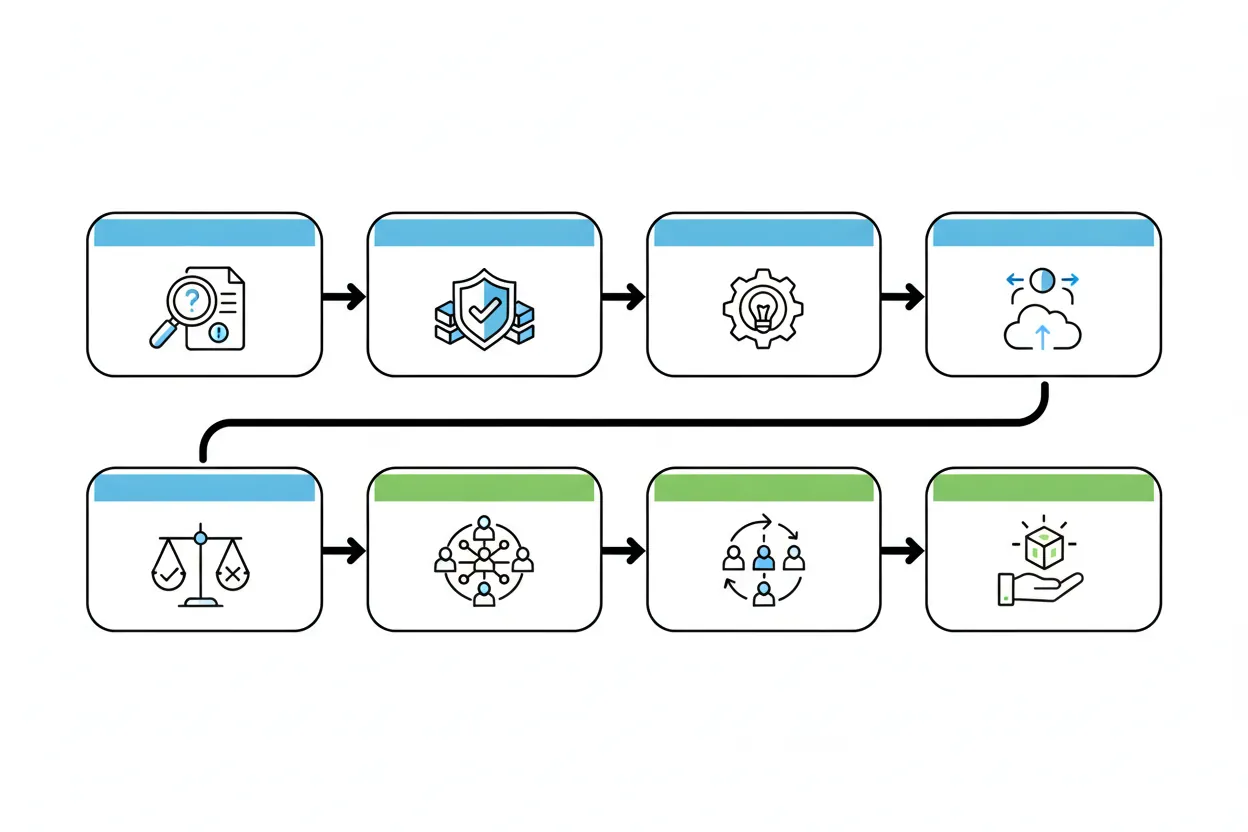
Serious private AI consulting work separates phases so that each one can fail cheaply. The sequence below is the engagement pattern this service is scoped around.
Assessment. Sessions with the people who perform the task, a walkthrough of the systems involved, and a written description of the workflow, data sources, identity requirements and acceptance conditions. Output is a scoping document, not a build.
Dataset approval. Before any content is indexed, your team approves which repositories, folders, record types and fields are in scope, and which are excluded. Permissions are mapped so the system cannot surface to a user what that user could not already open. Custody and processing questions at this stage are covered in data custody and processing boundaries.
Prototype. A narrow working version against approved data, with the retrieval, prompting and interface decisions made explicit rather than hidden behind a product.
Evaluation. A test set drawn from real tasks, scored against criteria agreed in assessment, with failure modes documented rather than averaged away. Organizations that want an external reference for structuring this can use the voluntary NIST AI Risk Management Framework, which addresses trustworthiness across AI design, development, use and evaluation and includes a separate generative AI profile (NIST).
Controlled rollout. A defined user group, a review rule, a logging policy and a rollback path.
Handoff. Configuration, prompts, retrieval settings, integration details, evaluation results and operating runbook, in a form your team can read and act on. Whether Marketing Powered continues to operate the system or your team takes it over is a commercial decision made at this point, not an assumption baked into the build.
How requirements change from small business to enterprise
The engineering is similar across company sizes. The surrounding obligations are not.
A ten-person professional services firm usually has one or two integrations, a flat permission model, a single approver and no internal platform team. The right scope is one workflow, a short evaluation cycle and a support arrangement that names who to call. Over-governing that engagement wastes the budget that should go into making the task actually work.
A multi-site healthcare organization or a mid-market operator with several hundred staff changes four variables at once: integration count, identity, review process and support responsibility. Identity moves from shared logins to directory-backed groups and role-based retrieval, so that a regional manager and a front-desk coordinator see different results from the same question. Review moves from one person to a named owner per function. Change control appears, because an update to a prompt or a retrieval rule now affects multiple teams.
Enterprise private AI adds procurement review, security questionnaires, documented subprocessors, audit expectations and multi-team governance. Timelines lengthen because approvals are serial, and the acceptance criteria are written by people who will never use the system.
Across all three, the constant is where processing happens and under whose control. Supported local processing describes which workloads can run on infrastructure under agency control and where that is not the case, which matters more as regulated data enters the workflow.
Evidence, ownership and what sits outside scope
Ask every candidate for private artificial intelligence services to produce the same three artifacts, and compare the answers rather than the brochures: a dated inventory of workloads they actually support, a redacted deployment and data-flow diagram for a comparable engagement, and evaluation results from a pilot with a stated baseline. Vendors who cannot produce these are asking you to buy a label.
An acceptance checklist, illustrative in structure and set per engagement, generally covers: task accuracy against an agreed test set; behavior on out-of-scope questions; permission enforcement tested with at least two user roles; response time under expected load; logging and retention matching the agreed policy; a documented rollback; and a named operator for day-to-day issues.
An ownership schedule, also illustrative, should state line by line who owns source data, derived indexes and embeddings, prompts and configuration, custom application code, evaluation artifacts, and the partner's pre-existing tooling. Clients retain ownership of their data; access to a service does not transfer a provider's underlying workflows or proprietary configurations, and that boundary belongs in writing on both sides.
Common exclusions worth naming early: data cleanup and record deduplication, licensing for third-party systems, changes to source systems you do not control, and legal or regulatory sign-off, which remains with your counsel. Marketing Powered's founder brings operator background from regulated healthcare marketing, including serving as a court-certified expert witness in advertising strategy, which informs how claims and controls are documented, and is not a substitute for your own legal review.
Related depth sits in AI governance and approval controls, open-source selection and licensing, and how configurable AI workflows are scoped.

Email Us
Prefer to send the context directly?
Questions buyers ask before scoping
Does private AI require hardware in our office?
No. On-premises hardware is one boundary among several, and it is the right answer mainly when a contract, a regulator or an internal policy requires processing inside your own facility. Provider-managed infrastructure, dedicated cloud tenancy and hybrid designs can all meet strict data handling requirements when hosting, administration, logging and external connections are documented. The decision should follow your data classification and failure cost, not a preference for a particular form of ownership.
Who owns our data, model configuration and application code?
Your organization owns its source data in every configuration. Ownership of derived artifacts such as indexes, embeddings, prompts, evaluation sets and custom application code is a contract term, and it should be written line by line before work starts rather than inferred afterwards. A provider's pre-existing tooling and internal workflows typically remain the provider's property, which is normal, provided the boundary is explicit and your side of it is exportable.
What information can leave the environment?
Only what the design allows, which is why the outbound connection list belongs in the scoping document. In a locally processed design, prompts and retrieved content can stay inside the controlled environment while telemetry or error reporting may still leave unless it is disabled. In a design that calls an external model, the request content leaves by definition, and the provider's retention and training terms then apply. Private networking changes the route, not the destination.
What information and access are needed to scope this work?
A description of the task and its volume, sample inputs and acceptable outputs, a list of the systems involved, your identity and permission model, your data classification rules, and the name of the person who approves use of each repository. Scoping can run on redacted or synthetic samples when the real records are sensitive. Full system access is not required to produce a scope, and it should not be granted until data sources are formally approved.
What will our organization own and be able to export at the end?
The intended end state is an exportable package: approved datasets and indexes, prompt and retrieval configuration, integration specifications, evaluation criteria and results, access and logging policies, and an operating runbook. Export format and timing are commercial terms, so settle them at contract stage alongside notice periods and transition support. Ask for them in writing before the first invoice, not during an exit.
More Services
Ready to see where your marketing can improve?
Request a free audit of your paid media, landing pages, attribution, and measurement setup. You'll get a straight assessment of where the opportunities are.
or email us at info@marketingpowered.ai