Capabilities
AI Readiness Assessment Built Around Business Decisions
Most AI buying decisions start with a label and end with a contract nobody can defend: unclear data custody, no named operator, no agreed definition of working. An AI readiness assessment from Marketing Powered is a cross-functional review that ranks candidate use cases by business value, data readiness, risk and delivery requirements before any implementation spend is committed. The output is a decision, not a score.

Start with the decision, the owner and the constraints
Readiness work goes wrong when it opens with technology. It should open with a decision somebody is already responsible for making: reduce intake response time, cut manual chart or document handling, improve quoting accuracy, lift qualified demand from the same media budget.
For each candidate, the assessment captures four things. The decision itself and the person accountable for it. The workflow owner who runs the process today, not the executive sponsor.
A measured baseline: volume, cycle time, error rate, cost per unit of work, drawn from systems rather than estimates, and labelled as an estimate when no system record exists.
And the unacceptable outcome, stated plainly, such as a clinical or billing error reaching a patient, or a regulated record leaving an approved environment.
Projects without a named workflow owner and a baseline have nothing to compare results against. That alone disqualifies more use cases than any technical limitation.

Review the data, systems and access that AI would depend on
The second pass is an inventory, run jointly with whoever administers your systems. It covers where the relevant records live, who can grant access, how clean and complete the fields actually are, what usage rights and contractual restrictions apply, which integrations exist versus which would need building, and where identity-linked or regulated data sits inside the flow.
This is where most AI data readiness problems surface. Records that look structured in a demo turn out to be free-text notes. A CRM holds the outcome field but nobody populates it. A vendor's terms allow processing but not training.
Regulated data adds a contractual layer, not just a technical one. Under the HIPAA Security Rule, a covered entity may permit a business associate to create, receive, maintain or transmit electronic protected health information on its behalf only if it obtains satisfactory assurances that the business associate will appropriately safeguard that information (HHS). That requirement shapes which tools are even eligible. For the narrower question of judging a marketing vendor's AI claims, see Evaluating AI Marketing Agency Capabilities.
Assess the people and operating model behind the output
An AI maturity assessment that stops at infrastructure misses the part that fails first. Every viable use case needs three roles named before build: who reviews output before it reaches a customer, patient or public channel; who handles the exceptions the system cannot resolve; and who owns the process change after go-live, including retraining, prompt and policy updates, and the decision to roll back.
Review capacity is a real constraint. If a workflow produces 400 items a day and one reviewer can check 60, the use case needs sampling rules, confidence thresholds or a narrower scope. We document that honestly rather than assuming review is free.
Marketing Powered is operator-led. Its founder is a former healthcare CMO who ran marketing for a treatment network that grew from 3 to 24 locations, managed $1.5 to $2M per month in Google Ads across 11+ behavioral and mental health accounts, and is a court-certified expert witness in advertising strategy. For operating-model depth inside marketing teams specifically, see Build an AI-Native Marketing Function.
Free Audit
Want a straight read on where your budget is leaking?
Rank use cases on value, data readiness and risk
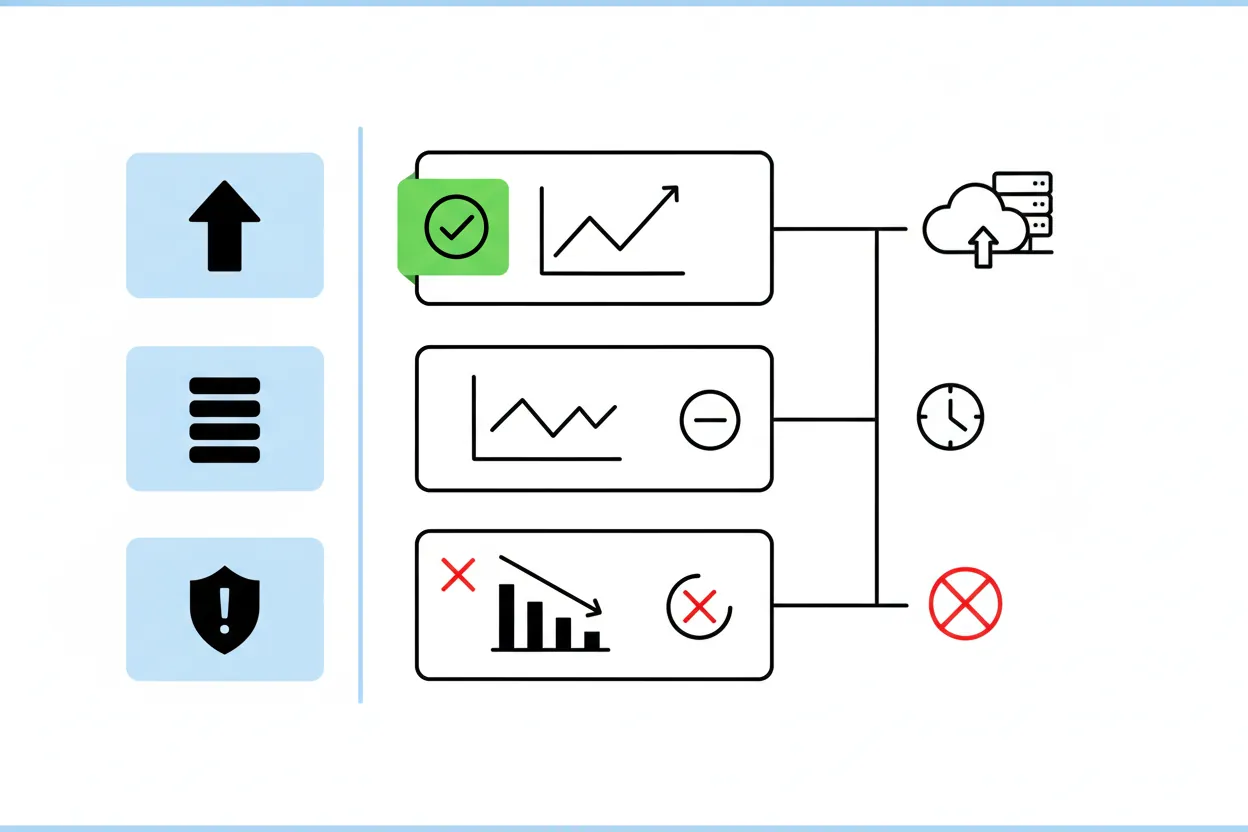
Each candidate is scored on four axes: business value, data readiness, risk exposure and delivery requirement. Scores are not the point. The evidence column is. Every line records whether the input is measured, estimated or assumed, and who supplied it.
As an illustrative example of how the rubric reads: an intake follow-up assistant might score high on value because call logs give a measured baseline, medium on data readiness because consent and identity fields are inconsistent, and high on risk because output reaches prospective patients directly. A document summarization task might score lower on value but clear readiness and risk easily, which can make it the better first build.
Risk scoring draws on recognized public guidance. The NIST AI Risk Management Framework is intended for voluntary use and is designed to improve the ability to incorporate trustworthiness considerations into the design, development, use and evaluation of AI products, services and systems, with a generative AI profile released on July 26, 2024 (NIST). Deployment boundaries matter to the ranking, which is why candidates are also assessed against owned AI systems and deployment boundaries.
Define a pilot someone can actually stop
A ranked list is still not a decision until one use case is specified tightly enough to build and to abandon. The pilot definition names the exact dataset and its source system, the current-state baseline it will be measured against, acceptance tests written before work starts, the budget boundary, the review and escalation path, and explicit stop criteria.
Stop criteria are the part buyers rarely get. They state the accuracy, latency, review-burden or cost threshold below which the pilot ends rather than expands. Ownership and processing questions are settled at the same time, covering hosting, retention, subprocessors, access and approved data flows, which is addressed directly in data custody and processing boundaries. Private deployment does not by itself establish security or legal compliance, and the assessment says so where it applies.
Deliver a decision pack, not a maturity score
The engagement ends with a document your leadership team can act on and your counsel can read. It contains the ranked use cases with their evidence, the recommended pilot with acceptance tests and stop criteria, an AI implementation roadmap sequenced by dependency rather than enthusiasm, named owners for each step, the data and access work that must happen first, and a list of use cases not recommended yet with the specific reason each one failed.
That last list is often the most valuable page. Readiness is a decision gate, not a certificate, and no assessment can certify compliance or outcomes.
Related work in this cluster: supported local processing, AI governance and approval controls, and open-source selection and licensing.

Email Us
Prefer to send the context directly?
Questions buyers ask before commissioning this work
What information do you need for the assessment?
A short list of candidate use cases, access to the people who run those workflows today, a system inventory, and whatever baseline data exists. Where no baseline exists, we build one from available records and label it as an estimate.
Will the result recommend against some AI use cases?
Yes, routinely. Use cases fail on absent baselines, unusable data, review capacity, licensing restrictions or risk exposure that outweighs the value. Each exclusion is documented with the reason and what would have to change for it to qualify later.
How does the scope change for a small company versus an enterprise?
The axes stay the same; the interview and system surface changes. A single-site professional services firm may involve three stakeholders and two systems. A multi-location health organization typically adds IT, compliance, clinical or legal review and more integration mapping. Scope and coverage are agreed in the scoping call, not assumed.
What access is needed before you can scope the work?
Scoping needs conversation, not credentials. System access is only requested once the use cases are agreed and the appropriate agreements, including a business associate agreement where regulated data is involved, are in place.
What will our organization own and be able to export at the end?
The assessment artifacts: the rubric and scores, the evidence log, the pilot specification and the roadmap, delivered in formats you keep and can hand to any implementation partner, including one that is not us.
More Services
Ready to see where your marketing can improve?
Request a free audit of your paid media, landing pages, attribution, and measurement setup. You'll get a straight assessment of where the opportunities are.
or email us at info@marketingpowered.ai