Resources
What Is Behavioral Health Marketing? A Plain-Language Guide
Behavioral health marketing is the specialized discipline of connecting individuals and families with mental health, addiction treatment, and psychiatric care providers while maintaining strict compliance with healthcare privacy regulations and advertising platform policies. Unlike standard commercial marketing, success in this sector is measured by qualified clinical intake and verified patient admissions rather than raw inquiry volume. Meeting patients during moments of clinical crisis requires an operational bridge between digital discovery, clinical qualification, and admissions intake.
By Mike Hulick, Founder, Marketing Powered

The Regulatory Baseline: Platform Policies, Privacy, and LegitScript

What Is Behavioral Health Marketing and What Does It Include?
To understand this operational discipline, leaders must first clarify what is behavioral health and what is included in behavioral health care. Behavioral health encompasses the treatment of mental health conditions, substance use disorders, and addictive behaviors, alongside the broader management of emotional and psychological well-being. According to the Substance Abuse and Mental Health Services Administration, tens of millions of adults in the United States navigate mental illness or substance use disorders each year, creating an ongoing need for accessible care.
In practice, behavioral health marketing coordinates patient acquisition across four clinical pillars:
- Substance Use Disorder Treatment: Medical detoxification, residential inpatient rehabilitation, partial hospitalization programs (PHP), and intensive outpatient programs (IOP).
- Mental Health and Psychiatric Care: Inpatient crisis stabilization, residential psychiatric treatment, dual-diagnosis programs, and outpatient psychiatric clinics addressing major depressive disorder, anxiety, bipolar disorder, and trauma.
- Eating Disorder Care: Specialized medical and psychological facilities treating anorexia, bulimia, binge eating disorder, and related conditions across adolescent and adult populations.
- Specialized Behavioral Programs: Adolescent residential centers, neurobehavioral treatment clinics, and specialized therapy practices.
Standard retail and business-to-business marketing rely on long evaluation funnels, promotional discounting, and broad retargeting campaigns. Behavioral health patient acquisition functions entirely differently. Inquiries often occur during acute personal crises, requiring immediate, empathetic, and clinically informed responsiveness. Furthermore, admissions depend heavily on health plan verification, geographic proximity, clinical acuity matching, and bed availability. Marketing that generates hundreds of inquiries outside a facility's licensure or payer network creates heavy operational overhead for intake teams without helping patients reach appropriate care.
For a deeper analysis of the strategic principles governing this sector, review Behavioral health marketing: an operator's guide to ethical growth.
Operating in behavioral health requires strict compliance with federal privacy frameworks and major advertising network mandates. Standard digital marketing tactics that work for consumer brands can create significant legal and financial liability for healthcare organizations.
First, major advertising platforms restrict how healthcare services target potential patients. Under Google Ads personalized advertising policies, advertisers are prohibited from targeting audiences based on sensitive personal categories, including health conditions, clinical treatments, and personal hardship. Marketers cannot create remarketing lists of users who visited addiction treatment or depression treatment pages to serve them follow-up display banners across the web.
Second, search engines enforce mandatory third-party verification to combat fraudulent patient brokering. Google and Meta require providers advertising substance use disorder services in the United States to secure LegitScript addiction treatment certification. LegitScript audits facility licensure, physical addresses, clinical staffing, insurance billing practices, and domain ownership. Paid search campaigns targeting addiction treatment keywords will not serve impressions without this active credential linked directly to the advertising account.
Third, patient privacy rules govern digital tracking technologies. The HHS Office for Civil Rights guidance on online tracking technologies warns covered entities against deploying third-party tracking pixels that disclose protected health information (PHI) to technology vendors without explicit authorization or a business associate agreement. Transmitting unencrypted IP addresses combined with URLs that reveal a visitor sought specific psychiatric or addiction services creates immediate regulatory exposure. Compliant organizations manage their tracking architecture with strict server-side governance, stripping sensitive identifiers before processing conversion signals.
Core Channels in a Behavioral Health Patient Acquisition Strategy
An effective patient acquisition model relies on diversified channels that capture active intent while building long-term local trust.
High-Intent Paid Search
Paid search via Google Ads remains the primary digital channel for capturing acute demand. Prospective patients or their family members search for terms such as "medical detox center near me" or "dual diagnosis residential treatment." Because retargeting is prohibited, initial ad positioning, message clarity, and mobile landing page utility dictate performance. Paid search requires continuous negative keyword management to eliminate queries seeking free hotlines, academic research, or clinical job postings.
Local SEO and Organic Search Architecture
For outpatient clinics, partial hospitalization programs, and regional residential centers, Google Business Profiles and localized organic rankings drive sustainable call volume. Local search optimization demands consistent National Provider Identifier (NPI) records, accurate physical address verification, and local directory synchronization. Organic content must focus on clinical depth, accepted insurance plans, and specific treatment modalities rather than thin, keyword-stuffed articles.
Professional Referral Development
Digital campaigns complement medical and community referral networks. Primary care physicians, acute care hospital discharge planners, employee assistance programs (EAPs), and outpatient therapists represent reliable referral sources. Digital assets, including clinical white papers and downloadable intake criteria, support field liaisons building relationships with these institutional referrers.
To evaluate agency capabilities across these channels, read Addiction treatment marketing agency: how to vet one before you sign and Mental health marketing agency: what a specialist partner should deliver.
Free Audit
Want a straight read on where your budget is leaking?
Intake Alignment, Attribution, and Behavioral Health Management
The traditional metric of cost per lead (CPL) is insufficient in healthcare operations. A low CPL often signals poor marketing hygiene: broad match keywords bringing in callers with unsupported insurance, individuals seeking services the facility does not provide, or wrong numbers.
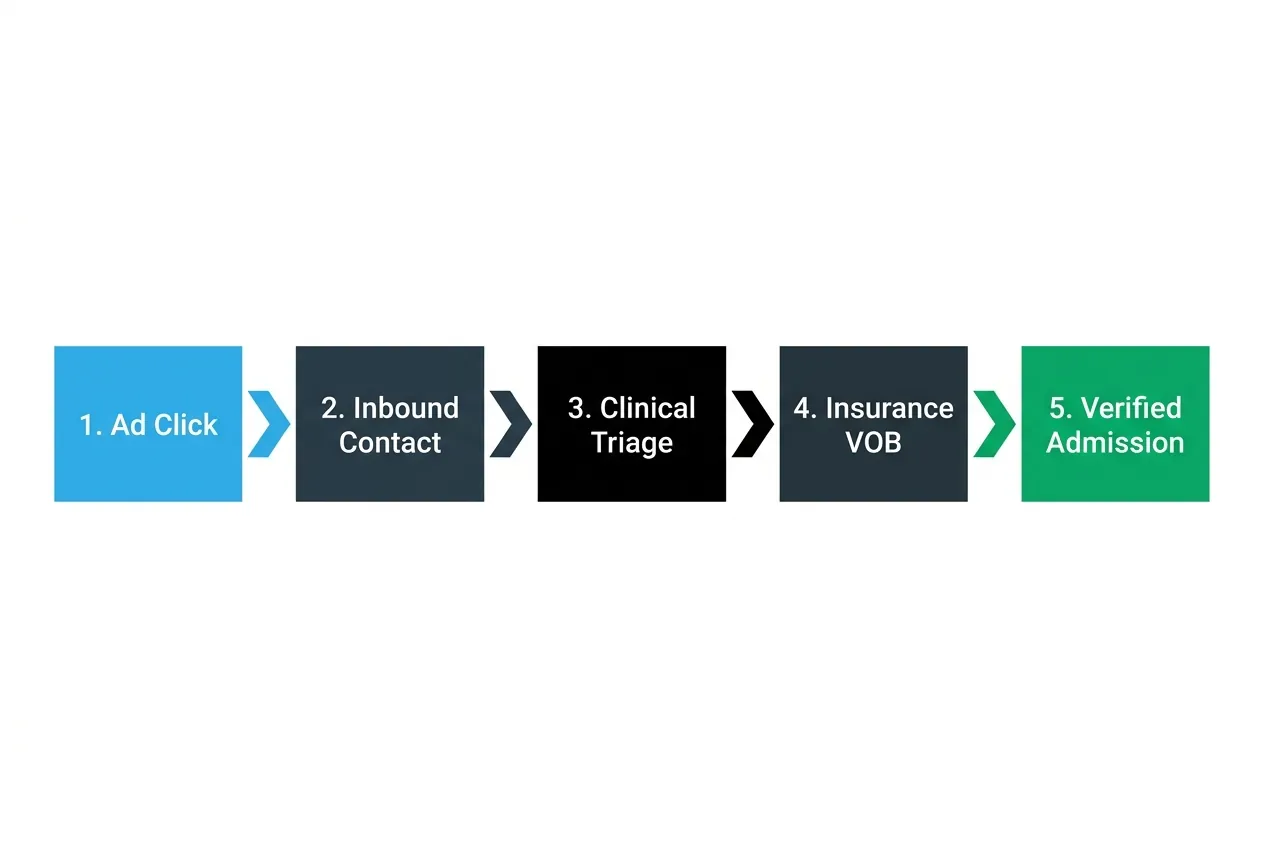
This reality highlights the importance of behavioral health management, which coordinates business operations, clinical intake, and marketing spend around real patient admissions. When acquisition teams operate in isolation from intake departments, operational friction ensues:
Sustainable unit economics require tracking campaigns downstream to admission. Effective behavioral health management calculates customer acquisition cost (CAC) based on admitted days of care or net revenue per admission, factoring in:
- Contact Rate: Percentage of web inquiries and inbound calls answered by live admissions coordinators within 60 seconds.
- Verification of Benefits (VOB) Rate: Percentage of inquiries with active, compatible commercial insurance or self-pay viability.
- Clinical Viability Rate: Percentage of prospects whose clinical acuity matches the facility's medical admission criteria.
- Conversion to Arrival: Percentage of clinically appropriate, financially verified inquiries who arrive at the facility and complete intake.
Optimizing paid media requires feeding these qualified milestone signals back into advertising platforms using privacy-safe server protocols. This trains automated bidding algorithms toward higher-value search queries rather than sheer lead volume.
Team Architecture: Behavioral Health Marketing Careers, Roles, and Staffing
Building or restructuring a marketing team requires understanding how behavioral health marketing careers have evolved into specialized operational roles.
Internal teams commonly organize around three key operational levels:
- Executive Marketing Leadership: Whether structured as a vice president of marketing, chief marketing officer, or an enterprise role such as a Sagent behavioral health marketing director, these executives oversee brand reputation, marketing technology, regulatory compliance, and cross-channel budget allocation. They ensure acquisition metrics align with census targets across multiple clinical facilities.
- Digital and Acquisition Specialists: These professionals manage paid search accounts, organic search visibility, server-side tracking, and call routing infrastructure. They work within platform policy restrictions and collaborate with clinical leadership to ensure advertising copy accurately reflects available services.
- Outreach and Field Coordinators: Professionals in positions such as a TABS behavioral health marketing coordinator or regional business development liaison handle direct referral relationships with hospitals, union representatives, and private therapists. They coordinate intake logistics and track admissions data across referral source categories.
Ongoing training is vital. Marketing teams maintain regulatory proficiency by attending specialized events such as an accredited behavioral health marketing conference or healthcare compliance symposium. These venues allow operators to review FTC advertising updates, HHS privacy rulings, and platform policy shifts alongside clinical and legal peers.
How Marketing Powered Delivers Compliant Patient Acquisition Systems
Marketing Powered structures patient acquisition around verified admissions, regulatory protection, and owned data infrastructure. The agency is built specifically for Google's sensitive healthcare vertical, where retargeting is not permitted, and operates with complete LegitScript awareness and HIPAA awareness.
The firm's operating philosophy draws directly from its founder's background as a former healthcare CMO who led marketing for a treatment network that grew from 3 to 24 locations. That executive experience includes managing $1.5 to $2M per month in Google Ads across 11+ behavioral and mental health accounts, as well as serving as a court-certified expert witness in advertising strategy.
Marketing Powered delivers accountable healthcare marketing through four core pillars:
- Closed-Loop Admissions Attribution: Marketing systems track patient discovery directly to intake verification and admission milestones, replacing inflated lead generation metrics with true acquisition cost visibility.
- Privacy-Safe Data Infrastructure: Utilizing owned, local AI infrastructure for HIPAA-aware inference, Marketing Powered protects patient privacy while analyzing campaign data and operational intake workflows.
- Compliant Paid Search Architecture: Search campaigns are built to capture high-intent clinical queries while adhering strictly to Google Ads personalized advertising rules and LegitScript certification standards.
- Intake and Media Alignment: Paid media campaigns integrate with call center routing and admissions intake data, enabling campaigns to adjust dynamically based on real-time bed capacity and payer mix requirements.
To explore how these systems apply to your organization, visit our behavioral health and addiction treatment marketing services.
Questions, Answered.
Behavioral health describes the connection between daily behaviors, emotions, biology, and overall mental well-being. It includes clinical services for mental health conditions such as depression and anxiety, psychiatric treatment, substance use disorder rehabilitation, and behavioral therapies that support lasting recovery.
Behavioral health encompasses a continuum of care: Medical detoxification and crisis stabilization Inpatient and residential psychiatric and substance abuse treatment Partial hospitalization programs (PHP) Intensive outpatient programs (IOP) Routine outpatient counseling, medication management, and specialized therapies
Behavioral health management refers to the operational, clinical, and financial administration of treatment facilities. It involves coordinating patient intake, insurance verification, clinical staffing, regulatory compliance, and marketing investments to maintain an operationally sound and clinically ethical healthcare organization.
Advertising platforms like Google prohibit personalized advertising for sensitive health categories to protect user privacy. Showing display ads to individuals based on their past visits to addiction or mental health treatment websites exposes personal health information and violates platform policies.
Without an active LegitScript certification linked to an advertiser account, Google Ads will not permit search campaigns targeting addiction treatment keywords to run in the United States. Obtaining this credential verifies legal operation, appropriate licensure, and ethical billing practices, which are required for ad delivery. Talk with Marketing Powered about your admissions and marketing economics.
Ready to see where your marketing can improve?
Request a free audit of your paid media, landing pages, attribution, and measurement setup. You'll get a straight assessment of where the opportunities are.
or email us at info@marketingpowered.ai