Resources
What Treatment Operators Get Wrong About Cost per Admission
Most behavioral health leadership teams evaluate acquisition performance through front-end vanity metrics like call volume and raw cost per inquiry, leaving clinical beds unfilled while marketing budgets expand. When your reporting disconnects ad spend from clinical intake and bed placement, your true cost per admission escalates quietly behind the scenes. Controlling acquisition economics requires aligning ad architecture directly with clinical qualification, insurance verification, and intake operations.
By Mike Hulick, Founder, Marketing Powered

The Cost per Lead Trap in Behavioral Health Marketing
On the intake floor of an active residential treatment facility, the phones ring constantly. Intake coordinators sit with headsets on, logging call after call into the customer relationship management system while three different verification of benefits checks run in the background. At the end of the month, the marketing agency presents a sleek presentation showing that lead volume rose thirty percent while cost per lead dropped to sixty dollars. Yet the executive director knows the reality: residential census dropped by four beds, out-of-pocket collections missed targets, and the intake staff is demoralized from fielding hundreds of out-of-market inquiries.
Lowering front-end lead costs in behavioral health is easy. Any media buyer can broaden keyword match types, target generic crisis terms, or run loose social campaigns offering vague promises of immediate support. Doing so floods your phone queues with individuals seeking state-funded detoxification when you operate a private commercial facility, people looking for adolescent psychiatric care when you treat adult substance use, or callers whose commercial policies carry catastrophic deductibles they cannot meet.
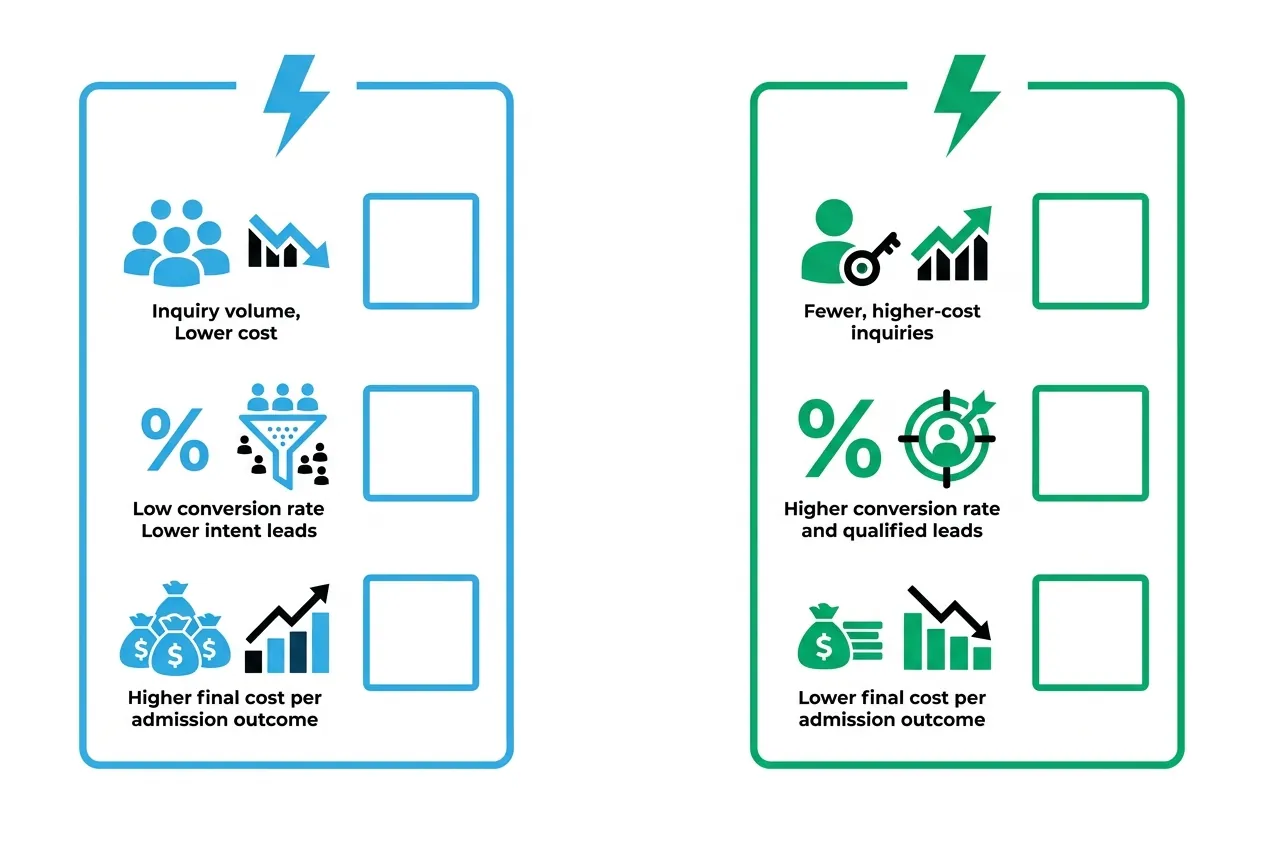
The mathematics of the front-end lead trap are brutal on your balance sheet. Consider an illustrative mathematical model of two operational strategies. In Strategy A, a program generates inquiries at $60 each. Because the intent is unrefined and the landing pages fail to clarify clinical criteria, only 1% of those inquiries complete clinical intake, verify benefits, and physically arrive at the facility. The resulting media cost per admission is $6,000. In Strategy B, the facility targets precise, high-intent clinical search queries and explicitly filters out non-qualifying profiles on the landing page. The cost per lead rises to $250, but because every caller matches the clinical and financial profile of the program, 10% convert into arrivals. The media cost per admission drops to $2,500.
Chasing low lead costs does not save money. It shifts the burden of marketing qualification onto your highest-paid operational staff, burning out intake specialists while inflating your true cost per admission.
What Real Cost per Admission Entails Across Search Channels
True cost per admission is not simply total ad spend divided by the number of admitted patients. That blended number masks massive performance variances across channels, campaigns, and levels of care. To control unit economics, operators must measure the path to admission across three distinct search acquisition channels, each with its own capital requirements and conversion velocity.
High-intent paid search through Google Ads represents the fastest, most controllable path to census stabilization, but it carries the highest immediate media cost. In behavioral health, paid search captures acute crisis demand: families actively searching for medical detox, residential dual-diagnosis treatment, or partial hospitalization programs. When managed with precise clinical targeting, paid search inquiries convert to physical admissions at high rates because intent is immediate. However, treating paid search as an isolated bucket without click-level attribution to bed placement leads to rapid budget waste.
Organic search provides a durable counterweight to rising media costs. Technical search engine optimization and deep clinical content capture prospective patients and loved ones earlier in the research cycle, such as individuals evaluating the signs of severe withdrawal, workplace leave options under the Family and Medical Leave Act, or differences between residential care and intensive outpatient programming. While organic search requires upfront capital and operational patience, its marginal cost per inquiry decreases over time, lowering your blended admissions cost across quarters.
Local map pack visibility operates between the two. When an adult daughter searches for licensed treatment facilities within a two-hour drive of her parents' home, local search visibility captures hyper-local commercial intent. These inquiries convert at higher rates than broad regional campaigns because family involvement and physical proximity directly correlate with admission speed. In our comprehensive pillar guide, Behavioral health marketing: an operator's guide to ethical growth, we explore how coordinating local search, technical authority, and paid media creates a predictable admissions pipeline.
Auditing Treatment Center Marketing Costs Beyond Media Spend
A persistent mistake among treatment center executives is treating media spend as the sole marketing expense on the profit and loss statement. True treatment center marketing costs encompass the entire operational supply chain required to move an inquiry from digital impression to a verified admission.
When an intake team spends forty-five minutes evaluating an inquiry that should have been filtered out by front-end ad copy, that labor cost must be assigned to acquisition. If your facility processes 500 low-quality leads per month to secure ten admissions, your intake team is spending hundreds of operational hours on administrative friction. That operational overhead inflates your real admissions cost just as directly as bidding up competitive keywords on search networks.
Furthermore, speed-to-lead friction represents an invisible balance sheet loss. Behavioral health admissions exist within narrow decision windows. If an inquiry submitted at 9:00 PM is not contacted, clinically qualified, and verified by 9:15 PM, the likelihood of admission drops precipitously. The cost of an empty bed for three days while intake coordinators navigate disorganized lead queues exceeds the monthly cost of sophisticated CRM integration. An accurate accounting of treatment center marketing costs must unite media spend, intake labor, software licensing, and operational latency.
Free Audit
Want a straight read on where your budget is leaking?
How Platform Regulations Reshape Real Admissions Cost
Behavioral health marketing operates under tighter regulatory constraints than almost any other commercial vertical. Operators who attempt to apply standard e-commerce or B2B lead generation tactics quickly face suspended ad accounts, rejected campaigns, and wasted capital. Navigating these rules directly influences your ultimate admissions cost.
First, Google strictly enforces policies governing sensitive healthcare categories. Under the Google Advertising Policies on Personalized Ads, advertisers cannot use remarketing lists, customer match lists, or behavioral audience targeting for health-related queries. In retail or technology, marketers routinely capture an initial site visit and use remarketing campaigns across display and video networks to nurture the lead over sixty days. In addiction treatment and mental health, retargeting is not permitted.
You do not get a second chance to re-engage a lost visitor with cookie-based tracking. Your first-touch creative, landing page speed, clinical clarity, and conversion architecture must be flawless on the initial visit. If your landing page fails to communicate your clinical scope, payer acceptance, and admission process immediately, that visitor leaves, and the acquisition investment is lost.
Second, advertising addiction treatment services on search engines requires mandatory verification through third-party monitoring bodies. Providers must achieve certification under LegitScript Certification Requirements before Google permits ad delivery, as outlined in the Google Ads Healthcare and Medicines Policy.
Maintaining LegitScript certification demands rigorous background checks, documented operational licensure, physical facility inspections, and continuous compliance reviews. While this regulatory barrier protects vulnerable patients from predatory lead aggregators, it adds mandatory operational overhead. When selecting an agency partner, facilities must choose teams that understand these constraints, a dynamic discussed in our analysis, Addiction treatment marketing agency: how to vet one before you sign.

Calculating Rehab Marketing ROI Across Payers and Levels of Care
Evaluating marketing performance through blended return on ad spend (ROAS) creates dangerous blind spots for financial leadership. Calculating true rehab marketing roi requires tracking attribution through to clinical discharge and net revenue collection, segmented by payer contract and level of care.
An admission is not a uniform financial unit. Consider the commercial variance across typical behavioral health service lines:
- Medical Detoxification and Residential Care: High daily reimbursement rate, shorter average length of stay (7 to 28 days), substantial clinical staffing costs, and acute medical necessity requirements.
- Partial Hospitalization Programs (PHP): Moderate daily rate, variable length of stay, lower medical staffing costs, often accompanied by supportive housing expenses.
- Intensive Outpatient (IOP) and Outpatient (OP): Lower per-session reimbursement, extended duration of care (60 to 180 days), predictable recurring revenue, and minimal overnight operational overhead.
If a marketing campaign produces ten admissions for an evening outpatient program at an acquisition cost of $1,200 per admit, and another campaign produces ten residential admissions at an acquisition cost of $4,500 per admit, a superficial audit might conclude the outpatient campaign is superior. However, if the residential admissions yield an average net commercial collection of $22,000 per patient while the outpatient program yields $4,800, the residential campaign produces substantially higher net margin.
Furthermore, payer contracts govern financial viability. An admission carrying an in-network commercial policy with an easily met deductible produces immediate cash flow. An admission requiring complex single-case agreements, high out-of-pocket deductibles, or stringent concurrent review requirements introduces financial drag. Real rehab marketing roi cannot be evaluated until acquisition clicks are joined with electronic health record (EHR) census logs and actual insurance collections.

How Marketing Powered Connects Paid Media to Physical Bed Placement
Bridging the gap between click-level ad spend and verified bed placement requires an operational perspective, not generic marketing templates. Marketing Powered was built from the executive desk down, led by a former healthcare chief marketing officer who ran marketing for a treatment network that grew from 3 to 24 locations, managed $1.5 to $2M per month in Google Ads across 11+ behavioral and mental health accounts, and serves as a court-certified expert witness in advertising strategy.
Our work focuses on eliminating the friction between advertising platforms and the intake department:
- Attribution Tracked to Admission: We configure data architectures that track performance past the form fill or initial phone call. By integrating HIPAA-aware identifiers with CRM intake logs, campaigns are measured by verified benefits, clinical assessments, and physical admissions.
- Compliant Infrastructure: We build acquisition pipelines specifically for Google's sensitive healthcare vertical, where retargeting is not permitted and LegitScript compliance is mandatory.
- Local, Sovereign Intelligence: To protect patient data integrity while automating complex intake workflows, we deploy owned, local AI infrastructure for HIPAA-aware inference. This approach keeps sensitive workflow processing under direct operational control rather than exposing private operational data to public cloud wrappers.
- Intake and Media Alignment: We analyze call transcripts, intake disposition codes, and out-of-network decline reasons to refine negative keyword lists and landing page messaging in real time. If your intake team reports an influx of Medicaid calls that your facility cannot serve, our feedback loop adjusts front-end targeting within hours, preserving intake labor for qualified inquiries.
Operators evaluating external support can review our strategic criteria in Mental health marketing agency: what a specialist partner should deliver to understand the operational standards required in regulated healthcare environments.
Questions, Answered.
Cost per admission represents the fully burdened operational and advertising expense required to place a single qualified patient into a clinical bed or outpatient program. Unlike cost per lead, which measures raw inquiries, cost per admission accounts for media spend, intake labor, insurance verification overhead, and the qualification drop-off between initial contact and physical arrival.
Marketing costs vary widely based on geographic location, clinical level of care, facility licensure, and payer mix (in-network commercial, out-of-network, or private pay). Rather than chasing arbitrary industry averages, operators should evaluate acquisition costs against their net revenue per patient and average length of stay. A compliant residential program operating in a competitive commercial market will naturally carry a higher acquisition cost than a local community outpatient clinic.
This divergence almost always signals front-end audience dilution. Media buyers frequently lower lead costs by bidding on broad, unqualified search queries or targeting low-intent demographic groups on social channels. While this generates high call volumes, the callers are often uninsured, seeking levels of care you do not provide, or located outside your licensing jurisdiction, clogging your intake floor while clinical beds sit empty.
Because platform regulations strictly prohibit retargeting in sensitive health categories, facilities cannot rely on passive remarketing to convert undecided visitors. Additionally, strict compliance with federal privacy standards prevents unvetted third-party tracking pixels from capturing patient journeys. These constraints require marketing teams to optimize first-touch conversion clarity and deploy compliant, direct attribution pipelines. Talk with Marketing Powered about your admissions and marketing economics
Ready to see where your marketing can improve?
Request a free audit of your paid media, landing pages, attribution, and measurement setup. You'll get a straight assessment of where the opportunities are.
or email us at info@marketingpowered.ai