Resources
Peptide Supplement and Cosmetic Claims: A Review Framework
Most brand teams treat the bottle as the boundary: if it says supplement or cosmetic, the copy must be safe. Regulators look at something else entirely, which is what the marketing says the product is for. This framework helps reviewers sort peptide supplement cosmetic claims by classification, intended use and evidence before launch spend is committed.
By Mike Hulick, Founder, Marketing Powered

Classify the actual product before anyone drafts copy
Claims review starts at the bench and the spec sheet, not in the copy doc. Before a writer opens a brief, someone on the team should be able to state, in one page, what the product contains, how it is delivered, who it is sold to, and which federal framework applies. That page is the product classification evidence every later decision depends on.
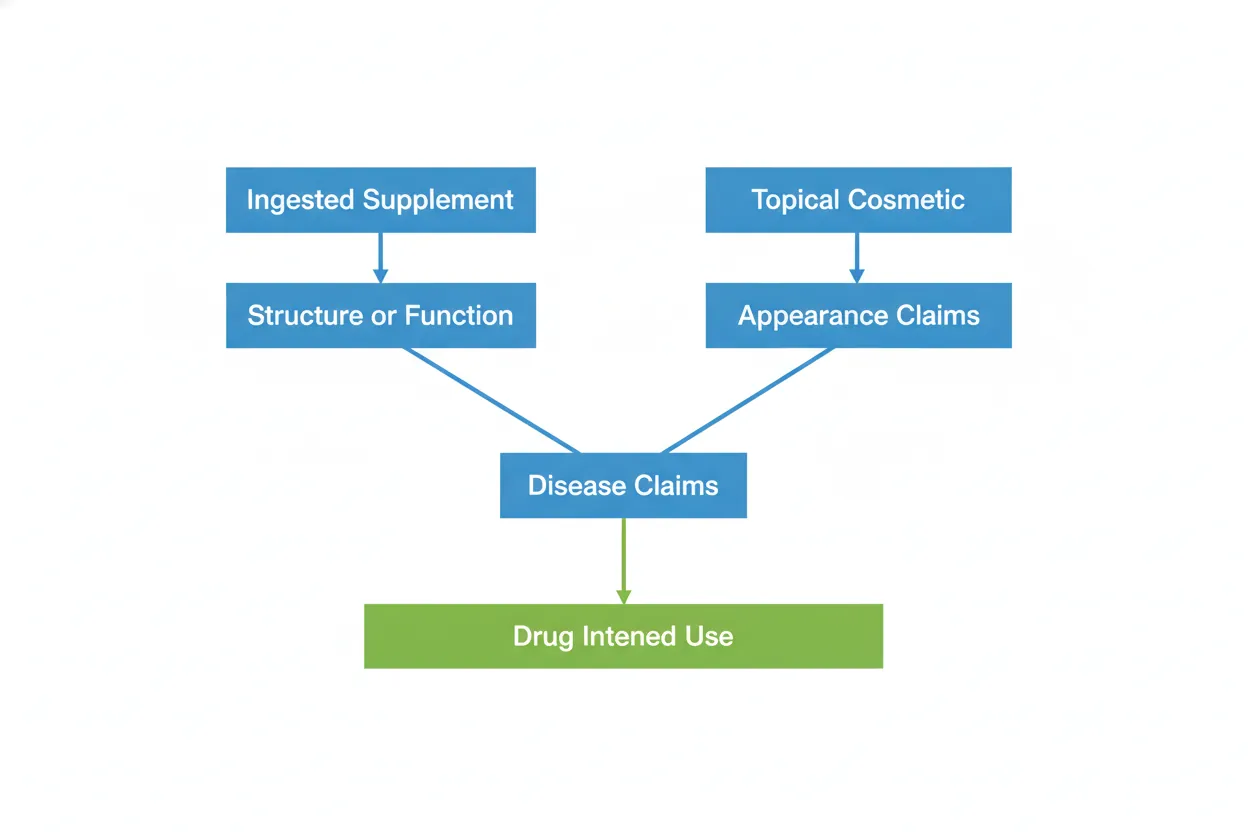
The format decision is not cosmetic in the casual sense. Dietary supplements are products that are ingested, specifically swallowed, so topical or inhaled products are not supplements, and to be a dietary supplement a product must also be labeled as one (FDA, Questions and Answers on Dietary Supplements). A topical peptide serum is therefore evaluated as a cosmetic or a drug, never as a supplement, no matter how the ingredient is discussed in supplier literature.
On the other side, the Federal Food, Drug, and Cosmetic Act defines cosmetics as articles intended to be applied to the human body for cleansing, beautifying, promoting attractiveness, or altering the appearance, while drugs are defined in part by intended use as articles intended for use in the diagnosis, cure, mitigation, treatment, or prevention of disease and articles other than food intended to affect the structure or any function of the body (FDA, Is It a Cosmetic, a Drug, or Both?).
Two cautions belong in the classification record. First, this page takes no position on whether any specific peptide is lawful in a supplement or a cosmetic; that is a product-specific question for qualified regulatory counsel, and new dietary ingredients carry their own notification path. Second, prescription and compounded peptide drug products sit on a different regulatory track altogether. Nothing in a marketing review converts one category into another.
Separate the category rules instead of blending them
The most common failure in collagen marketing claims is a copy deck that borrows supplement language for a topical product, or cosmetic language for a capsule, because both sell the same visual promise. Keep the two columns apart on the page and in the review.
- Governing definition. Ingestible peptide or collagen supplement: Ingested product labeled as a dietary supplement. Topical peptide skincare: Applied to the body to cleanse, beautify, promote attractiveness or alter appearance.
- Claim range generally available. Ingestible peptide or collagen supplement: Structure/function, nutrient content and authorized health claims, each with its own requirements. Topical peptide skincare: Appearance and attractiveness claims.
- Required disclaimer. Ingestible peptide or collagen supplement: Two-part disclaimer required by law when a structure/function claim is made in labeling. Topical peptide skincare: No equivalent disclaimer converts a drug claim into a cosmetic claim.
- What crosses into drug territory. Ingestible peptide or collagen supplement: Representing the product explicitly or implicitly for treatment, prevention or cure of a specific disease. Topical peptide skincare: Claims that the product will treat or prevent disease or otherwise affect the structure or functions of the body.
- Premarket approval. Ingestible peptide or collagen supplement: FDA does not have authority to approve dietary supplements before they are marketed. Topical peptide skincare: Cosmetic products and ingredients, other than color additives, do not require FDA approval before market.
Two details matter more than the table suggests. The absence of premarket approval is not permission to make a therapeutic promise; it simply means the burden sits with the firm.
And the marketing category label has no magic to it: the FD&C Act does not recognize any category called "cosmeceuticals," and the term has no meaning under the law.
Teams that already run clinical or compliance review on content will recognize the workflow; the governance patterns in our healthcare content marketing guide transfer directly to consumer-product review.
Review express and implied promises across every asset
Reviewers tend to search for banned words. The actual standard is broader. Before disseminating an ad, advertisers must have adequate substantiation for all objective product claims conveyed, expressly or by implication, to consumers acting reasonably, and marketers should assess the net impression conveyed by all elements of the ad, including the text, product name, and any charts, graphs and other images, with the advertiser responsible for substantiating each reasonable interpretation (FTC Health Products Compliance Guidance).
That makes four asset types claim-bearing even when the body copy is clean. Product names that promise repair or restoration. Mechanism explanations that describe the product acting on tissue rather than on appearance. Before and after imagery that implies a clinical result.
And endorser language, since advertisers should not make claims through testimonials or expert endorsements that would be deceptive if made directly, and must have appropriate scientific evidence for the underlying implied claim that the product will work for buyers as it did for the endorser.
Intended use also forms outside your copy. FDA notes that intended use may be established through claims in labeling, advertising, on the internet or in other promotional materials, through consumer perception established by the product's reputation, and through ingredients with a well-known therapeutic use. Examples given there are instructive for peptide skincare claims, including promises to restore hair growth, reduce cellulite or regenerate cells.
Scope the review accordingly. FTC guidance treats advertising as including statements on packaging and labeling, promotional materials, internet and digital content, social media and influencer marketing, press releases and media appearances, and trade show and seminar material. Channel rules sit on top of that federal baseline, since ad platforms apply their own health and supplement restrictions; our healthcare advertising policy guide covers how those platform layers interact with claim language.
Free Audit
Want a straight read on where your budget is leaking?
Assess whether the evidence matches the claim
This is where most collagen substantiation files quietly fail. The studies are real, the authors are credentialed, and the research still does not support the sentence on the page. FTC guidance describes this as a common problem: an advertiser has valid studies, but the studies do not support the claim in its ad, so the research must be not only internally valid but relevant to the specific product and the specific advertised benefit.
Run each claim against a relevance worksheet before it is approved. The columns below are an illustrative structure, not a legal standard.
- Dose and formulation. What the reviewer compares: How the dosage and formulation of the advertised product compare to the product used in the study.
- Ingredient identity. What the reviewer compares: Whether the ingredient or combination in the advertised product is the same as what was studied.
- Administration. What the reviewer compares: Whether the product is administered in the same manner as in the study.
- Outcome match. What the reviewer compares: How well the outcomes tested relate to the specific benefits advertised.
- Population. What the reviewer compares: Whether the study population reflects the audience targeted by the ad, and whether extrapolation is appropriate where conditions differ.
Evidence type matters as much as evidence fit. Animal and in vitro studies may provide useful supporting or background information, but without confirmation by human randomized controlled trials they are not sufficient to substantiate health-related claims, and anecdotal evidence about individual consumer experiences, including surveys of consumer experiences, is never sufficient to substantiate claims about the effects of a health product. Ingredient-supplier decks often lean on exactly those categories.
Wording discipline closes the gap. Claims that do not match the research results are likely to be deceptive regardless of how sound the research is, so advertisers should avoid exaggerating the extent, nature or permanence of effects achieved in a study. A claim that survives this worksheet is usually narrower, more specific and easier to defend than the one originally drafted. Reviewers who want a general process scaffold can adapt our healthcare marketing compliance checklist to consumer-product workflows.

Correct the claim, not the label
When a reviewer flags a problem, the tempting fix is cosmetic in the literal sense: change the category word, add a disclaimer, soften one verb, ship. That approach misreads how both agencies evaluate the file.
On the supplement side, a product sold as a dietary supplement and represented explicitly or implicitly for treatment, prevention or cure of a specific disease or class of diseases meets the definition of a drug and is subject to regulation as a drug, and FDA considers advertising when evaluating the intended use of a product labeled as a dietary supplement.
The required disclaimer exists because only a drug can legally make a claim to diagnose, treat, cure or prevent disease, which is the opposite of a safe harbor.
On the advertising side, the DSHEA disclaimer is not required in other forms of advertising, and marketers should be aware that the disclaimer or similar statements will not cure an otherwise deceptive ad, particularly where the deception concerns health-related benefits. The same logic applies to dramatic testimonials, where statements such as "results not typical" do not cure the deception.
So corrections have to operate on the promise itself. Either the claim is rewritten to describe appearance or a supported structure/function effect with evidence attached, or the claim is dropped, or the company accepts that it is describing a drug and takes that question to qualified counsel.
Avoid a second trap while you are at it: regulatory notifications, facility registrations and third-party certifications are not approval of a claim, and advertisers should not imply that FDA has specifically approved a claim on the basis of DSHEA notification and disclaimer compliance.
Certification programs such as the ones covered in our LegitScript certification guide address channel and marketplace eligibility, which is a separate question from product classification and claim support.

Build a review record the team can defend
Claims review scales only when it leaves a trace. The practical artifact is a single living log, owned by one person, that a reviewer can open mid-campaign and read without reconstructing six months of Slack threads.
Useful fields are mundane: SKU and formulation version, the exact claim text, the asset and channel where it runs, the category decision and who made it, the evidence relied on with a link to the study or file, the relevance worksheet result, the reviewer name and role, the approval date, a recheck date, and for rejected claims the reason and the approved alternative.
Illustrative entries help new writers calibrate. An approved row might read "visibly smooths the appearance of fine lines," tied to a finished-product consumer study on the marketed formulation.
A rejected row might read "rebuilds damaged skin structure," rejected because it describes a structural effect rather than appearance and because the only supporting data came from in vitro work on a different concentration. Both examples here are illustrative constructions, not real products or real approvals.
Two roles make the record credible. A qualified reviewer with regulatory or legal familiarity in the applicable category signs the classification and claim decisions. A marketing owner keeps the log current across SKUs, influencer briefs and paid assets.
Marketing Powered works in regulated categories where this discipline is routine, including Google's sensitive healthcare vertical, where retargeting is not permitted, and its founder is a court-certified expert witness in advertising strategy.
The media side of this work, including how claims constraints shape search and social structure, is covered in our paid media services overview; buyers evaluating outside help can use our healthcare marketing agency vetting guide, and teams with data-handling questions can review our security overview.
Questions, Answered.
No. The disclaimer accompanies structure/function and related claims in labeling; it does not convert a disease claim into a lawful one. A supplement represented explicitly or implicitly for treatment, prevention or cure of a specific disease meets the drug definition, and in advertising the disclaimer will not cure an otherwise deceptive ad.
When the claim promises disease treatment or a change to how the body works rather than how it looks. FDA states that certain claims may cause a product to be considered a drug even if marketed as a cosmetic, because the intended use is to treat or prevent disease or otherwise affect the structure or functions of the body.
Products can also carry both intended uses at once, in which case they must comply with the requirements for both cosmetics and drugs.
Not on its own. The study has to match the marketed product on ingredient identity, dose, formulation, route of administration, outcome measured and population, and where research conditions differ significantly from the promoted real-life use, advertisers must evaluate whether extrapolation is appropriate. Supplier research on a raw material rarely clears that bar for a finished formula without further work.
Yes. FTC guidance treats social media and influencer marketing as advertising alongside packaging, labeling and digital content, and advertisers should not make claims through endorsements that would be deceptive if made directly. Captions, pinned replies, affiliate scripts and creator briefs belong in the same review queue as site copy.
A qualified reviewer with regulatory or legal familiarity in the applicable category, named and dated in the review record, rather than the marketing team that drafted the copy. This page is general marketing guidance and not legal or regulatory advice.
Agency guidance pages are also updated without notice, so confirm the current text of each source before you publish and build a recheck date into the record.
If you are planning a launch, a reformulation or an influencer program and are not confident the claims file can carry the spend, we can review the framework with you. Review your consumer-product claims framework
More Resource Topics
Ready to see where your marketing can improve?
Request a free audit of your paid media, landing pages, attribution, and measurement setup. You'll get a straight assessment of where the opportunities are.
or email us at info@marketingpowered.ai