Resources
Local SEO for Law Firms: Winning the Map Pack in Competitive Markets
Winning high-intent legal clients requires dominating the local map pack across every zip code your firm serves. Mastering local SEO for law firms allows regional practices to capture qualified cases in competitive geographic markets without relying entirely on high-cost paid search. When regional firms align physical operations with localized search architecture, map pack visibility becomes a predictable engine for signed cases.
By Mike Hulick, Founder, Marketing Powered

The Mechanics of Local SEO for Law Firms in Competitive Markets
In any major metropolitan legal market, prospective clients facing an urgent legal crisis turn to Google on mobile devices. A commuter involved in a commercial vehicle collision on an interstate corridor or a family navigating an immediate custody dispute does not browse through pages of traditional search results. They evaluate the three firms featured in Google's local map pack. If your practice does not occupy one of those three positions, prospective clients contact competing attorneys before discovering your standard organic listings.
Securing these positions requires understanding how local search algorithms evaluate professional legal practices. Google Business Profile Help confirms that local rankings depend on three foundational factors: relevance, distance, and prominence. Relevance calculates how closely a business profile matches the specific phrase a prospective client searches. Distance measures the physical proximity between the user's location and the verified address of the law office. Prominence evaluates how well-known and reputable the firm appears across the broader web, drawing on review velocity, citation consistency, directory authority, and localized organic search signals.
In dense metropolitan areas where dozens of qualified attorneys operate within a five-mile radius, distance alone rarely determines the top three listings. Two competing personal injury practices may share the same commercial boulevard, yet one appears consistently across surrounding suburbs while the other disappears three blocks away. That divide is determined by algorithmic prominence.
Prominence reflects real-world operational health. Search engines assess whether a firm possesses verifiable physical offices, a steady stream of authentic client reviews, structured local practice-area pages, and active local engagement. Achieving sustainable map pack visibility is not an exercise in adding zip codes to website footers. It requires an operational system that coordinates physical office management, website architecture, and client intake workflows.
Core Signals for a Law Firm Google Business Profile
Your law firm Google Business Profile serves as the direct connection between your practice and local searchers. It functions as an authoritative entity record rather than a passive directory listing. Configuring this asset correctly establishes the baseline relevance necessary to compete for high-value legal queries.
The primary category you select anchors your profile across Google's entity graph. Selecting a broad category such as "Law Firm" or "Legal Services" dilutes your relevance for specific, high-intent client inquiries. If your practice generates the majority of its case volume from civil litigation or motor vehicle accidents, "Personal Injury Attorney" must serve as the primary category, with related specializations added as secondary categories. A multi-discipline regional firm should map secondary categories to reflect its core fee-generating practice groups, including "Criminal Defense Attorney," "Divorce Lawyer," or "Employment Attorney." Adding categories for practice areas your firm does not actively litigate triggers irrelevant inquiries and harms algorithmic relevance.
Establishing physical legitimacy is equally critical. In response to widespread lead-generation tactics and virtual office networks, Google has intensified verification standards for legal entities. Setting up a presence in an unstaffed shared workspace, executive suite, or virtual maildrop creates significant operational vulnerability. Listings operating out of virtual offices frequently face algorithmic suppression or immediate suspension during routine re-verification checks.
A defensible local profile requires a leased physical premises with prominent exterior or lobby suite signage, dedicated local phone numbers, and operational staff present during published business hours. When video verification occurs, Google requires documentation demonstrating physical custody of the space, including lease agreements, utility statements, branded entry doors, and operational conference rooms. Investing in genuine physical footprints protects your practice from unexpected suspensions that sever your intake pipeline overnight.
Practice-Area Architecture and Attorney Local SEO
A verified business profile cannot achieve map pack dominance in isolation. It relies on your primary website to confirm entity authority and technical relevance. Local map rankings correlate strongly with the organic strength of the specific landing page linked to the business profile. For multi-location practices, aligning attorney local seo with practice-area website architecture is essential.
Many expanding firms rely on a centralized website architecture that points every local listing to the root domain or to thin, generic city pages. A page that simply swaps city names within identical paragraphs of text creates duplicate content issues and fails to prove geographic authority. As outlined in our guide on multi-location SEO: how to rank every location without duplicate content, multi-location practices must establish distinct geographic silos that pair each physical location with customized practice-area depth.
If a firm maintains offices in three adjacent counties, each location requires a primary location hub page linked directly to its corresponding business profile. Beneath that location hub, the site should house localized practice-area pages addressing jurisdiction-specific statutes, regional courts, and relevant municipal procedures. A personal injury page for an office in one municipal district should reference the local county court system, local filing procedures, and regionally specific case contexts rather than mirroring the text of an office forty miles away.
Structured data bridges the technical gap between your website and search engines. Implementing schema markup using specific schema types such as LegalService and Attorney provides explicit detail regarding office addresses, geographic coordinates, practicing partners, and localized service offerings. When search engine crawlers encounter matching entity records across your structured markup, your verified business profile, and authoritative legal registries, algorithmic confidence increases, lifting your profile across competitive map searches.
Free Audit
Want a straight read on where your budget is leaking?
Geo-Grid Decay and Proximity Limits in Dense Metros
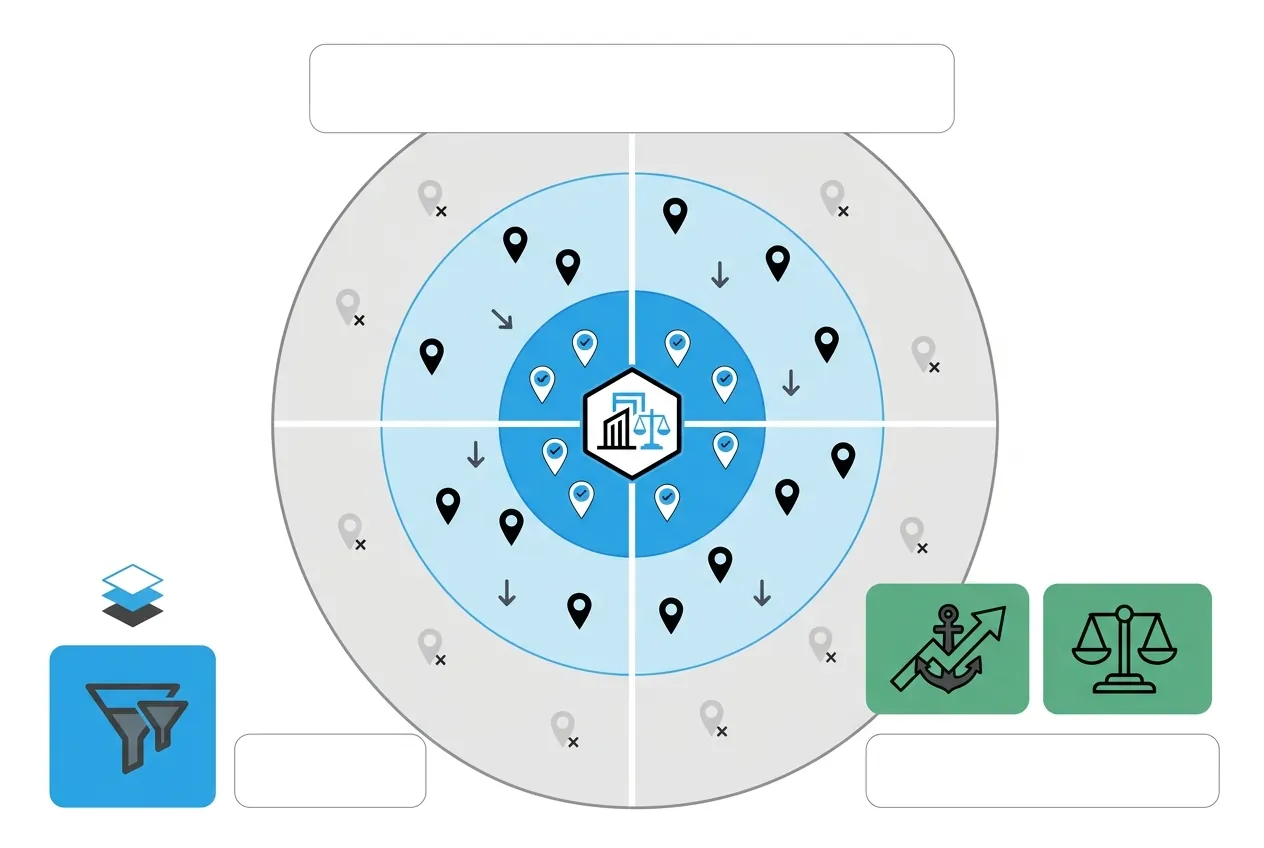
One of the most persistent frustrations for legal marketing directors is geo-grid ranking decay. A firm examining its local search positions often finds it ranks in position 1 when searching from its own reception area. However, measuring rank positions across a five-mile geographic grid reveals that rankings often drop off sharply just two miles outside the office door.
This drop occurs because Google treats physical distance as a primary filter. In a dense market with dozens of personal injury or criminal defense attorneys, the algorithm prioritizes proximity to prevent a single downtown firm from monopolizing map visibility across an entire metropolitan region. Understanding this dynamic prevents marketing leadership from wasting resources attempting to force a single downtown address to rank across distant suburbs.
Widening your firm's effective geographic radius requires building outsized entity prominence. Prominence acts as an algorithmic counterweight to physical distance. A firm with exceptional review velocity, extensive local media mentions, high organic domain authority, and deep localized content can maintain map pack visibility several miles further from its office than a competitor with weak prominence signals.
When organic prominence reaches its natural geographic ceiling, physical expansion becomes necessary. Multi-location legal practices scale their intake by identifying profitable territory gaps using geo-grid tracking software and opening fully staffed satellite offices in underserved sub-markets. Combining strategic physical placement with targeted local optimization expands your firm's composite map coverage, capturing prospective clients who would otherwise be routed to nearby competitors.
Review Operations: How Powered Cards Streamline Law Firm Local SEO
Client feedback is a foundational prominence signal in local search algorithms. The total volume of reviews, the velocity of new submissions, average numerical ratings, and the presence of natural practice-area keywords within client feedback directly influence map rankings. A firm that gathered fifty reviews three years ago and ceased acquiring feedback will steadily lose ground to an active competitor securing three detailed reviews each week.
Securing consistent client reviews in the legal sector is challenging. Paralegals, case managers, and associate attorneys focus on case preparation and court deadlines, rarely prioritizing marketing initiatives. Furthermore, sending generic email links weeks after a case concludes yields minimal response rates. When prospective clients leave the office, their willingness to navigate complex review workflows drops dramatically.
Deploying physical review acquisition tools bridges this operational gap. Implementing Google review cards: using NFC and QR cards to collect reviews at the point of service allows legal teams to capture feedback at peak moments of client satisfaction. When a favorable settlement is signed or a final resolution is reached in an office conference room, an attorney or case manager can present a physical Powered Card. A single tap of a smartphone on the card opens your verified review destination directly on the client's screen, eliminating search friction and third-party login barriers.
Review generation systems must adhere strictly to platform and regulatory guidelines. The Google Maps User Contributed Content Policy strictly prohibits review gating, offering incentives, purchasing feedback, or staging employee reviews. Similarly, the FTC Consumer Reviews and Testimonials Rule prohibits deceptive review practices, including suppressing unfavorable reviews or conditioning incentives on positive sentiment. Law firms must also adhere to state bar advertising ethics governing client confidentiality and testimonials. Staff should be trained to invite genuine, voluntary feedback without scripts, pressure, or conditional screening.
Measuring Lawyer SEO Through Intake and Retained Matters
Tracking impressions, map clicks, and direction requests provides directional insight, but these metrics do not demonstrate marketing return. A local search campaign that produces hundreds of calls for practice areas your firm does not handle, or from geographic areas where you do not litigate, wastes administrative intake resources. Effective lawyer seo requires measuring performance through the intake process down to signed client retainers.
Achieving closed-loop attribution requires dynamic call tracking integrated with local search assets. Multi-location law firms must assign distinct, local call tracking numbers to each Google Business Profile, routing calls into a centralized intake management platform. Using dynamic number insertion on website location pages ensures that when a user clicks through from a local map listing to the website, the correct tracking number displays dynamically while preserving consistent primary phone citations across your underlying directory schema.
Intake coordinators must tag incoming inquiries with specific source identifiers, tracking prospects through initial qualification, conflict checks, consultation scheduling, and final retainer signing. This level of measurement exposes the actual commercial value generated by each geographic location and practice category.
Tracking downstream conversions also surfaces operational bottlenecks inside the firm. If an optimized local profile generates forty qualified personal injury calls in a month but only three sign retainers, the primary constraint is rarely search engine visibility. The issue typically lies in slow response times, missed calls during peak hours, or flawed intake qualification protocols. Aligning search measurement with intake data ensures marketing investments produce tangible caseload growth.
Email Us
Prefer to send the context directly?
Building Defensible Multi-Location Legal Visibility with Marketing Powered
Scaling visibility across multi-location professional service networks demands technical rigor, compliance awareness, and operational execution. Marketing Powered approaches local legal search as an integrated operational discipline rather than an isolated set of tactical tricks. Our framework unifies physical location governance, technical search architecture, frictionless point-of-service review systems, and complete intake attribution.
Our team brings substantial experience managing complex, regulated marketing systems. Our founder is a former healthcare Chief Marketing Officer who ran marketing for a treatment network that grew from 3 to 24 locations, managing $1.5 to $2M per month in Google Ads across 11+ behavioral and mental health accounts, and serving as a court-certified expert witness in advertising strategy. We apply the same operational standards developed in highly regulated, sensitive healthcare environments to regional law practices, ensuring full alignment with strict advertising boundaries and professional conduct rules.
Our local search engagements focus on systematic commercial execution:
- Geo-grid rank analysis mapping street-level local search visibility across core practice categories.
- Physical location compliance audits to ensure Google Business Profiles meet strict staffing and facility guidelines.
- Technical architecture development that establishes dedicated, non-duplicate location silos and localized practice pages.
- Deployment of custom Powered Cards using NFC and QR technology to build compliant, high-velocity review acquisition at matter resolution.
- Intake and CRM integration tracking qualified calls and web submissions directly to signed client retainers.
- Proprietary, owned local computing infrastructure that enables private, secure data processing for sensitive legal operations.
As examined in our analysis of multi location seo services: what a specialist partner delivers and how to vet one, building enduring local prominence requires treating local search as a continuous operating discipline. By establishing verifiable physical relevance and removing friction from review capture, firms secure prominent map pack placement that consistently captures high-value cases.
Questions, Answered.
In the commercial legal market, Tier 1 traditionally refers to elite institutional law firms recognized by national ranking publications for high-stakes corporate transactions and complex multi-district litigation. However, this corporate prestige rarely translates to dominance in consumer-facing local search map packs. Google's local algorithm prioritizes localized physical proximity, verified business profiles, practice-area page relevance, and active client review velocity over industry directory status. A regional three-partner litigation firm with disciplined local search architecture and robust review velocity will consistently outrank a global corporate practice for high-intent consumer searches such as personal injury, family law, or criminal defense.
Google requires every business profile to maintain a verified physical location with dedicated signage and staff present during stated operational hours. Utilizing executive suites, mail-drop addresses, or unstaffed co-working desks carries high risk. Google regularly sweeps competitive legal categories, suspending profiles that fail to prove permanent physical occupancy and dedicated staff. To maintain stable rankings, law firms must establish legitimate, lease-backed physical offices with permanent signage and dedicated local telephone numbers.
There is no fixed numerical threshold for reviews that guarantees a top-three ranking. The required volume depends on the competitive density of your metropolitan area and the review metrics of competing firms. More important than total historical volume is consistent review velocity and recency. A law firm that consistently receives two to three authentic, keyword-relevant client reviews each week will routinely outpace competitors with larger, stagnant review counts.
Your website's organic search authority directly impacts your map pack prominence. Google uses the organic ranking strength of the landing page linked to your business profile to assess entity authority. If your target practice page ranks organically on page one for relevant legal queries, the associated business profile is substantially more likely to rank within the top three map pack positions. Integrating localized content, internal linking, and structured schema markup strengthens both organic and map pack rankings simultaneously. Get a multi-location visibility audit from Marketing Powered
Ready to see where your marketing can improve?
Request a free audit of your paid media, landing pages, attribution, and measurement setup. You'll get a straight assessment of where the opportunities are.
or email us at info@marketingpowered.ai