Resources
Local SEO for Dentists: The Multi-Location Operational Guide
Executing local seo for dentists across multiple clinical facilities requires treating local search as an operational intake pipeline rather than an isolated digital checklist. Regional dental groups and dental support organizations expand practice revenue only when verified map profiles, high-intent procedural web architecture, point-of-care review systems, and patient intake tracking operate as a unified commercial engine.
By Mike Hulick, Founder, Marketing Powered

The Core Signals of Local SEO for Dentists: Relevance, Distance, Prominence
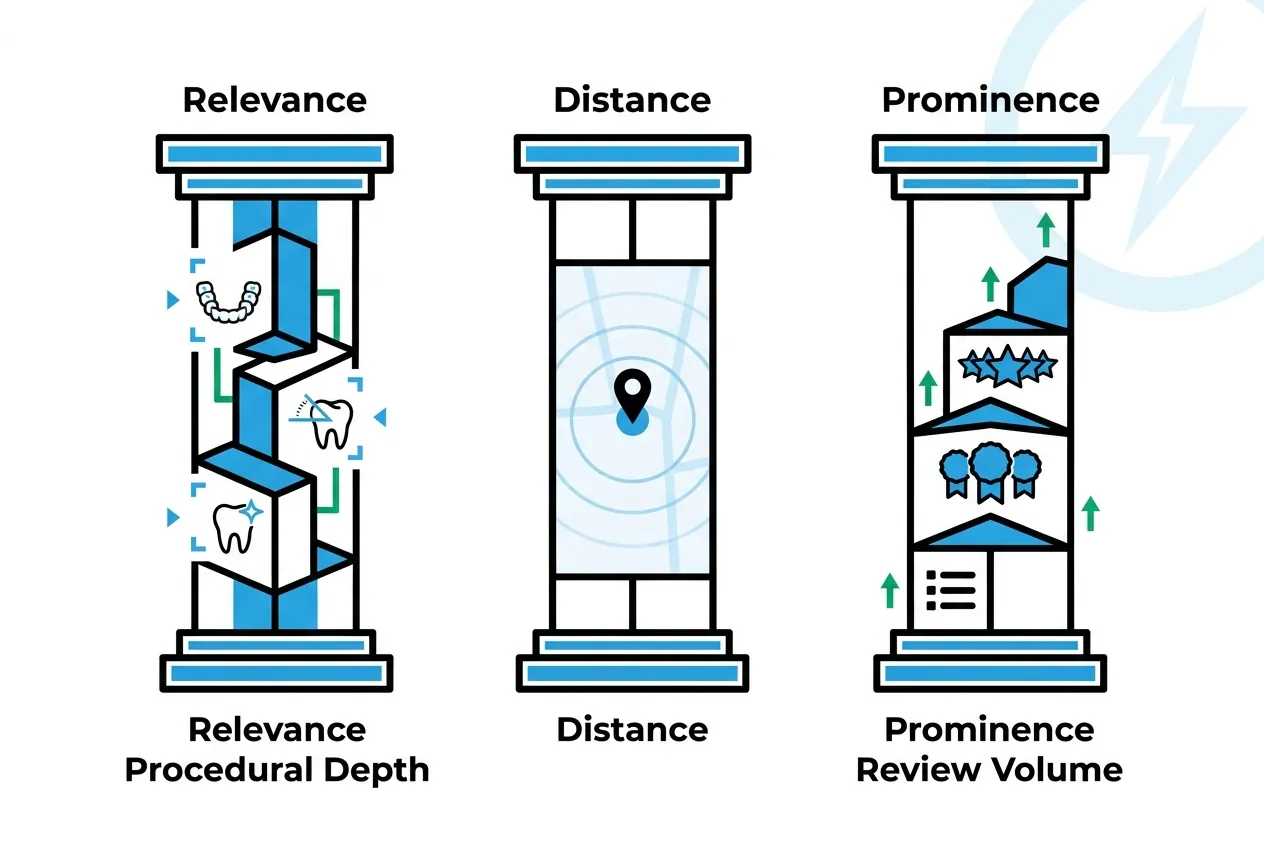
Search engines evaluate local dental practices using three fundamental pillars. According to Google Business Profile Help, local search results are determined primarily by relevance, distance, and prominence. Understanding how these factors interact allows clinical operators to focus their resources on the variables they can influence.
Distance reflects the physical proximity between the searcher and the clinic address. A prospective patient searching for emergency tooth extractions from five miles away will see map results that prioritize closer facilities, assuming all other signals are competitive. Dental organizations cannot alter physical coordinates to manipulate proximity. Therefore, operational success depends on maximizing relevance and prominence across every clinical territory.
Relevance measures how closely a clinic's digital footprint matches the intent of a patient query. If a user searches for clear aligners, Google evaluates whether the clinic profile, primary and secondary categories, service menus, and linked website content explicitly address clear aligner therapy. Selecting a generic category such as "Dentist" while ignoring procedural categories like "Cosmetic Dentist" or "Orthodontist" directly impairs relevance for high-margin procedures.
Prominence measures how established and reputable a practice appears across the web. Google assesses prominence through review volume, review velocity, average rating, local community citations, directory consistency, and organic website authority. A clinic with hundreds of authentic, steadily acquired patient reviews and deep clinical content will routinely outrank a competitor that sits closer to the searcher but maintains an abandoned profile with stagnant reviews.
Configuring Practice and Practitioner Listings on Your Google Business Profile
Multi-location practices face a specific architectural challenge when managing their presence on Google Maps: balancing the primary clinic facility against the individual dentists practicing inside it. Managing a dentist google business profile requires adhering strictly to platform guidelines to avoid internal competition and review fragmentation.
Under Google's guidelines, a multi-dentist practice is permitted to maintain a primary practice profile for the physical location, while individual licensed practitioners may maintain their own practitioner profiles at that same address. When left unmanaged, associate dentists who join or leave the practice often create ad-hoc profiles. This splits patient reviews across multiple listings, dilutes location authority, and produces conflicting contact information that confuses prospective patients.
To establish operational control, assign clear hierarchy across your listings:
- Prioritize the Practice Listing: The practice listing must serve as the primary commercial hub. Focus the majority of patient review collection on this profile. Ensure its primary category reflects the facility focus (such as "Dental Clinic" or "Dentist") and that its website URL points directly to that specific clinic's location page.
- Standardize Practitioner Profiles: If associate dentists maintain individual listings, verify them under explicit sub-specialties rather than duplicating the clinic's primary category. An in-house specialist should use "Pediatric Dentist," "Periodontist," or "Endodontist." Ensure the practitioner's profile links directly to their individual biography page on the practice website rather than the general homepage.
- Establish Departed Provider Protocols: When a dentist leaves the organization, do not mark the practitioner listing permanently closed if it shares the address, as this can trigger algorithmic confusion for the clinic itself. Instead, contact Google support or update the profile to reflect the provider's new operating address, decoupling it from your clinic's physical location.
For operators scaling multiple offices, aligning individual profiles with location hubs prevents profile suspension and ensures your primary location retains hard-earned patient feedback.
Structuring Practice Website Architecture for Dental SEO
High-ranking map profiles cannot perform in a vacuum. Google uses the organic authority and structured content of your linked website to validate the relevance and prominence of your listings. Effective dental seo requires an intentional site architecture that separates geographic locations while building dedicated landing pages for specific procedures.
Many multi-location dental groups make the mistake of publishing thin, near-duplicate location pages that simply swap city names in the text. Search engine crawlers recognize programmatic templating that lacks unique clinical value, suppressing those pages in organic search results. To build sustainable authority across markets, organize your website under a clean directory structure:
- Root Domain: exampledental.com
- Geographic Hub: exampledental.com/locations/
- Clinic Location Page: exampledental.com/locations/north-austin/
- Clinic Procedure Page: exampledental.com/locations/north-austin/dental-implants/
Every clinic location page must contain distinct, verified details about the specific facility. This includes localized driving directions referencing identifiable landmarks, unique interior and exterior clinic photography, clinic-specific telephone numbers, accepted insurance plans, and precise operational hours.
Directly below the clinic location page, build out procedural landing pages for high-intent services like dental implants, sedation dentistry, cosmetic veneers, and wisdom tooth extraction. Rather than routing all traffic to a single generic implants page, local procedural pages confirm to search engines that the procedure is actively performed at that physical clinic. This structural depth directly informs Google's relevance score for high-value transactional queries.
To learn more about organizing enterprise site structures across multiple markets, read Multi-location SEO: how to rank every location without duplicate content.
Free Audit
Want a straight read on where your budget is leaking?
Local SEO Guide for Dentists: Citations, Schema, and On-Page Alignment
Executing an authoritative local seo guide for dentists demands rigorous technical alignment across off-page directories and on-page metadata. Consistency establishes search engine trust.
First, audit and standardize Name, Address, and Phone (NAP) data across major aggregators and healthcare directories, including Healthgrades, WebMD, Yelp, and regional chambers of commerce. Inconsistent suite numbers, outdated phone numbers, or legacy practice names generate entity confusion that degrades prominence. Centralize citation governance so that address updates or clinical rebrands deploy simultaneously across all platforms.
Second, deploy nested LocalBusiness and Dentist structured data schema on every location page. Schema markup provides machine-readable code that clarifies your physical operational data to web crawlers. Ensure your schema script explicitly includes:
- Exact legal entity name and physical address
- Precise geo-coordinates (latitude and longitude)
- Clinic-specific telephone number
- Accepted payment methods and insurance networks
- Links to verified social profiles and official directory listings
- Specific medical procedures offered at the facility
Third, align title tags and header structure around patient search intent rather than internal corporate terminology. Instead of writing "North Austin Services," format your primary H1 tag as "Comprehensive Dental Care in North Austin, TX." Structure secondary headers around specific patient needs, such as "Emergency Tooth Pain Relief" or "Sedation Options for Anxious Patients." This on-page alignment gives crawlers unambiguous proof that your physical clinic satisfies the specific clinical needs of local searchers.

Point-of-Care Review Generation Systems
Patient reviews represent both a core ranking signal for prominence and the primary conversion asset on your Google Business Profile. Prospective patients facing complex dental treatments evaluate recent patient experiences before booking an exam. However, most dental organizations rely on delayed email sequences or SMS blasts sent days after an appointment, when patient enthusiasm has already faded.
Review intent decays rapidly once a patient leaves the clinical facility. A patient who experienced compassionate care during an emergency root canal is highly motivated to leave a review immediately following treatment. Forty-eight hours later, competing personal priorities reduce review form completion rates dramatically. Capturing sentiment requires integrating review requests directly into the physical patient checkout workflow.
Review collection systems must strictly follow legal and platform standards. Under the Google Maps User Contributed Content Policy, practices are prohibited from offering financial incentives, discounts, or gifts in exchange for reviews. Google also forbids review gating, which involves filtering dissatisfied patients into internal feedback forms while directing only satisfied patients to public review sites.
Furthermore, the Federal Trade Commission actively enforces regulations against deceptive consumer testimonials, undisclosed incentives, and conditional feedback collection. Violations risk public regulatory action, severe platform penalties, or the total removal of a clinic's review history.
Compliant review generation relies on removing friction at the point of care. Equipping front-desk staff with physical access tools, such as Powered Cards, allows patients to tap an NFC-enabled card or scan a dynamic QR code using their mobile device while scheduling follow-up appointments. This takes the patient directly to the verified review submission screen on Google without searching or navigating intermediate portals. Front-desk teams do not need to make uncomfortable sales pitches. They simply invite the patient to share their honest feedback on the care they received today.
Technical and Local Search Execution: How Marketing Powered Delivers
Scaling search visibility across five, ten, or fifty dental clinics requires an enterprise approach to local infrastructure. Marketing Powered is an operator-led firm built around measurable commercial outcomes, first-party data architecture, and attribution that ties acquisition spend directly to patient intake.
Our background is rooted in large-scale healthcare operations. Marketing Powered's founder previously served as a healthcare Chief Marketing Officer, leading marketing operations for a clinical treatment network that scaled from 3 to 24 locations while managing $1.5 to $2M per month in Google Ads across 11+ behavioral and mental health accounts. As a court-certified expert witness in advertising strategy, our leadership designs local search systems capable of withstanding regulatory scrutiny and aggressive regional competition.
When partnering with expanding dental networks and healthcare groups, we deploy structured technical and local search frameworks:
- Geo-Grid Visibility Tracking: We implement precise geo-grid tracking across every clinic territory to identify rank decay down to individual zip codes and street intersections, showing exactly where your map pack visibility ends.
- Profile Architecture and Entity Resolution: We audit, clean, and structure practice and practitioner profiles, eliminating duplicate listings, standardizing categories, and securing verified ownership across all markets.
- On-Page and Schema Deployment: We implement validated Dentist and MedicalBusiness schema, build high-intent procedural site architectures, and eliminate duplicate copy across clinic location hubs.
- Point-of-Care Infrastructure: We integrate physical review acquisition systems via Powered Cards, training clinic operations to collect authentic patient reviews compliantly at checkout.
To evaluate how an operator-led partner manages complex clinic networks, explore our multi location seo services.

Email Us
Prefer to send the context directly?
Tracking Local Search Clicks to Booked Dental Appointments
Local search optimization fails as an investment if practice leadership cannot measure its impact on clinic revenue. High search impression volumes and map-pack rankings do not pay clinical overhead; scheduled appointments and seated procedures do. Multi-location dental groups must bridge the gap between map interactions and practice management software.
Most dental groups rely solely on Google Business Profile performance dashboards, which report aggregate metric counts such as profile views, search queries, website clicks, and phone calls. While useful for monitoring platform visibility trends, these metrics do not reveal whether an incoming call resulted in a booked consultation, an out-of-network cancellation, or a routine billing question.
Connecting local search to clinical revenue requires closed-loop call attribution:
- Dynamic and Profile Call Tracking: Assign dedicated, trackable local telephone numbers to each Google Business Profile location. Ensure your website dynamically displays matching tracking numbers when a visitor lands from a local search profile, preserving attribution integrity.
- Intake Call Classification: Track incoming calls through speech analytics or intake logging to distinguish new patient appointment inquiries from existing patient appointment confirmations or operational vendor calls.
- Practice Management Reconciliation: Match tracked intake calls against new patient records inside your practice management system (such as Dentrix, Eaglesoft, or Curve Dental). This identifies which organic search listings generated scheduled restorative, cosmetic, or hygiene appointments.
Measuring local search down to booked chairs provides clinical leadership with exact acquisition economics. Rather than guessing which locations need operational support, marketing directors can deploy resources directly to geographic territories with declining appointment conversion rates.
Questions, Answered.
Ranking timelines depend on proximity, market density, and the clinic's historical domain authority. A newly verified practice profile in a moderately competitive suburban market typically requires three to six months of consistent optimization, local citation indexing, and authentic review acquisition to secure prominent map-pack placement. Highly competitive metropolitan areas with established regional practices often require longer timelines focused on deep procedural content development and consistent point-of-care review velocity.
Individual practitioner profiles are permitted under Google's guidelines, but they must be managed carefully. If an associate dentist shares the exact same primary category as the main clinic, their listing can split review equity and cannibalize search impressions. The most effective strategy is to concentrate the bulk of review acquisition on the primary practice profile while setting associate practitioner profiles to distinct clinical specialties, such as "Orthodontist" or "Pediatric Dentist," linking them to individual doctor biography pages.
Yes. Purchasing reviews, offering discounts, or providing incentives of any kind directly violates Google's User Contributed Content policies. Review gating—the practice of screening customers via a private survey and only sending satisfied patients to Google—is explicitly prohibited by Google and regulated as a deceptive commercial practice by the Federal Trade Commission. Practices caught using gated or incentivized reviews face listing penalties, public warnings, and the algorithmic removal of accumulated reviews.
The most effective review collection happens at the checkout desk immediately following care. Staff should not read aggressive sales scripts or demand five-star ratings. Instead, make the process frictionless by offering physical access points, such as tapping an NFC-enabled card or scanning an on-counter QR code with their mobile device. Staff simply ask: "If you had a positive experience with our team today, would you mind tapping this card to share your honest feedback on Google?"
Single-practice marketing operates within a single geographic radius, allowing teams to direct all off-page citations, content marketing, and review collection toward one profile and domain. Multi-location dental SEO requires maintaining strict entity separation across locations to prevent search engines from conflating profiles. It demands localized procedural site architectures, distributed review acquisition across diverse clinic teams, deduplicated citation governance, and granular call attribution back to individual clinic practice management systems. Get a multi-location visibility audit from Marketing Powered
Ready to see where your marketing can improve?
Request a free audit of your paid media, landing pages, attribution, and measurement setup. You'll get a straight assessment of where the opportunities are.
or email us at info@marketingpowered.ai