Resources
Law Firm Marketing: Building a Measurable Client Acquisition System
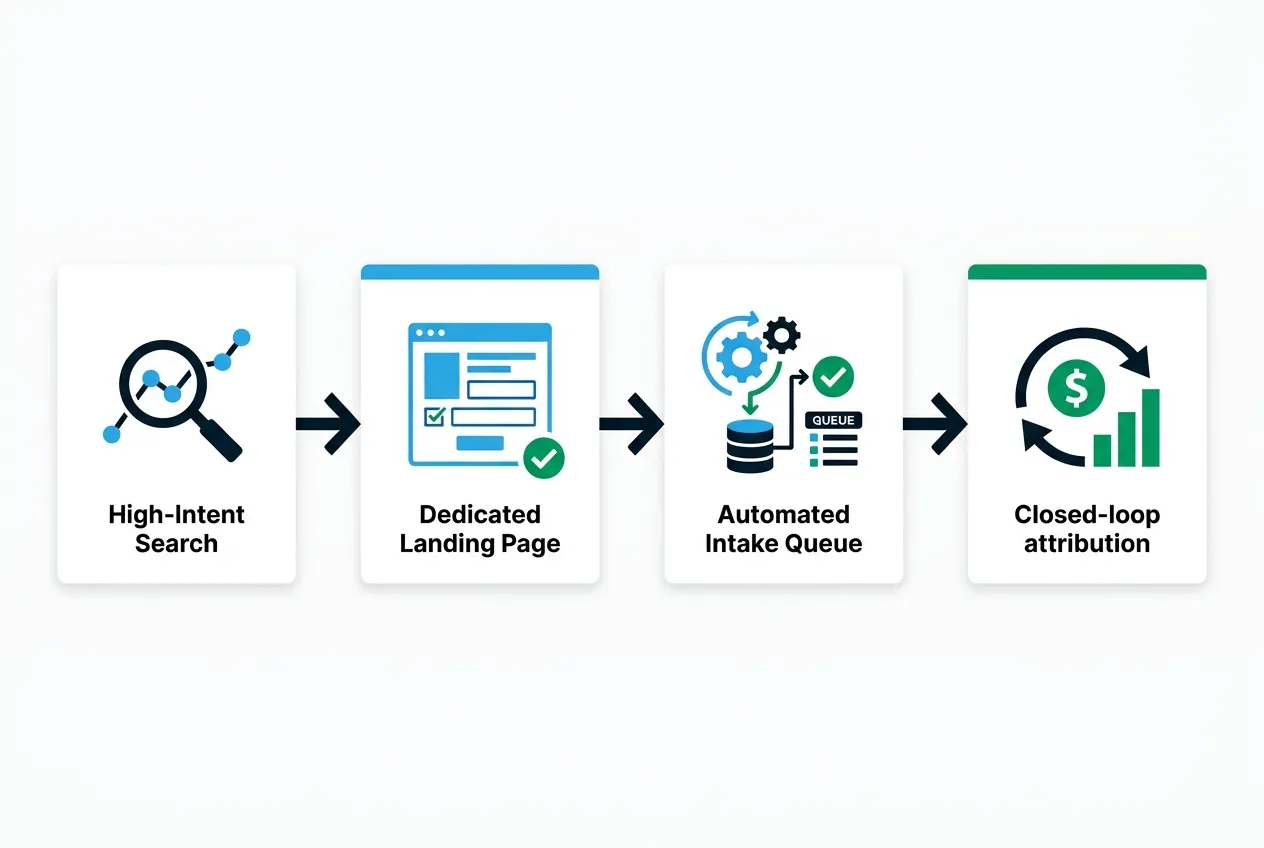
Sustainable law firm marketing requires an integrated operational pipeline rather than an isolated pursuit of web traffic. When legal practices drive high-cost clicks into generic homepages and unmonitored intake desks, marketing budgets drain while case volume stagnates. This guide details how managing partners and growth leaders align search intent, landing page conversion, and CRM automation into a measurable client acquisition system.
By Mike Hulick, Founder, Marketing Powered

Core Pillars of Modern Legal Marketing and Attorney Marketing

What Is Law Firm Marketing in a Performance-Driven Practice?
At an operational level, law firm marketing is the systematic process of identifying, attracting, qualifying, and retaining profitable legal clients. It encompasses every touchpoint where a prospective claimant or corporate client encounters the firm: organic search listings, localized paid search campaigns, practice-area landing pages, automated intake questionnaires, and initial consultation calls.
In a traditional practice, partners often treat marketing as an irregular discretionary expense. A firm redesigns its website every four years, purchases billboard space along commuter corridors, sponsors local civic associations, and waits for referrals. While brand recognition holds value, this unstructured approach creates extreme revenue volatility. It leaves executive committees unable to identify which channels yield valuable cases and which produce administrative overhead.
In contrast, a performance-driven acquisition system views marketing as an accountable commercial engine. Every dollar deployed into advertising media must connect to downstream business metrics. Instead of evaluating campaigns by surface metrics such as impressions, clicks, or raw form submissions, leadership measures cost per qualified consultation and cost per signed retainer.
Consider the physical reality of an active intake department inside a multi-partner personal injury or commercial litigation firm. In the intake room, coordinators sit before multi-screen workstations tracking incoming phone calls, web chats, and form submissions in real time. On one monitor, paid search dashboards display incoming keyword queries; on another, the practice management CRM records timestamps down to the second. When an ad click occurs, the intake coordinator evaluates whether that individual meets specific jurisdictional and statutory criteria before routing the case file to an associate attorney. This operational interface is where marketing performance is decided. If the bridge between the search query, the landing page message, and the intake desk breaks, the advertising capital spent to generate that call is lost.
Treating acquisition as an integrated system changes how partners allocate capital. It shifts the strategic conversation away from aesthetic preferences and focuses attention on unit economics: client lifetime value, matter realization rates, and intake conversion velocity.
Developing a resilient legal marketing foundation requires balancing short-term intent capture with long-term brand equity. High-growth practices build their operational pipeline around distinct, reinforcing disciplines rather than relying on a single channel.
High-Intent Demand Capture vs. Broad Awareness
Many legal marketing initiatives fail because they deploy brand-awareness tactics to solve direct-response problems. Billboards, podcast sponsorships, and display banner ads build general name recognition over years, but they cannot replace the precision of capturing active legal demand.
When an individual or business faces an immediate legal crisis, whether an acute regulatory investigation, a commercial contract dispute, or a catastrophic motor vehicle collision, they do not wait to encounter a brand advertisement. They turn directly to search engines to locate an attorney qualified to resolve their problem immediately. Successful attorney marketing prioritizes capturing this active intent before investing in broad awareness. High-intent capture focuses resources where prospective clients are already evaluating legal representation, ensuring that initial capital outlays produce immediate consultation volume.
Channel Discipline: Search, Local Presence, and Referrals
A mature acquisition pipeline unifies three distinct demand sources:
- Paid Search: Captures acute, immediate demand for competitive practice areas where organic positioning takes time to develop.
- Organic and Local Search: Establishes localized geographic authority across regional courthouses, metropolitan markets, and multi-office footprints.
- Professional Referral Networks: Digitizes and systematizes word-of-mouth recommendations through automated relationship management and co-counsel workflow tracking.
Relying exclusively on referral networks leaves a firm vulnerable to changes in partner relationships or market consolidation. Conversely, relying solely on paid search exposes the practice to rising cost-per-click rates in competitive auctions. Structuring these channels into an integrated framework insulates the firm from platform volatility while maintaining steady case flow.
Treating Marketing Assets as Balance-Sheet Capital
A firm website should not function as a passive digital brochure. Properly constructed landing pages, educational matter analyses, and structured intake systems represent durable business assets. When built on owned infrastructure with clear attribution protocols, these assets compound in enterprise value over time. They lower customer acquisition costs by lifting conversion efficiency across every inbound channel.
Law Firm SEO vs. Paid Search: Capturing High-Intent Demand
Balancing organic and paid acquisition is an operational requirement for managing partner balance sheets. Paid search provides rapid market entry and immediate volume control, while search engine optimization builds durable market dominance that reduces blending acquisition costs over time.
Law Firm SEO and Local Pack Dominance
For consumer-facing practice areas such as personal injury, criminal defense, family law, and estate planning, localized search presence dictates market share. Prospective clients consistently select representation from Google's local map pack, evaluating aggregate client review volume, proximity, and practice-specific relevancy.
Executing effective law firm SEO requires technical rigor:
- Location Architecture: Building dedicated practice-area pages mapped to specific municipal and regional jurisdictions without generating duplicate content.
- Entity and Schema Markup: Implementing structured data that clearly informs search engines of attorney bar admissions, legal specializations, office addresses, and verified client ratings.
- Authoritative Legal Content: Publishing detailed legal resources that address statutory frameworks, court procedures, and filing deadlines rather than thin, generic blog posts.
Organic visibility compounds. A well-indexed practice page that ranks organically for high-intent queries generates qualified consultations month after month without an incremental media cost per click.
Paid Search as an Intent-Capture Engine
While organic authority builds, paid search serves as an immediate mechanism to secure case volume. Legal queries represent some of the most competitive commercial auctions in digital advertising. Bidding on competitive terms without strict targeting parameters results in rapid budget exhaustion.
Controlling paid search economics requires:
- Aggressive Negative Keyword Management: Systematically excluding non-transactional queries such as pro bono inquiries, legal aid forms, statutory definitions, and bar exam study materials.
- Exact-Match Focus: Prioritizing narrow, problem-specific terms over broad match phrases that draw irrelevant consumer searches.
- Direct Landing Page Alignment: Routing paid traffic exclusively to standalone, single-topic conversion environments rather than the firm homepage.
Organic and paid search should not operate as competing silos. Search query data from high-converting paid campaigns should directly inform the firm's editorial roadmap for organic search. Simultaneously, strong organic rankings allow media managers to pull back paid bids on terms where the firm already commands organic dominance, reallocating media spend toward expanding geographic territories.
Free Audit
Want a straight read on where your budget is leaking?
The Intake Gap: Why Landing Page Optimization Governs Acquisition Cost
The primary vulnerability in legal client acquisition is rarely traffic volume. The most common breakdown occurs between the ad click, the landing page experience, and the responsiveness of the intake team. When prospective clients experience friction or delay, client acquisition costs escalate rapidly.
Dedicated Landing Pages vs. Main Website Navigation
Directing paid search traffic to a law firm homepage is one of the most common operational errors in professional services marketing. Standard firm homepages are designed for general browsing. They feature expansive navigation headers, partner biographies, firm news, civic awards, and links to a dozen distinct practice areas.
A consumer seeking immediate representation for an employment dispute or a commercial real estate default does not want to hunt through a menu to find relevant counsel. Dedicated landing pages eliminate this friction. By removing main site navigation and aligning the headline directly with the search query, the page presents a clear value proposition: relevant case experience, clear jurisdictional coverage, verified peer recognition, and a secure consultation intake form.
The architecture of these pages must balance direct response with professional credibility. In our analysis of conversion environments, detailed in our guide to Conversion rate optimization for lead generation: a system, not a list of tests, conversion gains stem from reducing cognitive load and clarifying the prospective client's immediate next step.
Speed to Lead: Why Latency Destroys Marketing Margin
The commercial value of an inbound legal inquiry decays rapidly with every passing minute. When an individual completes a contact form following an adverse incident, they are frequently reaching out to multiple law firms simultaneously.
Consider an intake facility where staff process inbound form fills alongside administrative duties. In a typical workflow, a lead notification sits in a general email inbox. Forty-five minutes elapse before a clerk opens the message, reviews the notes, and dials the telephone number. By the time the call connects, the prospect has already spoken with a competing firm that utilized automated call routing to contact them within two minutes of submission. The initial firm pays the full media cost for the ad click but secures zero return because of internal latency.
Establishing an automated intake architecture closes this operational gap:
- Web Form Submission. Manual Intake Workflow: Notification sits in shared email inbox (average response: 2 to 4 hours). Automated System Architecture: Instant webhook triggers automated SMS acknowledgment and dynamic CRM call queueing (response under 3 minutes). Operational Impact: Prevents prospect from contacting competing regional practices.
- After-Hours Call. Manual Intake Workflow: Generic answering machine directs caller to call back during business hours. Automated System Architecture: Specialized legal answering service with direct API integration to the firm CRM conducts preliminary screening. Operational Impact: Captures acute night and weekend search demand without unbillable partner hours.
- Lead Qualification. Manual Intake Workflow: Attorneys conduct manual screening calls, spending unbillable time on non-viable matters. Automated System Architecture: Form logic dynamically screens for statute of limitations, geographic jurisdiction, and conflict checks. Operational Impact: Protects attorney billable hours while surfacing high-value retainers immediately.
Optimizing intake operations is an indispensable component of conversion rate optimization. Firms evaluating third-party support can review structural criteria in our strategic breakdown of what a conversion rate optimization agency delivers and how to vet one.

Navigating Bar Advertising Compliance and Legal Ethics Rules
Deploying digital conversion strategies requires strict adherence to state ethics guidelines. Unlike general commercial enterprises, law firms operate under rigorous professional conduct standards governing solicitation, representations of expertise, and public communications.
False, Misleading, and Unverifiable Statements
The foundation of legal advertising ethics is codified in the American Bar Association Model Rules of Professional Conduct. Specifically, ABA Model Rule 7.1 establishes that a lawyer shall not make a false or misleading communication about the lawyer or the lawyer’s services. A communication is false or misleading if it contains a material misrepresentation of fact or law, or omits a fact necessary to make the statement considered as a whole not materially misleading.
In practice, this rule impacts digital copy across several areas:
- Case Results and Past Performance: Presenting historical settlements or verdicts without contextual disclaimers can mislead prospective clients into expecting identical outcomes. Most jurisdictions require explicit disclosures stating that past results do not predict future legal resolutions.
- Claims of Specialization: Under Model Rule 7.2, an attorney cannot state or imply that they are certified as a specialist in a particular field of law unless they have been formally certified by an accredited state authority or ABA-accredited organization, and the name of the certifying body is clearly identified. Marketing copy must avoid casual assertions of being an "expert" or "specialist" unless fully certified within that specific state.
- Comparative Statements: Assertions that a firm provides "better," "faster," or "cheaper" legal representation than competing counsel are routinely classified as misleading if they cannot be substantiated with objective factual evidence.
Direct Solicitation and Digital Channels
The boundaries governing direct communication are established under ABA Model Rule 7.3. The rule prohibits an attorney from soliciting professional employment by live person-to-person contact when a significant motive for doing so is the lawyer’s pecuniary gain, unless the target of the solicitation is another lawyer, a family member, or a person with whom the lawyer has a prior professional relationship.
In digital marketing, this impacts automated text messaging, live chat interventions, and direct social messaging. Deploying automated chatbots that simulate live legal consultations or sending unrequested direct messages to individuals involved in recent accidents can trigger severe regulatory sanctions. Digital communication systems must function as inbound response mechanisms initiated by the prospective client rather than unprompted electronic solicitations.
The Requirement for State-Specific Verification
The ABA Model Rules serve as an advisory template; the binding authority rests entirely with individual state supreme courts and their corresponding bar disciplinary committees. Advertising rules vary substantially across state lines.
For instance, jurisdictions such as Florida, New York, and California maintain strict, specialized requirements regarding the pre-filing of advertisements, mandatory font sizes for disclaimers, and restrictions on dramatizations or actor portrayals. A digital campaign structured for a multi-state practice must undergo jurisdiction-by-jurisdiction ethics verification before launch. Marketing teams must never deploy uniform national ad copy without validating compliance against local bar ethics committee mandates.
Law Firm Marketing Systems: How Marketing Powered Builds Infrastructure
Building an enterprise client acquisition system requires technical precision and deep operational experience in regulated markets. Marketing Powered approaches law firm digital marketing not as an exercise in graphic design, but as the engineering of an accountable, closed-loop revenue pipeline.
Our practice builds upon executive experience. Our founder served as a healthcare CMO who directed marketing for a treatment network that expanded from 3 to 24 locations, personally managed $1.5 to $2M per month in Google Ads across 11+ behavioral and mental health accounts, and serves as a court-certified expert witness in advertising strategy. We apply this background in sensitive, highly scrutinized verticals directly to professional legal services.
In regulated verticals like addiction treatment, Google explicitly prohibits retargeting, and marketing operations must strictly respect privacy guidelines. This operational environment requires getting intent capture and first-touch conversion right the first time. We bring that same operational discipline to law firms navigating stringent state bar ethics rules.
When implementing acquisition systems for law firms, our work focuses on four core infrastructure layers:
Conversion Optimization and Dedicated Landing Page Design
We engineer purpose-built conversion environments structured specifically for high-stakes legal inquiries. Instead of using off-the-shelf templates, we design landing pages that emphasize legal credibility, state bar compliance disclaimers, clear fee structures, and immediate contact mechanisms. To evaluate how specialist agencies structure these high-performance environments, review our guide on what a landing page optimization agency delivers and how to vet one.
CRM Integration and Intake Workflow Automation
A landing page form submission is useless if it stalls in an administrative backlog. We design direct API and webhook integrations linking landing pages, call tracking software, and legal practice management systems such as Clio, Lead Docket, or Filevine. Every inbound inquiry instantly triggers conditional intake workflows: automated SMS confirmation, pre-qualification questionnaires, and dynamic routing to on-call intake specialists.
Owned Computing Infrastructure and Data Sovereignty
As an AI-native organization since 2022, Marketing Powered maintains owned, local AI infrastructure for sensitive data inference. For law firms handling confidential client data, prospective matter narratives, and proprietary practice workflows, third-party public cloud APIs introduce operational and ethical concerns. We run inference locally on controlled hardware, ensuring that prospective client communications and internal marketing data remain sovereign and protected.
Email Us
Prefer to send the context directly?
Full-Funnel Attribution: Tracking Marketing Spend to Signed Retainers
The most critical point of failure in legal marketing governance is the attribution blind spot. Most digital marketing agencies provide monthly reports highlighting platform-level metrics: cost per thousand impressions (CPM), click-through rate (CTR), and raw form submissions. These metrics reveal nothing about the financial health of the practice.
Moving Beyond Lead Volume to Matter Qualification
A law firm does not generate revenue from inquiries; it generates revenue from retained matters that settle or bill successfully. An advertising campaign that generates 150 inquiries at $40 each appears successful on an agency dashboard. However, if 145 of those inquiries are outside the firm's jurisdiction, barred by the statute of limitations, or financially non-viable, the firm has spent $6,000 in ad spend while burdening its intake team with unbillable administrative labor.
Conversely, a campaign generating 20 inquiries at $300 each appears expensive on surface metrics. But if five of those inquiries translate into high-value retained cases, the cost per retained matter is drastically lower, and the net realization for the practice is significantly higher.
Attribution tracking must extend down to the matter status:
- Ad Click and Session Tracking: Capturing source campaign, keyword query, and click identifier (GCLID) through first-party tracking scripts.
- Intake Milestone Tracking: Recording initial contact timestamp, screening qualification score, and consultation scheduling.
- Practice Management Integration: Aligning CRM matter status updates (e.g., Conflict Cleared, Retainer Sent, Retainer Signed) with the original acquisition source.
- Offline Conversion Value Postback: Feeding verified retainer milestones back into ad platform bidding engines via Google Ads Offline Conversion Tracking (OCT), training algorithmic bidding models to pursue signed cases rather than casual form fills.
Evaluating Practice Economics: Illustrative Model
To evaluate acquisition efficiency, legal leadership must calculate the complete operational funnel. Consider the following illustrative mathematical model comparing an unstructured marketing approach with an integrated acquisition system:
In this illustrative scenario, media spend remains identical. The difference in unit economics stems entirely from optimizing landing page conversion, accelerating intake response velocity, and screening for qualified intent. The firm adopting an integrated acquisition pipeline scales its client intake by more than fourfold while driving its cost per retained client down by nearly 80 percent.
Questions, Answered.
Law firm marketing is the systematic process of building brand authority, capturing active search demand, qualifying prospective matters, and converting inquiries into signed legal retainers. It integrates paid advertising, search engine optimization, landing page conversion systems, and intake automation while maintaining strict compliance with state bar ethics rules.
The cost to acquire an existing law firm typically ranges from 0.5x to 1.5x annual gross revenues, or 2.0x to 4.0x seller's discretionary earnings (SDE), depending on practice area, transferability of goodwill, and recurring case volume. Practice areas with institutional client relationships or predictable contingency case pipelines command higher valuation multiples, whereas practices dependent entirely on the personal reputation of a retiring founding partner trade at lower valuations.
Most legal PPC campaigns fail because they route high-cost clicks to generic website homepages, fail to maintain negative keyword lists, and allow inbound leads to sit uncontacted for hours. Without dedicated conversion environments and rapid intake workflows, ad budgets are rapidly consumed by unqualified searches and slow response times.
An intake team should contact an online legal inquiry within five minutes of submission. Data across direct-response industries indicates that conversion rates decline sharply after the first five minutes. Implementing automated SMS responses and dynamic CRM call distribution ensures that prospective claimants speak with a firm representative before seeking alternative counsel.
Yes, law firms can utilize artificial intelligence for search intent analysis, landing page personalization, intake call routing, and marketing performance attribution. However, firms must ensure that all systems comply with client confidentiality mandates, do not expose sensitive prospective client information to public large language models, and adhere strictly to state bar rules regarding non-lawyer solicitation and legal advice. Schedule a strategy call with Marketing Powered
Ready to see where your marketing can improve?
Request a free audit of your paid media, landing pages, attribution, and measurement setup. You'll get a straight assessment of where the opportunities are.
or email us at info@marketingpowered.ai