Resources
In-House vs Agency Marketing: A Cost and Control Comparison
Choosing between in house vs agency marketing is often framed as an all-or-nothing trade-off between complete internal control and external variable cost. In reality, commercial leaders navigating complex acquisition funnels face balance-sheet realities, recruitment delays, and technical skill gaps that make this binary misleading. Evaluating true marketing economics requires auditing fully burdened labor, execution velocity, specialized technical capabilities, and first-party data ownership.
By Mike Hulick, Founder, Marketing Powered

In-House vs Agency Marketing: The Executive Operational Dilemma
Executive leadership evaluating customer acquisition faces a structural challenge. An internal marketing department provides dedicated attention, immediate physical presence, and cultural alignment. Corporate leaders can walk down the hall to the marketing bullpen, review creative assets directly with brand managers, and ensure that every public message aligns with internal operational priorities. However, this perceived direct oversight often masks operational friction. When market conditions shift or paid media efficiency declines, internal teams frequently lack the multi-disciplinary technical depth needed to diagnose bottlenecks across the conversion chain.
Conversely, engaging an outside firm introduces external speed, cross-industry testing libraries, and specialized technical execution without adding permanent overhead to the payroll. Yet executives frequently report frustration with conventional agencies that operate as disconnected service bureaus. Traditional agencies often focus on vanity metrics, delivering monthly reports filled with impressions, click-through rates, and unverified form submissions while remaining entirely detached from downstream pipeline velocity, appointment schedules, or closed revenue.
The core question for executive leaders is not whether internal control beats external capability. The real challenge is determining which operational components must remain sovereign inside the organization and which specialized execution engines are better managed by technical partners. In regulated sectors such as healthcare, hospital networks, and specialized professional services, this decision directly influences customer acquisition costs and operational risk.

Total Cost of Ownership: Headcount Versus Marketing Agency Pricing
When assessing marketing agency pricing against building an internal marketing unit, financial models that compare an agency retainer against an employee base salary are fundamentally incomplete. A complete balance sheet analysis requires auditing the fully burdened cost of employment alongside specialized software infrastructure.
Direct salary represents only a portion of the financial commitment required for internal personnel. According to the U.S. Bureau of Labor Statistics Employer Costs for Employee Compensation, employer costs for employee compensation include benefits, mandated insurance, and payroll taxes that average 29 to 31 percent of total compensation costs across the economy. For professional and technical growth roles, recruitment fees typically add 15 to 25 percent of first-year base salary, while administrative overhead, office footprint, hardware provisioning, and management bandwidth compound the total.
Beyond direct personnel expenses, modern conversion optimization and paid media demand an enterprise software stack. A competitive growth team requires session recording software, multivariate split-testing platforms, call-tracking routing engines, server-side attribution infrastructure, and data visualization tools. When purchased individually by an internal department, these software subscriptions routinely cost thousands of dollars per month before a single campaign launches.
Building an internal department capable of managing modern commercial acquisition requires more than one hire. A functional unit requires paid media management, landing page design, conversion copywriting, technical web development, data engineering, and intake integration. Assembling this roster internally multiplies fixed payroll obligations. Marketing agency pricing models, whether structured around fixed retainers, performance milestones, or dedicated technical infrastructure builds, allow organizations to access an entire multi-disciplinary team for less than the fully burdened cost of two senior internal employees.
Operational Velocity and the Hidden Friction of Outsourced Marketing
Execution speed represents a critical commercial asset. When an organization decides to build an internal marketing department from scratch, the calendar works against rapid growth. Sourcing, interviewing, vetting, and hiring a qualified growth marketer regularly takes 60 to 90 days. Onboarding, integrating cross-functional workflows, and provisioning technical environments consume another 30 to 60 days. If an organization must assemble a complete four-person team, six to nine months often elapse before the company deploys its first statistically rigorous landing page test.
Turnover introduces further friction to internal operations. If a key growth engineer or media buyer departs, the entire acquisition engine stalls while leadership restarts the recruitment cycle. This disruption directly impacts revenue velocity, leaving paid media campaigns unmanaged or suboptimal for months.
Outsourced marketing solves the onboarding lag by deploying experienced teams with established operating procedures from day one. An outside partner brings mature testing frameworks, pre-built landing page architectures, and calibrated tracking templates immediately to the account. Rather than spending months determining which testing software to license or how to structure server-side attribution, leadership gains operational momentum instantly.
However, outsourced models present their own risks if mismanaged. An outside agency operating without rigorous service-level agreements can introduce communication friction, bureaucratic ticket queues, and delays in creative approvals. Velocity is only achieved when external partners operate with clear commercial integration, structured weekly sprints, and direct accountability to executive business metrics.
Free Audit
Want a straight read on where your budget is leaking?
Specialization Gaps: Why Generalist Teams Struggle with Conversion Systems
A common failure mode in growing organizations is expecting a generalist internal team to execute advanced conversion rate optimization and technical intake architecture. An internal marketing manager may write compelling brand messaging, coordinate organic social media, and oversee graphic design. Yet expecting that same individual to engineer high-converting multi-step landing pages, write responsive behavioral scripts, configure server-side conversion APIs, and optimize database routing creates a severe operational bottleneck.
Modern digital acquisition requires technical specialization:
- Conversion Engineering: Designing responsive web environments optimized for mobile layout shifts, dynamic typography, and psychological value sequencing.
- Quantitative Experimentation: Structuring statistically valid split tests that isolate single variables, control for sample size anomalies, and avoid false-positive conclusions.
- Restricted Platform Compliance: Operating within strict regulatory frameworks. Under the Google Ads Policy on Personalized Advertising, personalized advertising, remarketing, and retargeting lists are strictly prohibited for sensitive healthcare and medical verticals. In these environments, acquisition engines cannot rely on second-chance retargeting ads; the conversion architecture must capture and qualify user intent on the initial landing session.
- Intake and CRM Integration: Connecting paid traffic directly to call centers, intake desks, or sales pipelines via webhooks, automated call-routing engines, and real-time CRM stage updates.
When generalist internal teams face these advanced requirements, campaigns often stall at surface-level metrics. Budget is spent driving raw traffic to rigid corporate websites that fail to convert visitors into qualified inquiries.
Marketing Powered addresses this technical capability gap directly. We engineer high-converting digital environments, landing page testing frameworks, and automated CRM intake systems that turn paid clicks into verified opportunities. Rather than treating conversion optimization as an isolated design exercise, our approach treats conversion rate optimization for lead generation: a system, not a list of tests. You can review how an external partner builds and validates these conversion frameworks in our guides to evaluating a conversion rate optimization agency: what a specialist partner delivers and how to vet one, as well as vetting a landing page optimization agency: what a specialist partner delivers and how to vet one.

Data Sovereignty and Attribution: Marketing Agency vs In House
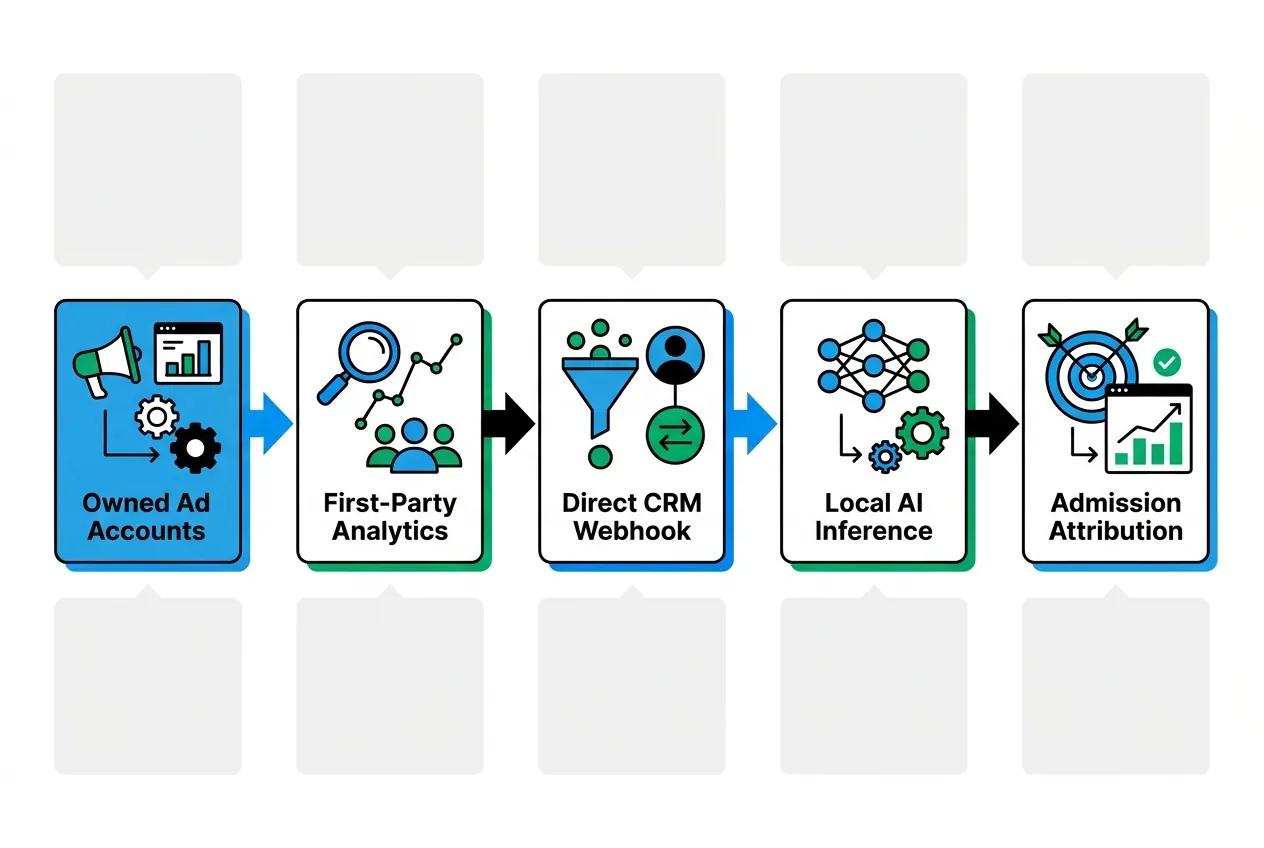
A primary argument for maintaining an internal department is protecting company intelligence. In the marketing agency vs in house debate, data ownership is critical. Historically, conventional marketing agencies maintained control over client assets by deploying proprietary tracking accounts, withholding raw search query logs, and managing advertising portals under agency-owned business managers. When an organization parted ways with such an agency, historical conversion data, campaign structures, and behavioral learnings were frequently lost.
Commercial leaders must enforce strict data sovereignty. Every asset, advertising account, conversion pixel, analytics property, and CRM database must remain the exclusive, owned property of the business.
Organizations operating in sensitive or regulated markets, including healthcare services, hospital networks, and legal practices, face additional regulatory layers under HIPAA and industry data standards. Relying on public, multi-tenant cloud platforms for automated intake processing introduces privacy vulnerabilities. Marketing Powered addresses data governance by operating owned, local AI infrastructure for HIPAA-aware inference. This allows our partners to automate complex intake classification, sentiment analysis, and operational reporting locally without routing private records through public model APIs.
Furthermore, true commercial attribution must connect marketing spend to closed business. In professional services or behavioral health, stopping attribution at a form submission creates false optimization signals. Marketing Powered's founder brings direct executive experience as a former healthcare CMO who ran marketing for a treatment network that grew from 3 to 24 locations, managing $1.5 to $2M per month in Google Ads across 11+ behavioral and mental health accounts, and serving as a court-certified expert witness in advertising strategy. Being AI-native since 2022 and maintaining LegitScript-aware and HIPAA-aware architectures ensures that commercial attribution is tracked through to actual admission or closed contract rather than stopping at an unverified lead.
When to Hire a Marketing Agency: The Hybrid Growth Engine
The modern enterprise does not have to choose between an isolated in-house department and an unmonitored external agency. The most capital-efficient operating model is a structured hybrid framework.
When you hire a marketing agency with specialized technical depth, internal leadership focuses on business strategy, operational capacity, brand stewardship, and customer fulfillment. The external specialist focuses on performance media buying, conversion optimization, intake automation, and attribution engineering. This modular approach preserves internal agility while accessing enterprise-level technical infrastructure.
This hybrid model delivers specific advantages across each commercial phase:
- Capital Allocation Efficiency: Organizations avoid adding $300,000 or more in permanent payroll overhead while deploying mature campaign systems immediately.
- Cross-Industry Innovation: An internal team sees only its own metrics. A specialized partner identifies testing patterns, platform policy shifts, and bidding anomalies across multiple accounts, applying those operational insights directly to your campaigns.
- Downstream Alignment: Rather than insulating internal personnel from commercial realities, the hybrid model binds external execution directly to internal pipeline data.
Questions, Answered.
Review internal capital allocations, technical requirements, and target launch speed. If an organization requires broad daily brand management, internal cultural communications, and immediate on-site creative coordination, an in-house hire is beneficial. If the immediate objective is engineering complex paid media funnels, implementing conversion rate optimization, scaling multi-location customer acquisition, and configuring CRM intake pipelines without adding long-term overhead, contracting a technical specialist partner is significantly more cost-effective.
The primary risks are communication friction, lack of operational transparency, and vanity-metric reporting. Many traditional agencies report platform clicks and raw form submissions while ignoring whether those leads convert into downstream sales or admissions. These risks are mitigated by requiring that all advertising accounts remain company property, implementing server-side attribution, and tying agency performance reviews to qualified pipeline stages rather than top-of-funnel traffic.
Building an internal team requires funding base salaries, 29 to 31 percent in taxes and benefits, recruitment commissions, equipment, and substantial software licensing fees for testing and attribution platforms. A complete internal team can require $300,000 to $500,000 or more in annual overhead. A specialized agency partner provides access to an established team of media buyers, conversion engineers, and data analysts under a structured monthly retainer or project framework, typically lowering overall annual capital expenditure while eliminating recruitment lag.
Conversion rate optimization requires deep cross-disciplinary expertise: quantitative data analysis, behavioral psychology, responsive front-end development, UX design, and statistical testing methodologies. Most internal marketing personnel are generalists hired to manage branding, communications, and product marketing. Expecting a generalist to configure server-side tracking, design isolated multivariate tests, and automate CRM database webhooks creates execution delays and inconclusive split-test results.
Yes. An effective specialist partner builds scalable marketing assets inside your own technology accounts. When an organization establishes clear operational scale and chooses to bring execution in-house, the transition is seamless as long as data sovereignty was protected from day one. The company retains all landing page templates, conversion data, tracking containers, and campaign histories, allowing internal personnel to assume management of an already optimized commercial engine. Schedule a strategy call with Marketing Powered
Ready to see where your marketing can improve?
Request a free audit of your paid media, landing pages, attribution, and measurement setup. You'll get a straight assessment of where the opportunities are.
or email us at info@marketingpowered.ai