Resources
Generative Engine Optimization vs SEO: What Actually Changes
The emergence of conversational answer engines has divided digital marketing into two camps: those declaring traditional search dead, and those assuming organic visibility will continue unchanged. Evaluating generative engine optimization vs SEO reveals that conversational models do not replace underlying web indexes; they synthesize them. Maintaining discoverability across both modalities requires marketing leaders to shift focus from raw keyword counts to verified entity authority, clear data architecture, and full-funnel attribution.
By Mike Hulick, Founder, Marketing Powered

Generative Engine Optimization vs SEO: Core Architectural Differences
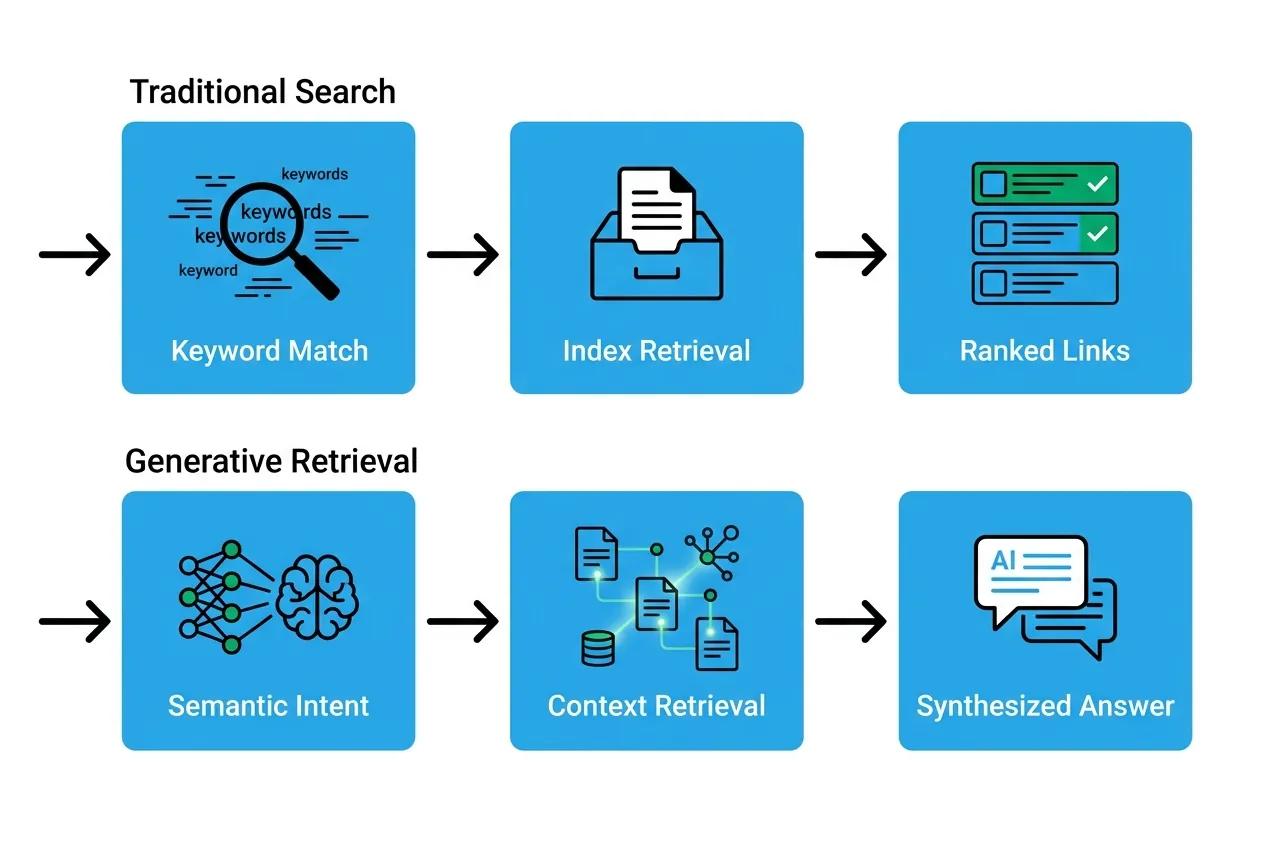
Traditional search engine optimization functions on an established retrieve-and-rank framework. Crawlers index raw web pages, analyze contextual signals such as backlinks and header structures, and present a ranked list of blue links corresponding to user queries. The user performs the synthesis by scanning titles, meta descriptions, and page previews before clicking through to review the source material directly.
Generative engine optimization (GEO) operates on a distinct retrieval-augmented generation framework. When a user submits a natural-language query to a model, the engine does not merely pull a directory of indexed links. Instead, it extracts the semantic intent of the query, executes real-time vector search across retrieved documentation, extracts relevant facts, and compiles a natural-language response. In engines like Google Search, the conversational layer pulls directly from existing index systems to populate conversational summaries, as detailed by Google Search Documentation on AI Overviews.
This structural shift alters how information must be published. In traditional SEO, an engineering firm or hospital group can target fragmented long-tail keywords across separate pages. In generative retrieval, systems evaluate whether your digital footprint provides authoritative, factual consensus across an entire subject domain. If your brand is not recognized as a verified entity with clean, machine-readable facts, retrieval engines omit your content from the synthesized answer entirely.
Will AI Replace SEO or Reshape Organic Discovery?
The question of whether AI will replace SEO misinterprets how generative systems access information. Large language models do not maintain static, self-contained knowledge bases for real-time commercial queries. Models hallucinate when isolated from real-time data, which makes grounding mechanisms mandatory. Generative engines depend continuously on web crawling and semantic indexation to confirm factual data, check operational statuses, and cite live sources.
As documented by Google Search Central, search engines still rely on automated web crawlers to discover, render, and index digital content before any algorithmic scoring occurs. If a site lacks technical crawlability, mobile responsiveness, and clean semantic code, it cannot be indexed. What cannot be indexed cannot be retrieved during generative synthesis.
AI reshapes the distribution of clicks rather than eliminating search discovery. High-level informational queries that once drove vast quantities of non-converting blog traffic are increasingly resolved directly inside the search interface. Users asking basic conceptual questions often find the answer within the synthesized text without visiting an external domain.
However, high-intent transactional and evaluation queries behave differently. When a prospective patient seeks a specialized surgery center, or an enterprise executive evaluates risk management counsel, generative engines serve as preliminary research assistants. The generated response highlights a shortlist of verified organizations and includes link citations for further due diligence. The total volume of top-of-funnel clicks may contract, but the remaining visitors arriving through citations demonstrate higher qualification and clearer purchase intent.
GEO vs SEO: Technical Indexing, Entities, and Crawlability
Understanding GEO vs SEO requires auditing your underlying technical baseline. Traditional SEO often permitted technical debt if a page managed to acquire sufficient inbound link equity. Generative engines are far less forgiving of structural ambiguity.
Language models and retrieval systems evaluate text by mapping entities: distinct, verifiable people, places, organizations, and concepts. When a model digests content, it looks for explicit schema, clear parent-child page hierarchies, and unconflicted factual statements.
To ensure content is interpreted accurately by both search crawlers and AI retrieval models, organizations must prioritize three technical areas:
- Structured Data and JSON-LD Implementation: Explicit schema markup gives retrieval bots unambiguous context. Organizations must implement Organization, MedicalEntity, LocalBusiness, and Service schemas. These data blocks clarify precisely who you are, what licensed personnel you employ, and what regulated services you provide.
- Entity Consistency Across the Digital Footprint: Generative systems cross-reference internal web content against external databases, government registries, press mentions, and verified industry directories. Discrepancies in leadership names, physical addresses, licensing data, or service descriptions undermine the model's confidence score, reducing citation probability.
- Information Density and Semantic Chunking: Generative engines extract discrete sections of text to answer user prompts. Long narrative content packed with conversational fluff dilutes retrieval relevance. Pages structured with distinct subheadings, direct factual definitions, and clear data tables make passage retrieval straightforward for vector search algorithms.
Dismantling classical SEO practices to chase generative visibility is an operational error. Technical crawl efficiency, fast response times, and clear information hierarchy remain the required entry ticket for both classic indexing and modern retrieval-augmented generation.
Free Audit
Want a straight read on where your budget is leaking?
Local SEO vs GEO: What Changes for Multi-Location Operations
For multi-location health systems, treatment providers, and professional services firms, local discoverability represents the core of patient and client acquisition. When analyzing local SEO vs GEO, the operational friction multiplies across regional operating facilities.
Traditional local SEO centers on geographic proximity signals, local pack listings, and individual landing pages built for distinct municipalities. Generative search systems integrate these signals with natural-language sentiment and institutional reputation. When a user asks an AI interface to recommend the most qualified behavioral health clinic or clinical laboratory in a regional market, the model does not simply pull the closest pin on a map. It synthesizes operational attributes, patient sentiment, published physician credentials, and regulatory verifications.
Consider the operational reality of managing regional expansions. In historical operations scaling a behavioral health network from 3 to 24 locations, fragmented local listings routinely compromised digital performance. If facility addresses, clinical directors, or operational accreditations conflict across regional directories, generative engines default to safer, more cohesive competitors.
Local generative discoverability requires centralized governance. Multi-location operators must maintain structured data records across every site, monitor third-party reviews for qualitative themes, and provide explicit answers on local pages regarding accepted insurance, clinical levels of care, and admission workflows.

AI SEO vs Traditional SEO: Attribution and Modern Measurement
The evolution from AI SEO vs traditional SEO forces a long-overdue correction in marketing measurement. For decades, agencies sold clients on vanity metrics: search volume indices, aggregate keyword rankings, and top-of-funnel impression counts. In an environment where conversational models answer surface-level questions directly, tracking raw keyword position on a page is an obsolete measure of business health.
Executive marketing leaders must align their attribution models with actual business velocity. Generative engines distribute authority by citing sources within dynamic, individualized summaries. Two users entering comparable prompts may receive synthesized paragraphs that cite different authoritative references based on conversational context.
- Keyword Rank Position. Generative Engine Reality: Dynamic answers with contextual citations. Executive Focus Metric: Brand Citation Frequency in Synthesized Answers.
- Total Organic Impressions. Generative Engine Reality: Informational queries answered zero-click. Executive Focus Metric: Qualified Referral Visits from AI Citations.
- Aggregate Click-Through Rate. Generative Engine Reality: Lower volume on top-of-funnel informational queries. Executive Focus Metric: Downstream Conversion Rate from High-Intent Visitors.
- Raw Form Submissions. Generative Engine Reality: Superficial leads requiring extensive screening. Executive Focus Metric: Completed Intakes, Consultations, and Admissions.
Modern marketing operations must measure business outcomes rather than isolated interaction points. In Google's sensitive healthcare vertical, where retargeting is not permitted due to strict regulatory and privacy boundaries, relying on superficial lead counts can mask underlying acquisition inefficiencies.
Marketing Powered tracks attribution directly to verified business outcomes, such as clinical admissions and signed commercial agreements, rather than stopping at an initial form submission. When organic discovery is measured by closed revenue and authenticated customer milestones, shifts in search engine interfaces become operational adaptations rather than existential threats.
Deploying Owned AI Systems for Verifiable Search Authority
Winning visibility across modern search landscapes cannot be achieved by flooding the web with automated, commodity AI copy. When marketing departments rely on standard public consumer models, they produce generic content that mirrors the existing statistical consensus. This undifferentiated text fails the editorial standards required by search engines and human buyers alike.
To build durable market authority, organizations must transition from renting third-party tools to operating specialized infrastructure. Marketing Powered is an AI-native firm that builds and deploys specialized AI systems and AI-native marketing operations on owned, local infrastructure. By running local models for HIPAA-aware inference, organizations can process proprietary internal knowledge, clinical research, operational insights, and compliance data without exposing confidential records to public cloud repositories.
Our operational perspective is shaped by hands-on execution. Our founder previously served as a healthcare CMO who managed $1.5 to $2M per month in Google Ads across 11+ behavioral and mental health accounts, scaled a multi-location network from 3 to 24 facilities, and serves as a court-certified expert witness in advertising strategy. That scale taught us that sustainable competitive moats come from proprietary data control and defensible process execution.
Using owned compute infrastructure, we model customer search journeys, audit organizational entity footprints across global indexes, and uncover technical content gaps. Marketing teams can then produce deep, defensible thought leadership anchored in real commercial and clinical experience. This approach provides search crawlers and generative models with the precise, verifiable facts necessary to cite your organization as a definitive market authority.
To examine broader structural shifts across leadership and operational planning, read our strategic guide on AI marketing: what it changes for strategy, teams and budgets. If you are vetting external support, our operational frameworks on AI marketing agency: how to evaluate one beyond the label and Generative engine optimization agency: what a specialist partner delivers and how to vet one provide rigorous criteria for evaluating prospective partners.
Questions, Answered.
No. GEO does not require abandoning your existing digital infrastructure. Generative engines rely on the same fundamental technical protocols as traditional search engines, including crawlability, fast page speeds, and mobile-responsive layouts. The necessary changes involve refining your information architecture: adding structured JSON-LD schema, organizing content around clear entity definitions, and removing thin, duplicate, or unverified copy.
Search engines select citation sources using retrieval-augmented generation. When a model processes a user prompt, it searches its underlying index for authoritative pages that match the semantic intent. It assesses domain trustworthiness, factual consensus across external references, content clarity, and structured entity data. Pages that provide concise, well-documented, and verifiable answers to specific components of the query have the highest probability of being cited as reference links.
No. Generative engine optimization and technical SEO reinforce each other. Improving your site's entity clarity, structured data markup, and informational depth enhances your organic ranking potential on traditional search result pages while simultaneously qualifying your domain for inclusion in generative summaries. The two disciplines share the same core foundation: providing accurate, accessible, and authoritative information to search indexers.
Brand reputation is a primary filtering mechanism for generative models. Unlike traditional search algorithms that historically relied heavily on backlink counts, generative systems evaluate natural-language sentiment, third-party reviews, regulatory filings, and directory consistency. If independent external sources consistently document high service quality, verified professional credentials, and clean compliance records, generative engines are significantly more likely to synthesize your brand as a trusted recommendation. Talk with Marketing Powered about owning your marketing AI stack
Ready to see where your marketing can improve?
Request a free audit of your paid media, landing pages, attribution, and measurement setup. You'll get a straight assessment of where the opportunities are.
or email us at info@marketingpowered.ai