Resources
Landing Page vs Website: When a Dedicated Page Converts Better
Marketing leaders allocating capital across paid channels face an operational decision between routing clicks to an existing corporate website or building standalone conversion environments. Evaluating a landing page vs website is not a debate over visual design preferences, but a functional choice determined by visitor intent, channel friction, and acquisition economics. Understanding how these assets function across specific traffic sources enables leadership teams to eliminate media waste and systematically capture high-value commercial demand.
By Mike Hulick, Founder, Marketing Powered

What Is a Landing Page vs Website? The Structural Difference
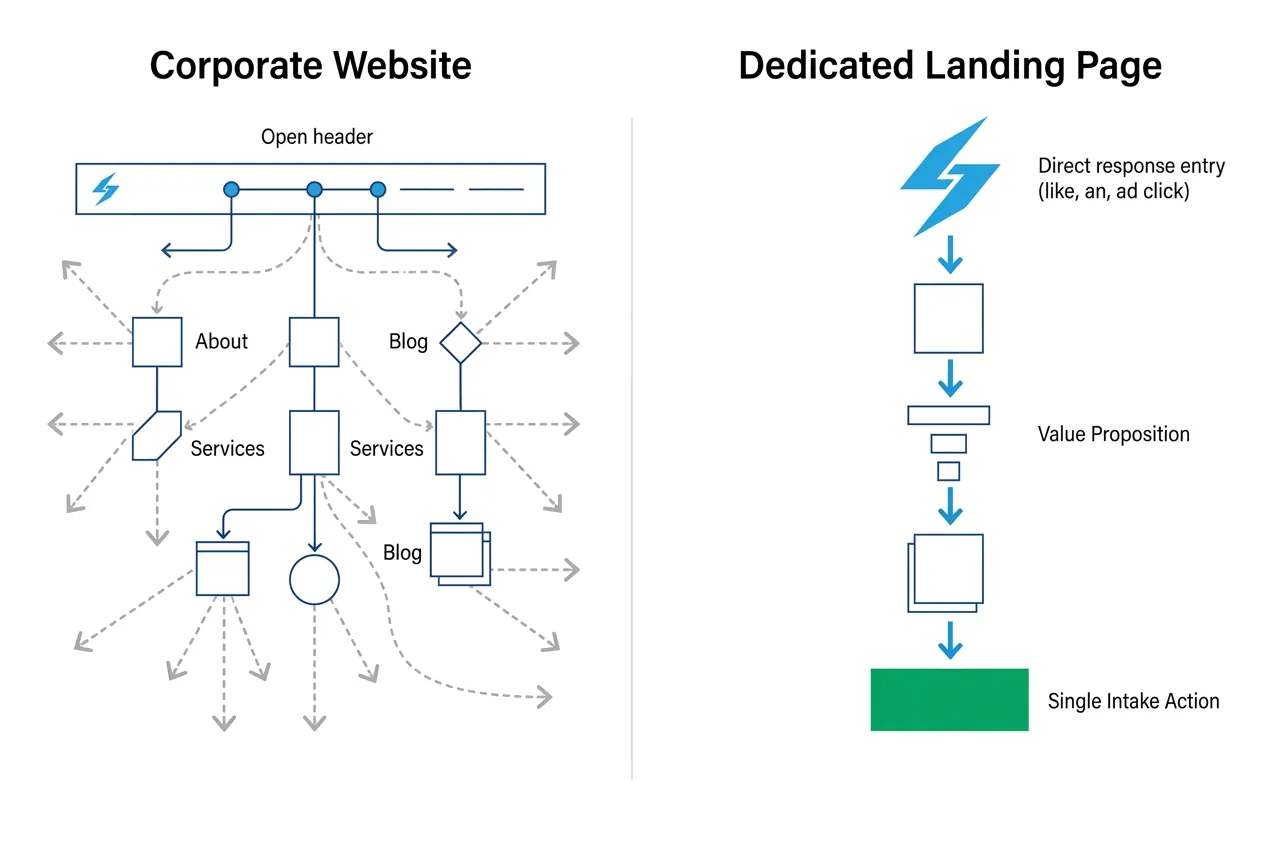
A complete website serves as an organization's digital headquarters. It is engineered for open-ended exploration, multi-stakeholder vetting, search engine indexing, and institutional transparency. A standard corporate website contains global navigation bars, multi-level dropdown menus, utility footers, career listings, press archives, and broad educational resources. These navigational elements invite visitors to wander across multiple URLs, evaluate organizational background, and research related services at their own pace.
What Is a Landing Page?
By contrast, a dedicated landing page is an isolated entry point engineered to accomplish a single business outcome. When an ad click or direct response promotion delivers a user to this page, the environment strips away extraneous choices. There is no top navigation menu, no sidebar directing readers to unrelated company blog posts, and no external footer links to social media accounts. The entire page focuses on one specific value proposition, supporting evidence, and a linear intake action such as scheduling an assessment, requesting a proposal, or calling an operational intake desk.
The structural tension between these formats comes down to choice architecture. A standard corporate web page offers dozens of competing links, encouraging exploratory browsing that often delays decision-making. A dedicated landing page confines the user to a binary decision: complete the defined conversion action or leave the session. When inbound traffic arrives with explicit intent, removing navigational detours increases the probability that the visitor completes the intake sequence.
The Economics of Traffic Routing and Intent Match
Routing paid traffic to a general website frequently inflates customer acquisition costs. When an organization buys paid search or paid social media clicks, it pays for immediate attention directed toward a specific offer. If a prospect clicks an advertisement for a specialized diagnostic service or enterprise consulting package and lands on a generic homepage, that prospect must decipher the primary navigation, identify the correct sub-menu, and locate the relevant intake form. Every additional click introduced between ad impression and inquiry degrades conversion volume.
Intent alignment governs conversion performance. In competitive commercial markets, high-cost clicks require tight message match: the copy, visual hierarchy, and primary call to action on the destination page must mirror the exact search query and ad promise. Dedicated pages maintain this linear narrative without the noise of competing service lines.
This dynamic becomes urgent in highly regulated sectors. In behavioral healthcare and addiction treatment advertising, the Google Ads Personalized Advertising Policy explicitly prohibits remarketing and retargeting lists. Advertisers in these verticals cannot rely on audience recapture campaigns to re-engage prospects who abandon an unstructured corporate website. Because the first interaction is often the only interaction, media viability requires dedicated conversion pages that align search intent with immediate intake paths. Furthermore, healthcare advertisers operating on search networks must hold verified credentials under the Google Ads Healthcare and Medicines Policy. When verification and compliance require substantial investment, routing traffic to general pages that dilute visitor focus directly compromises campaign return on investment.
Understanding Landing Page vs Homepage for Commercial Traffic
A frequent error in performance marketing is treating the corporate homepage as a campaign destination. Evaluating a landing page vs homepage clarifies why homepages consistently underperform on paid search and paid social traffic.
A homepage must satisfy diverse audiences simultaneously. On any given business day, visitors arriving at a homepage include current clients looking for customer support, prospective job candidates reviewing employment benefits, investors examining governance filings, vendors seeking procurement contacts, and evaluators conducting preliminary brand discovery. To accommodate these disparate groups, the homepage distributes visual emphasis across brand statements, secondary links, login buttons, and press releases.
Directing paid commercial traffic into this multi-directional environment forces qualified buyers to navigate past irrelevant organizational announcements. A dedicated landing page, conversely, addresses a single segment with a tailored argument. It matches the commercial query, validates the organization's qualifications for that narrow scope, presents transparent proof points, and directs the visitor to an optimized contact method. Homepages organize organizations; dedicated landing pages organize decisions.
Free Audit
Want a straight read on where your budget is leaking?
When Your Main Website Is the Right Destination
While dedicated pages excel at capturing focused direct response demand, replacing an entire digital presence with isolated campaign pages creates severe operational vulnerabilities. The primary website remains an indispensable commercial asset across several distinct buying contexts.
First, comprehensive corporate websites are required for organic search engine optimization. Organic discovery depends on technical site architecture, content depth, topical authority clusters, and authoritative internal linking. Search engine crawlers require interconnected domain structures to understand service relationships and index long-tail informational assets that capture early-stage research queries.
Second, multi-stakeholder B2B and institutional decisions require broad corporate verification. When enterprise committees evaluate large-scale partnerships, hospital affiliations, or long-term vendor agreements, individual stakeholders conduct varied diligence tracks:
- Procurement officers review security standards, corporate stability, and vendor compliance disclosures.
- Technical leaders inspect service architectures, data privacy frameworks, and integration documentation.
- Executive decision-makers evaluate leadership credentials, clinical leadership backgrounds, and physical facility locations.
These evaluation teams require the open navigation of a structured corporate domain. Routing an enterprise committee member to a closed-loop landing page that conceals organizational governance can erode institutional credibility. For late-stage vetting, navigational brand searches, and organic discovery, the main website provides the necessary depth. Strategic marketing systems deploy both assets: a robust corporate website establishes institutional authority, while dedicated landing pages harvest targeted commercial traffic.

Practical Landing Page Examples Across Regulated Industries
Examining concrete landing page examples highlights how focused pages outperform broad site templates in complex operating environments.
Consider an outpatient orthopedic surgical clinic running paid search campaigns targeting private-pay joint replacement procedures.
- Website Route: The clinic directs ad clicks to its general orthopedic department page. The visitor sees a sprawling layout featuring general hospital news, parking directions, a general patient portal login, physical therapy hours, and a broad listing of twenty different physicians. Locating the surgical intake team requires scrolling past unrelated clinical updates, resulting in high bounce rates and lost patient inquiries.
- Dedicated Landing Page Route: The clinic routes identical ad traffic to a dedicated procedural page. The top fold features a clear headline confirming specialized robotic joint replacement, direct credential markers for the lead orthopedic surgeons, a transparent explanation of the intake process, and two prominent contact choices: a confidential digital consultation form and a direct telephone number connecting straight to the surgical intake coordinator. The page contains zero external navigation links. Prospective patients receive direct answers to their specific medical inquiry and an immediate path to schedule an initial consultation.
A similar contrast appears in regional commercial accounting and audit practices. When targeting enterprise controllers searching for specialized regulatory compliance audits, sending traffic to a broad firm homepage forces the prospect to filter through personal wealth management, tax preparation, and general blog archives. A dedicated audit services landing page immediately presents industry accreditations, partner lead times, engagement scope parameters, and an intake form requesting project specifications. In both cases, the dedicated page converts higher because it respects the visitor's time and directly answers their immediate operational requirements.
Core Landing Page Design Principles That Protect Conversion Value
Engineering an effective conversion environment requires discipline rather than decorative design. High-converting landing page design adheres to several strict operational standards:
1. Navigational Containment
Remove primary header navigation, sidebars, and outbound footer links. Every outbound link that directs users to external social media platforms or tangential articles creates an unmonitored exit path that drains campaign efficiency.
2. Immediate Proposition Clarity
Within five seconds of page render, the visitor must understand:
- The exact service or solution offered.
- Who the organization serves and under what operational parameters.
- The precise action required to initiate the relationship.
3. Integrated Telephony and Friction-Free Forms
High-intent commercial prospects often prefer immediate verbal communication over form submissions, particularly in crisis-driven or time-sensitive verticals. Dedicated pages must integrate dynamic call tracking numbers alongside concise digital intake forms. Phone numbers should be click-to-call on mobile interfaces and clearly positioned above the fold on desktop layouts.
4. Visible Credibility and Compliance Badges
Conversion is an exercise in risk mitigation. Pages must feature defensible proof markers directly adjacent to intake fields. In healthcare, this includes relevant state licensure, LegitScript certification badges where required by ad platforms, accreditation seals, and clear data confidentiality statements. In professional services, display verified partner certifications, professional memberships, and transparent engagement criteria.

Email Us
Prefer to send the context directly?
How Marketing Powered Delivers Integrated Landing Pages and Intake Systems
Marketing Powered engineers dedicated conversion architecture as an operational bridge between paid media acquisition and bottom-line revenue. Rather than treating conversion pages as isolated graphic design projects, we construct end-to-end systems that align ad targeting, page messaging, and downstream data capture.
Our background is rooted in large-scale operational realities. Our founder previously served as a healthcare CMO directing marketing operations for a treatment network that expanded from 3 to 24 physical locations. In high-stakes environments, our founder managed $1.5 to $2M per month in Google Ads across 11+ behavioral and mental health accounts, while also serving as a court-certified expert witness in advertising strategy. These operational contexts demand rigorous conversion architecture: when advertising rules prohibit audience remarketing, first-touch conversion design determines the financial viability of the entire acquisition program.
Our methodology connects paid search and paid social campaigns directly to custom, high-velocity landing environments. We implement owned, local AI infrastructure for HIPAA-aware inference, ensuring patient data integrity while utilizing intelligent conversion systems. We deploy multi-variant testing engines that evaluate message match, value propositions, and form friction against validated business outcomes. Most importantly, we reject surface-level vanity metrics. Marketing Powered links call tracking, form submissions, and CRM intake automation directly to verified business outcomes, tracking attribution to actual admission or closed contract rather than stopping at an initial form submission.
Organizations evaluating their acquisition infrastructure can examine our specialized services in conversion optimization, landing pages, and intake automation to see how joined-up attribution and custom landing architecture protect marketing capital.
Questions, Answered.
No. While a standalone landing page can validate a single service line or support early-stage direct sales, an established business requires an authoritative website. A main website is essential for technical search engine optimization, publishing in-depth thought leadership, supporting multi-stakeholder B2B diligence, providing public regulatory disclosures, and handling operational customer communications such as support and careers.
Dedicated landing pages convert higher on Google Ads because they enforce complete alignment between the user's specific search query, the ad copy promise, and the destination page content. By removing global navigation menus and competing internal links, dedicated pages eliminate cognitive friction and guide the visitor directly into a single, structured intake or contact path.
Not when implemented correctly. Campaign-specific landing pages are typically designated with a noindex tag or configured with proper canonical tags pointing back to primary informational assets. This prevents search engines from penalizing the domain for duplicate content, while allowing paid media teams to test aggressive headlines and layout variations without disrupting the corporate site's organic architecture.
A homepage is a multi-purpose organizational directory designed to introduce a brand, provide navigation to diverse site sections, and accommodate multiple audience segments ranging from investors to job seekers. A landing page is a single-purpose conversion environment designed for a specific audience segment, stripped of navigation, and focused exclusively on completing one measurable commercial action.
Paid traffic should only be routed to a main website when the campaign objective is broad brand awareness, when targeting navigational searches where users already know the brand name, or when promoting a complex service that strictly requires multi-page technical exploration prior to initial inquiry. In nearly all direct response, paid search, and paid social campaigns, dedicated landing pages deliver superior cost-per-acquisition efficiency. Schedule a strategy call with Marketing Powered
Ready to see where your marketing can improve?
Request a free audit of your paid media, landing pages, attribution, and measurement setup. You'll get a straight assessment of where the opportunities are.
or email us at info@marketingpowered.ai