Resources
Hospital Marketing: How to Grow Service Lines Without Wasting Budget
Hospital marketing is caught between aggressive service-line growth targets and strict operational constraints. When health systems distribute acquisition budgets evenly across competing clinical departments, high-margin programs stall while media dollars subsidize services facing two-month appointment backlogs. Growing service lines efficiently requires aligning paid media directly with clinical capacity, local patient search intent, and privacy-compliant intake infrastructure.
By Mike Hulick, Founder, Marketing Powered

Aligning Service-Line Budgets with Clinical Capacity and Economics

What Is Hospital Marketing in a Modern Health System?
Hospital marketing is the disciplined management of patient demand, provider capacity, and brand reputation across inpatient facilities, outpatient clinics, and specialized clinical service lines. Unlike traditional consumer packaged goods advertising, it does not exist to manufacture impulse transactions. Its primary operational function is matching prospective patients experiencing acute or elective medical needs with the appropriate care setting, specialist, and facility location at the exact moment care is sought.
In a modern health system, hospital marketing spans several operational domains:
- Localized search engine visibility for emergency, urgent, and primary care access points.
- Condition-specific patient acquisition for specialized service lines such as orthopedics, cardiology, oncology, and neurosciences.
- Physician directory management and clinical credential distribution across regional networks.
- Intake optimization, ensuring inbound calls and digital appointment requests translate into scheduled, attended clinical encounters.
- Brand governance and regulatory compliance across hospital campuses, ambulatory surgical centers, and diagnostic facilities.
Historically, health-system executives evaluated marketing through broad institutional awareness metrics: billboard impressions, local sports sponsorships, regional magazine spreads, and general website pageviews. While broad visibility provides baseline community awareness, it fails to solve the commercial pressures facing hospital finance committees. When community members search for specialized surgical procedures or immediate joint replacements, institutional affinity rarely overrides proximity, insurance participation, and appointment availability.
Modern hospital marketing operates as a demand allocation engine. It replaces passive public relations with measurable digital systems that route qualified inquiries directly into open provider scheduling templates.
Defining Modern Hospital Marketing Strategy
A defensible hospital marketing strategy treats marketing capital as an operational asset deployed to maximize clinical throughput. Instead of viewing marketing as an overhead expense distributed by corporate fiat, progressive healthcare systems treat acquisition budgets as dynamic capital that moves based on contribution margins, physician recruitment milestones, and unused facility capacity.
This approach requires marketing leadership to dismantle the historical wall between clinical operations and digital media. A service line cannot run effective customer acquisition campaigns in isolation from the clinical roster. If an orthopedic institute recruits two new total joint replacement surgeons, the marketing department must actively coordinate with practice managers to project ramp-up schedules, calculate local surgical suite utilization, and build geo-targeted digital funnels months before those physicians arrive.
Why Traditional Brand Campaigns Fail Multi-Facility Networks
Traditional institutional awareness campaigns assume that if a health system establishes general community goodwill, patient volume will organically distribute itself across every department. In practice, generic brand campaigns create two major failures across multi-facility networks:
First, brand campaigns direct volume to points of maximum congestion. A statewide television ad promoting comprehensive cardiac care often drives patient inquiries to the flagship tertiary hospital where wait times already exceed acceptable clinical thresholds. Meanwhile, newly opened suburban diagnostic clinics and regional cardiac rehabilitation facilities remain underutilized.
Second, brand campaigns produce unmeasurable patient volume. Board members and chief financial officers increasingly demand verifiable return on investment. A campaign measured solely by estimated impressions or unvalidated website visits cannot demonstrate whether media spend contributed to diagnostic imaging revenue, surgical encounters, or downstream ancillary service usage. Sustainable growth requires moving away from undifferentiated brand spending toward targeted service-line acquisition.
The most frequent source of wasted hospital marketing expenditure is the political allocation of budgets, commonly referred to as peanut-butter budgeting. Under this pattern, executive leadership divides annual marketing funds equally or historically across departments. Every clinical division receives an arbitrary allocation regardless of provider availability, commercial payer mix, or contribution margin.
Deploying digital ad spend to promote a service line that has an eight-week backlog for initial consultations produces immediate financial waste. Prospective patients seeking orthopedic care or pain management will not wait two months for an evaluation. When confronted with extended wait times, high-intent patients abandon the health system and book with competing regional providers or independent ambulatory surgical centers. Marketing budgets spent generating calls that the front desk cannot schedule within five to seven business days do not generate patient volume; they fund patient frustration and subsidize competitor research.
Auditing Clinical Bottlenecks Before Allocating Media
Before a single dollar of media spend is assigned to any service line, marketing teams must audit the clinical workflow and intake capacity of the target program. This operational audit evaluates four distinct capacity indicators:
- Provider Template Availability: How many third-next-available appointments exist across the next fourteen days for participating physicians? If template utilization exceeds 85 percent, paid acquisition should be paused or redirected to specific sub-specialties or alternative facility locations.
- Call Center Routing and Abandonment Rates: What percentage of inbound patient acquisition calls drop before reaching a scheduling coordinator? Health systems frequently maintain call abandonment rates above 15 percent, meaning one out of every seven acquired prospects hangs up before speaking to a scheduler.
- Commercial Insurance Alignment: Does the clinical program hold active, in-network contracts with the dominant commercial payers in the target geographic area? Deploying acquisition media without payer alignment leads to high conversion friction and denied authorizations.
- Ancillary Diagnostic Capacity: Does the hospital have sufficient downstream magnetic resonance imaging, computed tomography, and surgical suite capacity to support the patient volume generated by outpatient consultations?
When marketing teams evaluate these indicators alongside practice managers, they discover where ad dollars can generate immediate encounters without running into systemic operational walls.
Prioritizing High-Contribution Service Lines
Not all hospital admissions or outpatient procedures generate identical financial value for a health system. Community health mandates require hospitals to maintain essential, lower-margin clinical services, but marketing investments must prioritize high-contribution service lines to remain financially viable.
Orthopedics, cardiovascular surgery, neurosciences, bariatrics, and oncology represent service lines with substantial downstream financial impact. A single patient entering an integrated health network for total knee replacement generates revenue across orthopedic consultation, pre-operative cardiac clearance, imaging, ambulatory surgery, post-operative physical therapy, and durable medical equipment.
By modeling downstream lifetime clinical value and commercial contribution margins, marketing leadership can establish defensible maximum acquisition costs for specific procedures. This economic clarity prevents premature campaign shutdowns based on raw cost-per-click metrics and focuses executive attention on actual net margin contribution per completed surgical case.
Constructing an Accountable Hospital Marketing Plan
An effective hospital marketing plan translates high-level clinical volume targets into a tactical operational roadmap. Rather than relying on sporadic campaign bursts, an accountable plan establishes persistent, localized demand capture across every geographic market where the health system operates physical facilities.
To succeed across multi-facility networks, the marketing plan must coordinate localized search architecture, digital media execution, and conversion infrastructure around verified patient intent.
Geo-Targeting and Local Search Dominance for Facility Networks
Healthcare decision-making is hyper-local. Patients routinely travel extensive distances for rare oncology treatments or advanced organ transplantation, but for elective outpatient procedures, diagnostic imaging, and urgent care, travel thresholds are tightly constrained by convenience and drive time.
Health systems must build an infrastructure that dominates localized organic search and map listings across every physical touchpoint:
- Facility-Level Google Business Profiles: Every hospital campus, emergency room, ambulatory surgical center, urgent care clinic, and outpatient imaging facility requires a verified, actively managed profile. Primary categories, operating hours, and emergency access notes must remain synchronized across directories.
- Individual Provider Directories: Employed medical group physicians must have dedicated local profiles linked directly to their primary practice location and their hospital system profile. Standardizing National Provider Identifier (NPI) records, clinical specialties, and accepted insurance plans across provider directories ensures accurate indexing.
- Localized Schema Markup: Landing pages must deploy MedicalClinic, Physician, and Hospital structured data. This markup gives search engines direct machine-readable confirmation of service offerings, physical addresses, accepted insurance networks, and booking endpoints.
- Precise Radius and Drive-Time Geofencing: Digital media campaigns should not target generic television markets or broad metropolitan areas. High-performing campaigns use drive-time polygons centered around facility locations, reflecting actual commuter corridors and regional patient migration habits.
Developing High-Converting Service-Line Landing Pages
Many hospital marketing initiatives drive paid media traffic directly to institutional department pages hosted on the main hospital website. These legacy pages typically suffer from navigation clutter: top-level headers containing hundreds of internal links, donor appeals, news releases, cafeteria menus, and physician research portals. High-intent prospective patients arriving from search engines are immediately overwhelmed by non-relevant options and exit without converting.
Dedicated, service-line acquisition pages must strip away institutional distractions and focus strictly on facilitating patient care:
- Transparent Insurance Guidance: Clear, filterable displays of accepted commercial, Medicare, and regional insurance plans. Uncertainty around coverage is the primary cause of landing page drop-off in elective healthcare.
- Provider Credentials and Clinical Focus: Clear profiles of the attending surgeons or specialists, highlighting board certifications, clinical interests, and hospital privileges.
- Clear Action Hierarchy: Prominent, persistent pathways to either book an appointment online or call a dedicated clinical scheduling line.
- Contextual Patient Proof and Quality Indicators: Third-party safety accreditations, clinical volume statistics, and relevant specialty distinctions, positioned near conversion points.
- Accessibility and Mobile Optimization: Full compliance with Section 508 and Web Content Accessibility Guidelines (WCAG) standards, ensuring rapid page loading and effortless mobile interaction for patients seeking urgent consultations.
Free Audit
Want a straight read on where your budget is leaking?
Navigating Hospital Advertising and Regulatory Constraints
Executing hospital advertising requires managing a highly complex regulatory landscape. Hospital marketing teams operate under strict federal rules governing patient privacy, condition-specific advertising policies, and strict compliance boundaries that consumer brands never encounter.
Failure to understand these boundaries leads to wasted advertising budgets, campaign suspensions, and severe legal liability.
Surviving Ad Restrictions in Healthcare Verticals
Major advertising platforms enforce strict policies on healthcare promotions to prevent discriminatory targeting and protect user privacy.
On Google Ads, healthcare advertisers face strict prohibitions on personalized advertising. According to the Google Ads Healthcare and Medicines Policy, advertisers are strictly prohibited from using personalized targeting, including remarketing lists, customer match, and interest-based audience categories, to target individuals based on their personal health conditions, clinical treatments, or prescription medication history.
This restriction completely reshapes hospital digital marketing strategies. In traditional consumer ecommerce, brands rely on retargeting pixels to repeatedly pursue users who visited a product page but did not purchase. In hospital advertising, retargeting an individual who researched cardiology, mental health, or oncology treatments is prohibited.
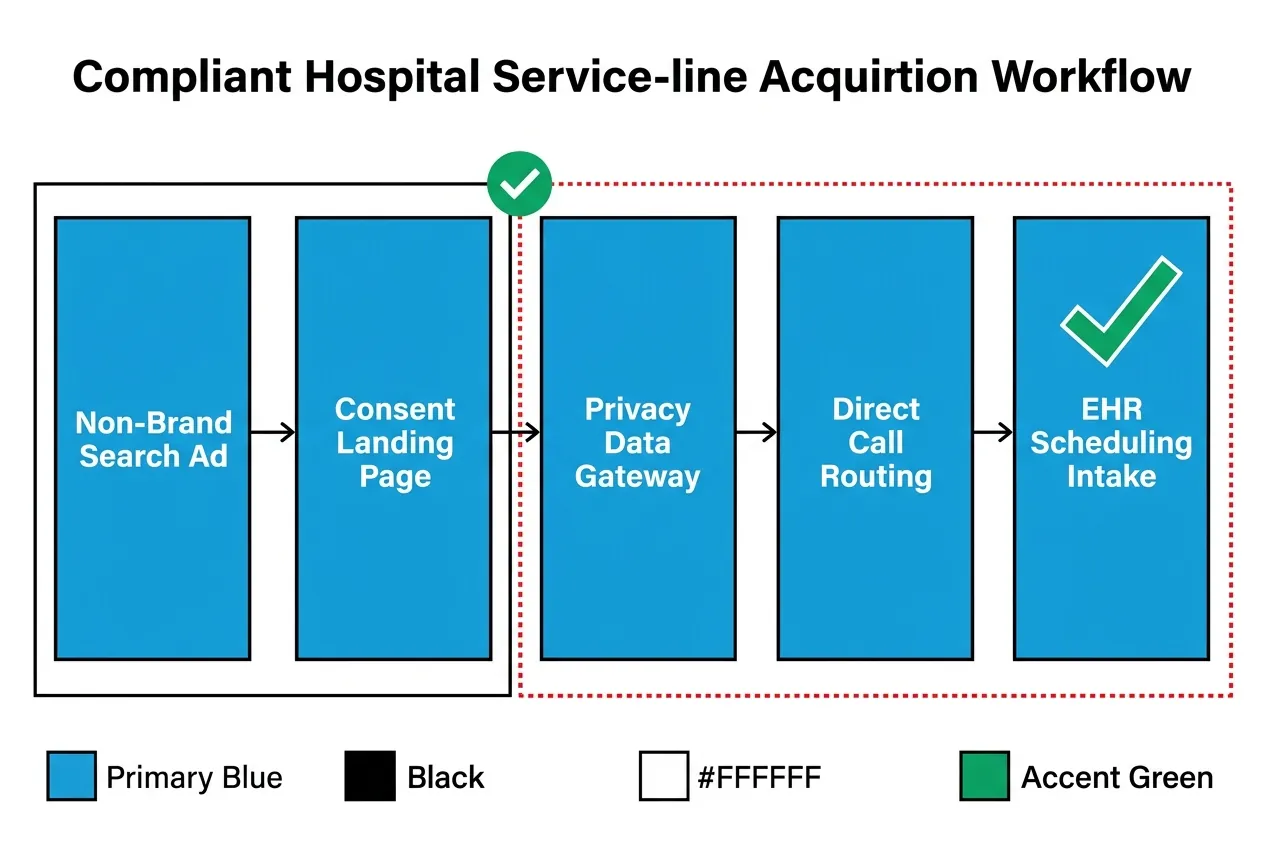
Because health systems cannot rely on retargeting as a secondary safety net, paid media must capture and convert intent on the very first touchpoint:
- Capture Exact Intent on Search: Allocate budget toward high-intent non-brand search queries (for example, "minimally invasive hip replacement near me" or "pediatric emergency room open now") rather than broad display or video prospecting.
- Strict Negative Keyword Hygiene: Aggressively eliminate informational, academic, and non-commercial searches (such as "orthopedic fellowship requirements," "nursing salaries," or "free medical research papers") to ensure ad spend is consumed exclusively by prospective patients seeking active treatment.
- Continuous Ad Copy Alignment: Ensure ad copy directly reflects the clinical specialization, accepted insurance parameters, and immediate availability highlighted on the destination landing page.
Privacy-Safe Measurement Under Federal Tracking Guidance
The historical practice of installing third-party tracking pixels (such as standard Meta, Google, or programmatic ad pixels) directly on hospital websites has exposed health systems across the country to immense regulatory scrutiny and civil litigation.
According to the HHS Office for Civil Rights Guidance on Online Tracking Technologies, covered entities under HIPAA cannot utilize tracking technologies that disclose protected health information (PHI) to third-party tracking vendors for marketing purposes without prior individual authorization or an executed Business Associate Agreement (BAA). Disclosing an individual's IP address, device identifier, or geographic location in conjunction with web pages addressing specific medical conditions or appointment scheduling workflows can constitute an unauthorized disclosure of PHI.
To navigate this enforcement landscape without losing conversion visibility, hospital marketing teams must modernize their measurement architecture:
- Server-Side Tracking and Event Filtering: Remove client-side advertising pixels from patient-facing digital properties. Replace them with secure, server-side data routing environments that intercept, sanitize, and de-identify web engagement data before any analytical signals are transmitted to advertising networks.
- BAA-Covered Analytics: Deploy web analytics and conversion infrastructure backed by signed Business Associate Agreements with vendors willing to accept HIPAA obligations.
- Privacy-Preserving Conversion Modeling: Rely on consent-based attribution models and aggregate conversion APIs that track media efficiency without transmitting sensitive patient identifiers or clinical categories.
Overcoming Internal Governance, Medical Review, and Committee Friction
Digital marketing velocity in health systems often stalls because of internal governance. A campaign concept developed to capture seasonal sports medicine injuries or promote a newly installed surgical robot frequently spends twelve to sixteen weeks winding through multi-disciplinary committees.
By the time marketing materials pass compliance, legal, service-line administrators, and physician advisory boards, the market window has closed. Competitors have captured local market share, consumer search patterns have shifted, and paid search ad groups remain frozen with outdated copy.
Hospital marketing leaders must replace slow, manual committee approvals with scalable governance frameworks.
Establishing Pre-Approved Clinical Messaging Frameworks
Physician committees and compliance officers demand oversight because they fear inaccurate clinical claims, misleading outcome statements, or regulatory non-compliance. Marketing departments can alleviate these concerns by shifting from individual asset reviews to comprehensive messaging frameworks.
Instead of submitting individual search ads or social graphics for approval one at a time, marketing teams should develop a standardized clinical messaging playbook for each service line:
- Pre-Approved Clinical Copy Blocks: Assemble a library of cleared statements detailing surgical techniques, diagnostic capabilities, fellowship credentials, and board certifications.
- Defined Outcome Boundaries: Establish explicit ground rules regarding clinical representations. Prohibit comparative statements that cannot be substantiated (such as "the best heart surgeons in the state") and replace them with objective, verifiable credentials (such as "accredited chest pain center" or "over 1,200 robotic procedures completed").
- Modular Ad Formats: Gain blanket approval for standardized search ad templates and call-to-action variants across service lines.
When a media manager needs to launch a new responsive search ad or test an ad copy variant, they select pre-approved elements from the cleared playbook without triggering a new, multi-week committee cycle.
Creating Service-Level Agreements with Legal and Compliance
Marketing leadership must treat internal review stakeholders as operational partners by establishing clear Service-Level Agreements (SLAs) for campaign reviews:
- Explicit Turnaround Windows: Establish a formal agreement that clinical and legal reviews will be completed within five business days of submission.
- Single-Point Consensus: Mandate that the service-line medical director serves as the final authority on clinical accuracy, preventing endless contradictory revisions from multiple physician reviewers.
- Materiality Thresholds: Define what constitutes a material change. Minor technical adjustments, such as modifying keyword bidding parameters, restructuring URL tracking parameters, or altering button background colors for ADA contrast compliance, should proceed automatically without legal re-examination.
Closing the Intake Gap: Turning Search Demand into Confirmed Encounters
A patient acquisition funnel does not terminate when a prospective patient clicks an ad, visits a landing page, or submits an appointment inquiry. In hospital systems, the vast majority of media spend is lost not on digital platforms, but during the transition from digital intent to front-desk scheduling.
Health systems routinely spend hundreds of dollars generating an inbound patient inquiry only to lose the patient due to broken intake processes.
Call Center Audits and Scheduling Friction Points
Inbound phone calls remain the dominant conversion channel for complex medical procedures and acute service lines. Prospective patients dealing with severe joint pain, suspicious oncology screenings, or worsening cardiac symptoms prefer speaking with a live coordinator rather than navigating web forms.
When health systems audit their call centers, they frequently discover catastrophic conversion bottlenecks:
- Long Hold Times and High Abandonment: Inbound callers forced to navigate multi-tier automated phone trees routinely abandon the call within three minutes.
- After-Hours Inquiries Sent to Voicemail: Patient search volume peaks during evening and weekend hours when individuals are home from work. Routing after-hours inquiries to general answering services or voicemails results in immediate patient leakage, as callers contact alternative clinics the following morning.
- Untrained Scheduling Staff: Call center agents often operate without basic clinical intake routing guides. When a coordinator cannot quickly identify which physician treats a specific condition, they place the caller on extended hold or transfer them to an incorrect clinic, prompting the caller to disconnect.
- Siloed Scheduling Technology: Call coordinators who lack direct visibility into provider scheduling templates across regional clinics are forced to take written messages and promise callbacks. Each manual callback step reduces appointment conversion by more than 50 percent.
Hospital marketing teams must partner with intake leadership to implement call recording analysis, live whisper coaching, dedicated marketing phone queues, and automated intake workflows that route callers directly to knowledgeable schedulers.
Moving Beyond CPL to Cost Per Completed Patient Appointment
Health-system marketing departments have historically reported performance using vanity metrics: impressions, clicks, click-through rates, and cost per lead (CPL). A CPL figure calculated solely from unvalidated web form fills or three-second phone calls provides no insight into financial return.
A three-hundred-dollar inquiry that cancels before their consultation or fails to qualify under commercial insurance contributes nothing to service-line solvency. Sustainable growth requires tracking attribution through to clinical admission and completed patient encounters:
- Integrating Intake Data with Media Systems: Connecting call tracking metrics and scheduling software directly to ad management platforms via secure, privacy-compliant server-side protocols.
- Tracking Through the Clinical Funnel: Measuring performance at four distinct milestones: Initial Qualified Inbound Inquiry, Scheduled Appointment, Attended Encounter, and Downstream Procedure Revenue.
- Calculating Cost Per Completed Encounter (CPCE): By evaluating campaigns against attended encounters rather than gross form fills, marketing managers quickly identify which search terms, geographic radiuses, and creative assets drive patients who actually receive care.
This level of attribution transforms the marketing department from a perceived cost center into an accountable driver of health-system growth. To understand how these disciplines operate at an organizational scale, explore our comprehensive framework in [Healthcare marketing: the operating guide for health systems and provider groups].

Email Us
Prefer to send the context directly?
How Marketing Powered Builds Accountable Hospital Marketing Programs
Marketing Powered provides operator-led marketing strategy, high-intent paid media management, local search optimization, and attribution systems built specifically for hospitals, health systems, and complex healthcare networks.
We do not approach healthcare as a generic consumer vertical. Our operational leadership brings extensive, real-world executive experience managing multi-facility growth:
- Built on Executive Healthcare Experience: Our approach is guided by a former healthcare chief marketing officer who ran marketing operations for an expanding clinical treatment network that scaled from 3 to 24 locations.
- Substantial Media Management History: Our founder, a former healthcare CMO, managed $1.5 to $2M per month in Google Ads across 11+ behavioral and mental health accounts, operating in environments with significant regulatory oversight and high financial stakes.
- Legal and Strategy Authority: Our founder is a court-certified expert witness in advertising strategy, ensuring all campaign structures, messaging frameworks, and media deployments adhere to rigorous standards of commercial transparency and defensibility.
- Native to Google Sensitive Vertical Restrictions: AI-native since 2022, our frameworks are purpose-built for Google's sensitive healthcare vertical, where personalized retargeting is strictly prohibited. We win by capturing high-intent search demand on the first interaction.
- Verifiable Encounter Attribution: We track attribution directly to patient admission and attended clinical encounters, ensuring marketing expenditure correlates with measurable hospital volume rather than superficial lead volume.
- Data Sovereignty and Localized Infrastructure: We maintain owned, local AI infrastructure for HIPAA-aware inference, allowing health systems to analyze clinical operational data, streamline administrative workflows, and refine marketing performance without transmitting sensitive organizational data to public cloud platforms.
Whether your health system needs to stabilize patient intake across established regional facilities or scale surgical volume across newly opened specialized centers, we provide the strategic infrastructure required to succeed. For a deeper evaluation of external partner models, read our analysis on [Healthcare marketing agency: what to expect and how to choose one] and review our guide on [Hospital marketing company: what a specialist partner delivers and how to vet one].
To learn more about our strategic approach, explore our dedicated healthcare and hospital marketing programs.
Questions, Answered.
Yes, the vast majority of community hospitals, regional health systems, and academic medical centers maintain dedicated internal marketing departments. These teams are typically responsible for brand reputation, service-line patient acquisition, public relations, internal communications, physician outreach, and provider directory accuracy. In larger health networks, corporate marketing teams manage central brand strategy and digital infrastructure, while decentralized regional marketing managers support individual hospital campuses and specialized clinical institutes.
While healthcare is a necessity, patients have substantial choice regarding where they seek elective care, outpatient surgeries, diagnostic imaging, and specialized medical treatments. Hospitals advertise to inform the community about new specialized clinical capabilities, educate patients on available screening procedures, recruit providers, and direct patients to the most appropriate facilities. Furthermore, because different clinical procedures carry varying contribution margins, strategic advertising allows health systems to attract the high-margin commercial cases necessary to fund non-revenue-generating community health services.
Hospital advertising is subject to strict regulatory, ethical, and legal constraints that consumer brands do not face. Under federal guidance, health systems must avoid unauthorized disclosure of protected health information via online tracking tools. Additionally, major ad networks prohibit personalized retargeting based on medical conditions. Most importantly, healthcare decisions carry profound emotional and physical consequences, requiring marketing communication to be grounded in clinical accuracy, objective provider credentials, and absolute clarity regarding insurance and availability.
Accurate measurement requires connecting top-of-funnel digital touchpoints to verified electronic health record scheduling and intake data through privacy-safe, server-side attribution systems. Instead of evaluating campaigns on cost per click or unvalidated form fills, health systems must track media spend through to scheduled consultations, attended patient encounters, and downstream clinical revenue. This allows marketing teams to evaluate true cost per acquired patient and contribution margin by service line.
Budget allocations should be determined by clinical capacity, contribution margins, and strategic growth goals rather than political parity. Service lines with open provider scheduling availability, high commercial reimbursement, and downstream diagnostic or surgical utilization (such as orthopedics, cardiology, and spine surgery) should receive prioritized media investment. Conversely, clinical programs operating at maximum capacity or facing multi-month appointment backlogs should see ad spend reduced until operational bottlenecks are resolved. Request a healthcare marketing assessment
Ready to see where your marketing can improve?
Request a free audit of your paid media, landing pages, attribution, and measurement setup. You'll get a straight assessment of where the opportunities are.
or email us at info@marketingpowered.ai