Guide
Microsoft Ads for Behavioral Health: Reach More Patients at Lower Cost
A strategic guide for treatment center marketers ready to diversify beyond Google and reach high-intent audiences on Microsoft Search.
Why Consider Microsoft Ads for Behavioral Health?
Most treatment centers allocate 90% or more of their paid search budget to Google Ads. That concentration makes sense given Google's market share, but it also creates blind spots. Microsoft Ads for behavioral health offers access to audiences that never appear in your Google campaigns, often at a lower cost per click and with less competition from national aggregators.
Microsoft Search powers results across Bing.com, Yahoo, AOL, DuckDuckGo syndication, and Microsoft Edge's default search. The combined network reaches approximately 37% of U.S. desktop searches, according to published network data. That reach skews toward demographics that matter for behavioral health marketing: users 35 and older, higher household incomes, and desktop-dominant search behavior.
The demographic profile aligns with families researching treatment options for a loved one, professionals seeking executive-level programs, and decision-makers who have the financial resources to consider private-pay or out-of-network treatment. These are not the same users clicking Google Ads. Microsoft Ads reaches a distinct population segment that many behavioral health centers miss entirely.
From an operational standpoint, Microsoft Advertising also offers import tools that allow you to replicate existing Google Ads campaigns in minutes. If you already have a working Google Ads structure, testing Microsoft is not a rebuild. It is an expansion.
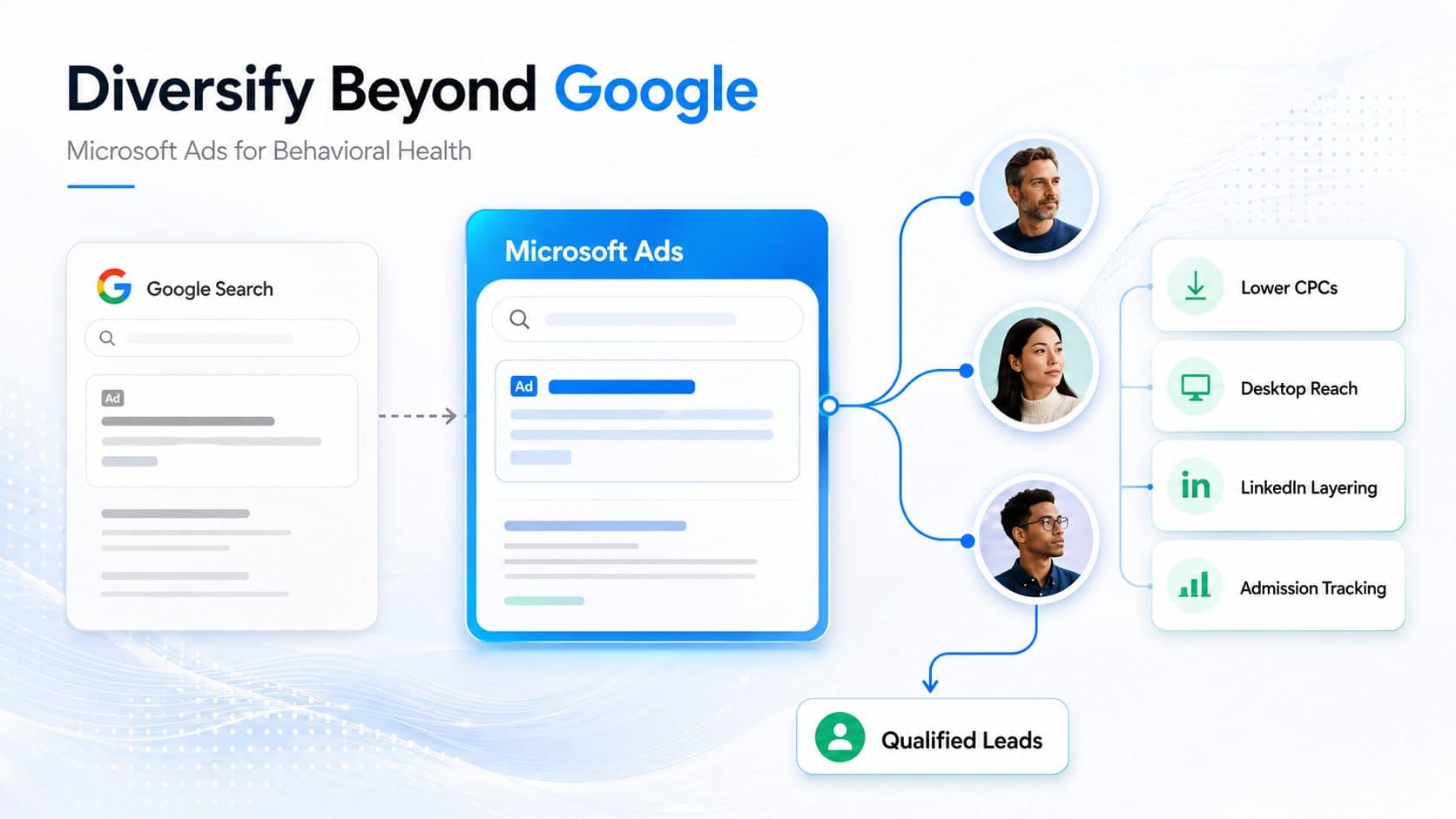
Benefits of Bing Ads for Treatment Centers
Running Bing Ads for treatment centers offers several concrete advantages over a Google-only approach. The first is cost efficiency. Behavioral health CPCs on Google often range from $40 to $150, depending on market and match type. Microsoft CPCs for comparable keywords frequently run 20% to 40% lower, according to cross-platform industry benchmarks. Lower CPCs mean more clicks per dollar, which translates to more intake calls if your landing pages convert.
The second advantage is reduced competition. Google's behavioral health auctions include national lead aggregators, private equity-backed networks, and sophisticated in-house teams. Microsoft's auctions tend to have fewer bidders, which reduces the pressure on impression share and allows smaller centers to compete on keywords they cannot afford on Google.
The third advantage is audience quality. Microsoft users skew older, more affluent, and more likely to use desktop devices. For treatment centers targeting families with private insurance or high-net-worth individuals seeking luxury or executive programs, this demographic alignment is meaningful.
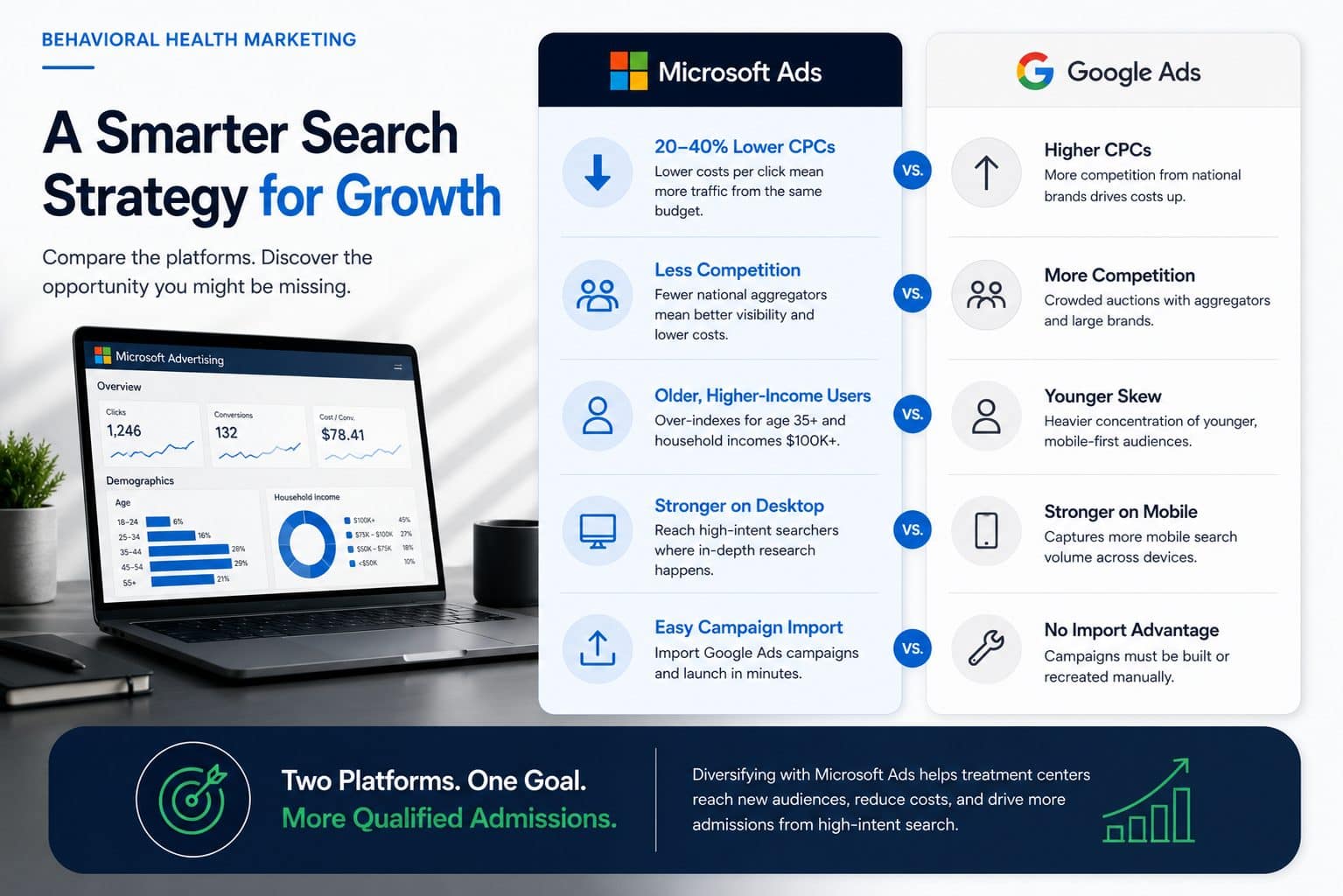
- Lower CPCs: Behavioral health keywords often cost 20% to 40% less on Microsoft than Google, stretching your budget further.
- Less auction competition: Fewer national aggregators and PE-backed competitors bidding on your keywords.
- Older, higher-income demographics: Microsoft users over-index for the 35-plus age range and household incomes above $100K.
- Desktop-dominant behavior: Families researching treatment options often use desktop devices, where Microsoft has a stronger reach.
- Easy campaign import: Replicate your Google Ads structure in Microsoft Advertising without rebuilding from scratch.
Microsoft Ads vs Google Ads in Behavioral Health
Understanding Microsoft Ads vs Google Ads for behavioral health requires looking beyond raw traffic volume. Google dominates mobile search, captures more total impressions, and offers the deepest audience targeting options. But dominance comes with cost. Behavioral health keywords on Google are among the most expensive in any vertical, and the auction includes aggressive competitors with deep pockets.
Microsoft Advertising operates in a less saturated environment. The trade-off is lower total volume. You will not generate as many impressions or clicks on Microsoft as you would on Google. But the clicks you do generate often cost less and convert at comparable or higher rates because the audience skews toward desktop users actively researching, not mobile users scrolling between apps.
Reach and Volume
Google captures roughly 83% of the U.S. search market share across all devices. Microsoft captures approximately 9% on its own, but its syndicated network extends that reach significantly on desktop. If your center serves a geographic market where desktop search behavior is strong, Microsoft's effective reach is higher than headline market share suggests. For centers targeting suburban and rural markets, where desktop search use remains higher than national averages, this distinction matters.
Cost Dynamics
Google's behavioral health auctions are expensive. A $100 CPC is not unusual for high-intent keywords like 'drug rehab near me' or 'alcohol treatment center.' Microsoft CPCs for identical keywords typically run 20% to 40% lower. For centers spending $50K or more monthly on paid search, reallocating even 15% of the budget to Microsoft can generate meaningful incremental volume without increasing total spend.
Compliance Parity
Both platforms enforce healthcare advertising policies. Google requires LegitScript certification for addiction treatment advertisers in the U.S., and Microsoft follows similar verification requirements. Microsoft's healthcare and medicines advertising policies require that advertisers promoting addiction treatment services meet certification standards. If your center is already LegitScript-certified for Google, you are likely eligible for Microsoft as well. The compliance lift is minimal.
The practical recommendation is not Microsoft or Google. It is Microsoft, in addition to Google. A diversified channel mix reduces dependence on any single platform's auction dynamics, policy changes, or algorithmic shifts. Centers that spread budget across both platforms tend to have more stable lead flow and better negotiating leverage with agencies.
Free Audit
Want a straight read on where your budget is leaking?
Strategies for Success with Microsoft Advertising in Healthcare
Running Microsoft Advertising healthcare campaigns requires the same strategic rigor you apply to Google, with a few platform-specific adjustments. The following strategies apply to inpatient treatment advertising, outpatient programs, and dual-diagnosis centers alike.
Import and Optimize, Not Copy and Forget
Microsoft's import tool makes it easy to replicate your Google Ads campaigns. But importing is not the same as optimizing. After import, review keyword match types, negative keyword lists, and ad copy for platform-specific performance. Microsoft's audience behaves differently from Google's, and your bids should reflect that. Start with 20% to 30% lower CPCs than your Google equivalents and adjust based on conversion data.
Pay particular attention to negative keywords. Terms that perform poorly on Google may generate even more wasted spend on Microsoft if not excluded. A thorough negative keyword audit at launch will protect your budget and improve your quality score over time.
Use Audience Layering for Precision
Microsoft offers LinkedIn profile targeting through its integration with LinkedIn data. You can layer job function, company, or industry targeting on top of keyword campaigns. For treatment centers targeting executives, healthcare professionals, or specific industries with elevated rates of substance use disorder, this capability is valuable. No other search platform offers LinkedIn-based audience layering.
Combine LinkedIn audience layers with in-market audience segments for users actively researching healthcare and treatment services. This combination narrows your reach to the highest-intent, most demographically aligned users on the platform.
Maintain Compliance Throughout
Behavioral health advertising requires LegitScript certification on both Google and Microsoft. Ensure your certification is current and that your landing pages meet Microsoft Advertising compliance requirements. Avoid claims about cure rates, guaranteed outcomes, or specific success percentages. Frame all messaging around the services you offer, not the results patients will achieve. This approach aligns with SAMHSA's guidance on responsible treatment marketing and LegitScript's certification standards.
Neither Google nor Microsoft allows retargeting for addiction treatment services. Build your campaigns around search intent and keyword targeting, not remarketing lists. Any agency recommending retargeting for behavioral health is creating compliance risk for your organization.
Track Attribution to Admission
Click-through rate and cost per click are vanity metrics in behavioral health. What matters is cost per qualified call, cost per admission, and revenue per advertising dollar. Configure conversion tracking to capture phone calls, form submissions, and chat interactions. Then work with your intake team to track which leads convert to admissions.
This closed-loop attribution is how you evaluate whether Microsoft Ads is delivering value, not whether it is generating clicks. Marketing Powered has managed more than $50 million in digital ad spend for behavioral health clients and tracks attribution through to admission for every engagement. The difference between knowing your CPC and knowing your cost per admission is the difference between guessing and growing.
Real-World Results: Behavioral Health Bing Campaigns That Performed
Behavioral health Bing campaigns work when executed with the same rigor applied to Google. The following examples illustrate how diversified paid search strategies have performed for treatment centers.
One multi-location treatment network had concentrated 100% of paid search budget on Google. CPCs had risen 35% year-over-year, and impression share was declining as larger competitors entered the market. After allocating 20% of the monthly budget to Microsoft Ads while maintaining Google spend, the network saw Microsoft generate 18% of total paid search leads at 28% lower cost per lead within 90 days. The additional volume came from audiences not searching on Google at all.
Another center specializing in executive treatment programs leveraged Microsoft's LinkedIn audience targeting. By layering C-suite job functions on top of high-intent keywords, the center reached decision-makers at a rate Google could not match. The campaign generated 14 qualified leads in the first 60 days, with three conversions to admission.
These outcomes reflect what happens when treatment centers treat Microsoft as a strategic channel rather than an afterthought. The centers that perform best on Microsoft are those that invest in proper setup, compliance review, and attribution tracking from day one.
Next Steps: Building Your Microsoft Ads Strategy
If your treatment center is spending $30,000 or more monthly on paid search and running Google Ads only, you are likely leaving qualified leads on the table. Microsoft Ads offers a lower-cost, lower-competition channel to reach audiences your Google campaigns miss entirely.
The question is not whether Microsoft Ads works for behavioral health. It does. The question is whether your current setup is optimized for the platform's strengths and compliant with its policies.
Marketing Powered has managed $1.5 million to $2 million monthly in Google Ads for behavioral health clients, with parallel Microsoft campaigns running for centers that want diversified lead flow. Our founder scaled a treatment network from 3 to 24 locations and is a court-certified expert witness in advertising strategy. We understand what it takes to grow a treatment center responsibly and at scale.
If you are ready to evaluate Microsoft Ads as part of your channel mix, request an audit. We will review your current campaigns, identify where Microsoft can add volume, and build a compliance-conscious strategy for expansion. No obligation. Just a clear-eyed look at where your next qualified leads could come from.

Email Us
Prefer to send the context directly?
Ready to Expand Your Reach with Microsoft Ads?
If your treatment center is ready to diversify beyond Google and capture qualified leads from untapped audiences, Marketing Powered can help. We bring more than $50 million in managed behavioral health ad spend, LegitScript compliance expertise, and attribution tracking through to admission. Let us evaluate where Microsoft Ads fits in your channel mix and build a strategy that grows your census responsibly.
Questions, Answered.
Microsoft Ads reaches approximately 37% of U.S. desktop searches through Bing, Yahoo, AOL, and DuckDuckGo syndication. The platform offers lower CPCs than Google, typically 20% to 40% less for behavioral health keywords, reduced auction competition, and access to audiences that skew older and higher-income. For treatment centers, this means reaching family decision-makers and privately-insured patients who may not appear in Google campaigns at all.
Google offers higher total volume and mobile dominance, but at a significantly higher cost per click. Microsoft offers lower CPCs, less competition from national aggregators, and unique targeting capabilities like LinkedIn profile layering. Treatment centers typically see the best results running both platforms simultaneously, using Microsoft to capture incremental volume at a lower cost rather than replacing Google.
Yes. Microsoft's user base skews toward desktop users aged 35 and older with household incomes above $100K. These demographics align with families researching treatment options and professionals seeking executive programs. Many of these users search exclusively on Microsoft-powered engines and never appear in Google campaigns, representing genuinely incremental demand.
Microsoft requires LegitScript certification for addiction treatment advertisers, similar to Google. Advertisers must avoid claims about cure rates, guaranteed outcomes, or specific success percentages. Retargeting is prohibited for behavioral health services on both platforms. If your center is already LegitScript-certified for Google Ads, you likely meet Microsoft's requirements as well, making the compliance lift minimal.
Track conversions beyond clicks: phone calls, form submissions, and chat interactions. Work with your intake team to attribute leads through to admission. The metrics that matter are cost per qualified call, cost per admission, and revenue per advertising dollar. Marketing Powered tracks attribution through to admission for every client, connecting ad spend directly to census growth and helping centers make data-driven budget decisions.
Ready to see what AI-native marketing can do for your treatment center?
Request a free audit of your paid media, landing pages, attribution, and compliance posture. You'll get a straight assessment of where the opportunities are.
or email us at info@marketingpowered.ai