Guide
Effective Landing Page Optimization for Paid Media
Turn paid traffic into qualified leads with landing page strategies built on real campaign data and operator-level experience.
What Is Landing Page Optimization?
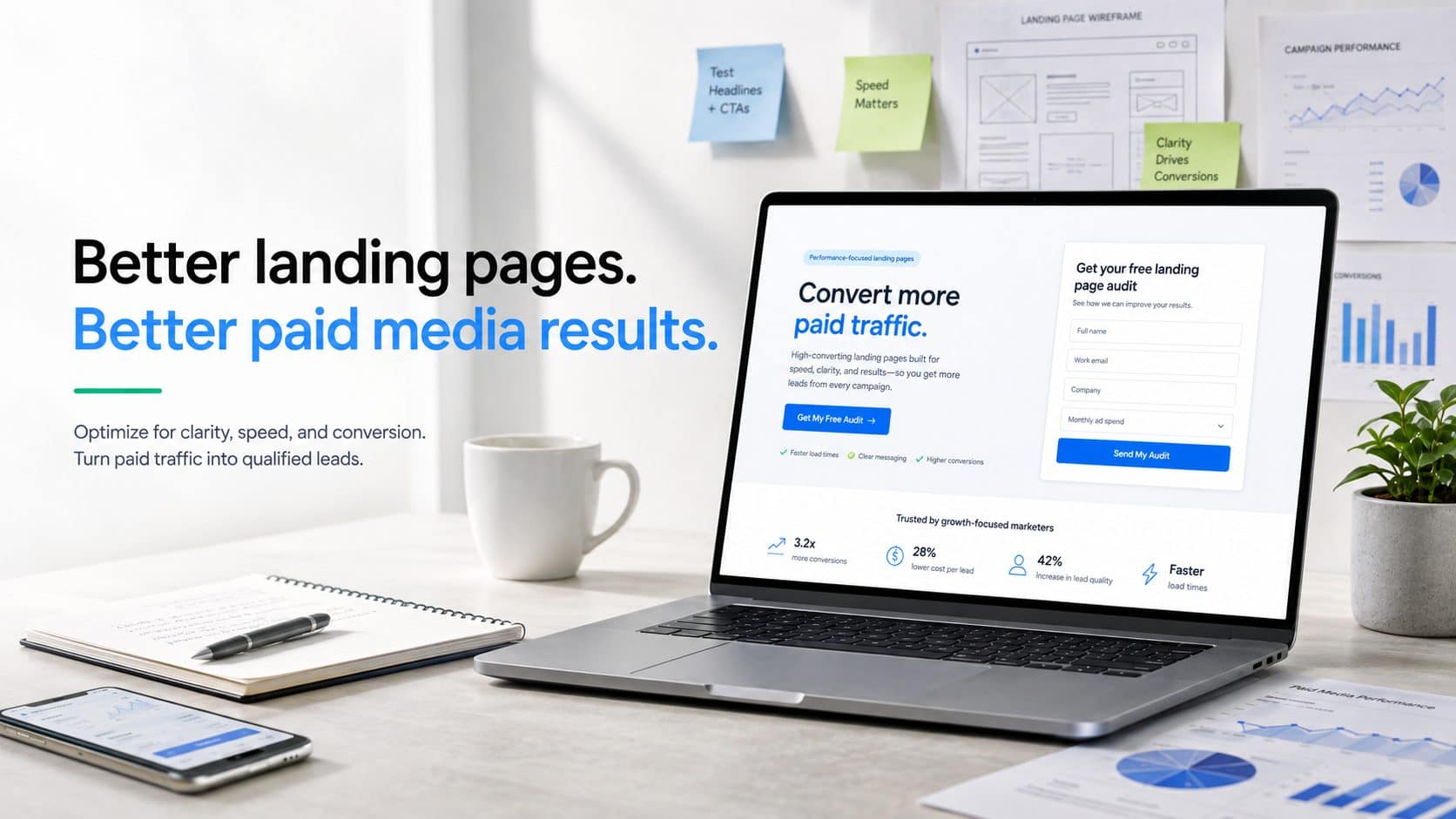
Landing page optimization is the systematic process of improving every element on a page to increase conversions from paid traffic. When you spend $10,000, $100,000, or $1M monthly on Google Ads or Meta campaigns, the landing page determines whether that spend generates qualified leads or disappears into bounce rates.
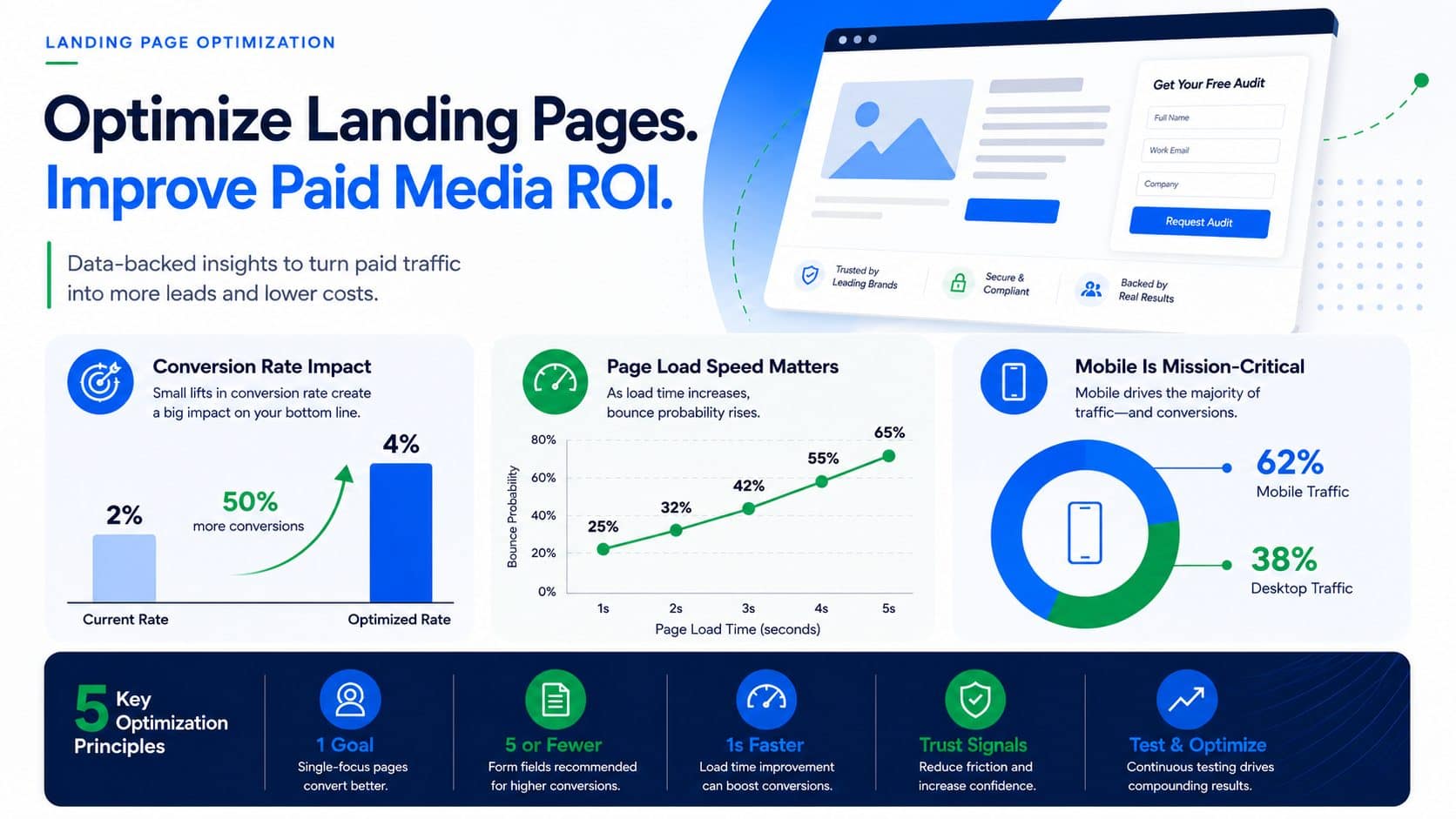
The difference between a 2% and 4% conversion rate on paid media landing pages is not marginal. It represents a 50% reduction in cost per lead with zero additional ad spend. That math compounds quickly at scale.
Landing page performance depends on alignment between three elements: the ad promise, the page experience, and the form or call to action. Break any link in that chain and performance suffers. Most teams focus on ad creative and bidding while treating the landing page as a static asset. That approach leaves measurable revenue on the table.
Essential Design Elements for Paid Media Landing Pages
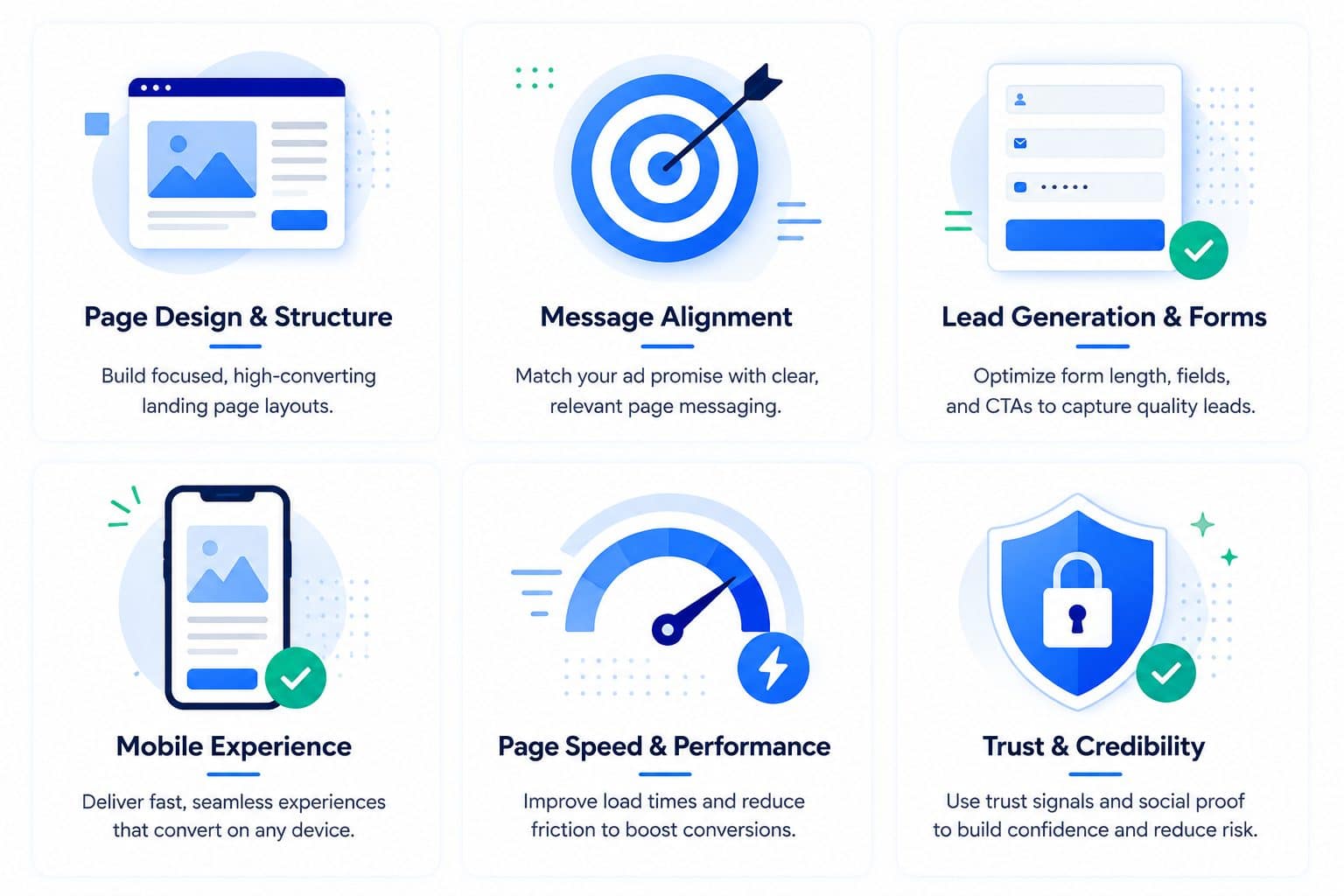
Effective paid traffic landing pages share structural patterns that guide visitors toward conversion. These are not aesthetic preferences. They are functional requirements backed by conversion data.
- Single-focus messaging: Every element on the page should support one conversion goal. Remove navigation links, competing offers, and anything that pulls attention away from the primary action. Distraction is the enemy of conversion.
- Above-the-fold clarity: Visitors decide within seconds whether to stay or leave. Your headline must match the ad copy that brought them there. The value proposition should be immediately visible without scrolling.
- Visual hierarchy that guides the eye: Use contrast, whitespace, and directional cues to move visitors from headline to supporting copy to CTA. The path should feel effortless, not cluttered.
- Mobile-first execution: More than 60% of searches now happen on mobile devices. If your landing page loads slowly or displays poorly on phones, you are paying for traffic you cannot convert.
- Trust signals positioned strategically: Logos, certifications, testimonials, and security badges reduce friction at the moment of decision. Place them near your form or CTA where hesitation occurs.
Best Practices for a Lead Gen Landing Page
A lead gen landing page exists to capture qualified contact information. Every element serves that goal or works against it.
Form length is a balance. Shorter forms increase submission rates but may reduce lead quality. Longer forms filter out casual interest but create friction. The right answer depends on your sales process and lead volume needs. Test both and measure downstream conversion, not just form fills.
Copy should address the visitor's specific problem before presenting your solution. Generic value propositions generate generic leads. The landing pages that perform best in our managed accounts speak directly to the visitor's situation rather than broadcasting broad claims.
Button copy matters more than most teams realize. 'Submit' is passive. 'Get My Free Audit' or 'See Pricing' creates forward momentum. The CTA text should complete the thought in the visitor's mind: 'I want to...'
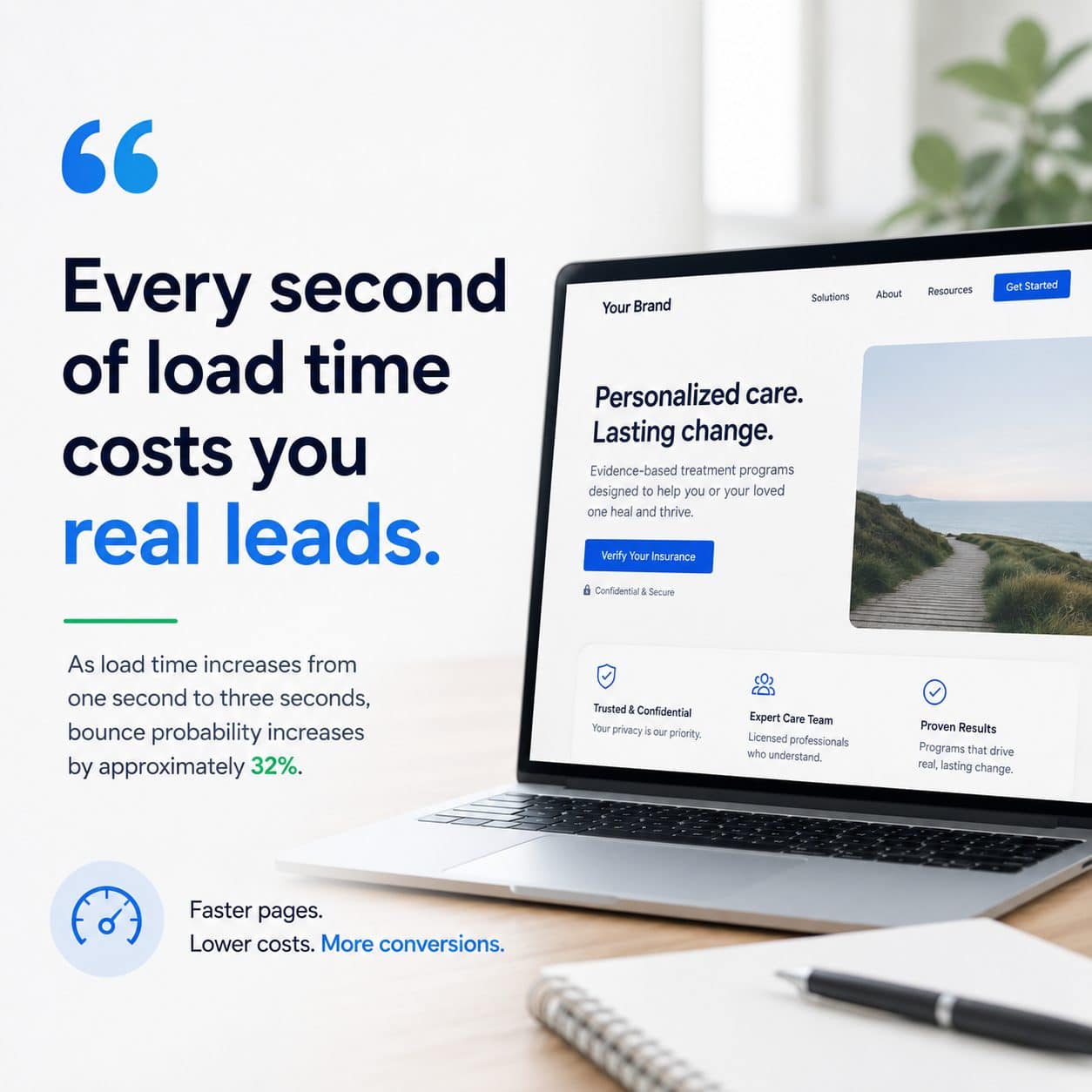
Page speed directly affects conversion rates. As load time increases from one second to three seconds, bounce probability increases by approximately 32%. Every second of delay costs you leads.
Free Audit
Want a straight read on where your budget is leaking?
B2B Landing Page Optimization
B2B landing page optimization requires different considerations than consumer campaigns. The buying cycle is longer, the decision involves multiple stakeholders, and the visitor often seeks information rather than an immediate purchase.
Account-based targeting allows you to customize landing page content for specific companies or industries. When a visitor from a target account arrives, they see messaging tailored to their vertical, company size, or known pain points. This level of personalization increases relevance and conversion rates meaningfully.
Content offers work differently in B2B. A whitepaper, benchmark report, or ROI calculator provides value while qualifying interest. The exchange of contact information for useful content feels fair rather than intrusive.
Social proof for B2B should emphasize relevant credentials. Enterprise buyers want to see that you have worked with companies of similar size and complexity. Industry-specific case studies outperform generic testimonials.
Form strategy for B2B often includes progressive profiling. Rather than asking for every detail upfront, capture essential information first and build the contact profile over subsequent interactions.
Results from Landing Page Optimization at Scale
Theory matters less than results. Here is what landing page optimization looks like when applied to real campaigns at scale.
Haven Health Management came to us managing 3 treatment center locations. Through systematic optimization of their paid media landing pages combined with full-funnel attribution, they scaled to 24 locations. The landing pages were not the only factor, but they were the conversion point where ad spend became admission inquiries.
Across our portfolio of behavioral health and mental health clients, we have managed $1.5M to $2M monthly in Google Ads. That volume generates enough data to test landing page variations quickly and identify winners with statistical confidence. Small operators cannot run meaningful tests because they lack traffic volume. We solve that problem by applying cross-account learnings while respecting the unique positioning of each client.
Our founder's experience as a court-certified expert witness in advertising strategy brings additional rigor to landing page claims. When we recommend copy changes, we understand what holds up under scrutiny and what creates compliance exposure.
For detailed examples of how landing page optimization integrates with full-funnel strategy, explore our case studies.
How to Start Optimizing Your Landing Pages
Landing page optimization is not a one-time project. It is an ongoing discipline of testing, measuring, and iterating based on real conversion data.
If you are spending significant budget on paid media and your landing pages have not been systematically optimized, you are likely overpaying for every lead. The fix is straightforward: audit your current pages, identify the highest-impact opportunities, build a testing roadmap, and execute with enough traffic to reach statistical significance.
Marketing Powered brings operator-level experience to this process. We have managed the budgets, run the tests, and tracked attribution through to actual business outcomes. Our consultation process starts with understanding your current state, your goals, and the constraints you operate within.
Email Us
Prefer to send the context directly?
Ready to Improve Your Landing Page Performance?
Stop paying for traffic that does not convert. A discovery call gives us the chance to understand your current paid media setup, identify landing page opportunities, and discuss how systematic optimization can reduce your cost per lead.
Questions, Answered.
Landing page optimization is the process of systematically improving page elements to increase conversion rates from paid traffic. This includes testing headlines, form designs, CTAs, page layouts, copy, and trust signals. The goal is to convert more visitors into leads or customers without increasing ad spend.
Landing pages directly determine how much value you extract from every dollar of ad spend. A higher-converting page reduces your effective cost per lead, improves your quality score on platforms like Google Ads, which can lower CPCs, and increases overall campaign ROI. The ad gets the click; the landing page gets the conversion.
Effective lead gen landing pages maintain a single focus, match the ad message that brought visitors there, use clear visual hierarchy, position CTAs prominently, and include trust signals near the form. Form length should balance submission rates with lead quality. Test button copy, and prioritize page speed since load time directly affects bounce rates and conversion rates.
B2B optimization requires accounting for longer buying cycles and multiple stakeholders. Use account-based personalization when possible, offer valuable content exchanges like whitepapers or calculators, feature industry-specific social proof, and consider progressive profiling to gather information over multiple interactions rather than asking for everything upfront.
User experience determines whether visitors complete the conversion action or abandon the page. Confusing layouts, slow load times, poor mobile rendering, and unclear messaging all increase bounce rates. A smooth, intuitive experience removes friction between the visitor's intent and the action you want them to take.
Ready to see what AI-native marketing can do for your treatment center?
Request a free audit of your paid media, landing pages, attribution, and compliance posture. You'll get a straight assessment of where the opportunities are.
or email us at info@marketingpowered.ai