Guide
Master Marketing Mix Modeling for Modern Attribution
Statistical attribution that reveals what actually drives revenue, not just what gets clicked.

Understanding Marketing Mix Modeling
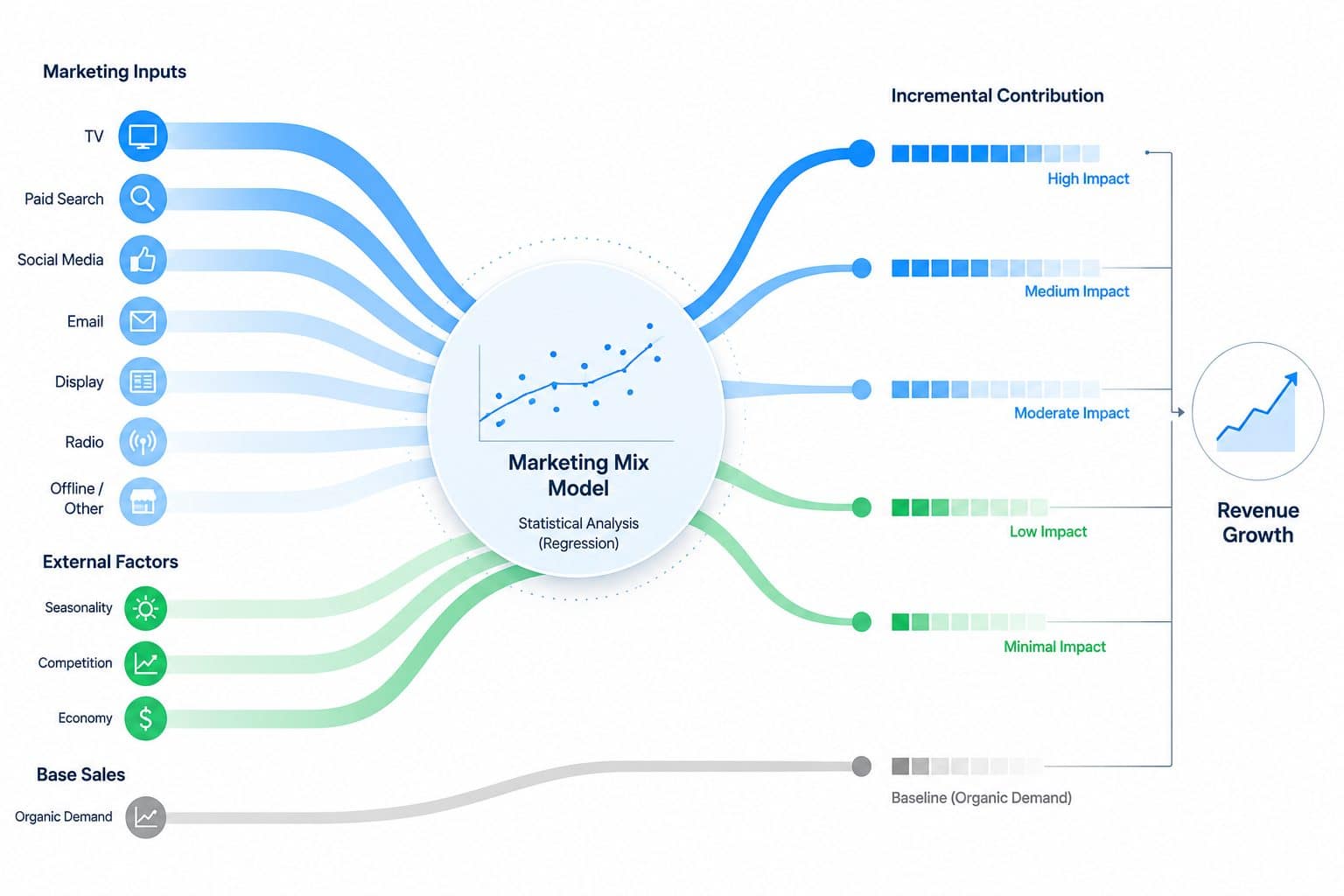
Marketing mix modeling is a statistical analysis technique that measures how each marketing channel contributes to business outcomes. Unlike click-based tracking that fragments the customer journey, MMM uses aggregate data and regression analysis to quantify the incremental impact of every media dollar spent.
The technique originated in the consumer packaged goods industry during the 1960s, when brands needed to understand how TV, print, and radio worked together to move product off shelves. Today, marketing mix modeling has become the gold standard for advertisers navigating a post-cookie environment where user-level tracking grows increasingly unreliable.
A properly constructed marketing mix model accounts for three categories of variables. Marketing inputs include paid media spend, creative rotation, promotional timing, and channel allocation. External factors capture seasonality, competitive activity, economic conditions, and weather patterns. Base sales represent organic demand that would exist without marketing intervention.
The model isolates the contribution of each variable through multivariate regression, producing coefficients that quantify incremental lift. This allows marketing leaders to answer questions that pixel-based attribution cannot: How much revenue did TV drive? What is the saturation point for paid search? Where does the next dollar produce the highest return?
For organizations managing significant media budgets, understanding these dynamics is not optional. With more than $50 million in lifetime managed paid media spend, we have seen firsthand how statistical attribution changes budget allocation decisions in ways that click-tracking alone never could.
Benefits of MMM in Marketing
The primary advantage of a marketing mix model is channel-agnostic measurement. MMM does not depend on cookies, device IDs, or platform pixels. It works equally well for digital and offline channels, giving marketers a unified view of performance that multi-touch attribution simply cannot provide.
Privacy regulations have accelerated MMM adoption. With GDPR, CCPA, and the deprecation of third-party cookies reshaping digital advertising, statistical attribution offers a compliant path forward. According to Gartner's 2024 marketing analytics forecast, over 60% of enterprise marketers now use or plan to implement MMM within 18 months.
Beyond compliance, MMM reveals diminishing returns and saturation curves that inform optimal spend levels. Rather than simply allocating more budget to the channel with the lowest CPA, marketing leaders can identify where incremental investment still produces incremental results and where it does not.
For behavioral health marketing and mental health marketing strategies, these insights matter even more. Sensitive verticals face advertising restrictions that limit retargeting and audience targeting options. MMM helps allocate budget to channels that actually influence admissions, not just the ones that happen to capture the last click before conversion.
MMM vs. MTA: Choosing the Right Approach
The MMM vs. MTA debate often presents a false choice. Marketing mix modeling and multi-touch attribution answer different questions at different time horizons, and sophisticated marketing organizations use both.
Multi-touch attribution excels at tactical optimization within digital channels. It tracks user-level journeys, assigns credit across touchpoints, and enables real-time bid adjustments. The limitation: MTA only sees what pixels can track. It misses offline channels entirely, struggles with cross-device behavior, and grows less reliable as privacy restrictions tighten.
Marketing mix modeling operates at the strategic level. It measures total channel contribution over weeks or months, incorporating offline media, seasonality, and external factors that MTA cannot capture. The tradeoff: MMM requires historical data (typically 2-3 years), updates less frequently, and cannot optimize individual campaigns in real time.
The right approach depends on your media mix and measurement maturity. Organizations spending heavily on television, radio, out-of-home, or programmatic display often find MMM indispensable. Brands operating exclusively in performance digital channels may get sufficient signal from MTA, at least until privacy changes erode that visibility.
Our recommendation: start with MMM to establish baseline channel contribution, then layer MTA for tactical optimization within digital. This hybrid approach, sometimes called unified marketing measurement, combines strategic clarity with operational agility. AI-powered marketing tools can accelerate model calibration and refresh cycles, making this combination more accessible than it was five years ago.
Free Audit
Want a straight read on where your budget is leaking?
Implementing a Marketing Mix Model
Successful MMM implementation begins with data infrastructure. You need at least two years of weekly or monthly data across all marketing channels, including spend, impressions, GRPs, and any available reach or frequency metrics. Revenue or conversion data must align to the same time periods.
Data quality determines model quality. Gaps, inconsistencies, or misattributed spend will produce coefficients that mislead rather than inform. Before modeling begins, audit your data sources for completeness and accuracy. This often reveals tracking gaps that need remediation before analysis can proceed.
The modeling process itself involves several stages. Variable transformation applies adstock (carryover effects) and diminishing returns curves to marketing inputs. Model specification tests different functional forms to find the best fit. Validation compares model predictions against holdout periods to confirm accuracy. Decomposition breaks down revenue into contributions from each variable.
- Collect 24-36 months of weekly marketing spend and revenue data across all channels
- Include external variables: seasonality indices, competitive spending (if available), economic indicators
- Apply adstock transformations to account for lagged effects from brand and awareness campaigns
- Validate model accuracy against holdout periods before using coefficients for budget allocation
- Refresh the model quarterly or when significant media mix changes occur
Building Internal Capability vs. Partnering
Organizations can build MMM capability in-house, license a platform solution, or partner with an agency that provides measurement as a service. Each path has tradeoffs.
In-house teams offer control and institutional knowledge but require significant investment in data science talent and infrastructure. Platform solutions (Google's Meridian, Meta's Robyn, various commercial offerings) reduce technical lift but may carry platform bias and still require analytical expertise to interpret results.
Partnering with a measurement-focused agency provides expertise without permanent headcount, though it requires trust in the partner's methodology and objectivity. For organizations in regulated verticals like behavioral health, the partner's compliance awareness matters as much as their statistical capabilities.

Real-World Applications and Case Studies
Statistical attribution becomes actionable when it connects marketing inputs to business outcomes that matter. For treatment centers, that means tracking attribution through to admission, not just to form fills or phone calls.
One application we have deployed repeatedly: using MMM to identify the true contribution of branded search. Many organizations over-credit branded terms because they capture demand that other channels created. A properly specified marketing mix model isolates incremental branded search contribution from the baseline demand that would have occurred anyway, often revealing that 30-50% of branded conversions are cannibalistic rather than incremental.
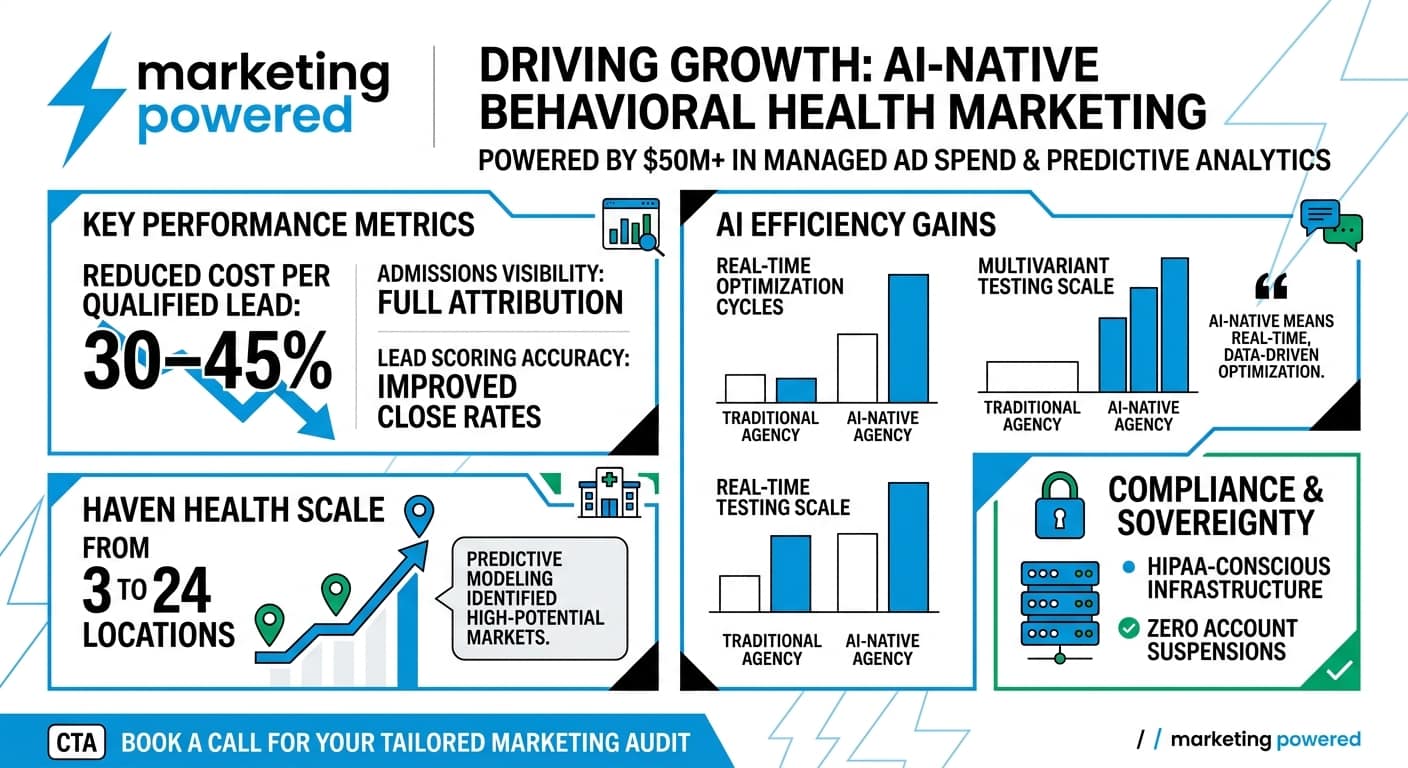
In the Haven Health engagement, we supported growth from 3 to 24 locations while maintaining attribution discipline throughout. The media mix model allowed leadership to understand which markets and channels warranted incremental investment and which had reached saturation. This is the difference between scaling efficiently and scaling blindly.
For healthcare marketers specifically, MMM provides measurement continuity when platform tracking becomes unreliable. Google Ads sensitive vertical restrictions limit conversion tracking options for behavioral health marketing campaigns. Statistical attribution fills the gap, connecting spend to admissions even when pixel-based tracking cannot.
The National Bureau of Economic Research has documented how regression-based attribution methods outperform rule-based models when measuring advertising effectiveness, particularly for brand-building channels where effects accumulate over time.
Email Us
Prefer to send the context directly?
Getting Started with Marketing Mix Modeling
If you are evaluating MMM for your organization, start with an honest assessment of your data readiness. Do you have two or more years of consistent spend and revenue data? Are your tracking systems capturing the metrics MMM requires? Is your team prepared to act on findings that may contradict platform-reported performance?
The investment in statistical attribution pays dividends when it changes budget allocation. A model that sits in a slide deck does not generate ROI. The value emerges when leadership trusts the findings enough to shift spend away from channels that claim credit and toward channels that actually produce incremental results.
We work with marketing leaders who want measurement that holds up to scrutiny, not dashboards that tell them what they want to hear. With AI-native infrastructure built for attribution discipline and court-certified expert credibility when findings need to be defended, we bring the rigor that statistical attribution demands.
Ready to understand what actually drives your results?
Statistical attribution separates channels that claim credit from channels that create demand. If you are ready for measurement that changes how you allocate budget, let's talk about your current attribution approach and where MMM fits in your measurement stack.
Questions, Answered.
Marketing mix modeling is a statistical analysis technique that uses regression analysis to estimate the impact of marketing tactics on sales and conversions. Unlike click-based attribution, MMM works with aggregate data to measure how each channel contributes to business outcomes, including offline channels that digital tracking cannot capture. The approach has become increasingly valuable as privacy regulations and cookie deprecation erode user-level tracking reliability.
Effective behavioral health marketing combines MMM with targeted content strategies and audience analysis to optimize budget allocation within regulatory constraints. Because Google Ads restricts retargeting in sensitive healthcare verticals, statistical attribution helps identify which channels actually influence admissions rather than simply capturing demand at the point of conversion. This allows providers to invest confidently in awareness channels whose contribution would otherwise be invisible to click-based tracking.
MMM and MTA operate at different levels and answer different questions. Multi-touch attribution tracks individual user journeys across digital touchpoints and enables real-time bid optimization. Marketing mix modeling uses aggregate historical data to measure total channel contribution over weeks or months, incorporating offline media and external factors. MTA excels at tactical optimization; MMM provides strategic clarity. Sophisticated organizations use both in a unified measurement framework.
Statistical attribution provides a more accurate, holistic view of marketing performance than basic analytics or rule-based attribution models. By isolating incremental contribution through regression analysis, statistical models reveal which channels actually drive business outcomes versus which simply capture credit for demand created elsewhere. This accuracy becomes increasingly important as privacy changes reduce the reliability of platform-reported metrics and user-level tracking.
Ready to see what AI-native marketing can do for your treatment center?
Request a free audit of your paid media, landing pages, attribution, and compliance posture. You'll get a straight assessment of where the opportunities are.
or email us at info@marketingpowered.ai