Guide
Understanding LLM SEO in Behavioral Health
How AI-powered search optimization is reshaping visibility for treatment centers and mental health providers
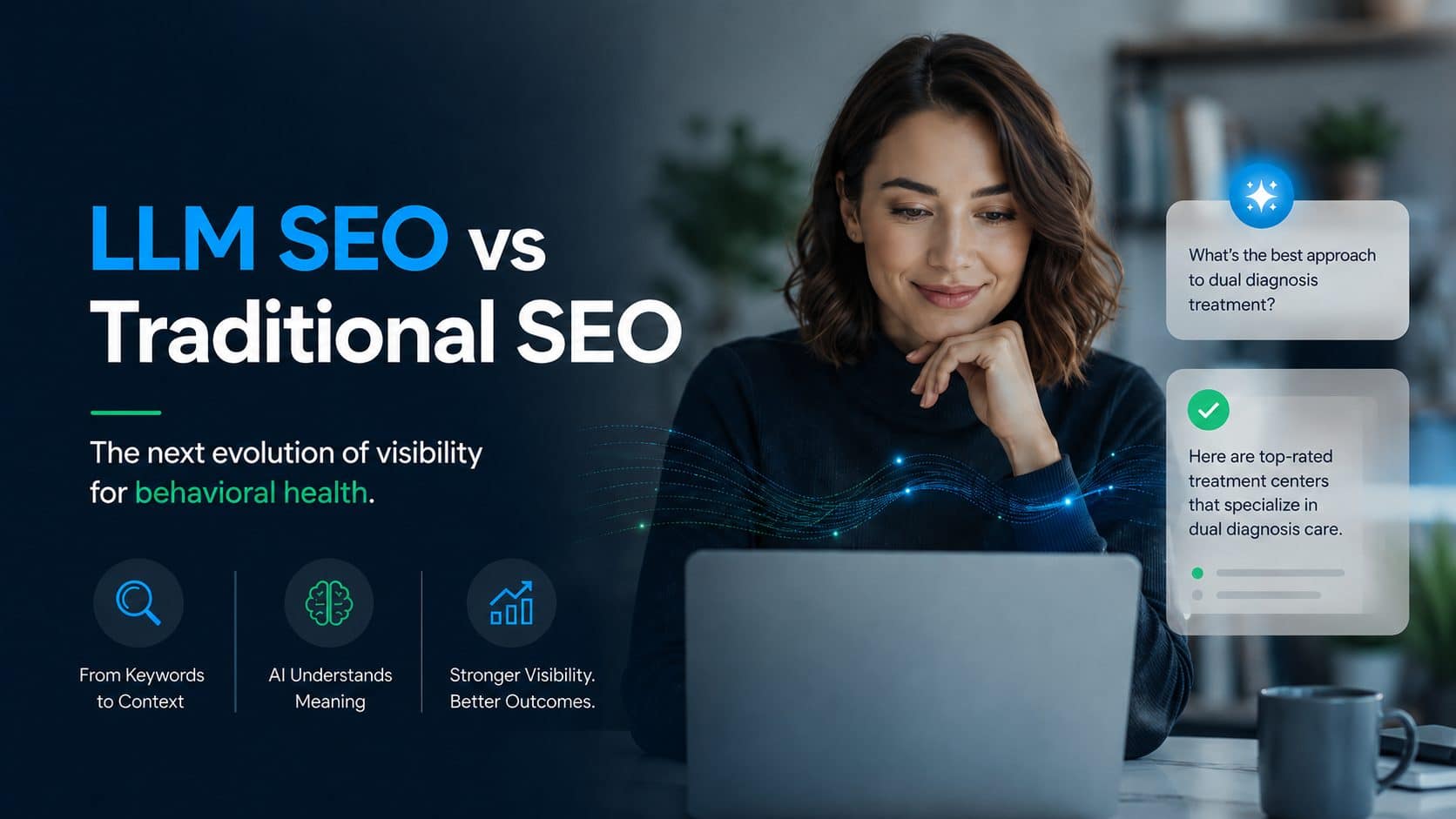
What is LLM SEO?
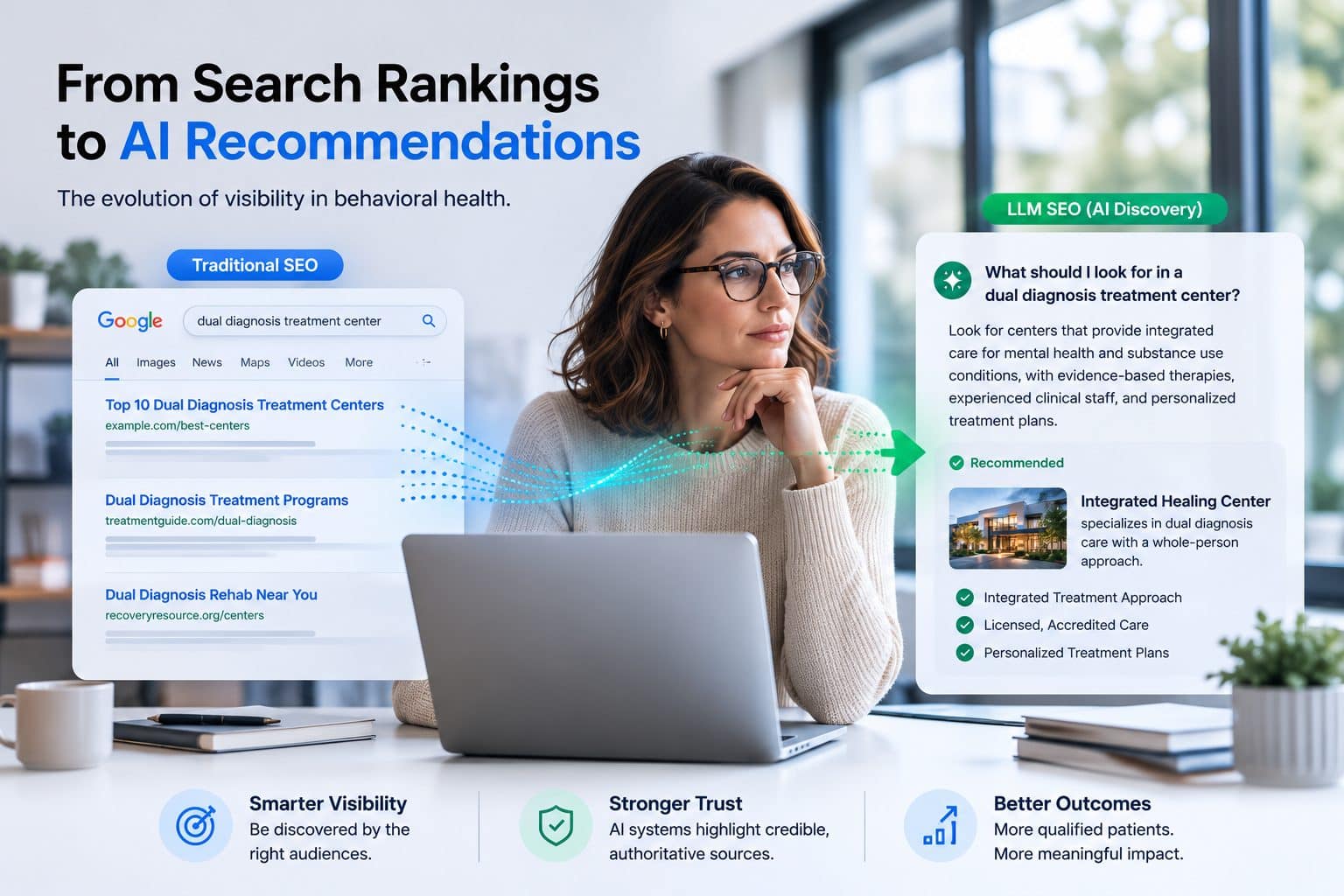
The shift from keyword matching to contextual understanding
LLM SEO is the practice of optimizing content so that large language models (the AI systems powering ChatGPT, Perplexity, Google AI Overviews, and similar platforms) can accurately understand, cite, and recommend your organization. Traditional SEO focused on matching keywords to search queries. LLM SEO focuses on matching meaning, context, and authority signals to the way AI systems process and surface information.
The distinction matters because of how these systems work. Traditional search engines crawl pages, index keywords, and rank results based on backlinks, domain authority, and on-page factors. Large language models do something different: they ingest vast amounts of text, build contextual relationships between concepts, and generate responses by predicting what information best answers a user's question. Your treatment center's content is no longer competing for a blue link position. It is competing to be the source an AI assistant cites when someone asks about behavioral health services in your region.
For behavioral health providers, this shift has practical implications. A prospective patient or their family member might ask an AI assistant: 'What should I look for in a dual diagnosis treatment center?' The AI will synthesize information from multiple sources to generate an answer. If your content clearly defines your clinical approach, explains your admissions process, and establishes your credentials with specific proof points, you become a candidate for citation. If your content is thin, keyword-stuffed, or lacks structured claims, the AI will pull from competitors who did the work.
This is why we describe LLM SEO as AI discovery optimization: the goal is to be discovered, understood, and recommended by AI systems as part of their answer generation process, not just indexed by traditional crawlers.
The Benefits of LLM SEO in Behavioral Health
Free Audit
Want a straight read on where your budget is leaking?
Precision targeting in a compliance-heavy vertical
Behavioral health marketing operates under restrictions that most industries never encounter. Google Ads healthcare vertical policies prohibit retargeting. LegitScript certification requirements add layers of compliance review. Meta's Special Ad Categories limit audience targeting. These constraints make organic visibility and AI-driven discovery more valuable, not less.
LLM SEO offers three specific advantages for treatment centers and mental health providers.
Contextual relevance over keyword density: Traditional SEO rewarded pages that mentioned target keywords frequently. LLM SEO rewards pages that thoroughly answer the questions AI systems are trained to recognize. For a behavioral health provider, this means content that explains your clinical modalities, intake process, insurance verification approach, and outcomes measurement will outperform content that simply repeats 'addiction treatment center' throughout the page.
Structured authority signals: AI systems look for indicators that a source is credible, including author credentials, citation of clinical research, clear organizational information, and consistency across the web. A treatment center with content that references SAMHSA treatment locator data, cites ASAM criteria appropriately, and demonstrates LegitScript compliance sends stronger authority signals than a competitor with generic marketing copy.
Answer-ready content structure: When someone asks an AI assistant a question about behavioral health, the system looks for content that provides direct, citable answers. Pages structured with clear definitions, numbered lists, FAQ sections, and specific claims are more likely to be surfaced than narrative-heavy content that buries information in long paragraphs. This is the practice some call answer engine optimization: structuring content so AI systems can extract and cite it cleanly.
For providers already investing in content marketing, LLM SEO is not a replacement for traditional efforts. It is an optimization layer that makes existing content work harder across both traditional search and the growing category of AI-assisted discovery.
Tools and Resources for LLM SEO
What supports effective AI search optimization
Executing LLM SEO requires a different toolkit than traditional search optimization. While keyword research platforms and backlink analyzers remain useful, they are insufficient for understanding how AI systems process and surface content.
LLM testing environments: Tools that allow you to query multiple AI systems (ChatGPT, Claude, Perplexity, Gemini) and track how your content is cited over time. This is the foundation of any LLM SEO tool stack: understanding which of your pages AI systems reference, and which they ignore.
Structured data validators: Schema markup (FAQ, Article, Organization, LocalBusiness) helps AI systems parse your content accurately. Google's Rich Results Test and Schema.org validators confirm your markup is correctly implemented.
Content structure analyzers: Tools that evaluate whether your content provides clear, citable claims. These assess heading hierarchy, definition placement, numerical specificity, and answer density. The goal is content that AI systems can excerpt without losing meaning.
Citation monitoring: Tracking when and where AI systems cite your organization, and what content they pull from. This is still an emerging category, but several platforms now offer AI citation tracking alongside traditional rank monitoring.
Authority signal audits: Evaluating your content against the E-E-A-T framework (Experience, Expertise, Authoritativeness, Trustworthiness) that Google's Search Quality Rater Guidelines describe. For behavioral health, this includes clinical credential display, author attribution, and citation of recognized bodies like SAMHSA, ASAM, and state licensing authorities.
A generative engine optimization agency will typically deploy these tools as part of an integrated monitoring stack, tracking both traditional search performance and AI discovery metrics to identify optimization opportunities.
Email Us
Prefer to send the context directly?
Comparing Traditional SEO and LLM SEO
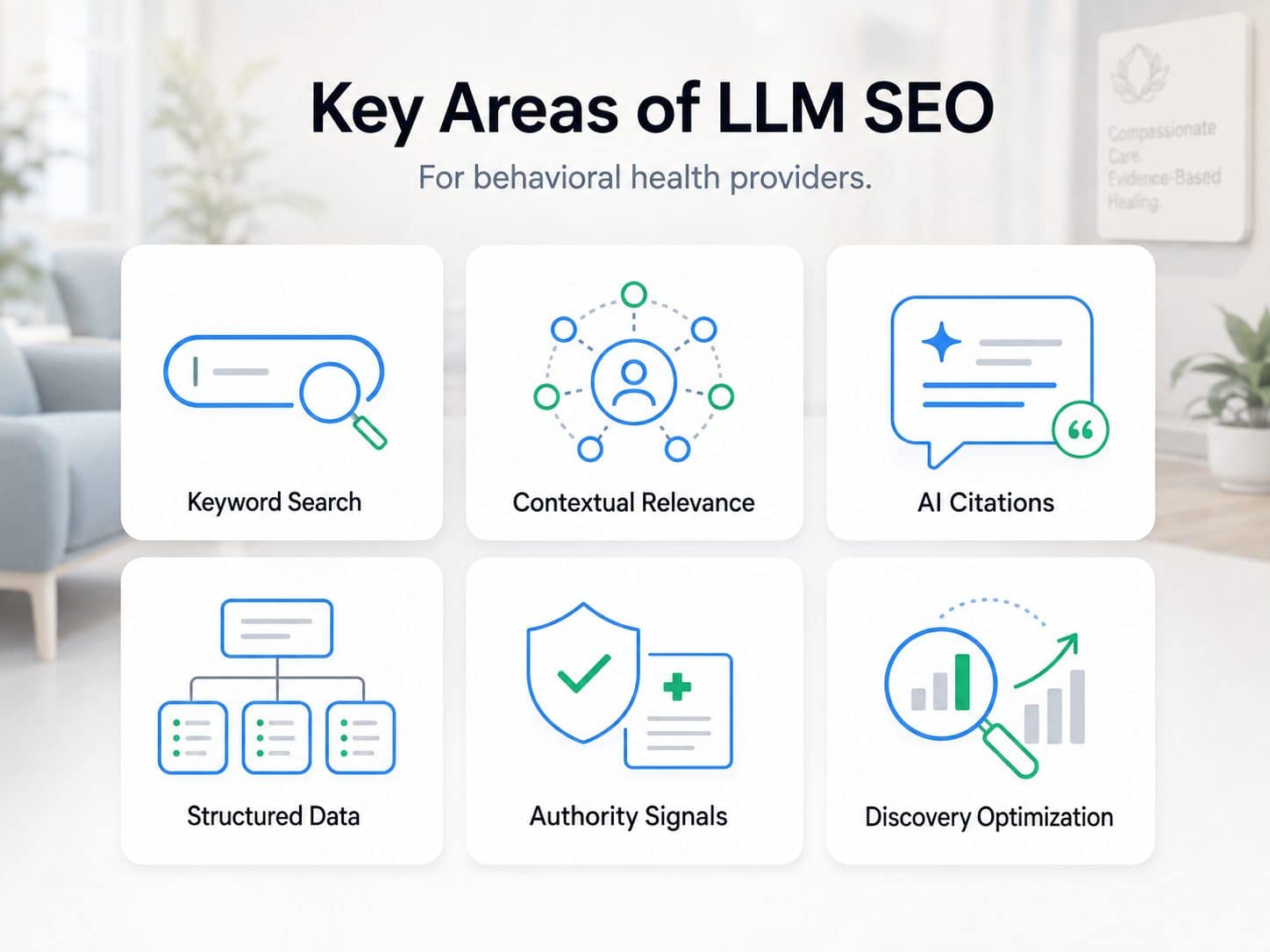
Different mechanisms, complementary outcomes
Traditional SEO and LLM SEO are not opposing strategies. They operate on different mechanisms but share the goal of increasing qualified visibility for your organization. Understanding where they differ helps clarify where to invest.
Ranking mechanism: Traditional SEO optimizes for position in a ranked list of ten blue links. Success is measured by where you appear on page one. LLM SEO optimizes for inclusion in AI-generated responses. Success is measured by whether the AI cites you, quotes you, or recommends you as a resource. These are different outcomes, and the content that performs well for one may not perform well for the other.
Content format: Traditional SEO rewards comprehensive pages that satisfy search intent and keep users on site. LLM SEO rewards content structured for extraction: clear definitions, specific claims, numbered frameworks, and FAQ sections that AI systems can pull into generated responses. The overlap is significant: well-structured content often performs well in both contexts, but the emphasis differs.
Authority signals: Traditional SEO relies heavily on backlinks as a proxy for authority. LLM SEO appears to weigh content quality, factual accuracy, and citation of recognized sources. A page with fewer backlinks but stronger clinical citations may outperform in AI discovery while underperforming in traditional rankings.
Update cadence: Traditional search indexes update continuously. AI model training happens on longer cycles, meaning content changes may take months to influence AI responses. This makes foundational content more important in LLM SEO: get the core claims right from the start.
Measurement: Traditional SEO has mature analytics like rank tracking, click-through rates, and conversion attribution. LLM SEO measurement is still developing. Tracking AI citations, monitoring brand mentions in AI responses, and correlating AI visibility with lead quality are emerging practices that require new tooling.
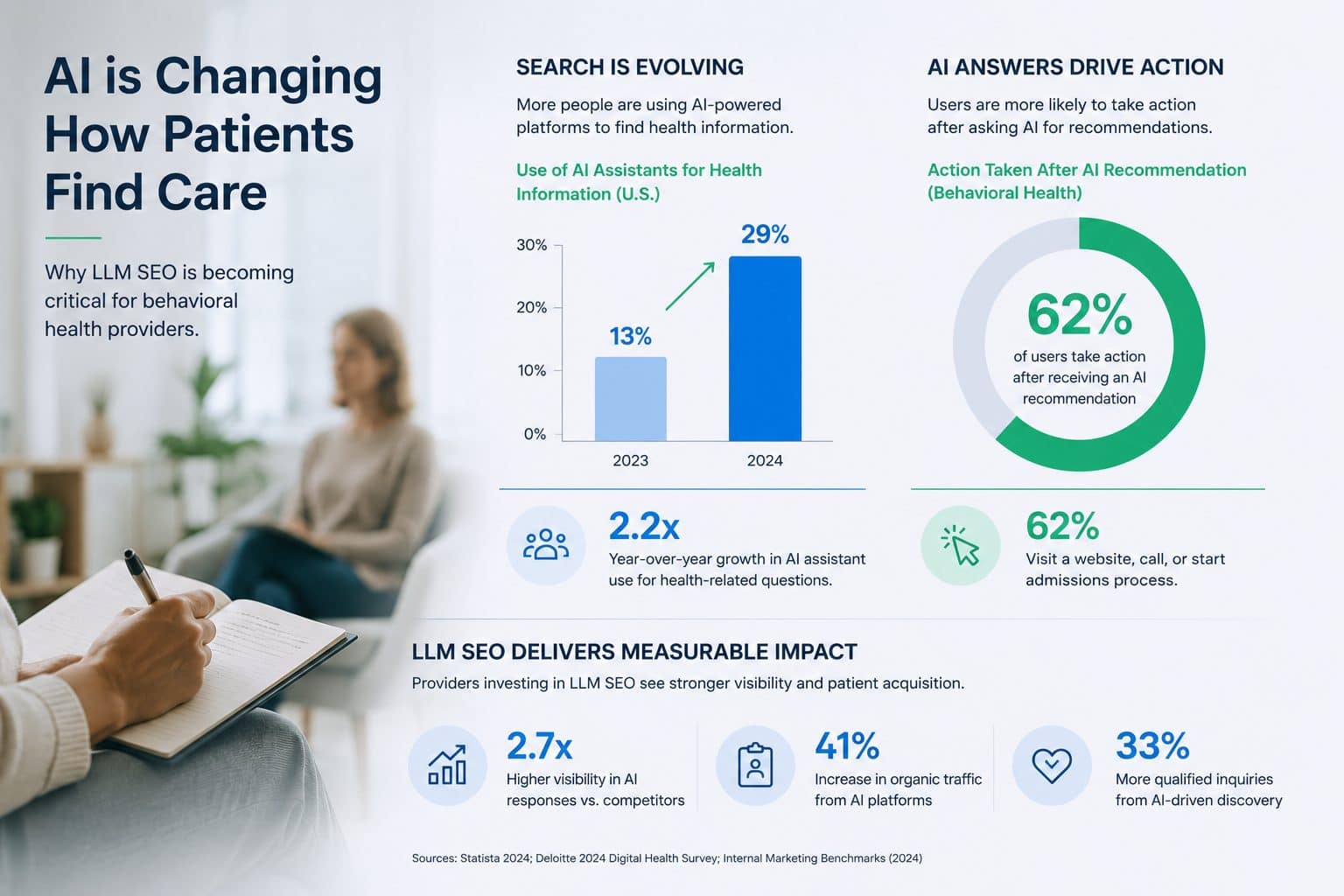
For behavioral health providers, the practical recommendation is to pursue both strategies simultaneously. Traditional SEO continues to drive the majority of organic traffic for most treatment centers. LLM SEO is where growth is accelerating, particularly among younger demographics who default to AI assistants for health-related research. A 2024 Pew Research study found that roughly one in five Americans has used ChatGPT, with higher adoption among 18-29-year-olds. That cohort is entering the age range where substance use disorders and mental health challenges often emerge.
Organizations that invest in generative search SEO now will gain a structural advantage as AI-assisted search becomes the default for more users.
Case Studies and Success Stories
Strategy
Want to start with a quick message?
What LLM SEO implementation looks like in practice
Marketing Powered has been AI-native since 2022, building infrastructure for AI-driven optimization before the category had a name. That early investment informs how we approach LLM SEO for behavioral health clients.
Haven Health: scaling visibility alongside locations. When Haven Health expanded from 3 to 24 locations, traditional SEO alone could not keep pace with the need for location-specific visibility. We implemented structured content frameworks that established each facility's clinical specialties, staff credentials, and insurance relationships in formats optimized for both traditional search and AI discovery. The approach contributed to Haven's growth from roughly $30M to $140M in revenue.
Attribution through the full funnel. One challenge behavioral health providers face is connecting marketing visibility to actual admissions. We track attribution through to admission, not just to form fills or phone calls. This discipline applies to LLM SEO as well: when a prospective patient mentions they 'asked ChatGPT about treatment options' during an intake call, that signal gets captured and incorporated into channel analysis. The ability to see which content AI systems cite, and which cited content converts, closes the loop between optimization strategies and business outcomes.
Compliance-first content architecture. Every piece of content we create for behavioral health clients passes through compliance review informed by LegitScript requirements and HIPAA awareness. This is not separate from LLM SEO strategy; it is foundational to it. AI systems are trained to recognize authoritative, trustworthy sources. Content that demonstrates compliance awareness, cites clinical standards appropriately, and avoids outcome guarantees sends stronger trust signals than content that cuts corners.
The common thread across these implementations: LLM SEO is not a standalone tactic. It is an optimization layer that sits on top of solid content fundamentals, clear clinical positioning, and rigorous attribution. When those foundations are in place, AI discovery optimization amplifies their impact.
Getting Started with LLM SEO
Next steps for behavioral health providers
If you are evaluating LLM SEO for your treatment center or mental health practice, start with an audit of your current content's AI readiness.
Test your visibility: Query ChatGPT, Perplexity, and Google AI Overviews with questions your prospective patients ask. Does your organization appear in responses? Are competitors being cited instead? This baseline tells you where you stand.
Assess content structure: Review your highest-traffic pages. Do they provide clear, specific answers to common questions? Are clinical credentials, treatment modalities, and outcomes data presented in formats AI systems can extract? Identify gaps.
Evaluate authority signals: Is your content citing recognized clinical sources (SAMHSA, ASAM, NIH)? Are the author's credentials displayed? Is schema markup implemented correctly? These signals influence both traditional SEO and AI discovery.
Map the integration: LLM SEO does not replace your existing lead generation and content efforts. It optimizes them for a changing search environment. The question is not 'traditional SEO or LLM SEO' but 'how does LLM SEO layer onto what we already do.'
Marketing Powered brings $50M+ in managed behavioral health media spend, court-certified marketing expert witness credentials, and AI infrastructure built specifically for HIPAA-compliant operations. We understand both the compliance constraints and the growth opportunities in this vertical because we have operated in it at scale.
Free Audit
Want a straight read on where your budget is leaking?
Ready to Optimize for AI Discovery?
The behavioral health organizations investing in LLM SEO now will have structural visibility advantages as AI-assisted search becomes the default. Schedule a consultation to discuss strategy, compliance, lead quality, and how AI discovery optimization fits into your marketing mix.
Questions, Answered.
LLM SEO is the practice of optimizing content so large language models (the AI systems behind ChatGPT, Perplexity, and Google AI Overviews) can accurately understand, cite, and recommend your organization. Unlike traditional SEO, which focuses on keyword matching and backlink authority, LLM SEO prioritizes contextual relevance, structured claims, and authority signals that AI systems use when generating responses to user queries.
Behavioral health providers operate under significant advertising restrictions, including no retargeting in Google Ads and Special Ad Categories in Meta. LLM SEO offers an alternative visibility channel by optimizing content for AI-assisted discovery. Specific benefits include improved contextual targeting, stronger authority signals through clinical citations, and an answer-ready content structure that AI systems can cite when users ask about treatment options.
Effective LLM SEO requires tools for testing AI responses across multiple platforms, validating structured data markup, analyzing content structure for citation readiness, monitoring AI citations over time, and auditing authority signals. Google's Rich Results Test, schema validators, and emerging AI citation tracking platforms form the foundation of most LLM SEO tool stacks.
LLM SEO complements traditional SEO rather than replacing it. Traditional SEO continues to drive the majority of organic traffic for most organizations, while LLM SEO captures the growing segment of users who default to AI assistants for research. The most effective strategy pursues both traditional SEO for established search behavior and LLM SEO for emerging AI-assisted discovery patterns.
AI underpins LLM SEO in two ways. First, understanding how AI systems (large language models) process and surface content is the foundation of the optimization strategy. Second, AI tools assist with content analysis, citation tracking, and authority signal assessment. The goal is to create content that AI systems recognize as authoritative, accurate, and relevant to user queries.
Ready to see what AI-native marketing can do for your treatment center?
Request a free audit of your paid media, landing pages, attribution, and compliance posture. You'll get a straight assessment of where the opportunities are.
or email us at info@marketingpowered.ai