Guide
Mastering Meta Ads Creative Testing for Behavioral Health
A data-driven framework for testing, iterating, and scaling Meta ad creative in a compliance-sensitive vertical.

Why Creative Testing Is Non-Negotiable in Behavioral Health
Systematic creative iteration separates high-performing campaigns from wasted spend
Meta ads creative testing is the difference between campaigns that scale and campaigns that stall. For behavioral health treatment centers, the stakes are higher: you operate in a sensitive advertising category with strict platform restrictions, audience targeting limitations, and compliance requirements that generic advertisers never face. Testing creativity systematically is not optional. It is the mechanism that identifies what resonates with families and individuals seeking help while staying within Meta's healthcare advertising policies.
The challenge is specificity. Behavioral health audiences are not browsing casually. They are often in crisis, researching options for themselves or a loved one, and filtering for trust signals that generic stock imagery cannot provide. A treatment center's Facebook creative that converts in one geographic market may fail in another. A message that drives admissions for detox may not work for PHP or IOP. Testing isolates these variables and gives you real answers.
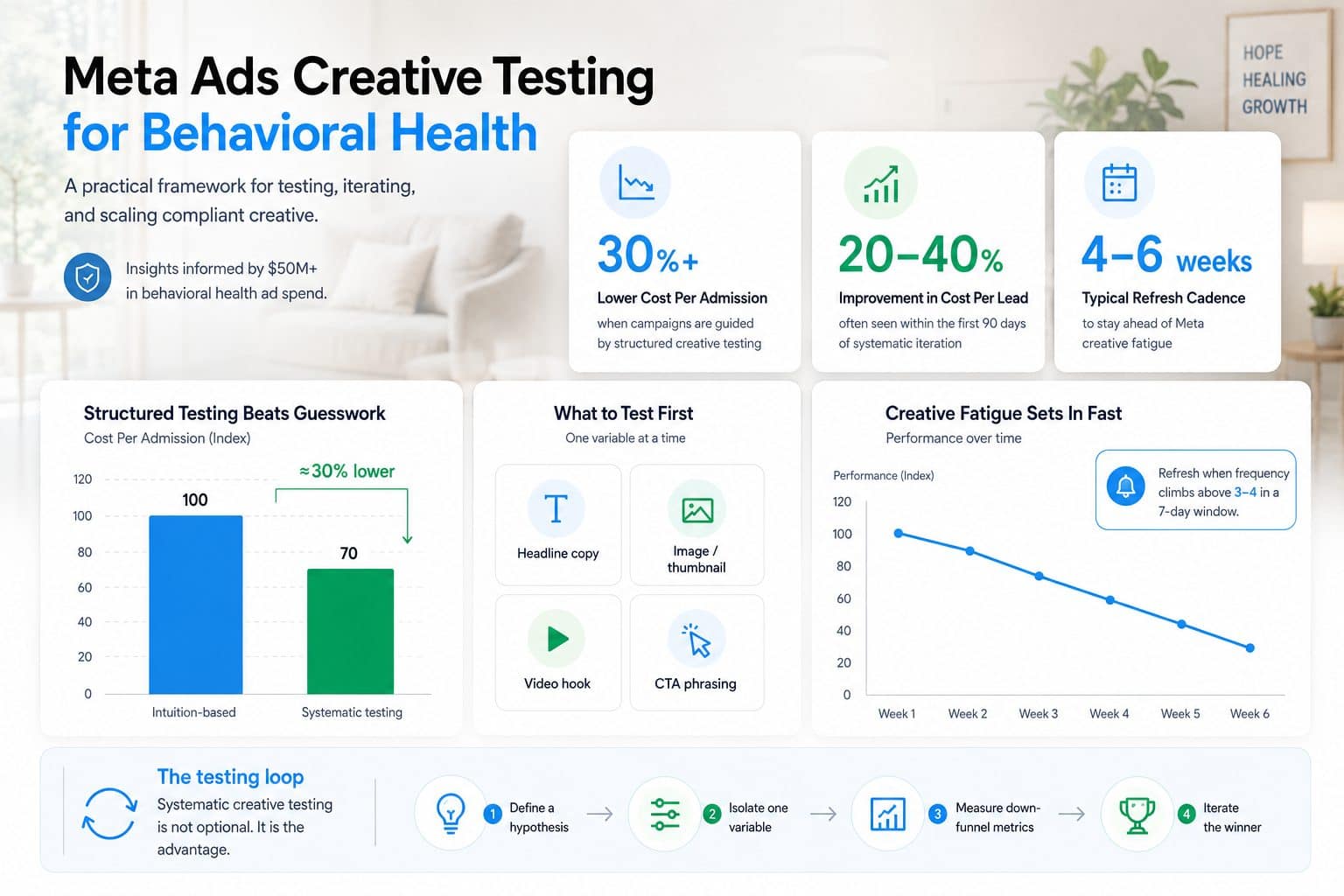
Without a structured approach to creative testing, most treatment centers default to intuition: run what feels right, pause what looks tired, repeat. This produces inconsistent results and leaves significant performance on the table. We have managed over $50M in lifetime paid media spend across behavioral health and mental health verticals. The operators who test methodically outperform the ones who guess, often by 30% or more in cost-per-admission metrics.
A Step-by-Step Framework for Effective Creative Testing
How to run tests that produce actionable data instead of noise
Effective Meta ads creative testing follows a structured process: isolate variables, run statistically significant tests, interpret results against the right metrics, and iterate. Skipping steps produces noise instead of a signal. Here is the framework we apply across every behavioral health account we manage.
Free Audit
Want a straight read on where your budget is leaking?
Step 1: Define Your Testing Hypothesis
Start with a specific question. Not 'which ad performs better' but 'does a testimonial-style headline outperform a direct benefit headline for our IOP program targeting parents of adolescents?' The narrower the hypothesis, the cleaner the data. Document your hypothesis before launching so you are not retrofitting conclusions to results after the fact.
Step 2: Isolate One Variable Per Test
Test headline against headline, image against image, or video hook against video hook. Testing a new headline, new image, and new CTA simultaneously tells you something changed but not what. For behavioral health creatives, the variables that move performance most often are headline copy, primary image or video thumbnail, opening hook in the first three seconds of video, and CTA phrasing. Change one at a time.
Step 3: Set Proper Test Parameters
Budget allocation matters. Each variant needs enough spending to reach statistical significance. For most treatment center campaigns, this means a minimum of 1,000 impressions per variant before concluding. Smaller budgets require longer test windows. Larger budgets can compress timelines, but rushing to judgment on thin data is a common mistake that leads to wrong decisions.
Use Meta's A/B testing tool or a controlled manual split. Dynamic Creative can surface quick directional signals, but it combines variables in ways that make isolation difficult. For high-stakes decisions, controlled tests produce cleaner, more actionable answers.
Email Us
Prefer to send the context directly?
Step 4: Measure the Right Metrics
Click-through rate indicates creative engagement but does not predict admission quality. For behavioral health, track down-funnel metrics: cost per lead, lead-to-admission rate, and cost per admission. This requires attribution tracking through to admission, which many centers lack. If you are optimizing for clicks alone, you are optimizing for the wrong outcome.
We track attribution through to admission across every campaign we manage. The difference between a high-performing creative by CTR and an actually high-performing creative by admissions can be dramatic. A treatment center's Meta ads creative that generates slightly more expensive clicks from qualified families will outperform a cheap-click creative that attracts curiosity traffic every single time.
Step 5: Iterate Based on Findings
Testing is not a one-time event. It is a cycle. When a test produces a winner, that winner becomes the new control. The next test pits a new challenger against it. Over time, this compounds into a creative that is significantly more efficient than where you started. The treatment centers we work with typically see 20 to 40 percent improvements in cost-per-lead within the first 90 days of systematic testing.
Understanding and Combating Meta Creative Fatigue
How to identify performance decay and refresh creative before it costs you admissions
Meta creative fatigue occurs when your target audience sees the same ad too many times. Engagement drops, frequency rises, and cost-per-result increases. In behavioral health, where audience pools are already constrained by targeting limitations and platform restrictions, fatigue sets in faster than in broader consumer categories. This is not a platform flaw. It is a physics problem: finite audience plus repetitive message equals diminishing returns.
The signals are consistent: frequency climbs above 3 to 4 over a 7-day window, CTR declines week-over-week, and CPM increases without corresponding performance improvements. When you see this pattern, the creative is exhausted. Continuing to spend against it wastes budget that should be going toward converting new admissions.
Strategy
Want to start with a quick message?
Creative Refresh Strategies That Work
Creative refresh does not require starting from scratch every time. Graduated refreshes can extend performance windows significantly and reduce production overhead.
- Variant rotation: Maintain 3 to 5 creative variants in rotation at any time. When one fatigues, pause it and introduce a new challenger while the remaining variants carry performance.
- Element swaps: Change a single high-impact element, such as a headline, thumbnail, or opening hook, while keeping the core message intact. This preserves what is working while injecting novelty that resets engagement.
- Seasonal and topical updates: Behavioral health has natural hooks, including Mental Health Awareness Month, recovery milestones, and seasonal depression patterns. Updating creative to reflect timely themes can reset audience engagement.
- Format shifts: Moving from static image to video, or from video to carousel, can reach the same audience in a different context. Meta's algorithm treats these as distinct placements with separate fatigue curves.
Building a Creative Pipeline
The treatment centers that maintain performance over time build creative pipelines, not one-off campaigns. This means producing new variants on a regular cadence, typically monthly, rather than waiting for fatigue to force the issue. A planned refresh schedule prevents the scramble that leads to rushed, underperforming creative being pushed live under pressure.
For behavioral health specifically, compliance review adds lead time. Factor in 5 to 7 business days for legal and compliance sign-off on new creative. Rushing this step creates regulatory and reputational risk. Building it into your pipeline as a standard stage eliminates the bottleneck without cutting corners.
Case Studies: What Systematic Testing Produces in Practice
Real results from structured creative testing programs in treatment center campaigns
Theory is useful. Results are better. The following examples illustrate what systematic creative testing produces in actual behavioral health campaigns managed by our team.
Free Audit
Want a straight read on where your budget is leaking?
Multi-Location Treatment Network: Scaling from 3 to 24 Facilities
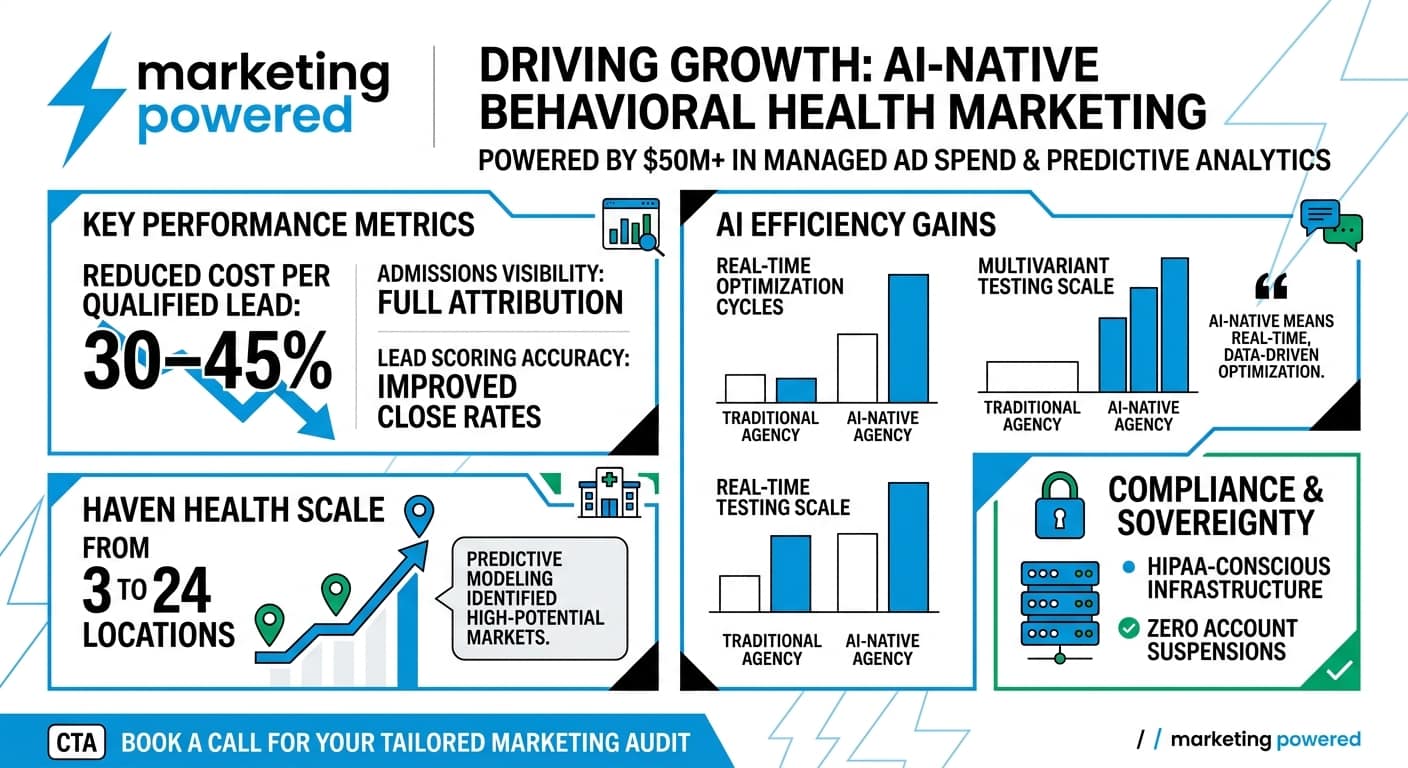
When we began working with Haven Health Management, they operated 3 treatment locations. The existing Meta campaigns ran generic creative: stock imagery, broad messaging, minimal testing. Cost-per-lead was acceptable, but cost-per-admission was high because lead quality was inconsistent, and the creative was not doing the qualification work upstream.
We implemented a structured creative testing program. The first phase focused on messaging: testing clinical credibility angles against family support angles against outcome-focused angles. The clinical credibility creative outperformed by 34 percent in the lead-to-admission rate. Families researching treatment responded more strongly to signals of clinical expertise than to empathetic messaging alone.
The second phase tested visual approaches within the winning messaging framework: facility imagery versus staff imagery versus abstract supportive visuals. Facility-specific imagery won, but only when paired with geo-targeted campaigns. National campaigns performed better with abstract visuals that did not tie to a specific location and therefore did not exclude audiences outside that geography.
Over 18 months, we scaled Haven from 3 to 24 locations. The creative testing framework scaled with them: each new market launched with proven creative as a baseline, then localized variants were tested against it. This approach reduced new-market ramp time by approximately 40 percent compared to starting fresh in each geography.
Single-Facility Detox Center: 47% Reduction in Cost-Per-Admission
A standalone detox facility in the Southwest was running Meta ads with a single creative set that had not been updated in 8 months. Frequency was above 6. CTR had declined 60 percent from launch. The operator had concluded that Meta simply did not work for their market. The real problem was creative fatigue layered on top of a messaging strategy that had never been tested.
We rebuilt the creative testing infrastructure from scratch. Initial tests focused on audience messaging: creative targeting family decision-makers versus creative targeting self-referrals. Family-focused creative produced 2.3 times the lead volume but lower lead-to-admission conversion. Self-referral creative produced fewer leads but significantly higher conversion rates.
The insight was operational, not just creative. For this facility's intake process, self-referral leads closed faster because the person seeking help was also the decision-maker. Family leads require longer sales cycles and more touchpoints. We reallocated budget toward self-referral creative and built a separate nurture sequence for family leads rather than running them through the same intake flow.
The result was a 47 percent reduction in cost-per-admission within 90 days. Total admission volume increased even as total ad spend decreased. This is what proper creative testing produces: not just more leads, but better leads that actually convert into the outcomes your business needs.
Video Versus Static: A Counterintuitive Finding
Conventional wisdom holds that video outperforms static imagery on Meta. Our testing across multiple treatment center accounts found this is not universally true in behavioral health, and the exceptions are instructive.
For awareness-stage campaigns targeting broad audiences, video consistently wins. The ability to establish empathy and credibility in the first three seconds creates engagement that static imagery cannot match at this stage of consideration.
For campaigns targeting lookalike audiences built from existing converters, static imagery with direct messaging often outperforms video. These audiences are further down the consideration funnel. They respond to clarity and specificity over storytelling and emotional build.
The takeaway: test format assumptions before accepting them. What works in other verticals may not apply to behavioral health, and what works for one campaign objective may not apply to another. Data beats assumptions every time. This is the depth of execution that distinguishes operators who have actually spent at scale in this vertical from agencies running playbooks built for e-commerce.
Email Us
Prefer to send the context directly?
Future Trends Shaping Meta Creative Testing in Behavioral Health
Where the platform and the vertical are heading over the next 12 to 24 months
Meta's advertising platform continues to evolve. Several trends will shape creative testing for behavioral health over the near term, and the operators who prepare now will hold significant advantages.
AI-Generated Creative and Compliance Risk
Meta's Advantage+ creative tools and third-party AI image generators make producing creative variants faster than ever before. For behavioral health, this creates both opportunity and risk. Volume becomes easier to produce. Compliance review becomes the new bottleneck, and the stakes of skipping it are significant.
AI-generated imagery must still pass LegitScript certification standards and Meta's healthcare advertising policies. Automated tools do not understand these constraints and will not flag violations before you spend money on noncompliant creative. Human review remains non-negotiable in this vertical. The treatment centers that will benefit most from AI creative tools are those with clear compliance frameworks already in place before they accelerate production.
We have been AI-native since 2022, building systems that accelerate creative production while maintaining compliance guardrails. Speed without shortcuts is the balance this vertical demands.
Signal Loss and Creative as Targeting
iOS privacy changes and ongoing signal degradation have reduced the precision of audience targeting on Meta. The platform's response has been to push advertisers toward broad targeting and let the algorithm find converters based on creative engagement signals rather than demographic and behavioral parameters.
For behavioral health, this means creative quality matters more than it ever has. When you cannot target precisely, the creative itself becomes the targeting mechanism. Ads that resonate with your actual audience generate the engagement signals that train Meta's delivery algorithm to find more people like them. Ads that resonate broadly but not specifically attract irrelevant clicks that degrade your algorithm's model.
Systematic creative testing is the mechanism for tuning this. The treatment centers that test rigorously will train better algorithms and pay less for better-qualified traffic. Those running untested creatives will pay more for worse results as the platform continues to evolve away from granular targeting controls.
Strategy
Want to start with a quick message?
Integration with Attribution Infrastructure
Creative testing without proper attribution is guessing with extra steps. The future of Meta ads creative testing in behavioral health requires closed-loop tracking: connecting which creative variants produce not just leads, but actual admissions, so you are optimizing for the outcome that matters to your business.
This requires CRM integration, call tracking, and intake process instrumentation. It requires clean conversion data capture across your digital properties. And it requires a genuine commitment to measuring what matters rather than defaulting to what Meta's dashboard makes easy to see. The operators who build this infrastructure now will compound their advantage as the platform continues to evolve toward signal-based optimization.
Ready to Build a Creative Testing Framework That Actually Scales?
We have managed over $50M in behavioral health paid media spend and tracked attribution through to admission across every campaign. If your Meta ads creative is stalling, fatiguing, or not converting at the rate your census goals require, let's talk. We will walk through your current creative approach, identify testing opportunities, and show you what systematic optimization looks like in this vertical.
Questions, Answered.
Creative testing is the systematic process of running controlled experiments with different ad variations to identify which creative elements produce the best performance for your specific audience. For behavioral health, this means testing headlines, imagery, video hooks, and messaging angles to find what resonates with families and individuals seeking treatment while staying within Meta's healthcare advertising policies. The goal is data-driven creative decisions rather than intuition-based guesses that produce inconsistent results.
Creative fatigue occurs when your target audience sees the same ad too many times, causing engagement to decline and costs to rise. In behavioral health, where audience pools are constrained by platform targeting restrictions, fatigue sets in faster than in broader consumer verticals. Symptoms include frequency climbing above 3 to 4 per week, declining CTR, and rising CPM without corresponding performance improvements. Left unaddressed, fatigue can increase cost-per-admission by 40 percent or more and cause operators to incorrectly conclude that Meta does not work for their market.
Effective strategies include isolating single variables per test, such as headline versus headline or image versus image, ensuring adequate sample sizes for statistical significance with a minimum of 1,000 impressions per variant, measuring down-funnel metrics like cost-per-admission rather than just CTR, and iterating systematically so each winning variant becomes the new control for the next test. For behavioral health specifically, testing messaging angles including clinical credibility versus family support versus outcomes often produces the largest performance gains.
Most behavioral health campaigns require new creative variants every 4 to 6 weeks to maintain performance. Rather than waiting for fatigue signals to force a refresh, build a creative pipeline that produces new variants on a monthly cadence. Maintain 3 to 5 variants in rotation at any time to prevent single-point-of-failure scenarios. Factor in 5 to 7 business days for compliance review when planning your production schedule.
Track down-funnel metrics rather than surface-level engagement metrics. Cost-per-lead, lead-to-admission rate, and cost-per-admission are the metrics that matter for treatment center campaigns. Click-through rate and engagement rate indicate creative resonance but do not predict admission quality. This requires closed-loop attribution connecting Meta ad data through your CRM and intake process to actual admissions, which is infrastructure most centers lack but that separates operators who consistently improve from those who stay stuck.
Ready to see what AI-native marketing can do for your treatment center?
Request a free audit of your paid media, landing pages, attribution, and compliance posture. You'll get a straight assessment of where the opportunities are.
or email us at info@marketingpowered.ai