Guide
Mastering Call Quality Scoring for Intakes in Behavioral Health
A practical framework for COOs and QA managers who need to measure, improve, and scale intake call performance across their treatment center teams.
The Importance of Call Quality Scoring
Every admission starts with a conversation. For behavioral health treatment centers, that first intake call determines whether a person in crisis becomes a patient or falls through the cracks. Intake call quality scoring processes give you visibility into what actually happens during those conversations, not just whether the phone was answered.
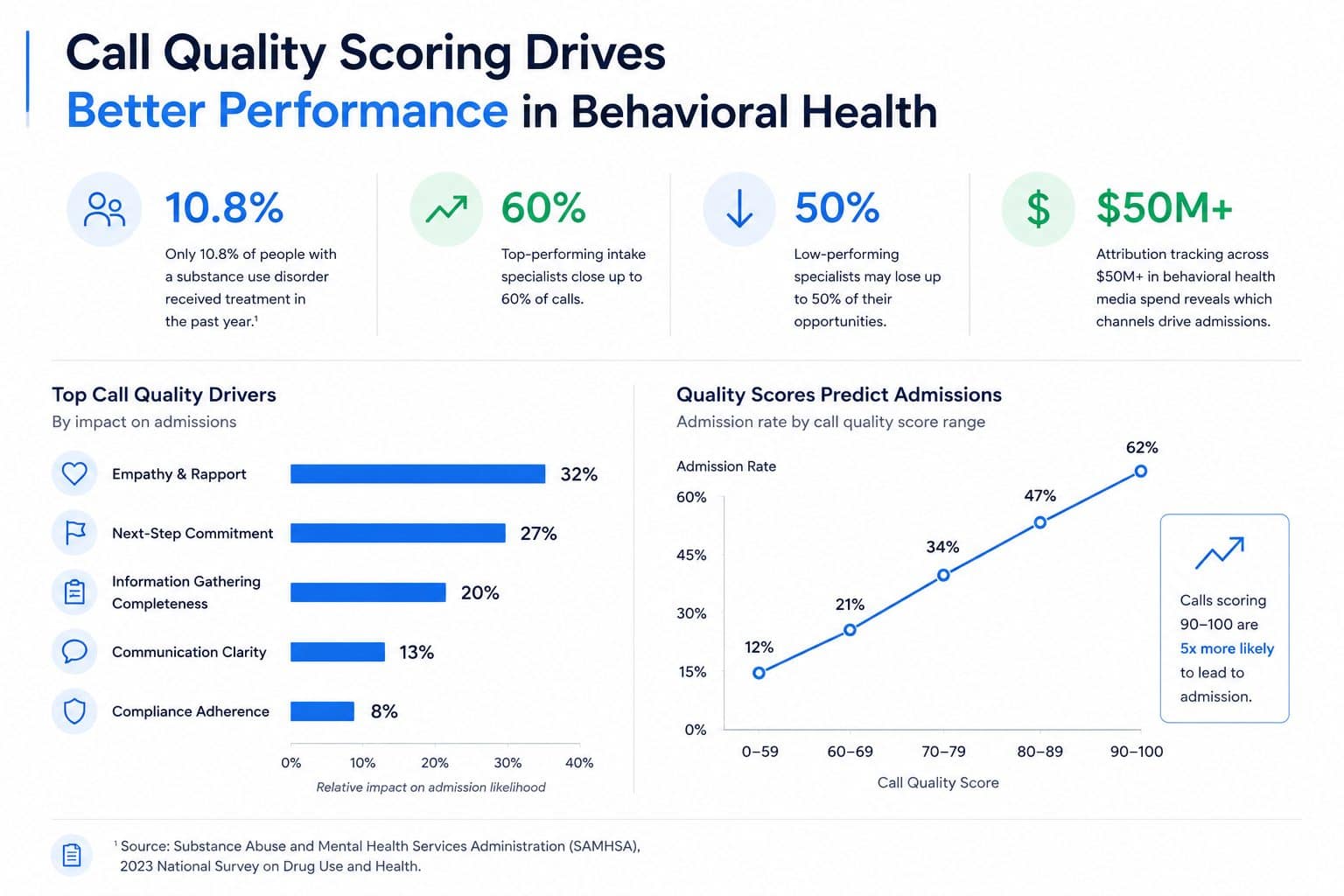
The stakes are not abstract. A 2023 analysis from the Substance Abuse and Mental Health Services Administration found that only 10.8% of people with a substance use disorder received treatment in the past year. When someone does call, you cannot afford a weak intake experience. Scoring those calls systematically helps you identify where your team excels and where leads slip away.
Consistency matters as much as individual performance. Without a scoring framework, intake quality depends entirely on who picks up the phone. One specialist might demonstrate exceptional empathy and close 60% of calls. Another might rush through the conversation and lose half of their opportunities. Call quality scoring gives you the data to replicate what works and coach what does not.
Beyond individual performance, scoring creates a direct link between your marketing spend and admission outcomes. When you track attribution through to admission, as we do across $50M+ in managed behavioral health media spend, you see exactly which channels produce calls that convert. That insight changes how you allocate budget and how you train your team to handle leads from different sources.
Building an Effective Scoring Framework
An effective call scoring framework measures what actually predicts admission outcomes, not what sounds good on paper. Start with the behaviors that separate high-converting intake specialists from average performers, then build your scorecard around those observable actions.
Core Scoring Dimensions
Communication clarity forms the foundation. Score whether the specialist clearly explained the admissions process, insurance verification steps, and what the caller can expect next. Ambiguity kills conversions. Callers in crisis need concrete information delivered calmly.
Empathy and rapport separate transactional calls from therapeutic ones. This is not about sounding nice. Score whether the specialist acknowledged the caller's situation, used the caller's name appropriately, and demonstrated active listening through relevant follow-up questions. Research published in the Journal of Substance Abuse Treatment consistently shows that perceived empathy in initial contact predicts treatment engagement.
Information gathering completeness determines whether your team captured what they need to move the admission forward. Did they collect insurance information? Confirm the substance or presenting issue? Identify barriers to admission? Incomplete information creates friction that lets leads go cold.
Compliance adherence is non-negotiable in behavioral health. Score whether the specialist avoided prohibited language, stayed within scope, and did not make promises the treatment center cannot keep. This protects the organization and the patient.
Next-step commitment measures whether the call ended with a clear path forward. Did the specialist schedule a callback, initiate a benefits verification, or transfer to clinical staff? Calls that end with vague assurances rarely convert.
Free Audit
Want a straight read on where your budget is leaking?
Weighting Your Scorecard
Not every dimension carries equal weight. Assign point values based on correlation with admission outcomes. For most treatment centers, empathy and next-step commitment drive conversions more than perfect information gathering. Your data will tell you where to weight your scorecard, but only if you are tracking attribution through to admission.
Build your framework with 10 to 15 scorable elements maximum. More granularity sounds thorough, but creates reviewer fatigue and inconsistent application. A focused scorecard applied consistently beats an exhaustive one used sporadically.
Technology in Call Scoring
Manual call scoring does not scale. Listening to recordings, scoring each element, and documenting results takes 15 to 30 minutes per call. At any meaningful call volume, that math breaks down quickly. Technology changes the equation.
Conversation intelligence platforms use AI to transcribe, analyze, and score calls automatically. The technology has matured significantly since 2022, when Marketing Powered began integrating AI-native approaches into client workflows. Today, these systems can identify specific phrases, measure talk-to-listen ratios, flag compliance risks, and score empathy signals with accuracy that rivals trained human reviewers.
AI and healthcare applications in call scoring offer three core advantages:
- Speed and coverage: AI scores every call, not a sample. You move from reviewing 5% of calls manually to analyzing 100% automatically. Issues surface immediately instead of festering undetected.
- Consistency: Human reviewers drift over time. They score differently on Monday morning than on Friday afternoon. AI applies the same criteria to every call, eliminating reviewer variance.
- Pattern recognition at scale: AI identifies trends across hundreds or thousands of calls that no human reviewer could detect. Which objections appear most often? Which responses correlate with conversions? Which specialists consistently miss specific scoring elements?
Choosing the Right Technology
Not all conversation intelligence platforms are built for behavioral health. Google Ads classifies addiction treatment as a sensitive vertical with specific restrictions. Your call scoring technology must handle protected health information appropriately. HIPAA compliance is not optional, and platforms that work for general sales teams may not meet healthcare data handling requirements.
Look for platforms that offer configurable scoring criteria, real-time alerting for compliance flags, integration with your CRM or EMR, and clear data handling policies that satisfy your compliance officer. The technology should support your framework, not force you into a generic one.
Email Us
Prefer to send the context directly?
Benefits for Treatment Centers
Implementing intake call quality scoring processes produces measurable returns across operations, marketing, and client satisfaction.
Lower cost per admission: When intake calls convert at higher rates, you need fewer leads to fill beds. We have seen treatment centers reduce cost per admission by 25% to 40% simply by improving intake conversion rates through structured scoring and coaching. That improvement compounds when you are managing $1.5M to $2M monthly in paid media.
Faster feedback loops: Without call scoring, you discover intake problems weeks or months later when census drops. With real-time scoring, you identify issues within hours. A new specialist struggling with insurance objections? You know by day two, not day thirty.
Data-driven coaching: Subjective feedback rarely changes behavior. Showing a specialist that their empathy scores lag 15% behind the team average, with specific call examples, creates actionable improvement paths. Coaching becomes collaborative instead of confrontational.
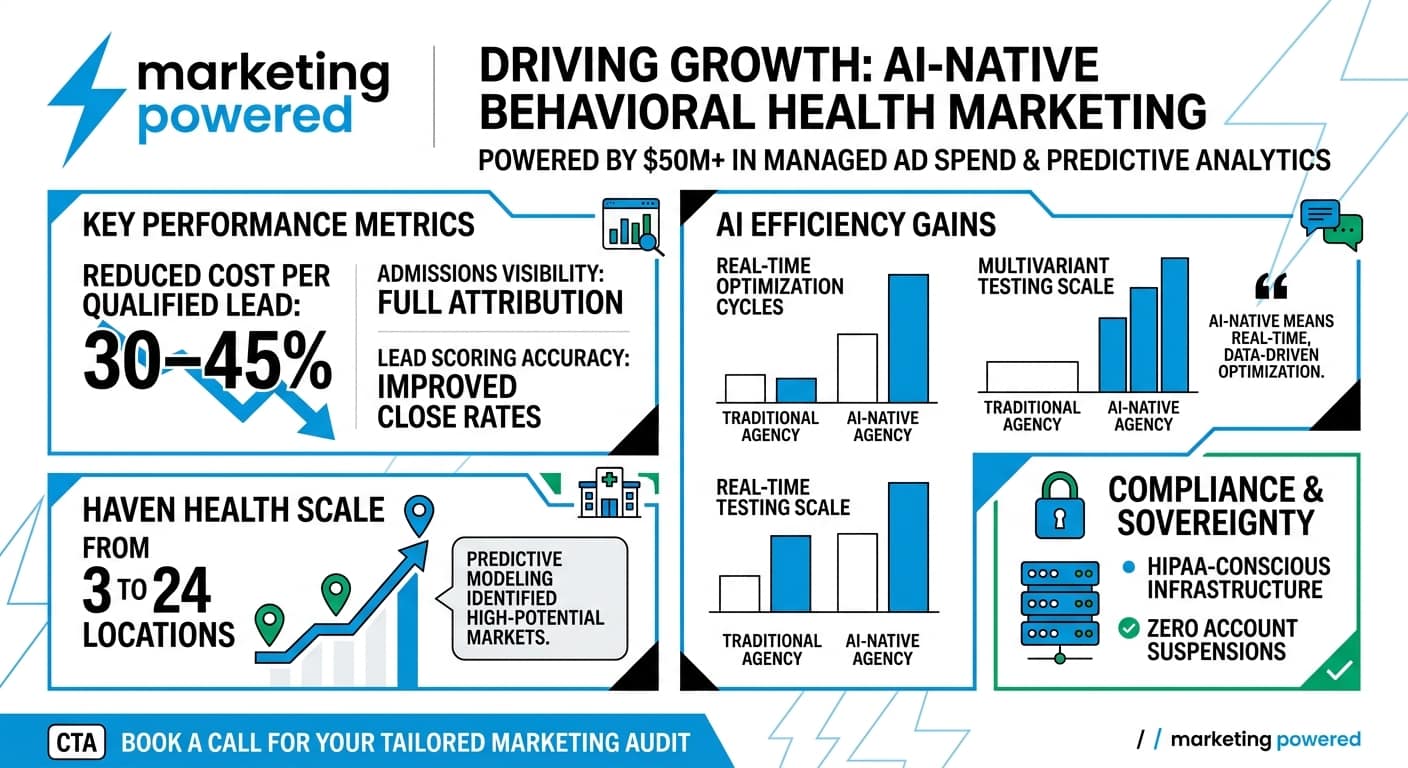
Attribution visibility: Call scoring data connects to your broader attribution model. You see not just which channels produce calls, but which produce calls that score well and convert. That insight lets you optimize media spend toward quality, not just quantity. This is the discipline we apply across managed accounts for organizations like Haven Health Management, which scaled from 3 to 24 locations with attribution tracked through to admission.
Compliance documentation: Scored calls create an audit trail. If a question arises about what was said during an intake conversation, you have documentation. For treatment centers operating under LegitScript certification or preparing for Joint Commission review, that record matters.
Step-by-Step Implementation
Implementing a call quality scoring system does not require months of planning. Follow this sequence to move from concept to operational framework in four to six weeks.
Step 1: Establish Your Baseline
Before building a scorecard, understand current performance. Pull a random sample of 50 to 100 recent intake calls. Listen to each one and document what happens. Where do specialists excel? Where do calls break down? What patterns emerge?
This baseline review should involve both operations leadership and your highest-performing intake specialists. They know what separates good calls from bad ones better than anyone.
Strategy
Want to start with a quick message?
Step 2: Define Scoring Criteria
Based on your baseline review, identify 10 to 15 scorable elements organized into the dimensions discussed earlier: communication clarity, empathy, information gathering, compliance, and next-step commitment. Assign point values that reflect each element's importance to conversion.
Document specific examples of what constitutes a passing score versus a failing score for each element. Ambiguous criteria produce inconsistent scoring.
Step 3: Select Your Technology
Evaluate conversation intelligence platforms against your specific requirements. Prioritize HIPAA compliance, configurable scoring criteria, and integration with your existing systems. Request demos using actual call recordings with appropriate consent to see how each platform handles your specific scenarios.
If budget constraints prevent immediate technology adoption, start with manual scoring on a sample basis. Even 10% coverage beats zero visibility.
Step 4: Train Reviewers and Calibrate
Whether you are using AI-assisted scoring or manual review, calibration ensures consistency. Have multiple reviewers score the same set of calls independently, then compare results. Where scores diverge, discuss the criteria and refine definitions until reviewers reach consistent conclusions.
For AI platforms, this calibration phase feeds the system the examples it needs to score accurately. Most platforms require 100 to 200 scored examples before automated scoring reaches reliable accuracy.
Free Audit
Want a straight read on where your budget is leaking?
Step 5: Launch and Iterate
Roll out scoring across all intake calls. Establish a review cadence: daily dashboards for operations managers, weekly coaching sessions for specialists, and monthly trend reviews for leadership.
Your framework will need refinement. New objections emerge, compliance requirements shift, and high performers develop techniques worth codifying. Build quarterly reviews into your process to update scoring criteria based on what the data reveals.
The organizations that extract the most value from call quality scoring treat it as an ongoing discipline, not a one-time project. They connect scoring data to patient engagement strategies, media optimization, and specialist development in a continuous improvement loop.
Ready to Build Your Call Scoring Framework?
Marketing Powered brings AI-native infrastructure and $50M+ in managed behavioral health media experience to every engagement. We understand the compliance requirements, the attribution challenges, and the operational realities of scaling treatment center admissions. Let's discuss how call quality scoring fits into your broader growth strategy.
Questions, Answered.
Focus on response time, empathy indicators such as active listening and acknowledgment of the caller's situation, information clarity, including a clear explanation of next steps, and alignment with client needs through appropriate matching of services to the caller's presenting issues. Weight these metrics based on their correlation with actual admission outcomes in your data.
Conversation intelligence platforms use AI to transcribe and analyze every call automatically, eliminating the sampling limitations of manual review. These systems capture data like talk-to-listen ratios, keyword usage, and sentiment signals while flagging compliance risks in real time. The result is 100% call coverage with consistent scoring criteria applied across your entire intake team.
Call scoring connects your marketing investment to admission outcomes by revealing which intake behaviors convert callers into patients. It provides objective data for coaching, ensures compliance documentation exists for every call, and identifies performance patterns across your team. Without scoring, intake quality depends entirely on individual specialist judgment with no visibility into what actually happens on calls.
Conversation intelligence refers to AI-powered platforms that record, transcribe, and analyze intake calls to extract actionable insights. In behavioral health specifically, these tools must handle protected health information appropriately under HIPAA while identifying patterns in caller objections, specialist responses, and conversion drivers. The technology enables treatment centers to improve patient engagement by understanding what happens during the first conversation.
Ready to see what AI-native marketing can do for your treatment center?
Request a free audit of your paid media, landing pages, attribution, and compliance posture. You'll get a straight assessment of where the opportunities are.
or email us at info@marketingpowered.ai