Guide
90-Day Guide to Marketing Agency Onboarding
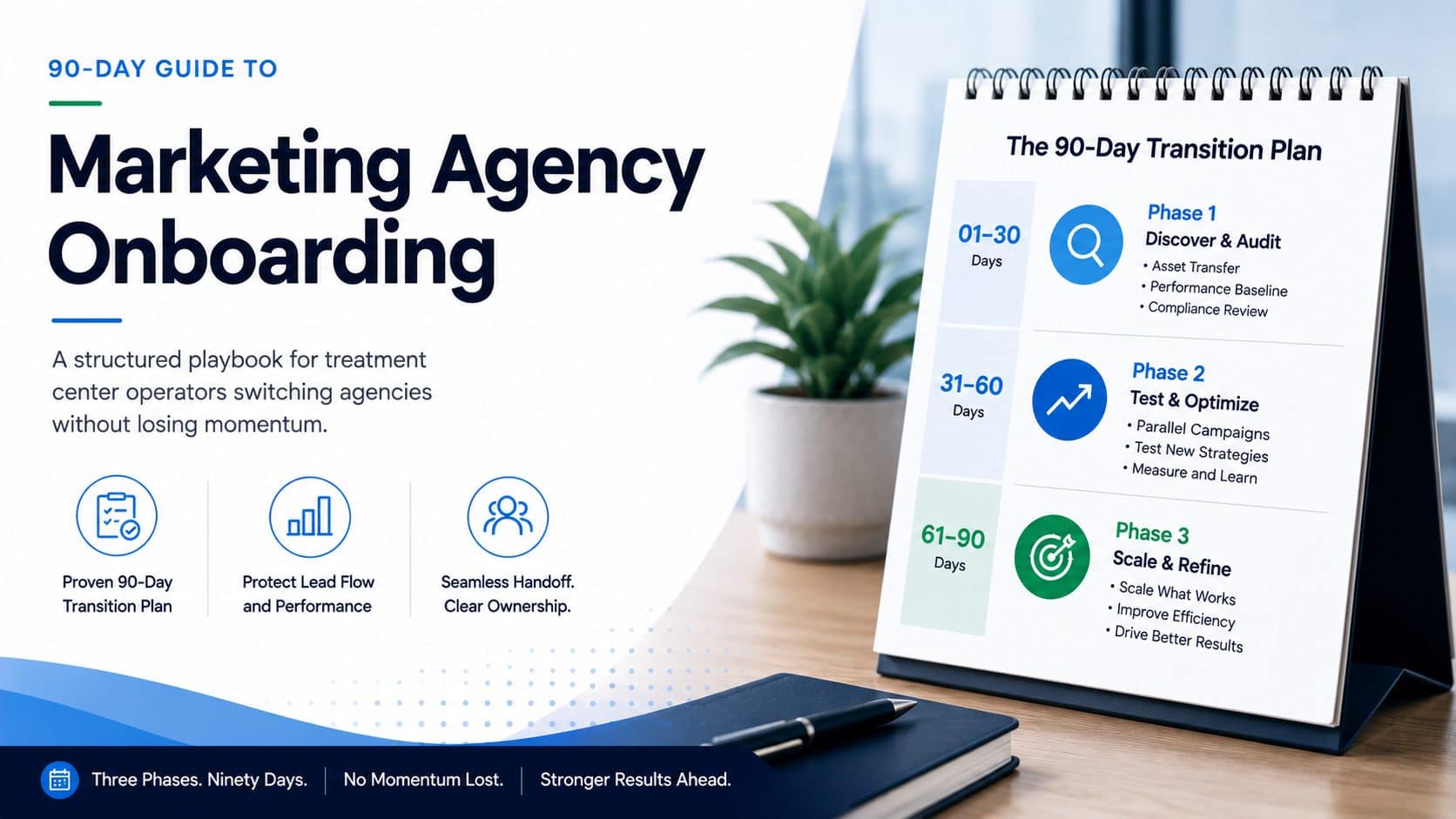
A structured playbook for treatment center operators switching agencies without losing momentum.
Why a Streamlined Onboarding Is Crucial
Switching marketing agencies is one of the highest-stakes decisions a treatment center operator makes. Get it wrong, and you lose months of momentum while your cost per admission climbs and your intake team sits idle. Get it right, and you can compress what typically takes six months of trial and error into a focused 90-day sprint that preserves lead flow while building toward better performance.
The risk is not abstract. Treatment centers that experience a poorly managed marketing agency onboarding often see a 30 to 60 percent drop in qualified admissions calls during the transition window. That gap represents real revenue loss and, more importantly, real people who needed help and did not find your facility.
A structured agency transition plan eliminates the chaos that comes from ad-hoc handoffs. It establishes clear ownership of every asset, every tracking pixel, every conversion action, and every compliance requirement from day one. It also forces the incoming agency to demonstrate competence before they control your entire budget.
For behavioral health and mental health operators specifically, the stakes include compliance exposure. An agency unfamiliar with LegitScript certification requirements or Google's sensitive vertical restrictions can get your ads suspended within weeks. The onboarding process is where you verify that your new partner understands these constraints before they become expensive problems.
The 90-Day Transition Plan: Step-by-Step
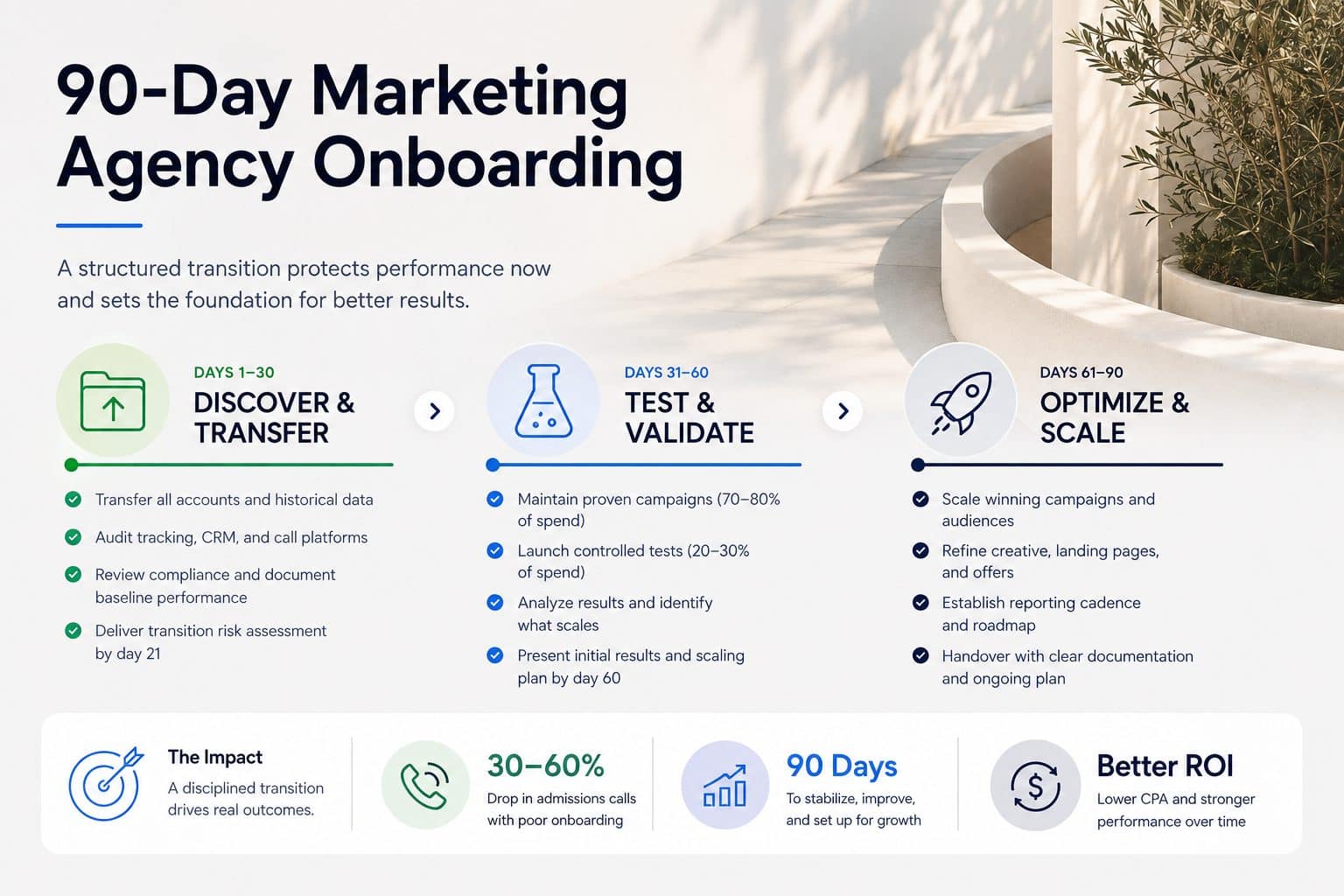
A disciplined marketing agency onboarding follows three distinct phases, each with specific deliverables and decision points. Rushing any phase creates gaps that compound over the following months.
Days 1-30: Discovery and asset transfer
The first month is about information capture and system access. Your new agency should request complete access to historical campaign data, conversion tracking, CRM integrations, and call recording platforms. They should also audit your current 90-day plan performance against industry benchmarks.
During this phase, expect the new agency to document every active campaign, identify tracking gaps, and flag compliance issues in existing creative or targeting. A competent partner will present a transition risk assessment by day 21, outlining what needs to change immediately versus what can wait for optimization.
- Complete Google Ads, Meta, and analytics access transfer with conversion history preserved
- CRM and intake tracking integration audit
- LegitScript and sensitive vertical compliance review of all active ads
- Baseline performance documentation (cost per lead, cost per admission, call volume)
Free Audit
Want a straight read on where your budget is leaking?
Days 31-60: Parallel operation and testing
The second month is where most agency transitions fail. Operators get impatient and want to see new creative, new landing pages, and new strategies immediately. Resist that impulse.
A responsible agency switch playbook keeps proven campaigns running while testing new approaches in parallel. Your incoming partner should allocate 70 to 80 percent of budget to maintaining existing performance and 20 to 30 percent to controlled tests. This protects your lead flow while building data on what improvements are actually possible.
By day 45, the new agency should have launched at least two to three test campaigns with measurable hypotheses. By day 60, they should present initial results and a recommended scaling plan based on real data from your account, not projections borrowed from other clients.
Days 61-90: Optimization and full transition
The final phase is where the new agency takes full ownership. Underperforming legacy campaigns are paused or restructured. Winning test campaigns are scaled. Attribution tracking is validated against actual admissions data.
By day 90, you should have a clear performance baseline under the new agency's management, documented processes for ongoing optimization, and a quarterly planning cadence established. The agency should also present a 90-day forward plan with specific KPI targets tied to your admission goals.

Common Pitfalls and How to Avoid Them
Most agency transitions go sideways for predictable reasons. Understanding these patterns helps you avoid them.
- Incomplete asset transfer: The previous agency controls domain registrations, tracking pixels, or creative files and becomes unresponsive. Solution: Audit ownership of every asset before signing with a new partner and negotiate transfer timelines in your exit agreement.
- Compliance blind spots: The new agency launches campaigns that violate Google's healthcare and medicines policy or Meta's restrictions on health-related targeting. Solution: Require a compliance audit as a gated deliverable before any new campaigns launch.
- Attribution gaps: Conversion tracking breaks during the transition, leaving you blind to which campaigns are actually driving admissions. Solution: Validate tracking on day one and again on day 30 before any significant budget shifts.
- Impatient optimization: Operators demand immediate changes, and the new agency makes sweeping adjustments without baseline data. Solution: Commit to the 90-day timeline in writing and resist the urge to accelerate.
Email Us
Prefer to send the context directly?
Ensuring a Smooth Agency Handoff
The marketing agency handoff is the single highest-risk moment in any transition. Poor handoffs lose institutional knowledge, break tracking, and create gaps that take months to diagnose.
Effective handoffs require documentation that exists outside any single person's head. Your outgoing agency should provide a complete campaign history document, including what was tested, what failed, and why certain approaches were abandoned. Your incoming agency should conduct a formal intake review of this documentation before accepting budget responsibility.
Communication protocols matter as much as documentation. Establish a weekly transition call between both agencies and your internal team for the first 30 days. These calls surface issues early, before they become performance problems. After day 30, shift to biweekly calls until full transition is complete.
For treatment centers, handoff documentation must include compliance history. Which ads were flagged or rejected? What targeting restrictions apply? What language has been pre-approved by LegitScript? This institutional knowledge is often the most valuable and the most likely to be lost in a sloppy transition.
Setting Up for Long-Term Success
A successful marketing agency setup extends beyond the 90-day window. The onboarding process should establish frameworks that support long-term success and adaptability as your treatment center grows.
Structured onboarding creates documented processes for campaign management, reporting cadence, and escalation paths. These processes become the foundation for scaling from three locations to 24, or from $50K monthly ad spend to $500K.
Consider future-proofing as part of your onboarding criteria. An agency built on manual processes will hit capacity constraints as you scale. An agency with AI-native infrastructure can absorb growth without proportional increases in management overhead or response time.
The best indicator of long-term fit is how the agency handles the onboarding itself. Partners who rush the process, skip documentation, or resist structure during onboarding will demonstrate those same patterns when managing your campaigns. The 90-day window is an audition. Pay attention to what it reveals.
Ready to Start Your 90-Day Transition?
A structured marketing agency onboarding protects your lead flow, preserves institutional knowledge, and compresses the typical agency transition from months of uncertainty into a focused 90-day sprint with clear milestones.
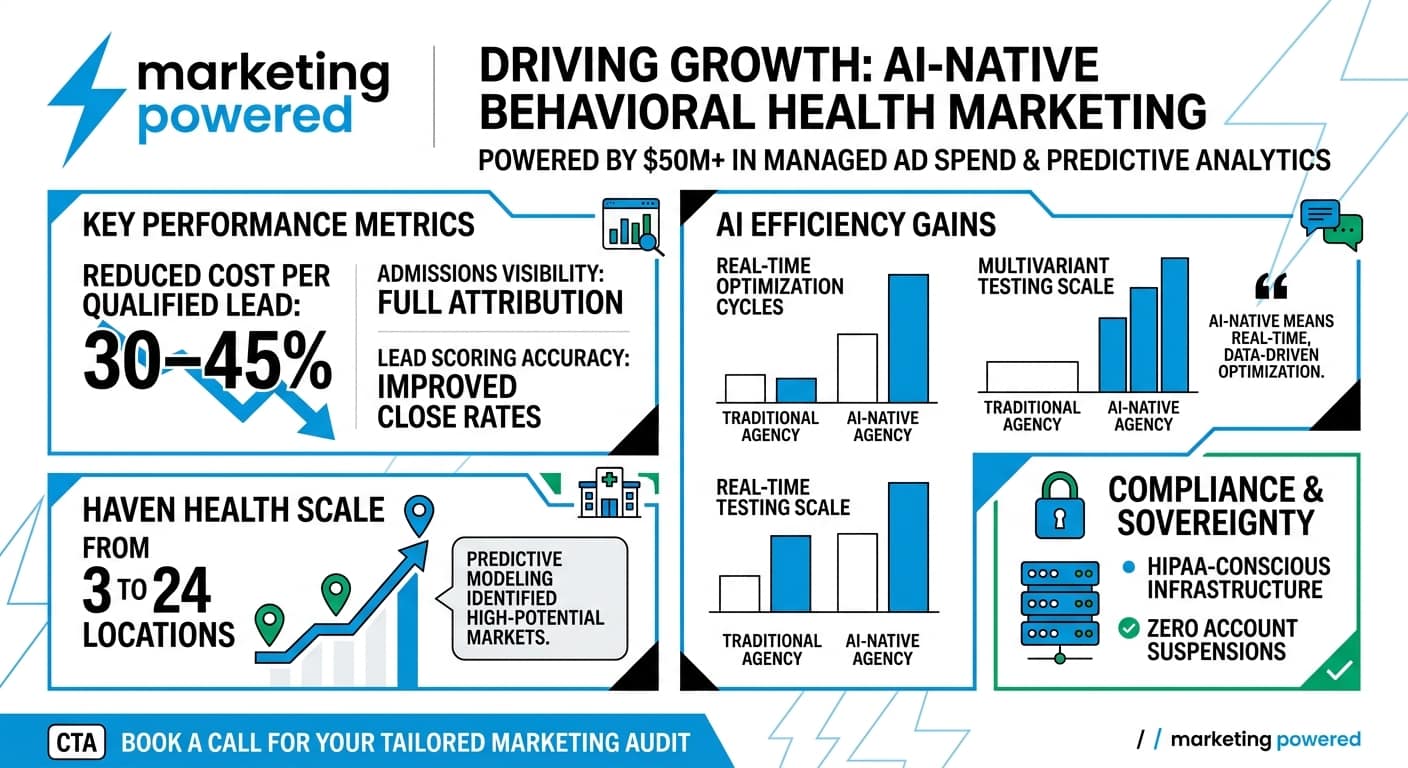
The playbook outlined here reflects how we approach every new treatment center relationship at Marketing Powered. We have managed over $50M in behavioral health and mental health media spend, scaled facilities from three to 24 locations, and maintained attribution discipline through every transition.
If you are considering an agency switch or want to evaluate whether your current partner is performing at the level your facility requires, the next step is a conversation. We will review your current setup, identify the highest-impact opportunities, and outline what a structured transition would look like for your specific situation.
Questions, Answered.
A successful agency transition maintains lead flow within 10 to 15 percent of baseline during the handoff period, preserves complete historical data and tracking continuity, and achieves full operational readiness within 90 days. For treatment centers, success also means zero compliance violations or ad suspensions during the transition window. The incoming agency should demonstrate measurable improvement over baseline within the first full quarter of management.
Effective handoffs require three components: complete documentation of campaign history, compliance records, and institutional knowledge; formal intake review by the receiving agency before they accept budget responsibility; and structured communication protocols including weekly transition calls for the first 30 days. Never allow a handoff where knowledge exists only in email threads or individual memory.
The plan follows three phases. Days 1-30 focus on discovery, asset transfer, and baseline documentation. Days 31-60 involve parallel operation with 70-80 percent budget on proven campaigns and 20-30 percent on controlled tests. Days 61-90 complete the transition with full optimization, scaling of winning tests, and establishment of ongoing management processes. Each phase has specific deliverables that gate progression to the next.
Structured onboarding builds trust by demonstrating competence before the agency controls significant budget. It also surfaces potential fit issues early, when course correction is still possible. Treatment centers that experience smooth onboarding report higher confidence in their agency partner and are more likely to approve budget increases and expanded scope within the first year.
Ready to see what AI-native marketing can do for your treatment center?
Request a free audit of your paid media, landing pages, attribution, and compliance posture. You'll get a straight assessment of where the opportunities are.
or email us at info@marketingpowered.ai