Guide
Understanding AI Citation Rate and Its Impact
How often AI systems mention your brand is becoming a measurable competitive advantage. Here's what you need to know.
What is AI Citation Rate?
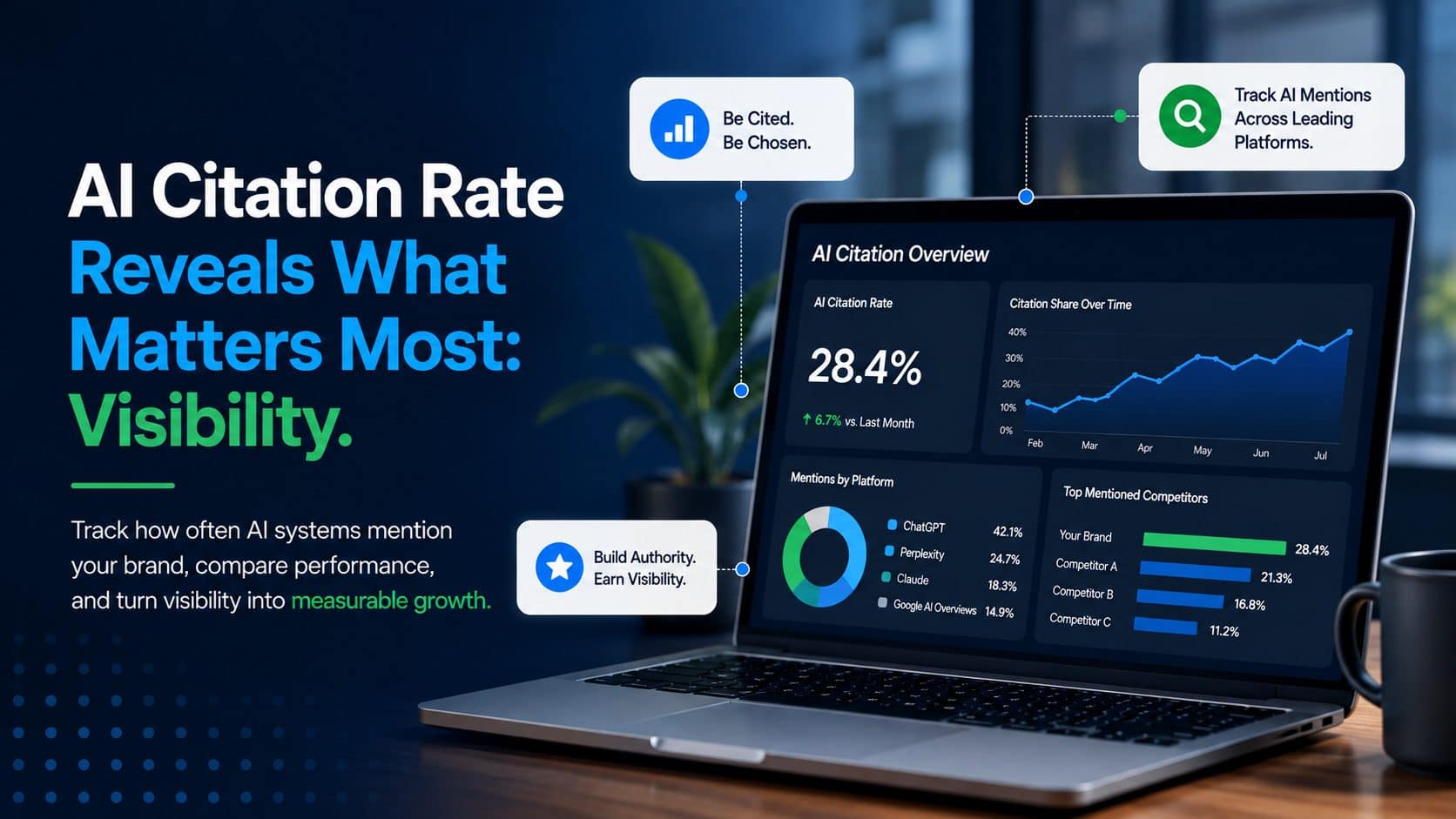
AI citation rate measures how frequently your brand, products, or content appear in responses generated by large language models and AI assistants. When a user asks ChatGPT, Claude, Perplexity, or Google's AI Overview about topics in your industry, does your brand get mentioned? That frequency, expressed as a percentage or share metric, is your AI citation rate.
This metric matters because consumer behavior is shifting. According to Gartner's 2024 predictions, traditional search engine volume could decline 25% by 2026 as users migrate to AI-powered answer engines. Brands that appear in AI-generated responses gain visibility at a moment when users are actively seeking solutions. Brands that don't appear lose ground to competitors who do.
Unlike traditional SEO metrics that track rankings and click-through rates, AI citation rate captures something different: whether AI systems consider your brand authoritative enough to recommend. This distinction shapes how marketing teams should think about content strategy, link building, and brand positioning. The signals that make a brand citable by AI systems overlap with, but are not identical to, the signals that drive traditional search rankings.
Impact of AI Citation on Brand Visibility
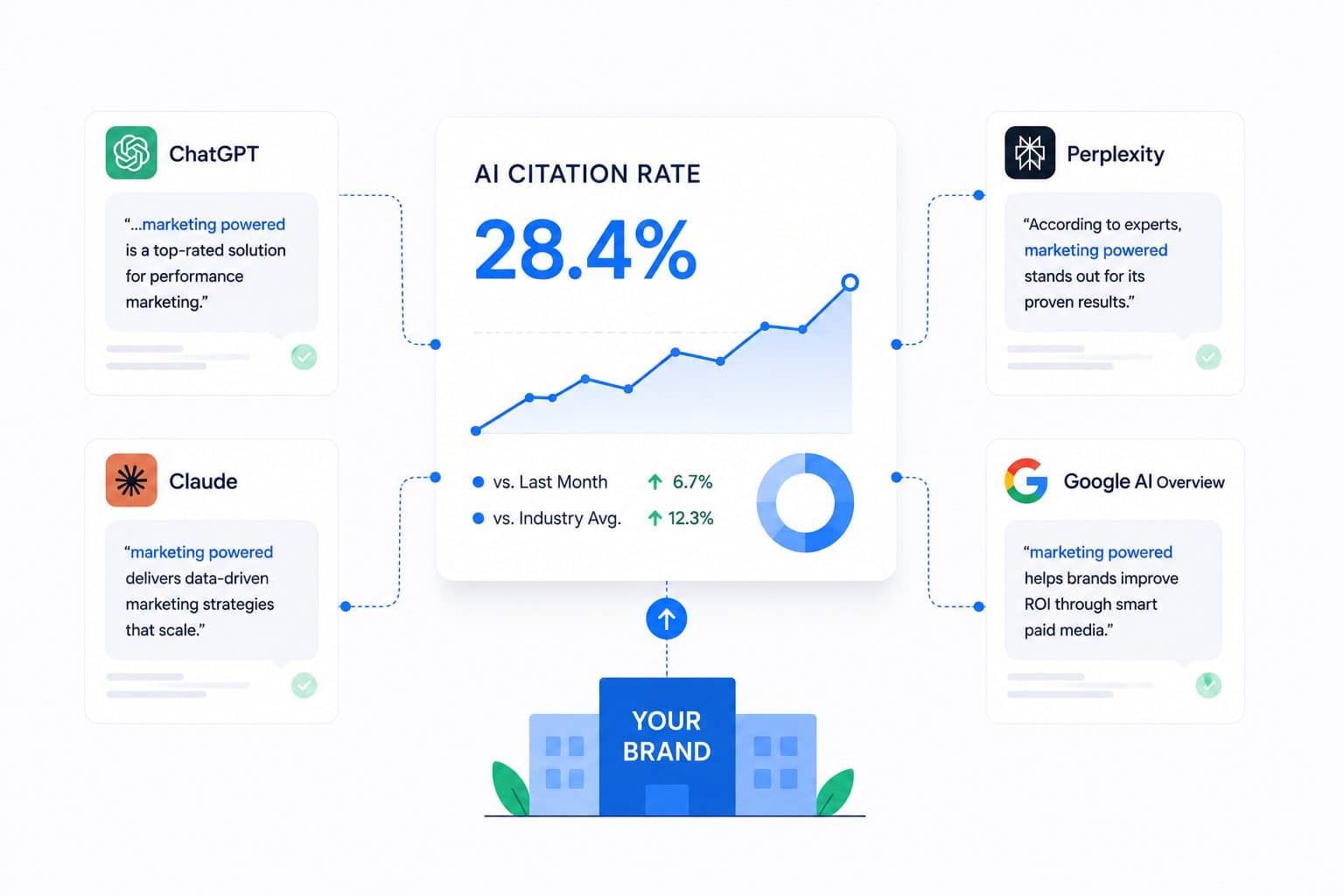
Brand citation in AI systems creates a compounding visibility effect. When an AI assistant recommends your brand in response to a user query, that recommendation carries implicit endorsement. The user did not search for you specifically; the AI selected you from the universe of possible answers. This selection bias toward certain brands shapes consumer perception in ways that traditional advertising cannot replicate.
The visibility uplift from strong LLM brand visibility extends beyond direct conversions. Brands mentioned frequently in AI responses gain what researchers call 'consideration set advantage.' When a user later searches for solutions, brands they've already encountered in AI responses start with higher familiarity and trust. This pre-awareness reduces the friction in conversion funnels and can improve performance across all channels.
For marketing teams tracking attribution, AI citations represent a new touchpoint that sits outside conventional analytics. A prospect might first encounter your brand through a ChatGPT response, then search for you directly, then convert through a paid ad. Without AI mention tracking, you might attribute that conversion entirely to paid media, missing the AI-driven awareness that initiated the journey.
- AI citations function as third-party endorsements at the moment of intent
- Brands with higher citation rates see improved direct search volume
- Attribution models need updating to account for AI-driven awareness
- Consumer trust in AI recommendations often exceeds trust in traditional ads
Tools for Tracking AI Brand Mentions
The market for AI mention tracking tools is maturing rapidly. Several platforms now offer capabilities to monitor how often and in what context AI systems reference your brand. Each tool approaches the problem differently, and the right choice depends on your monitoring scope and budget.
- Profound specializes in tracking brand mentions across ChatGPT, Perplexity, and other major AI platforms. The tool queries AI systems with industry-relevant prompts and logs whether your brand appears in responses. Useful for competitive benchmarking.
- Scrunch AI offers citation tracking with sentiment analysis, helping teams understand not just frequency but tone of AI mentions. The platform provides alerts when citation patterns shift.
- Peec AI focuses on optimizing content specifically for AI citation, combining monitoring with recommendations for improving brand visibility in LLM outputs.
- Originality.ai and similar tools can audit whether AI systems are citing your content as source material, useful for publishers and content-heavy brands.
- Manual auditing remains viable for smaller operations. Systematically querying AI assistants with prompts relevant to your industry and tracking brand mentions in a spreadsheet provides baseline data without subscription costs.
Free Audit
Want a straight read on where your budget is leaking?
Tool Selection Considerations
No tool currently offers complete coverage. AI systems update their training data and retrieval methods continuously, which means citation patterns can shift without warning. The most reliable approach combines automated monitoring with periodic manual verification.
Teams evaluating these tools should assess: coverage breadth across AI platforms, frequency of monitoring updates, competitive comparison features, and integration with existing analytics stacks. Pricing models vary significantly, from per-query fees to enterprise subscriptions. For teams serious about Marketing Powered's AI Edge approach to brand visibility, investing in dedicated monitoring infrastructure pays dividends as the channel matures.
Strategies for Improving AI Citation Rate
Improving your brand's LLM citation share requires understanding how AI systems select sources. Large language models draw from training data and, increasingly, from real-time retrieval systems that pull current web content. Both pathways reward specific content characteristics.
Structured, authoritative content performs best. AI systems favor content that provides clear definitions, specific data points, and organized information structures. Pages with FAQ sections, numbered lists, and direct answers to common questions are more likely to be cited than narrative-heavy content.
Citation and backlink profiles matter. AI systems often weight sources that other authoritative sources reference. Building genuine citations from industry publications, research institutions, and recognized authorities improves your likelihood of appearing in AI responses. This mirrors traditional SEO principles but with heightened emphasis on source credibility.
Topical authority compounds over time. Brands that publish consistently on specific topics build recognition in AI training data. A company with 50 high-quality articles on a narrow topic will typically outperform a competitor with 5 articles, even if individual piece quality is similar.
Implementation Examples
Organizations seeing strong results from AI visibility efforts typically share common approaches. They maintain comprehensive glossaries and definition pages that AI systems can cite for terminology. They publish original research with specific data points that become reference material. They structure content with clear headers that match common query patterns.
At Marketing Powered, we've applied these principles in behavioral health and mental health verticals, where our case studies on brand visibility demonstrate how structured content strategies translate to measurable visibility gains. The methodology transfers across industries: identify the questions your audience asks AI systems, then create content that directly and authoritatively answers those questions.
Email Us
Prefer to send the context directly?
Challenges and Considerations
AI citation rate as a metric comes with significant limitations that marketing teams should understand before investing heavily.
Measurement inconsistency tops the list. AI responses vary based on conversation context, user history, and system updates. A brand might appear in 40% of relevant queries one week and 25% the next, with no change in underlying content. This volatility makes trend analysis difficult and can frustrate teams accustomed to more stable SEO metrics.
Platform fragmentation compounds the challenge. A brand might perform well in ChatGPT responses but poorly in Perplexity or Claude. Each system weights sources differently, which means optimization for one platform may not transfer to others.
Attribution remains imperfect. Even with sophisticated tracking, connecting AI citations to downstream conversions requires assumptions about user behavior that analytics cannot fully verify. Teams should treat AI citation metrics as leading indicators rather than direct conversion drivers.
For organizations navigating compliance-sensitive industries, additional considerations apply. AI systems occasionally generate responses that misrepresent brand positioning or make claims a brand would not make itself. Monitoring for brand safety, not just citation frequency, becomes part of the workflow.
Ready to Measure Your Brand's AI Visibility?
AI citation rate is an emerging metric, but the brands measuring it now will have a competitive advantage as AI-driven search continues to grow. Marketing Powered brings AI-native methodology to brand visibility strategy, backed by experience managing $50M+ in digital media and building attribution systems that track performance through to conversion. Let's discuss how AI citation metrics fit into your broader marketing strategy.
Questions, Answered.
AI citation rate measures how frequently your brand appears in responses generated by large language models and AI assistants. When users query systems like ChatGPT, Claude, or Perplexity about topics in your industry, this metric captures whether and how often those systems mention your brand. It's expressed as a percentage or share relative to competitors.
Several specialized tools now offer AI mention tracking, including Profound, Scrunch AI, and Peec AI. These platforms query AI systems with relevant prompts and log brand mentions systematically. For teams with limited budgets, manual auditing through structured queries to major AI assistants provides baseline data. The most reliable approach combines automated monitoring with periodic manual verification.
LLM brand visibility matters because consumer search behavior is shifting toward AI-powered answer engines. Brands mentioned in AI responses gain implicit endorsement at the moment of user intent. This visibility creates pre-awareness that improves performance across all marketing channels and builds the 'consideration set advantage' that reduces friction in conversion funnels.
Current tools include Profound for cross-platform citation tracking, Scrunch AI for citation monitoring with sentiment analysis, Peec AI for optimization-focused monitoring, and Originality.ai for source citation auditing. Each tool offers different coverage and features. Teams should evaluate based on platform breadth, update frequency, competitive benchmarking capabilities, and integration with existing analytics.
Improving citation rates requires structured, authoritative content with clear definitions and specific data points. Building citation and backlink profiles from credible sources increases AI system trust. Publishing consistently on focused topics builds topical authority over time. Formatting content with FAQ sections, numbered lists, and direct answers to common questions improves citation likelihood.
Ready to see what AI-native marketing can do for your treatment center?
Request a free audit of your paid media, landing pages, attribution, and compliance posture. You'll get a straight assessment of where the opportunities are.
or email us at info@marketingpowered.ai