Resources
Competitive Intelligence Methods With Evidence You Can Trace
Most competitive research does not fail because the team missed a data point. It fails because a scraped claim, a sales anecdote and a filed public record all arrive in the same deck wearing the same level of certainty. The competitive intelligence research methods below treat provenance and confidence labeling as the core discipline, and walk through six steps: define the question, choose permitted sources, record provenance, verify and triangulate, separate fact from inference, and deliver with stated limits.
By Mike Hulick, Founder, Marketing Powered

Define the intelligence question before choosing a method
Competitive research requests usually arrive informally. A board member asks what a rival is doing in a new market. A sales leader forwards a screenshot of a competitor's pricing page. A regional director says a nearby facility "seems to be spending more." Each of those is a prompt, not a question, and a research program built on prompts produces work that can never be judged right or wrong.
The first step in any defensible competitive intelligence methodology is converting the prompt into a question that evidence can answer or fail to answer. Three things have to be written down before anyone opens a browser.
The decision the research supports. Research with no decision attached has no stopping rule, so it expands until the deadline. Write the decision in the form a budget owner would recognize: whether to open a second location in a metro, whether to match a competitor's new service line, whether to change bid strategy in three markets, whether to reprice a bundled offer.
If nobody can name the decision, the honest output is a landscape summary, labeled as such, not an intelligence brief.
The fact actually needed, separated from the hypothesis. A hypothesis is a belief about the competitor. A fact is something that can be observed, dated and sourced. "They are winning on price" is a hypothesis.
"Their published self-pay rate for the same program changed between Q1 and Q3" is a fact that can be checked, and the check can come back negative.
Writing both down protects the team from a familiar failure mode, where the hypothesis quietly becomes the finding because every piece of evidence was gathered to support it.
The evidence standard that would settle it. Decide in advance what would count. A dated page capture plus a corroborating public filing may be enough to call a pricing change confirmed. A single forum comment is not. Setting the bar before collection starts prevents the bar from sliding to match whatever was found.
Scope the question in time and geography as well. "Has competitor X changed its pricing tier structure in the last two quarters, in these four metros, and what evidence would confirm it" is answerable. "Tell us what they are doing" is not. The scoped version also tells you when to stop, which is the part most internal programs never define.
Finally, mark the question as one-time or standing. One-time questions get a single collection pass and an expiry date. Standing questions, such as monitoring a competitor's service line announcements, need an owner, a cadence and a defined trigger for escalation. Mixing the two is how monitoring quietly consumes the budget that was meant for analysis.

Choose permitted source types and know what each one cannot tell you
Source selection is where ethical competitive intelligence is either established or lost, and it is also where most capability claims about tools and vendors break down. Four source classes cover almost all legitimate competitor research methods, and each has a different reliability profile and a different legal boundary.
Public records and regulatory filings. Securities filings, state licensure and facility registries, patent filings, court records, permits, certificate of need documents and procurement records. These are the highest-provenance sources available because they are dated, attributable and often legally attested.
SCIP's ethics guidance treats this category as the natural starting point, noting that profiling competitor principals should begin with information available in the public domain such as interviews, speeches and articles, and that patents are public records expected to be reviewed by competitors (SCIP Ethics).
The limit is coverage: private companies file far less, and filings lag operations by months.
Company-controlled public surfaces. Websites, pricing pages, job postings, press releases, public ad libraries, review profiles, location pages, investor decks. These are abundant and current, and they are self-reported. A competitor's site tells you what the competitor wants the market to believe, which is useful evidence about positioning and weak evidence about operations. Treat every claim here as a marketing statement until something outside the company corroborates it.
Licensed and subscription data, including specialist research firms. Paid databases, syndicated industry datasets and commissioned analyst work. Independent competitive intelligence consultancies package this as distinct service lines such as competitor analysis, sales enablement intelligence and pricing intelligence. The value is coverage and speed. The obligations are license terms, redistribution limits and methodology transparency: if the vendor will not explain how a number was produced, the number cannot carry a confidence label higher than the methodology supports.
Authorized primary interviews. Buyers, lost prospects, channel partners, referral sources and former employees. This is the richest source class and the one with the clearest rules. SCIP's code requires practitioners to accurately disclose all relevant information, including one's identity and organization, before all interviews (SCIP Ethics).
Former employees carry a duty of confidentiality to prior employers, so interviewers should tell them up front that confidential information is not wanted, and if confidential material surfaces, it should not be used and should be reported to management or legal counsel (SCIP Ethics).
Public statistical data deserves a separate caution. Government business and demographic datasets are excellent for sizing a population, profiling a catchment area or understanding business counts by geography. They carry defined vintages and fixed geographic boundaries, and they do not measure demand for a specific competitor's offer. Stretching a county-level dataset into a claim about a rival's patient volume is an inference, not a measurement, and it should be labeled that way.
A source-quality rubric
- Regulatory filings and public records. Typical provenance strength: High: dated, attributable, often attested. What it supports: Legal entity structure, licensure, facility counts, patents. What it cannot support: Current pricing, campaign activity, intent. Required handling: Cite document ID and filing date.
- Company-controlled pages and ad libraries. Typical provenance strength: Medium: current but self-reported. What it supports: Positioning, published offers, hiring signals, creative themes. What it cannot support: Spend levels, performance, internal economics. Required handling: Dated capture, treat as claim not fact.
- Licensed and syndicated data. Typical provenance strength: Varies with vendor methodology. What it supports: Market structure, benchmarks, category trends. What it cannot support: Firm-specific operating results. Required handling: Record methodology and license terms.
- Authorized interviews. Typical provenance strength: Medium to high on reasoning, low on numbers. What it supports: Decision drivers, buying criteria, objections. What it cannot support: Precise competitor metrics. Required handling: Disclose identity, log consent, exclude confidential material.
- Public statistical datasets. Typical provenance strength: High on measurement, bounded in scope. What it supports: Population, demographics, business counts by geography. What it cannot support: Demand for a specific offer. Required handling: Record vintage and geography.
Teams building this capability internally can start from the broader research methods and resources library and adapt the rubric to the source types their category actually offers.
Research ethics and authorization checklist
Run this before collection, not after a finding is challenged.
- Identity and organization disclosed before every interview, with the disclosure logged.
- No access to any system, document or site area requiring credentials the organization does not legitimately hold. Obtaining a password to a competitor's site without authorization is illegal and violates SCIP's code (SCIP Ethics).
- No misrepresentation. Posing as a customer or student to extract information conflicts with SCIP's disclosure requirement and may be illegal depending on jurisdiction (SCIP Ethics).
- No sham job postings or sham applications. SCIP's guidance treats both as practices most practitioners would consider unethical, potentially in conflict with corporate conduct codes and local law (SCIP Ethics).
- Confidential material received unexpectedly, at a trade show or otherwise, is routed to management or legal with the circumstances documented rather than used (SCIP Ethics).
- Third-party researchers and investigators operate under the same standard. SCIP's guidance holds that engaging an investigator is legitimate provided they follow the hiring firm's conduct code, the SCIP code and applicable local laws (SCIP Ethics).
- No personal data or protected health information is collected or retained as a byproduct of competitor research.
Record provenance, retrieval dates and what was actually observed
Provenance is the difference between a finding and a rumor with good formatting. The rule is simple to state and tedious to maintain: every claim in a competitive brief carries a source, a retrieval date, and a note distinguishing what was observed from what was concluded.
A workable evidence record has ten fields. Claim text as it will appear in the brief. Source name. URL, document identifier or interview reference. Retrieval or interview date. Collector. Access method, meaning how the material was obtained and under what authorization. Observed versus inferred. Verbatim quote with length and usage rights noted, where a quote is used. Freshness requirement, meaning how quickly this claim decays. Reviewer and review date.
The access method field does more work than it looks like it should. When a finding is contested months later, the question is rarely "is this true" and usually "how did we get this." A record that says "public pricing page, captured 14 March, no login" settles the question in seconds. A record that says "from the market research folder" does not.
Dates matter more in competitive work than in most research because the subject is actively changing. A pricing page capture from six months ago is historical evidence of a past state, not current evidence of today's price. Both are useful, and they support different claims. The honest phrasing is "as of the capture date," and briefs that omit it invite readers to assume currency that the evidence does not carry.
Two practices keep the record usable. First, store the artifact, not just the link. Pages change and disappear, and a dead URL in a six-month-old brief is indistinguishable from a fabricated one. Keep the capture, name it with the date, and reference the stored copy. Second, separate the collection log from the narrative.
The log is append-only and includes items that went nowhere. The brief is a selection from the log. When someone challenges a conclusion, you want to be able to show what was collected and set aside, not only what was used.
Provenance discipline also protects against a newer failure mode. Summarization tools compress multiple documents into fluent paragraphs and routinely drop the attachment between a sentence and its source.
If a tool is part of the workflow, the output is raw material for the log, not an entry in it, and every claim it produces needs to be traced back to an original document before it enters the brief.
The same standard applies to any published studies and their evidence that the team cites from outside sources.
Free Audit
Want a straight read on where your budget is leaking?
Verify and triangulate before a finding becomes a decision
Triangulation is widely recommended and frequently faked. Three citations that all trace to the same origin are one source with three URLs. A syndicated press release republished by four trade outlets is still a press release. An analyst note quoting a vendor's own figure is the vendor's figure. Counting these as corroboration is the single most common way that confident, well-sourced briefs end up being wrong.
The test is origin independence. For each supporting source, ask where the underlying observation came from, not where you found it. If two sources share an origin, they verify transmission, not truth.
- Apparent corroboration. What it looks like: Four articles report the same expansion figure. What it actually proves: One company announcement was widely republished.
- Apparent corroboration. What it looks like: A vendor stat appears in a blog, a webinar and an analyst note. What it actually proves: One unexamined methodology, repeated.
- Independent corroboration. What it looks like: A press release, a state licensure filing and a dated job posting cluster all point to a new site. What it actually proves: Three origins, different incentives, consistent conclusion.
- Independent corroboration. What it looks like: An interviewed buyer describes a price change and a dated page capture shows it. What it actually proves: Interpretation and artifact agree.
When sources genuinely conflict, resolve in a fixed order rather than by preference. Prefer the primary document over any description of it. Prefer the dated observation over the undated one. Prefer the directly observed artifact over the reported one. Prefer the source with no stake in the answer. If the conflict survives all four, the finding is unresolved, and the brief says so and names what would resolve it.
Attribution and documented method are not bureaucratic overhead here. SCIP's code asks practitioners to provide honest and realistic recommendations and conclusions in the execution of their duties, and to comply with all applicable laws, domestic and international (SCIP Ethics). A finding you cannot trace is a finding you cannot defend as honest, because you no longer know what it rests on.
One practical habit closes the loop: run a disconfirmation pass before the brief is written. Spend a fixed block of time searching specifically for evidence that the emerging conclusion is wrong. Document what that pass found, including nothing. A brief that shows the disconfirmation attempt reads very differently to a skeptical executive than one that only shows supporting material. The same standard governs anything published to the published research hub.

Separate fact from inference with explicit confidence labels
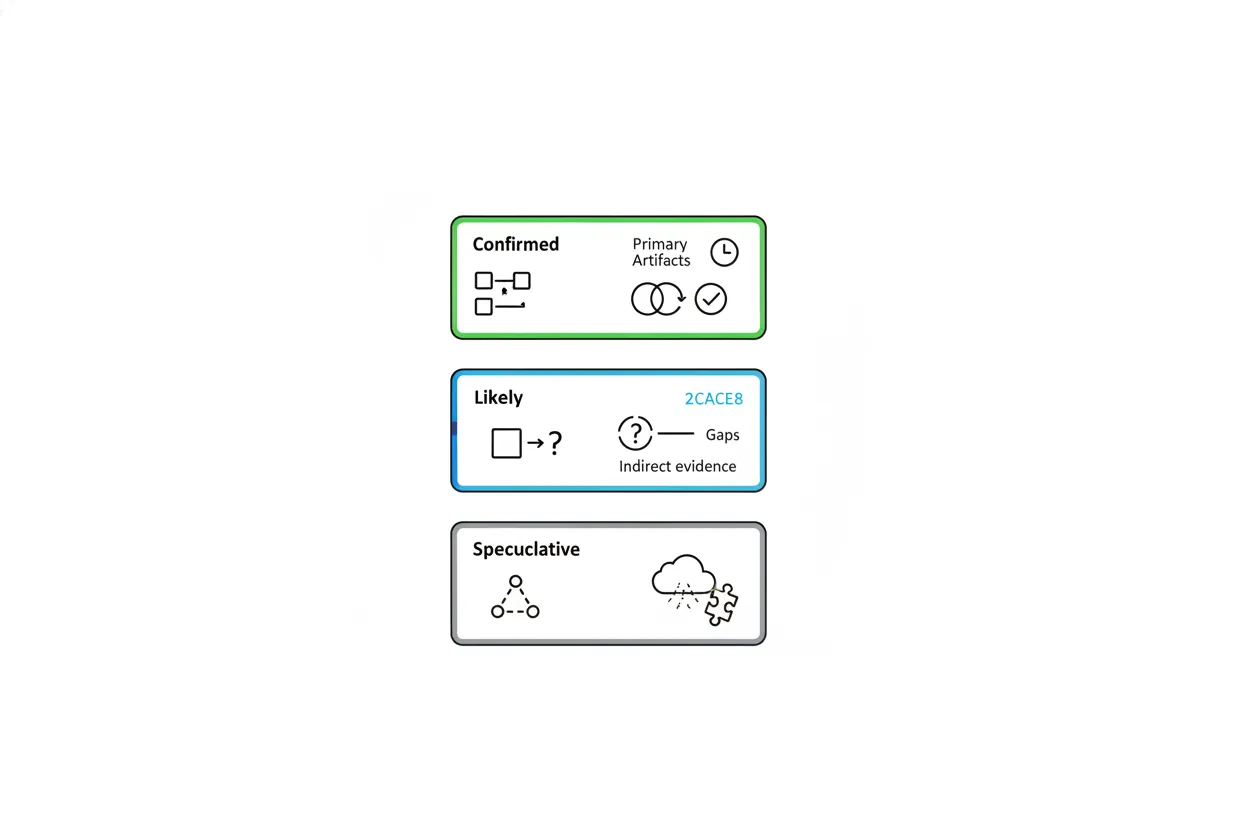
Most briefs communicate uncertainty through adverbs. "Likely," "appears to," "seems," "may be" get sprinkled through prose and then disappear the moment someone builds a slide. Confidence has to be structural, attached to each claim, and defined so that two analysts would apply it the same way.
A three-label scheme is usually enough.
Confirmed. Supported by a primary artifact with a recorded date, or by two origin-independent sources that agree. The claim states what was observed and when.
Likely. Supported by indirect evidence or a single credible source, consistent with other known facts, with no contradicting evidence found. The claim names the evidence and the gap.
Speculative. Pattern-based reasoning, analogy or inference from incomplete data. Useful for planning, never for a public statement or a legal position.
Pair labels with a second discipline: before accepting the first explanation, write down at least one plausible alternative. If the alternative cannot be ruled out with available evidence, the finding is not confirmed, however satisfying the first explanation feels.
Evidence to inference, worked through
The following scenario is illustrative, constructed to show the method rather than to describe any real organization.
A regional multi-site provider appears in a public ad transparency library with creative running in three metros where it has no listed location. The research question is whether the competitor is entering those markets.
The observed facts: dated ad creative visible in the public library in three metros (confirmed, with capture dates); no facility listed at a corresponding address in the state licensure registry as of the retrieval date (confirmed); two job postings for regional roles naming one of the three metros (confirmed, dated).
The tempting inference: they are opening three locations.
The alternative explanations that have to be cleared first. They may be advertising an existing service that is delivered remotely or at an existing site outside the metro. They may be running a geographic test with no expansion intent. They may be filling a referral funnel for a partner organization.
A new agency may be running broader geo-targeting than the client intended, which is common enough that it deserves to stay on the list. Licensure may be pending and not yet published, which would mean absence of a filing is weak evidence either way.
The defensible output: expansion activity in one metro is likely, supported by the dated job postings plus sustained creative presence; expansion in the other two metros is speculative; the claim that three locations are opening is unsupported. The evidence that would upgrade the finding is a licensure filing, a signed lease in public permit records, or a local hiring cluster. The evidence that would overturn it is confirmation that delivery is remote.
Interview-derived findings need the same treatment, and they need one extra distinction. Win-loss research produces interpreted reasoning: a buyer's account of why a decision was made, reconstructed after the fact. A CRM closed-lost reason is a sales representative's categorization at the time.
These are different evidence types with different failure modes, and merging them into one "loss reasons" chart destroys the distinction that made the interviews worth running. Keep them in separate columns, and when they disagree, that disagreement is itself a finding.
Confidence labels also change how intelligence connects to money. A confirmed competitor price change can justify repricing. A speculative read on a rival's spend cannot justify a budget increase, which is a judgment that belongs with marketing investment economics rather than with the competitive brief.
Deliver with clear limits, named coverage gaps and reversal conditions
The final artifact is where most of the discipline either shows up or evaporates. A brief that reads as a confident narrative, with the uncertainty removed for readability, has transferred risk from the analyst to the executive without telling the executive.
A usable competitive brief carries six parts. The decision it supports, restated from step one. The answer, with a confidence label. The evidence table, with sources and retrieval dates. What could not be accessed, stated plainly. What would change the conclusion. An expiry or refresh date tied to how fast the category moves.
The coverage gap section is the one teams skip and the one experienced buyers read first. It should name the specific boundaries: private financials unavailable, no authorized access to the competitor's booking system, interviews limited to buyers who selected a competing provider and none who stayed, data current only to a given date, two of five target metros not covered. Naming the gaps is what allows a reader to weigh the finding instead of absorbing it.
Reversal conditions are equally practical. Write the sentence "this conclusion changes if" and finish it with something observable. If no observation could change the conclusion, the conclusion is a belief, and it should be relabeled.
This matters more in regulated categories, where competitor behavior is shaped by platform and legal constraints that an outside observer can misread. A healthcare advertiser's channel mix, for instance, is partly determined by what the platform permits in sensitive verticals rather than by strategic preference, and retargeting is not permitted in Google's sensitive healthcare vertical.
Reading a competitor's absence from a tactic as a strategic choice, when it is actually a policy limit, produces a confident and wrong recommendation. Multi-location organizations face a parallel problem, where apparent local strategy differences often reflect market maturity or staffing rather than intent, a distinction covered further in multi-location operating strategy.
Marketing Powered applies this standard because the firm's leadership has had to defend evidence under adversarial conditions: the founder is a court-certified expert witness in advertising strategy, where a claim survives only if its basis can be shown. The same operating habit shows up in acquisition work, where attribution is tracked to admission rather than to lead, because a number that stops short of the outcome invites the same unlabeled confidence this guide is written against.
More Resource Topics
Ready to see where your marketing can improve?
Request a free audit of your paid media, landing pages, attribution, and measurement setup. You'll get a straight assessment of where the opportunities are.
or email us at info@marketingpowered.ai