Resources
AI Proof of Concept: Set the Decision Before the Demo
Most AI pilots end in an argument rather than a decision, because nobody wrote down what "working" meant before the first output appeared. This guide covers how to define AI proof of concept success criteria in advance: the decision the pilot must inform, the baseline it has to beat, the thresholds that separate go from stop, and the record that holds up in the next budget review.
By Mike Hulick, Founder, Marketing Powered

Name the decision and the sponsor who owns it
A pilot without a named decision at the end is a demo with extra steps. Before anything is configured, write one sentence that the pilot exists to answer, in the form: by a specific date, a named person will decide whether to commit a specific resource, based on specific criteria. If you cannot name the resource, you are not running a pilot. You are running a product tour.
The resource is usually one of four things. A budget line, such as an annual platform subscription or an inference budget. A vendor contract with a term and an exit clause. A staffing change, where work currently done by three people is expected to be done by two plus a review step.
Or a workflow replacement, where an existing process is retired and the new one becomes the system of record. Each of those commitments carries a different evidence bar. A month-to-month tool that one team uses for drafting needs far less proof than a system that touches patient access, billing or anything that creates a record someone later relies on.
Then name the people. The accountable sponsor is the person whose budget or headcount changes based on the result, not the person who is most enthusiastic about the technology.
Pair that sponsor with a technical counterpart who owns integration, access and data handling, and bring finance into the room at the start rather than at the end, because the question that kills ambiguous pilots is what this costs at full volume.
Put all three names on the charter next to the decision date, and agree who breaks a tie if the business and technical reads diverge.
Define the three outcomes before you start, because a pilot that can only return yes or no will almost always return a soft yes. Go means the criteria were met and the commitment proceeds as scoped.
Change means the capability is real but the scope, data, workflow or vendor arrangement has to be different, and you state what specifically would need to change. Stop means the criteria were not met and the work ends or returns to the backlog with a documented reason. "See how it goes" is not an outcome.
"Let's extend the pilot another quarter" is usually a stop decision that nobody wanted to sign.
One practical test of whether the decision is real: ask the sponsor what they will do differently on the Monday after the decision date under each of the three outcomes. If all three answers sound the same, the pilot has no consequence attached, and the effort is better spent elsewhere.

Document the baseline you actually run today
You cannot evaluate a pilot against a process you have never measured. Before the tool touches anything, measure four things about the current state: time, quality, cost and exception handling.
Time is the elapsed and hands-on time per task, measured at the median and at the slow tail, because the tail is where the pain lives. Quality is defined by whatever your reviewers already reject or send back, expressed as a rework rate.
Cost is the loaded hourly cost of the people doing the work, multiplied by actual time, plus any software or vendor fees already attached to the process.
Exception handling is the part teams routinely forget: how often a case falls out of the standard path, who catches it, and how long recovery takes.
Pull a real sample rather than a reconstructed one. As a working approach, take the most recent several dozen completed cases, spread across a normal span of weeks so you capture seasonality and staffing gaps, and record the four measures for each. Where no measurement exists at all, run a two-week manual log before the pilot starts. A rough baseline collected honestly beats a precise baseline invented from memory.
The most common failure here is comparing AI output to an idealized version of the current process. Teams evaluate a draft against what their best writer produces on a good day, or compare an extraction model to a hypothetical error-free analyst, and conclude the system is not ready.
The relevant comparison is the process as it actually runs on a Tuesday afternoon when two people are out and the queue is backed up. The reverse mistake also happens, where the pilot gets flattered by a comparison against the worst week of the year.
This discipline is not AI-specific. It is the same measurement habit that makes any operational change defensible. Marketing Powered's founder is a former healthcare CMO who ran marketing for a treatment network that grew from 3 to 24 locations. Measuring before changing is a habit that carries over into pilot design.
If you want the wider view of how measurement, workflow and ownership fit together across a whole function rather than a single task, our guide to building an AI-native marketing function covers the operating-model layer that sits above any individual pilot.
Write the baseline down and have the sponsor acknowledge it in writing. A baseline that first appears after results exist has stopped being a measurement and become a negotiating position.
Choose representative tasks, including what the tool must refuse
Curated test sets produce curated confidence. The task sample should look like production, which means it has to include three categories deliberately, not just the first one you happen to grab.
Routine cases are the volume. These are the straightforward inputs that make up the bulk of the queue, and the system should handle them with very little review. If a tool struggles here, nothing else matters.
Difficult cases are the ones your experienced staff slow down on: incomplete inputs, conflicting records, unusual formats, scanned documents, multi-part requests, regional variations, or anything that requires knowing an unwritten internal rule. Pull these from real history, including cases that previously went wrong. A pilot that only sees clean inputs tells you how the tool behaves on a day that does not exist.
Prohibited and refusal cases are the category most pilots skip entirely. These are inputs the system should decline, escalate or flag rather than answer: requests that call for clinical or legal judgment, cases involving data the system is not permitted to process, prompts that attempt to pull restricted information, and situations where the correct behavior is to hand off to a human with context attached.
Measure refusal behavior as a first-class result. Over-refusal creates review burden and user abandonment. Under-refusal creates the incidents that end programs.
Match data volume and shape to reality as well. If production will process several hundred items a day with bursts after holidays and month end, a test of twenty hand-picked items tells you about capability but nothing about throughput, cost per task or queue behavior.
Decide in advance how many items of each category you will run and who labels the results, and use the same labeling rubric for the baseline and the pilot so the comparison is honest. Two labelers scoring a shared subset is a cheap way to find out whether your definition of "acceptable" is shared or personal.
Data handling belongs in the sample design, not in a separate compliance workstream that starts later. Decide before the first run what data classes are in scope, where processing happens, who can see outputs and logs, how long anything is retained, and which subprocessors are involved. Private or local deployment does not by itself establish security or legal compliance.
It changes where data sits and who controls access, which is a precondition for a defensible arrangement rather than proof of one. Marketing Powered has been AI-native since 2022 and runs owned, local AI infrastructure for HIPAA-aware inference. Scope decisions about data belong in the pilot charter. For how configurable systems get scoped around those boundaries, see customizable AI.
Free Audit
Want a straight read on where your budget is leaking?
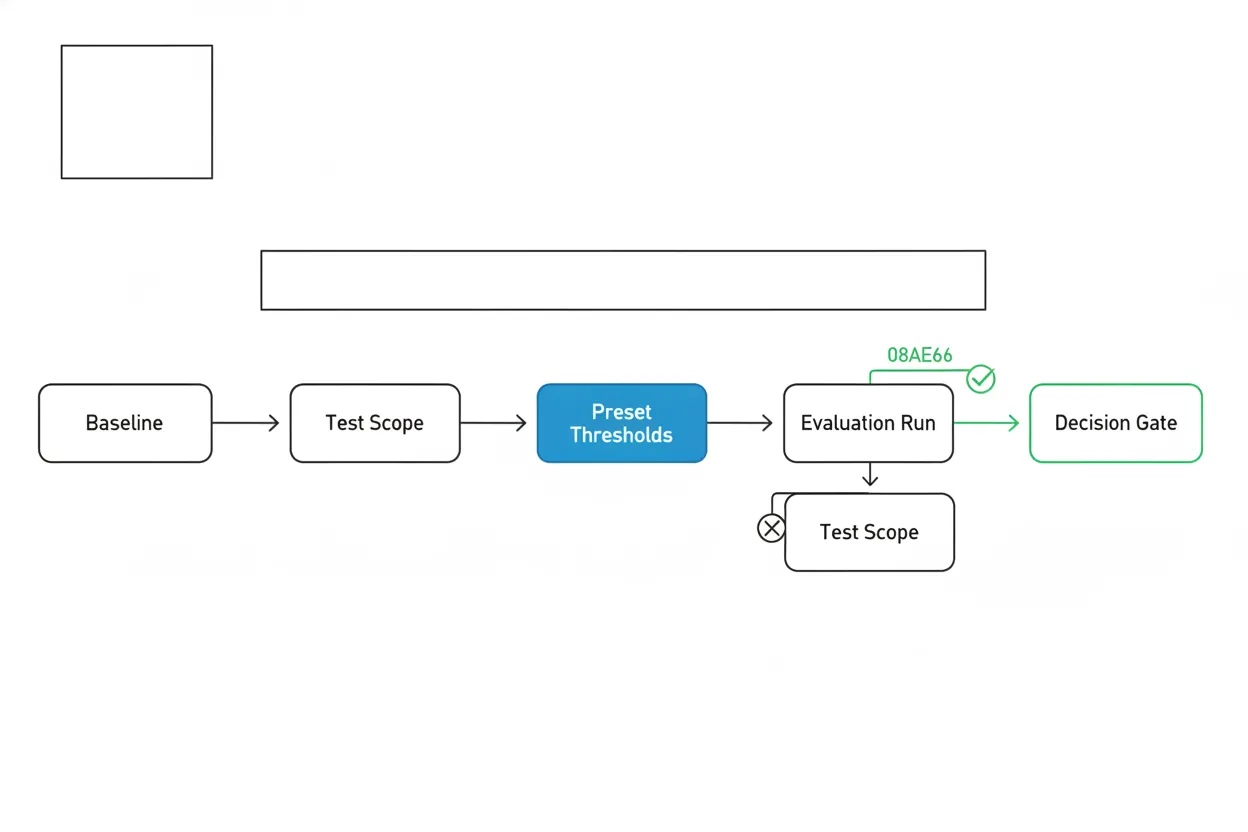
Set thresholds before anyone sees an output
A threshold written after you have seen results is a rationalization with a number attached. Set four classes of threshold in the charter and have the sponsor sign them.
Usefulness. What proportion of outputs must be acceptable with no edits, and what proportion acceptable with light edits? Define "light" concretely, for example a reviewer changing a sentence or a single field rather than rewriting the item. Tie the target to the baseline you measured, not to a round number that sounds impressive in a steering meeting.
Error tolerance by severity. Not all errors cost the same. Separate cosmetic errors from substantive errors from unacceptable errors, and set a different tolerance for each. In regulated settings, one class is usually zero-tolerance: anything that misstates a clinical, financial or legal fact, exposes restricted data, or creates a record that someone downstream will treat as verified.
Review effort. State the maximum human minutes per item that still leaves the change worth making. This is where many pilots quietly fail. The model performs well, but verifying its work costs almost as much as doing the work, so the net saving disappears into the review queue.
Operational constraints. Latency at peak, cost per task at projected volume, integration limits with your existing systems, availability expectations, and the logging and access controls required to approve the workflow at all.
The table below shows how definitions are written. Every entry is illustrative, not a benchmark and not a performance claim. Your numbers come from your own baseline.
Table 1. Illustrative metric definitions for a pilot charter. Examples only.
- Acceptable without edits. Definition (example): Reviewer approves output unchanged. Threshold source: Set above measured baseline first-pass approval rate.
- Substantive error rate. Definition (example): Factual, numeric or policy error reaching a reviewer. Threshold source: Set at or below current process rework rate.
- Unacceptable error. Definition (example): Restricted data exposure or fabricated source. Threshold source: Zero tolerance, triggers immediate stop.
- Review minutes per item. Definition (example): Median hands-on verification time. Threshold source: Must leave a net time saving versus baseline.
- Cost per task at volume. Definition (example): Inference plus license plus review labor. Threshold source: Must be below baseline cost per task.
Thresholds also need stop conditions attached, which is the part teams leave out. A stop condition is an event that ends the pilot early regardless of the aggregate numbers: any unacceptable error, a data handling breach, a failed integration that cannot be recovered within an agreed window, or a vendor change that alters where data is processed.
Deciding where a workload runs, and what the deployment boundary is, belongs in this same conversation. See owned AI systems for how those boundaries get defined before a pilot starts rather than renegotiated after an incident.
Evaluate the whole workflow, not just the model
Scoring a model in isolation answers a research question. Your decision is an operations question, and operations live in the handoffs.
Specialist vendors describe the same split. One LLM consultancy, Winder.AI, states that the hard parts of production work in 2026 are evaluation harnesses, retrieval quality, inference cost at scale and on-premises or air-gapped deployment for regulated data, and defines the fixed-fee proof of concept it sells as one use case, one data source and an evaluation harness (Winder.AI).
Public frameworks put evaluation in similar company. NIST's AI Risk Management Framework is intended for voluntary use and to improve the ability to incorporate trustworthiness considerations into the design, development, use and evaluation of AI products, services and systems, and NIST released a Generative AI Profile, NIST-AI-600-1, on July 26, 2024 to help organizations identify risks specific to generative systems (NIST).
Our reading of that framing is that evaluation sits beside design and use rather than after them. NIST does not prescribe a sequence.
So evaluate the path an item actually takes. Intake: does the item arrive with the context the system needs, or does someone have to assemble it first? That assembly time counts. Processing: does the system produce output in a format your downstream tools accept without manual reformatting?
Review: who checks it, how do they know what to check, and can they see why the system produced what it produced? Write-back: does the result land in the customer relationship management (CRM) system, the electronic health record (EHR), the ticketing queue or the ad platform reliably, and what happens when a write fails silently?
Then test failure deliberately. Take the integration down mid-run. Feed a malformed record. Send an item that should have been refused. Watch what the system does and, more importantly, what the people do. A workflow is ready for production when failures are visible, recoverable and attributable. If a wrong answer can pass through unnoticed and become the record, the pilot has found a design problem, which is a useful result worth reporting as such.
Measure the human side honestly. Track reviewer time separately from system time, note whether reviewers become less careful as volume rises, and record how long new users take to reach competent use. Reviewers under queue pressure may approve plausible output, so test whether review actually catches seeded errors rather than assuming it will. If your acceptance criteria depend on human review as the safety net, the net itself is part of what you are evaluating.
Data custody deserves its own test rather than an assumption. Confirm where processing happened, what was logged, who could access the logs, and whether any third party received data you did not intend to send. Document the answers alongside the performance results, since both inform the same decision. Our overview of data sovereignty covers how custody and processing boundaries are documented in practice, and local processing covers where inference can be kept when that matters to the arrangement.
Record the decision and its limits
The deliverable of a pilot is a short decision record that someone can read in twelve months and understand what was proven, what was assumed, and what would have to be retested. Two pages is enough.
State the decision in the sponsor's words: go, change or stop, with the date and the commitment it authorizes. Then separate two categories that teams routinely blur. Demonstrated under pilot conditions covers the task types, data volumes, time period, user group, integrations and model or vendor version that were actually tested, with measured results against the agreed thresholds.
Assumed beyond pilot conditions covers performance at full volume, with different data, with less experienced users, after the vendor updates the model, or when the person who championed the project moves on. Everything in the second list is an assumption, and labeling it as one is what makes the record defensible when someone reopens it.
A minimal acceptance and stop-condition worksheet looks like this. Entries are illustrative.
Table 2. Illustrative acceptance and stop-condition worksheet. Examples only.
- Decision statement. Entry (example): Sponsor decides on annual contract by a set date.
- Baseline measured. Entry (example): Median handling time, rework rate, cost per task.
- Thresholds met. Entry (example): Which criteria passed, which failed, by how much.
- Stop conditions triggered. Entry (example): None, or the specific event and date.
- Demonstrated scope. Entry (example): Task types, volume, data classes, system version.
- Explicit assumptions. Entry (example): Behavior at higher volume, future model versions.
- Retest triggers. Entry (example): Vendor model change, data source change, volume increase.
- Decision. Entry (example): Go, change or stop, with named signer.
Build retest triggers into the record rather than scheduling a vague review. A model version change, a new data source, a jump in volume beyond what was tested, or a change in where processing occurs should each trigger a rerun of the same test set. That rerun is cheap once the set exists, and it is the difference between a system you monitor and a system you hope about.
Resist the single-score summary. Readiness frameworks already hedge their own numbers: Thoughtworks evaluates enterprise AI maturity across six dimensions, foundational architecture, operating model, ready data, experiences for humans and AI, strategic alignment and trustworthy AI, and pairs the readiness score it returns with a report covering maturity, key gaps, strategic priorities and next steps (Thoughtworks).
A pilot result deserves the same treatment. One figure invites selective quoting in the next budget meeting, while a scoped record with stated limits survives it.
For the decisions that follow a go, see AI governance for approval and oversight controls, and open source for model selection and licensing considerations.

Email Us
Prefer to send the context directly?
Questions sponsors ask before funding a pilot
What makes a pilot different from a polished demo?
A demo is built to show capability under conditions the presenter chose. A pilot produces a decision under conditions you chose, using your data, your edge cases, your reviewers and your integrations.
The practical test: a demo can only succeed or impress, while a properly designed pilot can return a documented stop, and the people running it agreed in advance that a stop is an acceptable and useful outcome. The second test is reproducibility.
If the same inputs, run next month by a different person, produce results nobody can compare to the first run, you watched a demo with a longer runtime.
Which metrics should be agreed before starting?
At minimum: baseline time, quality and cost per task; the usefulness threshold for outputs accepted with no edits and with light edits; error tolerance split by severity, with a zero-tolerance class defined explicitly; maximum human review minutes per item; cost per task at projected volume; and operational limits for latency, availability and integration behavior.
Add refusal accuracy wherever the system must decline or escalate. Each metric needs a written definition, a measurement method and a named owner, because ambiguous definitions are how two people read the same result and reach opposite conclusions.
When should a successful pilot still not go into production?
When the capability is proven but the surrounding conditions are not. Common cases: the review burden erases the saving at real volume; the integration works in test but has no supported path in the production environment; the data arrangement that made the pilot possible cannot be sustained, for example because processing location, retention or subprocessor terms would change; the team that would operate it has no capacity; or the vendor's roadmap makes the tested version short-lived.
There is also the oversight case, where a system performs well but nobody can explain a given output to a regulator, an auditor or a patient.
A strong result sitting inside an unacceptable operating arrangement is a change decision, and the controls side of that question is covered in AI governance.
How should a small team adapt this approach?
Compress it rather than skip it. One sponsor who is also the technical owner, one decision sentence, a baseline sample of a few dozen recent cases logged over two weeks, three task categories with a handful of cases each including refusals, four thresholds, and a one-page decision record.
That is realistically a few days of work spread across a month, and it still produces something you can defend. The step small teams should never cut is writing thresholds before seeing output, because informal evaluation is exactly where enthusiasm substitutes for evidence. The step that can flex is sample size, as long as the record states the sample and limits the conclusions accordingly.
What evidence would change the recommended approach?
Three things. First, standards movement: NIST states that AI RMF 1.0 is being revised as part of the White House AI Action Plan, and in April 2026 NIST released a concept note for an AI RMF profile on trustworthy AI in critical infrastructure, so the vocabulary organizations are measured against is still moving (NIST).
Second, tooling: Winder.AI notes that frontier model providers now ship built-in evals (Winder.AI), so vendor-supplied evaluation may cover more of this work over time. Check whether what ships reflects your data, your edge cases and your thresholds before relying on it. Third, your own accumulated records.
Once you have several documented pilots, you will know which thresholds were set too loosely and which failure modes recur, and the charter should be amended to reflect that history rather than restating a generic checklist.
If you want a second set of eyes on the decision rules before the pilot starts, rather than after an ambiguous result, that is the conversation we are set up to have.
More Resource Topics
Ready to see where your marketing can improve?
Request a free audit of your paid media, landing pages, attribution, and measurement setup. You'll get a straight assessment of where the opportunities are.
or email us at info@marketingpowered.ai