Resources
Best Conversion Rate Optimization Tools: How to Evaluate Your Stack
Selecting the best conversion rate optimization tools requires looking past vendor feature lists and focusing on operational utility, data governance, and downstream revenue impact. For organizations operating in complex lead generation and regulated sectors, a conversion tool cannot function as an isolated testing widget. It must operate as part of an accountable intake system that connects visitor interactions directly to qualified pipeline, patient admissions, or signed contracts.
By Mike Hulick, Founder, Marketing Powered

Why Traditional CRO Software Falls Short for Complex Lead Generation
Most commercial conversion rate optimization software was engineered around high-volume retail e-commerce. In consumer e-commerce, the conversion event is immediate, transactional, and captured directly inside the web session through an online checkout. Traffic volumes on retail product pages often reach tens of thousands of visitors per week, allowing testing engines to reach 95 percent statistical confidence on micro-adjustments such as button colors, product badge placement, or banner copy within days.
Complex lead generation behaves completely differently. In sectors such as healthcare, specialized professional services, commercial contracting, and high-value B2B, the primary conversion event is not a credit card swipe. The on-page conversion is an inquiry: a submitted intake form, an inbound phone call, or a scheduled consultation. The actual commercial outcome happens offline, hours, days, or weeks later, inside a customer relationship management platform or electronic health record system.
When organizations in these verticals install standard testing platforms designed for retail, they encounter two severe structural bottlenecks:
- The Traffic Volume Deficit: Achieving statistical validity requires both adequate sample size and conversion volume. If a high-intent service page receives 2,500 unique monthly visitors and converts at 4 percent (100 inquiries), splitting traffic between two variations yields only 50 conversions per variation per month. Detecting a 10 percent relative improvement at standard statistical thresholds can take six to twelve months of uninterrupted testing. During that window, seasonal demand shifts, marketing campaign adjustments, and competitive dynamics corrupt the test environment.
- The Proxy Metric Trap: Standard experimentation tools measure on-page micro-actions: button clicks, form starts, and form completions. In complex service environments, optimizing for raw form fills frequently damages sales efficiency. A variation that removes qualifying friction, such as eliminating insurance questions or omitting project budget filters, will show an immediate lift in on-page conversion rates. Downstream, however, the intake team is flooded with unqualified contacts, intake operational costs rise, and revenue declines.
Evaluating tools strictly on their ability to execute rapid client-side split tests ignores the economic reality of high-ticket lead generation. The evaluation must center on whether the software helps your team identify true user friction and verify whether changes improve downstream business metrics.

Core Categories of Conversion Rate Optimization Tools You Must Evaluate
A complete conversion optimization infrastructure is never a single monolithic software subscription. It is an operational stack divided into four distinct functional categories, each solving a specific engineering or diagnostic problem.
1. Qualitative Diagnostic Tools
Before writing a single line of test code or altering page copy, you must identify where qualified prospects experience operational friction. Qualitative tools capture actual user behavior rather than aggregated averages:
- Session Replay and Behavioral Heatmaps: Software that visually reconstructs user sessions, tracking cursor movement, dead clicks, scroll depth, and interaction pacing. These recordings reveal whether users fail to see critical trust markers, abandon forms due to confusing validation errors, or struggle with mobile interface elements.
- Form Analytics: Specialized utilities that measure field-by-field interaction times, drop-off rates, and refill frequencies. Identifying the single form field responsible for 40 percent of total user exits provides an immediate hypothesis for intervention.
2. Experience Deployment and Page Engines
Marketing teams cannot wait on four-week IT development sprints to deploy landing page improvements. Deployment engines allow conversion specialists to publish fast, mobile-responsive experiences outside the legacy content management system:
- Dedicated Landing Page Builders: Standalone environments that host high-velocity acquisition pages on custom subdomains, enabling rapid layout adjustments, dynamic text replacement, and custom tracking scripts.
- Headless and Static Frameworks: Modern development setups that decouple the front-end presentation layer from the back-end database, maximizing page rendering speed while maintaining complete design control.
3. Quantitative Experimentation Engines
When traffic volumes support controlled experimentation, testing engines manage the mechanics of visitor segmentation and variant delivery:
- Client-Side Testing Engines: Tools that load a JavaScript snippet in the visitor browser to alter DOM elements dynamically after the baseline page loads. These tools provide visual editors for non-technical teams but risk layout shift and page latency if implemented poorly.
- Server-Side Experimentation Platforms: Systems that render page variants directly on the web server before delivering HTML to the user browser. Server-side testing eliminates layout flickering, preserves site speed, and supports deep functional tests across application workflows.
4. Telephony and Intake Attribution Platforms
For high-intent services, phone calls often represent the highest-converting lead channel. Web analytics platforms cannot measure telephone conversations without dedicated telephony infrastructure:
- Dynamic Number Insertion (DNI): Software that swaps on-page phone numbers dynamically based on the visitor source, linking inbound calls directly to the specific ad campaign, keyword, and landing page variant.
- Intake Routing and Call Scoring: Systems that record, transcribe, and qualify conversations, feeding milestone signals back into reporting systems to confirm whether an inbound call represented a valid sales opportunity.
Evaluating CRO Platforms on Data Governance and Compliance
Data governance has become the central operational constraint when selecting conversion rate optimization platforms. For years, marketing teams freely embedded third-party tracking scripts, pixel tags, and session recording utilities across their digital properties without considering privacy implications. That practice is no longer viable in healthcare, financial services, legal sectors, and international markets.
In regulated healthcare, the deployment of third-party tracking technologies is subject to intense regulatory scrutiny. The HHS Office for Civil Rights Bulletin on Tracking Technologies establishes clear guidance regarding the use of tracking scripts across both authenticated (patient portal) and unauthenticated (public-facing) web pages. If a third-party tracking tool collects individually identifiable health information, including IP addresses, search terms related to medical conditions, or appointment request details, without an executed Business Associate Agreement (BAA), the deployment creates significant regulatory liability.
Furthermore, major advertising platforms enforce strict content boundaries. As detailed in the Google Ads Policy for Personalized Advertising, Google strictly prohibits personalized advertising and retargeting for sensitive healthcare categories, addiction treatment, and personal distress conditions. In these verticals, an advertiser cannot rely on secondary retargeting campaigns to recapture lost visitors. Every dollar spent on media depends entirely on first-touch conversion efficiency, elevating the importance of clean landing page architecture and strict data handling.
When vetting conversion rate optimization platforms for regulated or sensitive operations, evaluate vendors against five data governance criteria:
- Business Associate Agreements: Does the vendor sign standard BAAs covering session replay, form analytics, and data storage? If a vendor refuses to execute a BAA, their scripts cannot be placed on pages containing health-related inquiries.
- Client-Side Data Masking: Does the platform offer default, unalterable on-keystroke data masking that prevents form inputs (names, phone numbers, email addresses, medical descriptions) from ever leaving the user browser and hitting third-party servers?
- IP Anonymization and Geo-Hashing: Can the tool truncate or hash visitor IP addresses before data ingestion, ensuring that location tracking remains at the aggregate market level rather than identifying individual residential connections?
- Server-Side Data Routing: Does the platform support server-side tag management, allowing your engineering infrastructure to inspect, scrub, and sanitize event payloads before forwarding anonymous data to downstream analytics tools?
- Data Sovereignty and Storage Location: Where are session recordings, click logs, and user metadata physically stored? Can your organization configure data retention periods to purge raw interaction records automatically after 30 or 60 days?
Prioritizing platforms that enforce strict data hygiene protects your organization from statutory penalties while ensuring that site performance remains uncompromised by rogue third-party tracking libraries.
Free Audit
Want a straight read on where your budget is leaking?
Connecting Front-End Tests to a Conversion Rate Optimization Dashboard
The ultimate failure of many experimentation programs is the siloed metric. Front-end optimization tools typically present performance through an isolated dashboard showing conversion rate increases, total clicks, and statistical confidence bars. If that data does not synchronize directly with operational intake records, the numbers are functionally meaningless.
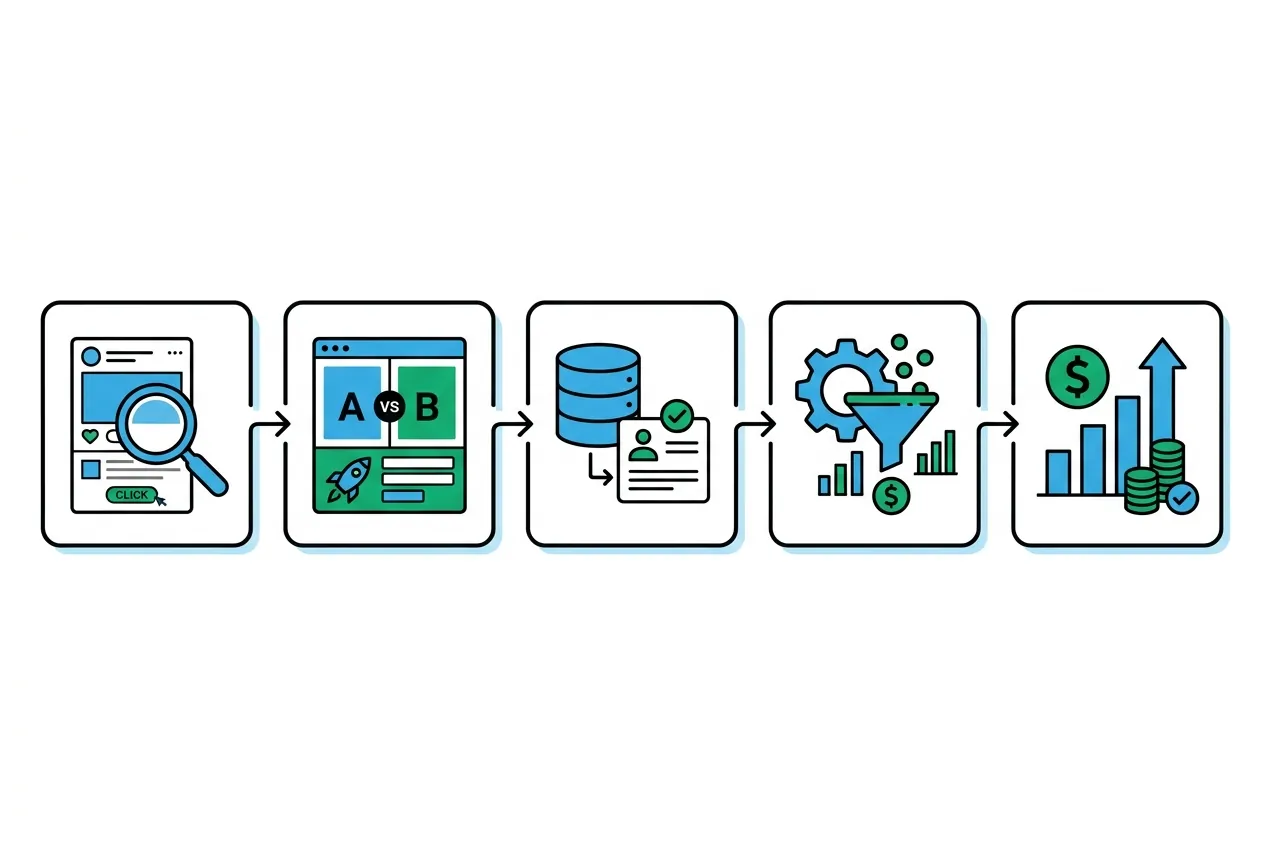
An executive-level conversion rate optimization dashboard must bridge the gap between anonymous front-end interaction and validated operational revenue. Achieving this visibility requires building an automated data pipeline across three layers:
To establish this architecture, your landing page and form systems must capture campaign parameters such as Google Click Identifiers (GCLID), privacy-safe identifiers (WBRAID), and campaign source parameters directly from the URL. These parameters must be injected into hidden form fields and transmitted into your customer relationship management platform alongside the lead data.
When a phone call occurs, your dynamic call tracking platform must achieve the same linkage, matching the caller phone number with the specific visitor web session and variant exposure.
Once this data reaches the CRM, operational milestones must be recorded systematically:
- Initial contact verified
- Intake qualification complete (insurance verified, budget confirmed, or scope accepted)
- Consult scheduled or clinical evaluation completed
- Final admission, signed agreement, or closed revenue
When your conversion rate optimization dashboard aggregates data at this level, test evaluation changes completely. Variant B might demonstrate an 8 percent lower initial form completion rate than Variant A, but if Variant B included qualifying copy that doubled the intake qualification rate, Variant B is the commercial winner. Tracking attribution through to admission or signed contract prevents teams from celebrating front-end micro-wins that quietly degrade operational intake efficiency.
How to Select CRO Software by Traffic Volume
Organizations frequently purchase high-cost enterprise experimentation platforms when their current traffic and operational maturity require fundamental diagnostic tools. Software licensing fees can quickly consume resources that would generate higher returns if allocated toward media or message development.
Use this operational framework to match software selection to your traffic realities:
- Under 10,000 visitors. Primary Optimization Focus: Qualitative diagnostics, technical site speed, value proposition clarity, intake form restructuring. Recommended Tool Capabilities: Session replay, page scroll heatmaps, dynamic call tracking, fast landing page builders. Operational Failure Mode to Avoid: Attempting high-frequency A/B split testing. Running tests that fail to reach statistical significance after 90 days.
- 10,000 to 100,000 visitors. Primary Optimization Focus: High-intent landing page split testing, multi-step form optimization, offer positioning. Recommended Tool Capabilities: Client-side split testing engines, form interaction analytics, dynamic text replacement, CRM integration hooks. Operational Failure Mode to Avoid: Declaring test winners prematurely based on 80% confidence intervals or front-end form fills without CRM validation.
- 100,000+ visitors. Primary Optimization Focus: Server-side experimentation, algorithmic personalization, funnel architectural overhauls. Recommended Tool Capabilities: Server-side testing frameworks, multi-arm bandit algorithms, automated traffic allocation, data warehouse event pipelines. Operational Failure Mode to Avoid: Accumulating technical debt through unmanaged client-side scripts, causing page load flicker and latency.
For organizations with under 10,000 monthly visitors per landing page template, qualitative analysis consistently outperforms automated testing tools. Reviewing 100 recorded user sessions will reveal navigation drop-offs, broken mobile layouts, and form friction far faster than waiting months for an A/B testing tool to reach statistical certainty. At this volume, structural redesigns informed by qualitative evidence should be deployed directly as baseline upgrades.
As traffic scales beyond 10,000 visitors on dedicated acquisition funnels, testing software becomes essential to isolate variables. At this stage, focus on platforms that offer rock-solid visual stability, clean code injection, and deep integration with tag management and attribution infrastructure.
Best Conversion Rate Optimization Tools by Operational Job
Rather than ranking software on a generic 1-to-10 scale, marketing leaders should evaluate specific platforms based on the operational job they perform within the conversion architecture.
Qualitative Behavioral Diagnostics: Hotjar, Microsoft Clarity, and Crazy Egg
When the objective is identifying user confusion and on-page drop-offs, visual diagnostic tools provide immediate behavioral clarity:
- Microsoft Clarity: An enterprise-grade, cost-effective behavioral analytics tool offering session replays, click heatmaps, and rage-click detection. It features built-in masking settings for sensitive data, making it an attractive baseline tool for organizations seeking deep behavioral observation without complex enterprise licensing.
- Hotjar: An established qualitative feedback suite combining session recordings and heatmaps with on-page micro-surveys and user feedback widgets. Hotjar excels at capturing direct user sentiment at the precise moment of abandonment, though script weight must be actively managed to preserve site speed.
Rapid Landing Page Deployment: Unbounce and Instapage
When marketing teams must deploy and iterate dedicated campaign landing pages without engineering dependencies:
- Unbounce: A specialized landing page platform built for paid media agility. It provides rapid drag-and-drop page creation, native dynamic text replacement to match search keyword intent, and built-in split-testing capabilities. It serves as an exceptional bridge for growth teams running dedicated PPC traffic.
- Instapage: Designed for multi-location teams and agency environments requiring high collaboration, scalable page templating, and advanced personalization. Its global block editing enables teams to update critical value propositions or compliance language across hundreds of location variants simultaneously.
Enterprise Experimentation Platforms: VWO and Optimizely
For high-traffic operations requiring rigorous statistical experimentation:
- VWO (Visual Website Optimizer): A comprehensive experimentation platform offering visual client-side split testing, server-side capabilities, mobile app testing, and integrated behavioral heatmaps. VWO provides robust Bayesian and Frequentist statistical engines, giving data teams clear parameters for testing validity.
- Optimizely: The enterprise benchmark for high-velocity experimentation. Optimizely focuses heavily on server-side feature flagging, dynamic product rollouts, and multi-channel experimentation. It requires dedicated developer resources to maintain but provides unmatched stability, security, and scalability for enterprise brands.
Telephony and Dynamic Attribution: CallRail
For complex service organizations where inbound phone calls drive high-value revenue:
- CallRail: The industry standard for dynamic call tracking, form capture, and conversation intelligence. By dynamically assigning trackable phone numbers to website visitors based on session source, CallRail links telephone leads directly back to specific ad clicks, keywords, and landing page variants. Its conversation intelligence automatically transcribes calls, identifies qualified commercial intent, and transmits conversion events downstream into CRM and advertising platforms.

Email Us
Prefer to send the context directly?
How Marketing Powered Builds Accountable Conversion Systems
Purchasing software licenses does not solve a conversion problem. Without experienced operational execution, testing software frequently sits idle or generates misleading micro-optimizations that fail to improve commercial intake.
Marketing Powered approaches conversion optimization as an integrated engineering and marketing discipline. Founded by a former healthcare CMO who led marketing operations for a treatment network that expanded from 3 to 24 locations, our methodologies are rooted in large-scale commercial reality. Our founder managed $1.5 to $2M per month in Google Ads across 11+ behavioral and mental health accounts, operating in environments where advertising platforms strictly prohibit retargeting and demand complete first-touch conversion precision. Our founder brings court-certified expert witness credentials in advertising strategy, ensuring that every operational system we deploy withstands technical, regulatory, and commercial scrutiny.
Our client engagements focus on three interconnected conversion disciplines:
- Landing Page Architecture and Rapid Deployment: We design and deploy high-speed, mobile-first landing pages tailored specifically to capture high-intent search traffic. Every layout is engineered to reduce cognitive fatigue, establish institutional authority, and eliminate conversion friction.
- Systematic Experimentation and Qualitative Auditing: We conduct thorough session audits, form drop-off analyses, and rigorous split testing. We do not test minor cosmetic changes; we test core positioning, intake mechanics, trust architecture, and conversion pathways to drive measurable lifts in commercial response.
- Intake and CRM Automation with Full Attribution: We connect front-end interactions directly to backend operational workflows. By engineering dynamic call tracking, hidden field parameter capture, and CRM pipeline automation, we track attribution through to patient admission or closed contract, not just the initial lead.
Operating as an AI-native organization since 2022, Marketing Powered maintains owned, local AI infrastructure for HIPAA-aware inference. This allows our team to run sophisticated diagnostic modeling, qualitative conversation analysis, and data processing while maintaining absolute sovereignty over proprietary and sensitive organizational data.
To understand how a systematic approach to conversion optimization can improve your acquisition economics, review our core methodology in our guide to [conversion rate optimization for lead generation: a system, not a list of tests]. If you are evaluating outside execution support, explore what to expect in our analysis of a [conversion rate optimization agency: what a specialist partner delivers and how to vet one], or review our evaluation criteria for a [landing page optimization agency: what a specialist partner delivers and how to vet one].
Questions, Answered.
Client-side conversion rate optimization tools use a JavaScript tag embedded in the website header to modify page elements in the visitor browser after the base page content loads. They are faster to deploy and allow marketing teams to launch tests without direct software engineering support. However, they can cause visual page flickering and slight load latency. Server-side tools execute testing logic directly on the web server before delivering HTML to the user browser. Server-side testing eliminates visual layout shift, protects page rendering speed, and allows organizations to test complex backend workflows, pricing models, and application architecture, but requires dedicated developer involvement to build and maintain.
If your acquisition funnels receive fewer than 10,000 unique monthly visitors, enterprise A/B testing platforms will rarely produce statistically valid results within practical timeframes. At traffic levels below this threshold, organizations should invest in qualitative behavioral tools such as session replays, heatmaps, and dynamic call tracking. These tools reveal operational friction and user drop-off points immediately without requiring large sample sizes. Once monthly traffic on primary conversion paths exceeds 10,000 visitors, investing in quantitative split-testing platforms becomes operationally viable.
Yes. If third-party session recording scripts, form analytics tools, or pixel trackers capture individually identifiable health information (IIHI) on unauthenticated or authenticated pages, and the software vendor has not executed a Business Associate Agreement (BAA), your organization risks violating federal privacy regulations. To maintain compliance, healthcare organizations must ensure that any analytics or testing script utilizes robust data masking to redact user inputs before transmission, anonymizes visitor IP addresses, or routes data through a secure server-side infrastructure where sensitive identifiers are scrubbed.
Dynamic call tracking software uses dynamic number insertion (DNI) to display unique telephone numbers to website visitors based on their traffic source, ad campaign, and landing page variant. When a visitor calls the displayed number, the platform links the phone call to the visitor digital session history, including attribution parameters such as GCLID or UTM variables. The software records call duration, transcribes the conversation, and pushes the event into your CRM and web analytics dashboard, ensuring that inbound telephone inquiries are credited to the exact page variant that generated them.
Measuring tests solely on form submissions creates a proxy metric trap. A landing page variant that removes qualifying friction, such as eliminating insurance validation, scope requirements, or budget confirmation fields, will almost always generate a higher volume of form submissions. However, if those inquiries are unqualified, operational intake costs increase while actual sales or admissions drop. Testing variants must be evaluated against downstream CRM revenue data to confirm that an increase in front-end conversion volume translates into qualified business growth. Schedule a strategy call with Marketing Powered
Ready to see where your marketing can improve?
Request a free audit of your paid media, landing pages, attribution, and measurement setup. You'll get a straight assessment of where the opportunities are.
or email us at info@marketingpowered.ai