Resources
Meta Ads Cost: How Pricing Works and How to Forecast It
Planning an acquisition budget requires understanding that your meta ads cost is neither a fixed media rate card nor a static industry benchmark. Meta ad inventory is priced through a continuous, dynamic clearing auction that balances monetary bids, projected user engagement, and post-click landing experience. Treating media pricing as a fixed expense causes marketing leaders to misallocate media capital and fail to hit downstream revenue targets.
By Mike Hulick, Founder, Marketing Powered

How Meta Ads Cost Is Determined Inside the Ad Auction
Every time an ad placement becomes available across Facebook or Instagram, Meta executes an automated auction to determine which creative asset appears and the clearing price paid by the winning advertiser. According to the Meta Business Help Center, ad delivery is determined by a total value formula:

Total Value = [Advertiser Bid] x [Estimated Action Rates] + [Ad Quality]
This equation means the highest cash bid does not automatically secure the impression. Meta balances two competing priorities: delivering commercial results for advertisers and maintaining a relevant user experience to protect platform retention. When an advertiser submits a high monetary bid paired with weak creative messaging or poor post-click engagement, the total value drops. Conversely, an advertiser with a lower bid can win the auction placement if the system predicts higher user engagement and positive post-click relevance.
In an active media operations room, practitioners observe this mechanic directly within campaign delivery diagnostics. Media buyers review real-time feedback scores, pacing charts, and audience saturation indicators across multiple monitors. When creative assets resonate with target audiences, estimated action rates climb, lowering the effective clearing price against competing market bids. When an ad triggers negative user actions such as hiding the post, reporting the creative, or bouncing immediately, the system applies an ad quality discount penalty. The advertiser must then raise their monetary bid to maintain identical impression volumes.
Auction competition fluctuates constantly throughout the business cycle. Inventory costs respond in real time to geographic concentration, dayparting, day-of-week trends, and broader seasonal pressures such as fourth-quarter retail demand, changing the baseline clearing price required to reach qualified prospects.
Core Pricing Models in Meta Ads Manager: CPM, CPC, and CPA
Campaign operations run inside Meta Ads Manager, where technical optimization settings interact with platform billing systems. As documented by the Meta Business Help Center, Meta bills accounts primarily on an impression basis, measured as cost per mille (CPM), even when bidding configurations optimize for downstream link clicks or conversion events.
Understanding the structural relationships among CPM, CPC, and CPA keeps forecasting models grounded in platform mechanics:
Cost Per Mille (CPM)
CPM represents the baseline clearing price to deliver 1,000 ad impressions. CPM reflects audience liquidity, geographic demand, and broader advertiser competition within an ad set. It measures the gross cost of media delivery before creative engagement or landing page efficiency takes effect.
Cost Per Click (CPC)
Cost per click measures the effective expense of generating an outbound website visit. While advertisers can set target cost caps for traffic, the realized CPC is mathematically derived from the CPM and the click-through rate (CTR):
Free Audit
Want a straight read on where your budget is leaking?
CPC = CPM / (CTR x 1,000)
For illustrative arithmetic, assume an ad set clears at a $30.00 CPM and produces a 1.5% click-through rate. The resulting effective CPC is $2.00. If creative fatigue causes the click-through rate to fall to 0.75%, the effective CPC rises to $4.00, even if the underlying CPM remains unchanged.
Cost Per Acquisition (CPA)
Cost per acquisition tracks the media investment required to generate a specific downstream conversion action, such as an inquiry form, an appointment schedule, or an inbound consultation call. CPA ties media delivery directly to website conversion efficiency:
CPA = CPC / Conversion Rate.
Continuing the illustrative arithmetic, an ad set producing a $2.00 CPC with an 8% landing page conversion rate yields a $25.00 CPA. If technical issues slow page speed or intake forms become cumbersome, dropping conversion efficiency to 4%, the effective CPA increases to $50.00.
Machine learning models continuously evaluate user behavioral signals to find users likely to complete the target action. According to the Meta Business Help Center, ad sets exit the initial learning phase after generating approximately 50 optimization events since the last major edit, allowing the delivery system to stabilize performance.
What Drives Facebook Ads Cost Fluctuations Across Industries?
Sudden volatility in facebook ads cost frequently leads growth leaders to suspect arbitrary platform changes. In practice, cost shifts stem from concrete operational factors across audience liquidity, market territory, ad fatigue, and conversion signal health.
Audience Saturation and Specificity
Targeting broad consumer cohorts yields higher platform liquidity, lower competitive concentration, and lower base CPMs. Conversely, targeting specialized business decision-makers, licensed professionals, or specific commercial audiences constrains available ad inventory. When multiple advertisers compete for a smaller, finite cohort, delivery costs rise.
Geographic Concentration
Media pricing reflects local market competition. Dense urban centers command elevated CPMs because thousands of regional, national, and enterprise advertisers bid on the same geographic population. Regional territories and rural districts offer lower baseline media costs, but smaller population pools require tighter budget pacing to prevent rapid frequency saturation.
Creative Fatigue and Ad Decay
Ad creative experiences natural performance decay over time. As frequency rises across a defined target audience, prospects stop responding to the message. Declining click-through rates and accumulated negative interactions reduce estimated action rates and ad quality scores, forcing the system to raise clearing CPMs to maintain delivery pace.
Data Signal Degradation
Modern ad auctions rely on server-level conversion signals to calibrate delivery algorithms. When organizations depend solely on standard browser pixel tracking, client-side ad blockers, browser privacy restrictions, and cookie expirations disrupt event reporting. Degraded conversion feedback prevents Meta from identifying high-value converters, resulting in less efficient ad distribution and higher acquisition costs.

How Much Do Facebook Ads Cost for Regulated and Multi-Location Businesses?
When growth leaders evaluate how much do facebook ads cost in specialized sectors like healthcare, law, and financial services, unit pricing reflects high customer lifetime values and strict compliance boundaries. In high-value service sectors, organizations absorb higher initial CPAs because an intake or signed agreement yields substantial commercial value.
Regulated categories operate under strict marketing constraints that retail brands do not face. In sensitive healthcare verticals, advertising networks restrict retargeting mechanisms. For example, Google Ads Policy Help confirms that Google restricts personalized advertising and retargeting for sensitive health conditions. While Meta permits certain healthcare brand awareness initiatives, consumer privacy protections prevent operators from deploying invasive pixel-based tracking funnels or sending protected health information (PHI) to public advertising networks.
Multi-location organizations, including regional clinic networks and distributed service practices, face the operational challenge of localized auction overlap. Media directors managing multi-territory accounts often review interactive mapping interfaces and regional spend dashboards to verify geographic boundaries. When physical service areas overlap without negative geographic exclusions, adjacent branch campaigns compete against each other for the identical prospective client, artificially inflating internal bid competition and driving up acquisition costs across both locations.
Operating across multiple locations requires strict territorial boundaries, dedicated local intake paths, and server-side conversion validation that filters duplicate inquiries before signal data returns to the platform.
Email Us
Prefer to send the context directly?
Instagram Ads Cost vs. Facebook Feed Placements
Allocating budgets across Meta inventory involves balancing placements across Facebook Feeds, Instagram Feeds, Stories, Reels, and third-party partner inventory. Evaluating the underlying instagram ads cost relative to Facebook Feed inventory enables marketing teams to design balanced media mixes.
Instagram placements frequently carry higher baseline CPMs among mobile-first demographics, particularly for visual storytelling formats. However, nominal CPM differences must be weighed against user interaction behavior:
- Audience Demographics. Facebook Feed Placements: Broad demographic liquidity, older cohorts, desktop representation. Instagram Placements (Feed, Stories, Reels): Mobile-first demographic, high engagement in visual lifestyle, health, and professional sectors.
- Engagement Pattern. Facebook Feed Placements: Long-form copy reading, detailed comment threads, direct outbound clicks. Instagram Placements (Feed, Stories, Reels): Rapid visual assessment, high vertical video completion, swipe interactions.
- CPM Tendencies; Facebook Feed Placements: Moderate baseline CPM; consistent link click volume; Instagram Placements (Feed, Stories, Reels): Higher baseline CPM; responsive to strong native creative execution
- Downstream Intake Flow. Facebook Feed Placements: Multi-step web intake, desktop evaluations, comprehensive forms. Instagram Placements (Feed, Stories, Reels): Streamlined mobile forms, short-form intake, mobile click-to-message flows.
Using Meta's Advantage+ placement delivery allows the platform to allocate budget across all surfaces automatically. While this approach can reduce blended CPMs, the system prioritizes the lowest-cost impressions available. In high-consideration verticals, this can route budget into low-intent placements that generate accidental clicks rather than qualified operational pipeline. High-consideration services benefit from testing placement-specific ad sets built with tailored visual assets instead of relying entirely on automated delivery.
A Deterministic Method to Forecast Your Meta Advertising Budget
Relying on published benchmark tables to forecast advertising spend produces unreliable financial models. An operator-grade budget forecast calculates capital requirements backward from target revenue, allowable unit economics, and operational sales velocity.
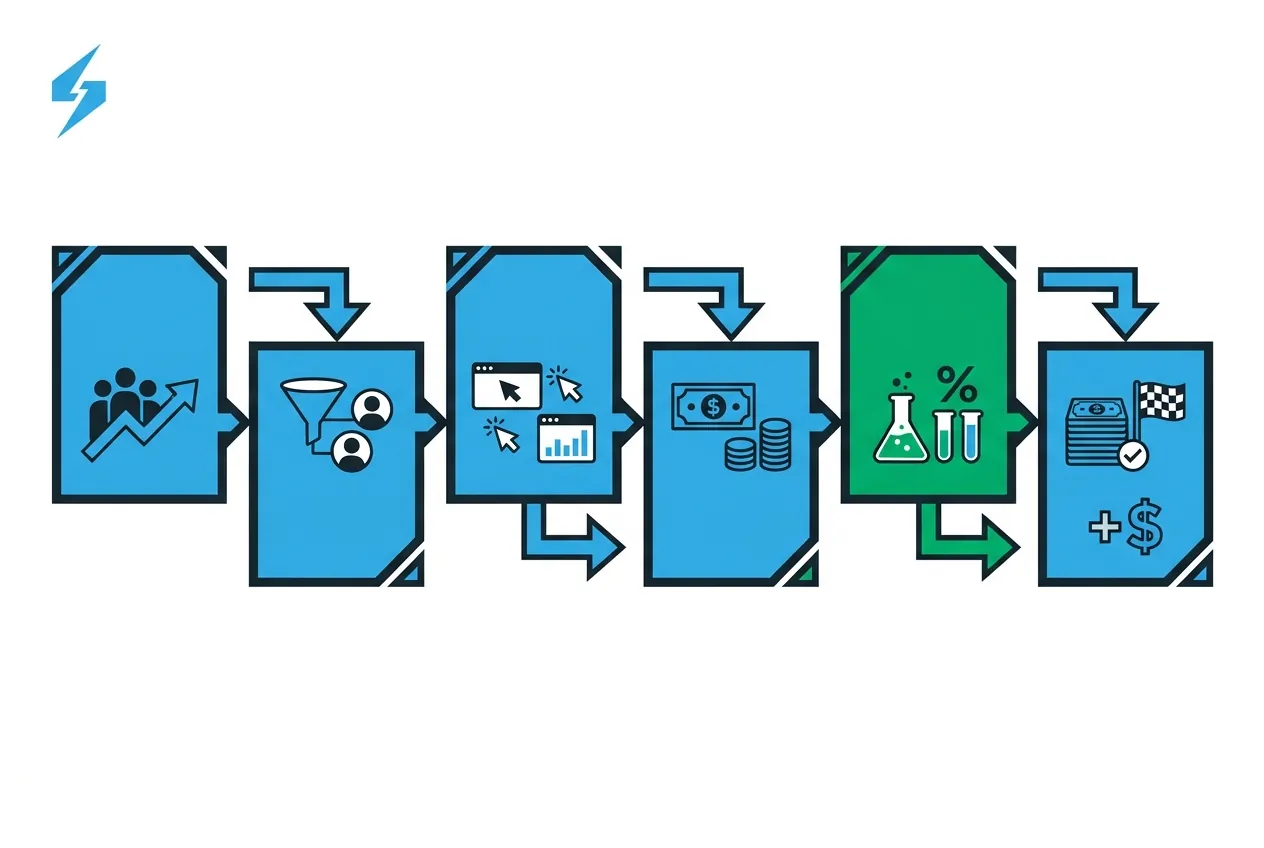
In an executive planning meeting, financial analysts and marketing directors map out this forecasting logic across shared financial workbooks, pressure-testing conversion assumptions before committing capital. The model works through deterministic arithmetic:
Work through this deterministic calculation sequence:
Step 1: Define Commercial Targets and Allowable CAC
Identify the target volume of new customer acquisitions or patient admissions required during the operating period, alongside your allowable customer acquisition cost (CAC).
- Illustrative target acquisitions: 20 clients
- Illustrative allowable CAC: $1,500
- Target total acquisition budget: $30,000
Step 2: Factor the Sales Opportunity Close Rate
Review CRM intake data to determine the historical percentage of qualified inquiries that complete intake and become closed revenue.
- Illustrative lead-to-client close rate: 10%
- Required qualified inquiries: 20 / 0.10 = 200 qualified leads
Step 3: Establish Intake Landing Page Performance
Evaluate the historical conversion efficiency of compliant landing environments.
- Illustrative conversion rate: 8%
- Required site clicks: 200 / 0.08 = 2,500 qualified visits
Step 4: Model the Market Cost Per Click
Review historical ad set pricing or initial test data across target territories to establish an achievable CPC range.
- Illustrative estimated market CPC: $10.00
- Core media budget required: 2,500 visits x $10.00 = $25,000
Step 5: Incorporate an Algorithmic Calibration Reserve
Add a 15% to 20% budget reserve dedicated to creative iteration, placement exploration, and auction calibration.
- Illustrative testing reserve (20%): $5,000
- Total projected Meta advertising budget: $30,000
This framework anchors budget requests in operational reality. If executive leadership requests 40 acquisitions on the same $30,000 budget, marketing directors can point to the specific operational variables that must adjust: internal close rates must rise, landing page intake friction must decrease, or creative resonance must lower click pricing.
Paid Media Management: How Marketing Powered Operates Accounts
Marketing Powered approaches paid acquisition as an accountable commercial engineering discipline rather than an open-ended media exercise. Led by a former healthcare Chief Marketing Officer who directed marketing for a treatment network that expanded from 3 to 24 locations, our team manages ad operations focused on measurable business outcomes.
Our founder's history includes managing $1.5 to $2M per month in Google Ads across 11+ behavioral and mental health accounts. Additionally, our leadership serves as a court-certified expert witness in advertising strategy. We apply these analytical standards across Google and Meta campaigns for hospital systems, healthcare providers, specialized professional practices, and multi-location service brands.
Our paid media management focuses on the commercial realities of complex markets:
- Attribution Tracked to Bottom-Line Admissions: We connect top-of-funnel media spend directly to validated intake records, pipeline opportunities, and confirmed admissions rather than raw form completions.
- Compliance-Aware Signal Systems: We operate with deep LegitScript and HIPAA awareness, configuring compliant server-side conversion architectures that protect consumer privacy while feeding high-density optimization signals back to platform algorithms.
- Owned, Local Computing Infrastructure: We have been AI-native since 2022, operating owned, local computing infrastructure for HIPAA-aware inference. This allows our team to run internal language models and intake data workflows without transmitting sensitive client information to third-party public cloud APIs.
- Cross-Channel Demand Alignment: We integrate Meta paid social with search intent. Readers evaluating full-funnel acquisition systems can examine our strategy in Healthcare PPC: structuring paid search for qualified patient demand to see how search capture and social generation support one another.
- Specialist Partner Standards: Learn how to vet dedicated operational agencies through our practical guides on Healthcare ppc services: what a specialist partner delivers and how to vet one and Google ads agency: what a specialist partner delivers and how to vet one.
In active account management, this involves setting up disciplined negative geographic exclusions, evaluating creative messaging against strict unit-economic hurdles, and optimizing intake workflows for high qualified lead density.
Questions, Answered.
Meta Ads Manager does not enforce an arbitrary monthly minimum spend, allowing accounts to operate on small daily budgets. However, generating predictable commercial outcomes in professional services or healthcare requires sufficient budget to produce reliable conversion feedback. If an ad set targets an expensive conversion event with low monthly spend, the platform struggles to gather enough conversion signals to optimize ad delivery. Commercial budgets in competitive service markets typically begin at several thousand dollars per month per territory to establish statistical confidence and support algorithmic delivery.
CPM measures the base media cost to display an ad 1,000 times, acting as the clearing price of inventory inside the auction. CPC measures the realized expense of an individual outbound link click to a destination website. Meta bills campaigns primarily on an impression basis (CPM), meaning CPC is a mathematical output determined by your ad's click-through rate relative to that underlying impression cost.
Meta incorporates ad quality and estimated action rates directly into its total value auction calculation alongside monetary bids. When target users engage positively with an ad by watching video creative, clicking through, and completing actions on site, the platform rewards the ad set with lower clearing CPMs. If users skip, hide, or report an ad, or bounce immediately from a slow landing page, the platform applies a quality discount penalty, requiring a higher monetary bid to sustain reach.
Ad cost inflation in active campaigns is primarily caused by audience fatigue and signal decay. As an ad set repeatedly reaches the same individuals, frequency increases and engagement drops. Falling click-through rates reduce estimated action rates in the auction algorithm, which increases effective CPMs and CPAs. Maintaining stable acquisition efficiency requires systematic creative testing, message variation, structured audience exclusions, and durable server-side conversion tracking. Request a paid media audit from Marketing Powered
Ready to see where your marketing can improve?
Request a free audit of your paid media, landing pages, attribution, and measurement setup. You'll get a straight assessment of where the opportunities are.
or email us at info@marketingpowered.ai