Resources
AI Data Readiness: A Checklist for One Real Use Case
Most stalled AI projects do not fail on the model. They fail three weeks into a build when someone discovers the policy archive holds four versions of the same document, two of them wrong, and none of them cleared for this use. An AI data readiness checklist fixes that by testing one named use case against five checkable dimensions before anyone commissions work.
By Mike Hulick, Founder, Marketing Powered

Define what the application must know
Readiness is not a property of an organization's data. It is a property of the pairing between a specific application and the sources that application will read. So the first artifact is not a data inventory. It is a one-sentence use case statement that a non-technical executive can repeat: who asks, what they ask about, what the system is allowed to do with the answer, and what happens when it does not know.
Write that sentence with the person who owns the workflow in the room, not only with IT. For an internal policy assistant, that is the operations lead, the intake supervisor whose team currently answers these questions by hand, and whoever signs off on compliance language. A ninety-minute working session produces three lists that drive everything downstream.
The first list is the question set. Pull real questions from ticket queues, shared inboxes, training requests and call notes, then write them in the words employees actually use. Thirty to fifty questions is enough to reveal the shape of the workload.
The second list is entities: the plans, locations, service lines, payers, program names, document types and internal codes the system must recognize and must not confuse. If two locations share a program name with different rules, that belongs on the list now rather than in a bug report later.
The third list is permitted actions. Answer only, answer with a citation, answer and route to a human, or answer and write back to a record. Each step up multiplies the evidence burden.
Retrieval and answer generation are separate components in a retrieval-augmented system, and the retrieval side carries its own distinct challenges, including query understanding, multi-source access and authorization (Microsoft Learn).
Treating them as one undifferentiated "AI" is how teams end up evaluating a vendor demo instead of their own evidence base.
Finish by bounding the pilot explicitly: date range, departments, document types in scope, and a written out-of-scope line. A narrow boundary is not timidity. It is what makes the rest of the checklist answerable in days rather than quarters.

Check rights and source authority
Authority answers a blunt question for each source: if two documents disagree, which one is the organization prepared to stand behind? Rights answers a second one: is this organization permitted to process this content in this way, for this audience, in this environment?
Build a source inventory with one row per source and these columns: source name, system it lives in, business owner by name, rough record count, authority tier, governing license or contract, permitted processing, and whether a trusted version exists. Authority tier is the column teams skip and regret.
A current, approved, dated policy document is tier one. A departmental interpretation of that policy is tier two. An email thread where two managers reached an informal agreement is not a source at all, even though it is often where the real answer lives.
Rights work has three common failure modes. Licensed third-party content, such as payer manuals, clinical reference material or market data, is frequently licensed for staff reading and not for ingestion into an index or a model context. Content created under a client or employer agreement may carry confidentiality terms that survive the project.
And regulated records carry statutory limits: the HIPAA Privacy Rule requires covered entities to make reasonable efforts to use, disclose and request only the minimum amount of protected health information needed for the purpose (HHS). Loading an entire records archive into a retrieval index because it was convenient is the opposite of that posture.
Document provenance as you go. NIST's Generative AI Profile directs teams to identify and document how a system relies on upstream data sources, including for content provenance, and whether it serves as an upstream dependency for other systems (NIST AI 600-1). That documentation is also the fastest way to answer a legal or security review later.
Where the processing happens is a rights question too, not only a cost question. The trade-offs between owned and rented compute are covered separately in AI infrastructure: owned vs rented AI economics.
Marketing Powered runs owned, local AI infrastructure for HIPAA-aware inference, and the honest framing is narrow: private deployment changes who holds the data and where it is processed. It does not by itself establish security or legal compliance. The contract terms, access rules and approved data flows still have to say so.
Assess coverage and quality
Coverage and quality are different tests, and most teams run neither because they assume the only option is reading everything. It is not. Start question-first, then sample document-first.
The coverage test uses the question set from the first section. For each question, have a knowledgeable person try to answer it using only the sources in scope, and record one of four results: answered cleanly from one authoritative source, answered only by combining sources, answered incorrectly or ambiguously, or not answerable at all.
The pattern matters more than the score. If a third of the questions require combining a policy document with an unwritten local practice, the archive does not contain the answer and no retrieval system will invent it responsibly.
The quality test uses a random sample stratified by source and by year, because error rates are rarely uniform across either.
Pull the sample, then score each item against a fixed rubric: current or superseded, duplicate or unique, contradicted by another in-scope document, readable by machine, carries a date and an owner, and contains content that should never have been in scope, such as personal identifiers or client material. Score the same rubric the same way across sources so the result is comparable.
Contradictions deserve their own handling. An illustrative example: two policy PDFs, both live on the shared drive, one stating a thirty-day window and one stating forty-five. A human reader resolves that by checking who sent it and when. A retrieval system will surface whichever chunk scores higher. For any question where a wrong answer creates clinical, financial or legal exposure, an unresolved contradiction is a blocking defect, not a cleanup item.
Keep the AI dataset quality assessment artifacts. The question set with verified answers becomes the evaluation set used before launch and reused as a regression test after every content change. The sample scores become the baseline that tells you whether remediation actually worked.
Defining fields and shared vocabulary is the same discipline applied upstream. The healthcare marketing data dictionary pipeline guide shows what that looks like in one regulated domain, where intake and marketing systems describe the same events with different names.
Free Audit
Want a straight read on where your budget is leaking?
Check structure and accessibility
This is the dimension that turns an optimistic timeline into a long engineering quarter. Content that a person can read is not automatically content a system can extract, chunk, cite and refresh.
Work through four checks on the sample you already pulled. Extraction: are these native text PDFs, or scanned images that need OCR, or slide decks where the real content is a diagram, or spreadsheets where meaning lives in cell formatting? Structure: do documents carry headings and sections that survive chunking, or are they wall-of-text memos where a retrieved passage loses its qualifying conditions?
Metadata: is there an effective date, a version, a department and an owner on the file itself, rather than in a folder name someone will rename? Identifiers: does each document have a stable ID or URL that can be shown in a citation and used to update or remove that document later?
Treat the identifier check as non-negotiable for anything an employee will act on. A passage the reader cannot trace back to a dated source is an assertion, and an assertion from an AI system carries unearned confidence.
Then check access. Enterprise content spans systems such as SharePoint, databases and blob storage, and building a unified search corpus without disrupting existing data operations is part of the problem (Microsoft Learn). Confirm each source offers an export or API path, who authorizes that access, and whether read traffic affects a production system.
Two retrieval realities belong in the readiness conversation rather than the build phase. Models accept limited input, so retrieval has to return concise relevant passages rather than exhaustive document dumps, and users ask vague, conversational questions in vocabulary that does not match document terminology (Microsoft Learn). The practical readiness output is a vocabulary map: staff terms on one side, document terms on the other. If the two sides barely overlap, budget for that gap now.
Deployment boundaries shape what is even testable, which is covered in owned AI systems and deployment boundaries.
Plan permissions and updates
A pilot is a snapshot. A deployment is a living copy of your content, and copies drift, leak and go stale. Readiness includes the maintenance plan, or it is not readiness.
Permissions first. The rule is inheritance, never widening: a user should see through the AI system exactly what they could see by opening the source. That is implementable. Azure AI Search, for example, supports document-level authorization through built-in access control list support, or through security filters that trim results based on a string containing a group or user identity (Microsoft Learn).
The readiness question is whether your entitlement data is clean enough to drive it. If group membership is inconsistent, the cheaper pilot path is to restrict scope to a single permission tier, such as documents already available to all staff, and defer entitlement mapping to phase two.
Freshness next. Set a tolerance per question type rather than one global number. Benefits eligibility rules may tolerate a weekly refresh; a rate sheet or an on-call roster may not tolerate a day. Incremental indexing keeps indexed content current as sources change (Microsoft Learn), but someone still has to own the pipeline and notice when it silently stops.
Deletion and correction are the obligations teams forget, and in regulated settings they are explicit. Under the HIPAA Privacy Rule, an individual has the right to request amendment of protected health information in a designated record set, the covered entity must act on that request no later than 60 days after receipt, and when it accepts an amendment it must make reasonable efforts to inform persons, including business associates, that hold the information and may foreseeably rely on it (45 CFR 164.526).
An AI index built on those records is one of those downstream holders. Name the person responsible, define the propagation path, and test it once before launch rather than discovering it during a complaint.
Record ownership, retention, hosting, subprocessors and approved data flows in the same document. Those choices are the substance behind data custody and processing boundaries.
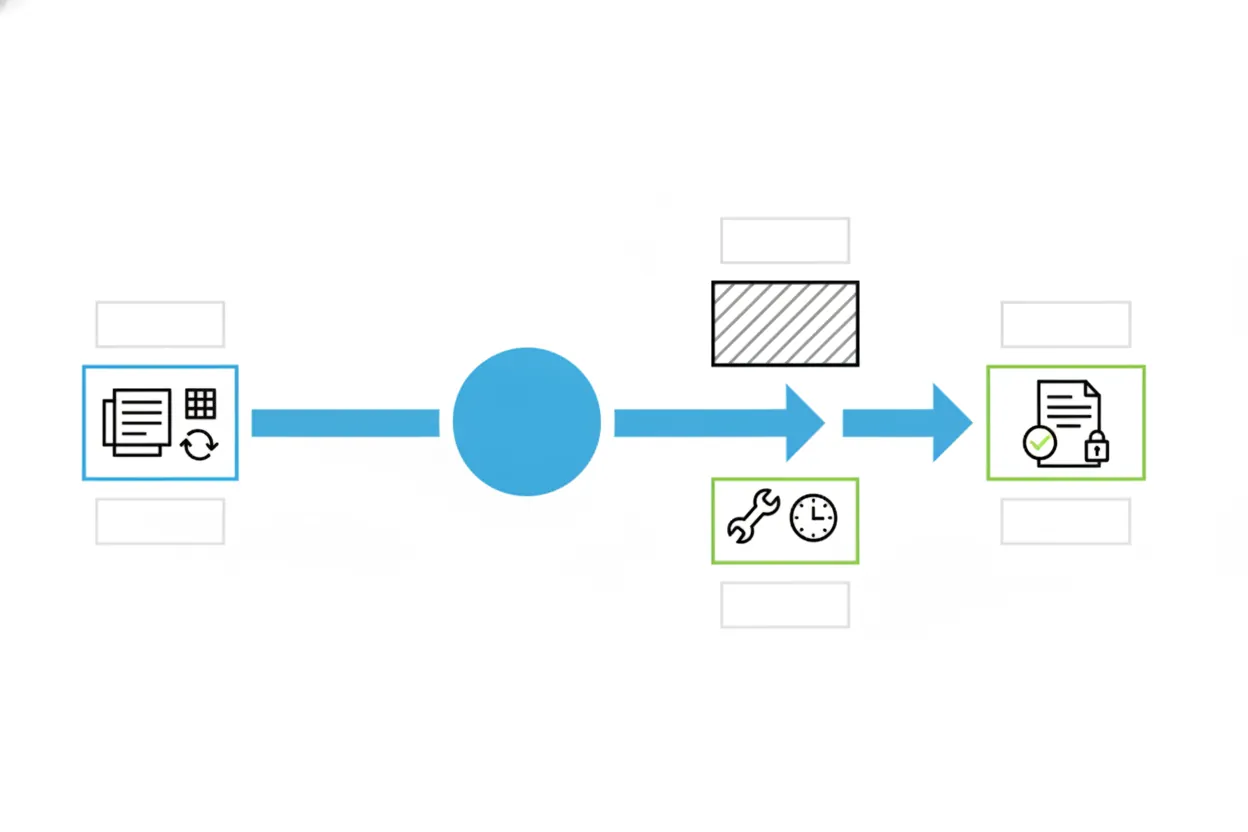
Walk one illustrative source inventory
The following example is illustrative and hypothetical, built to show the method rather than to report a result. A multi-location outpatient group wants an internal assistant that answers staff questions about admissions and benefits policy from a 2019 to 2026 document archive, answer-only, with citations, for non-clinical staff.
- Policy PDFs, shared drive. Owner: None named. Authority: Mixed, three versions of several files. Rights: Internal, unrestricted. Extraction: Native text, no dates in metadata. Permissions: All staff. Freshness: Ad hoc. Verdict: Remediate: name an owner, retire superseded files.
- Admissions SOPs, docs platform. Owner: Operations lead. Authority: Current and approved. Rights: Internal. Extraction: Clean, headings and versions. Permissions: All staff. Freshness: Monthly review. Verdict: Pass.
- Payer policy manuals. Owner: Vendor. Authority: Authoritative externally. Rights: License review required before ingestion. Extraction: Scanned PDFs, OCR needed. Permissions: All staff. Freshness: Vendor controlled. Verdict: Stop pending contract review.
- Email threads, shared inbox. Owner: None. Authority: Informal interpretations. Rights: Internal. Extraction: Poor, threaded and partial. Permissions: Mixed. Freshness: Continuous. Verdict: Exclude from scope.
- CRM intake notes. Owner: Intake director. Authority: Record level, not policy. Rights: Contains PHI. Extraction: Structured fields. Permissions: Role restricted. Freshness: Real time. Verdict: Exclude from pilot.
- Training decks, 2019 to 2022. Owner: Learning lead. Authority: Superseded. Rights: Internal. Extraction: Slides, text in images. Permissions: All staff. Freshness: Frozen. Verdict: Exclude, archive.
The inventory does the work that debate cannot. It narrows the pilot to two sources, restricts the date range, keeps protected health information out of the first build entirely, and converts a vendor licensing question into a task with an owner. It also makes the eventual cost estimate honest, because OCR, de-duplication and version retirement are now visible line items rather than surprises.
Recreate this as a spreadsheet with one row per source and the verdict column filled in last, after the rights, quality, structure and permissions checks are all scored. The verdict column is where the next section begins.
Email Us
Prefer to send the context directly?
Create the readiness decision: pass, remediate or stop
The checklist is only useful if it ends in a dated decision with a name attached. Three outcomes, defined in advance, applied per source and then rolled up to the use case.
Stop. The use case does not proceed in its current form if any of these hold: no identifiable owner or authoritative version for a source that answers high-stakes questions; licensing or contract terms that do not permit the intended processing; protected or confidential records in scope without a lawful basis and a documented data flow; contradictions that cannot be resolved for questions where a wrong answer causes harm; or no named owner for corrections and deletions after launch. These are rights and accountability failures. More engineering does not solve them.
Remediate. The use case proceeds after bounded work with an owner and a date: retiring superseded versions, adding effective dates and owners to metadata, OCR for scanned material, de-duplication, building the vocabulary map, or cleaning entitlement groups. Remediation items should be scoped to the sources the pilot actually uses, which is the entire reason for bounding the use case in the first section.
Pass with conditions. Most honest readiness reviews land here. Conditions are the mechanism: citations required on every answer, an explicit abstain behavior when confidence or coverage is low, human review retained for a defined question class, a limited audience, a frozen source set, and a review date. Write the conditions into the deployment, not into a slide.
Record the decision in one page: the use case statement, sources in and out with reasons, the evaluation question set, named owners for content, permissions and corrections, the conditions attached to a pass, and the trigger that forces re-review, such as adding a source or widening the audience. Governance frameworks are voluntary at this level of detail, so the discipline comes from the document existing and being revisited.
Treating readiness as a separate, time-boxed step from implementation is what protects the budget. Marketing Powered has worked this way since becoming AI-native in 2022, and the related decisions sit in supported local processing, AI governance and approval controls and open-source selection and licensing.
Questions teams ask before approving a pilot
Does all company data need to be cleaned before an AI pilot?
No, and attempting it is the most common way readiness work dies. Enterprise-wide cleanup is an open-ended program with no decision point, while this assessment covers only the sources one bounded use case will read. Define the question set, inventory the sources that answer it, and exclude everything else in writing.
Remediation then applies to a handful of sources rather than an archive. The exception is rights: a source with unclear licensing or unlawful content cannot be included at any level of effort, and that is a scope decision, not a cleanup task.
How can we assess a large archive without reading every file?
Use two passes. The question-first pass tests coverage by attempting real questions against the corpus and recording where answers are missing, ambiguous or split across sources.
The document-first pass takes a random sample stratified by source and by year, and scores each item against a fixed rubric for currency, duplication, contradiction, machine readability, metadata and out-of-scope content.
Sample size is a precision choice: larger samples narrow the estimate, and stratification matters more than volume because error rates cluster by era and by system. Report the result as an estimate with its sampling method stated, not as a measured census.
Which data problems should stop a deployment?
Rights and authority failures, and unresolved contradictions in high-stakes answers. If no one can say which version is authoritative, the system will choose for you. If licensing or confidentiality terms do not permit ingestion, the problem is legal rather than technical.
Two more belong on the stop list in regulated settings: no inheritance path for existing access permissions, since AI retrieval should never widen who can see what, and no named owner for corrections and deletions, because records obligations continue to apply to copies held in an index.
How should a small team adapt this approach?
Keep the structure, shrink the surface. Narrow to one question class and the single highest-risk source, usually the one that drives money or regulated decisions. Run the six columns of the inventory in a spreadsheet, sample fewer documents, and accept a wider estimate.
One person can own content accuracy and corrections, provided it is written down and someone other than the builder reviews the decision. Favor a pass-with-conditions pilot with citations and human review over a broader build, because conditions substitute for the governance depth a larger organization has in place.
What evidence would change the recommended approach?
Four things. Written licensing terms that permit or prohibit the intended processing, which can move a source from stop to pass or the reverse. Discovery of an authoritative, maintained source that replaces a contested archive, which often shrinks the project substantially.
Coverage results showing that answers live in people rather than documents, which redirects effort toward writing the missing content first. And a narrower use case definition, which is the lever teams underuse: cutting the question set in half frequently turns a blocked project into a defensible pilot.
Readiness work is cheap relative to a build that fails quietly, and it produces an artifact you can hand to legal, security and the executive sponsor in the same meeting. Bring one use case and the sources you think will support it.
More Resource Topics
Ready to see where your marketing can improve?
Request a free audit of your paid media, landing pages, attribution, and measurement setup. You'll get a straight assessment of where the opportunities are.
or email us at info@marketingpowered.ai