Who We Help
Market Intelligence for Small-Business Decisions
Market research for small business often arrives as a priced industry report that does not describe your trade area, or it does not happen at all and the call gets made on instinct. A scoped study works differently. It starts from one decision you are about to make, uses the cheapest credible evidence first, and stops once the uncertainty has been resolved.

Start with the decision, not the research
Before anything gets researched, the question has to be written in a form that can actually be answered. Not "should we grow," but something closer to "should we sign a lease on a second location in this submarket at this rent, or renew here and add a service line." A usable question names the choice, the money at risk, the date the answer is needed, and what the owner will do differently depending on which way it goes.
That framing also sets the budget for the research itself. A decision worth tens of thousands of dollars does not justify a study that consumes a meaningful share of it. The working test: if a finding would not change the choice, it does not need to be bought. Most owners facing one concrete decision need a handful of facts, not a slide library.
The founder is a former healthcare CMO who ran marketing for a treatment network that grew from 3 to 24 locations. That history shapes how this work is scoped: around a decision, not a deck.
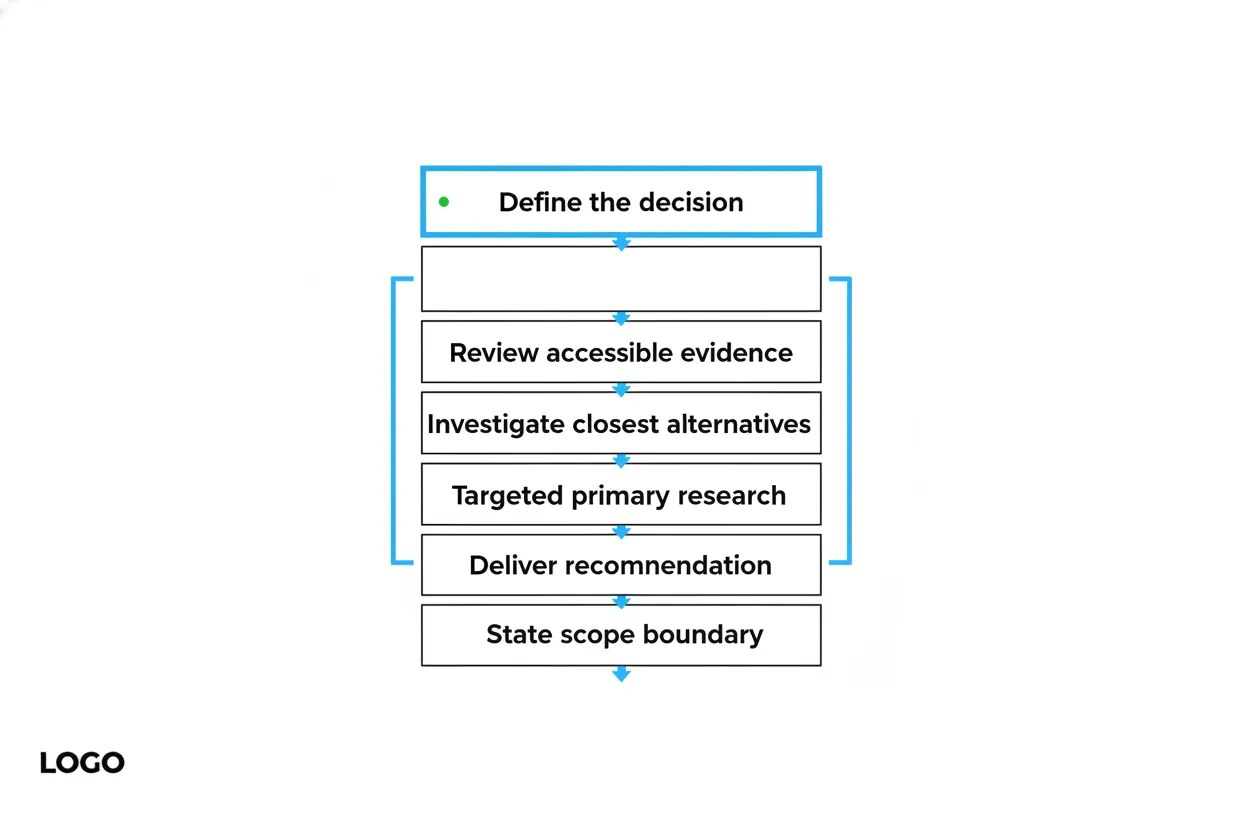
Use accessible evidence first
Free official data answers more than owners expect, and it answers faster than a commissioned study. The Census Bureau points small businesses to data.census.gov and the Census Business Builder, and describes Census Business Builder as useful for market research, business planning and location scouting, with interactive maps covering demographics, income levels, competition and consumer spending that you can zoom into at the ZIP code or county level.
County Business Patterns lists how many businesses exist in each industry by county and ZIP, along with establishment counts, employees and payroll, which is a quick read on local saturation. OnTheMap visualizes where workers live versus where they work, which matters when your customer base commutes.
You will need your North American Industry Classification System (NAICS) code to search most of these tools, as the Census Bureau notes.
The limits matter as much as the coverage. Census Business Builder data only goes down to the census tract level, and the Census Bureau advises checking the American Community Survey or a decennial census for block group questions (Census Bureau). Check each tool's data year and geography before leaning on it.
None of these sources measure demand for your specific offer at your price. Local market research that treats population counts as buying intent is how a bad lease gets justified. For an example of a local visibility review, see the Palm Beach County local visibility audit.
Investigate how buyers solve the problem today
The second layer of evidence is observational and costs attention rather than money. Prospective customers are already solving this problem somehow, and the fastest way to learn the standard you have to beat is to study the nearest alternatives. Read the pricing and service pages of the handful of businesses closest to the opportunity.
Count review volume, then read the one-star and three-star reviews, which describe unmet needs more precisely than most survey questions. Note which competitors advertise, where, and which offer they lead with. Call two of them the way a customer would and time how long it takes to reach a person.
That is the practical core of competitive analysis for small business. For context on how specialist firms divide this work, one research vendor's service menu separates market sizing and opportunity, competitive intelligence, industry trend analysis, win/loss analysis and market entry research into distinct engagements (Teknicks).
For a single pending decision, competitive observation and market entry questions usually carry the most weight, because they establish whether the gap you believe exists is real or already filled. Current Marketing Powered coverage is listed on the areas we serve page.
Free Audit
Want a straight read on where your budget is leaking?
Add primary research only when it changes the answer
Original research earns its cost when public and competitive sources leave the deciding unknown open, and not before. Name the single fact that would flip the decision, then check whether any existing source already contains it. If nothing does, you have justified talking to people or running a small live test.
In practice that stays modest. As an illustration, a short interview round might involve roughly eight to twelve structured conversations with current customers, lapsed customers and referral sources, run from a fixed question set so answers can be compared rather than recalled anecdotally.
The alternative is a geographically limited test: one campaign, one landing page, one offer, run in the target area long enough to produce a real cost per qualified inquiry instead of an estimate. A test like that leaves you with first-party data you keep.
Formal market sizing is a larger undertaking and is usually attached to larger decisions. One consultancy builds total, serviceable and obtainable market estimates from the bottom up using unit shipments, pricing and channel data, and lists new market entry, fundraising, annual planning, capacity planning and product line extensions as the typical situations for it (Douglas Insights). Deeper work of that kind sits on the published research hub.

Deliver a recommendation with stated assumptions
A project that ends in a summary of findings has not finished. The output should be a decision: the recommended option, the assumptions it rests on, the evidence behind each assumption, and the cost if an assumption proves wrong. The table below is an illustrative format for a two-option choice, not a result from any engagement.
- Decision. Option A: new location: Sign a lease in the target submarket. Option B: new offer at existing site: Launch a service line to the current base.
- Key assumption. Option A: new location: The trade area supports one more operator. Option B: new offer at existing site: Existing customers will buy the extension.
- Strongest evidence. Option A: new location: Establishment counts, commuting flows, competitor review patterns. Option B: new offer at existing site: Customer interviews, purchase history of current base.
- Weakest point. Option A: new location: Demand at your price point is unmeasured. Option B: new offer at existing site: Small interview sample.
- Cost of being wrong. Option A: new location: Fixed lease obligation and staffing. Option B: new offer at existing site: Opportunity cost and delayed focus.
- Reversibility. Option A: new location: Low. Option B: new offer at existing site: High.
The discipline this enforces is recording every input and its limitation. Serious sizing work applies the same principle: one consultancy includes a source register with a numbered citation for every input in its deliverables (Douglas Insights). Research narrows uncertainty; it does not promise a commercial outcome, and any study that implies otherwise is selling confidence rather than evidence. Methods and supporting material are collected under research methods and resources.
Keep research proportional to the decision
A right-sized scope can establish several things well: who is in the trade area and how many competitors serve them, how those competitors position and price, what current and lapsed customers say about the gap, and what one controlled test produces as a real acquisition cost. That is often enough to commit or walk away.
It cannot establish a defensible total market value, forecast multi-year growth, or turn a dozen conversations into statistically representative findings. Those need a larger study with a proper sampling frame and modeled supply and demand inputs. Saying so plainly is better than dressing a small sample as certainty. A larger study is warranted when the capital at risk could threaten the business, when lenders or outside investors need auditable numbers, or when the decision spans several markets that behave differently.
After the decision, keep measuring on the same terms: track qualified inquiries against the cost of the test that produced them. Related reading: published studies and their evidence, marketing investment economics and budget allocation principles.
Questions, Answered.
Yes, when the question is narrow. A study scoped to one decision concentrates effort on the few facts that would change the answer. The constraint is honesty about what a small sample supports: directional confidence about demand and competition, not precise forecasts. If the evidence comes back ambiguous, the right output is a recommendation to test further, not a manufactured conclusion.
The Census Bureau points small businesses to Census Business Builder for market research, planning and location scouting, data.census.gov for detailed demographic and economic tables, County Business Patterns for establishment, employee and payroll counts by county and ZIP, the American Community Survey for annual local estimates, the Economic Census for benchmarking against others in your industry, and OnTheMap for workforce and commuting patterns (Census Bureau). They describe the composition of a market. None of them measure demand for your particular offer.
A syndicated report answers the average question for a category, using segment definitions and geographies chosen by the publisher. One consultancy makes the same point about off-the-shelf numbers, noting that purchased syndicated figures are often two base years old and sized for a different segment definition (Douglas Insights). A scoped study starts from your decision, your trade area and your price point, and records the limitations of each input so you can weigh the findings yourself.
The decision stays with you, and so does access to the things only you hold: customer lists for interview outreach, historical sales or intake records, pricing constraints and capacity limits. Scope is agreed in a first conversation. That conversation sets which inputs come from your team, such as customer introductions and sales records, and which work Marketing Powered carries, so the split is explicit before anything begins rather than discovered later.
Expansion should be triggered by a specific gap, not by appetite. Reasonable triggers include a live test producing a cost per qualified inquiry close to your breakeven threshold, interview findings that split evenly instead of converging, or a multi-site decision where each market behaves differently. If the first pass resolves the question, a wider scope adds cost without changing the outcome. Scope a small-business research question
Ready to see where your marketing can improve?
Request a free audit of your paid media, landing pages, attribution, and measurement setup. You'll get a straight assessment of where the opportunities are.
or email us at info@marketingpowered.ai