Who We Help
Peptide Marketing Agency for Eligible Businesses
Peptide businesses are not one market. A licensed clinic, a compounding pharmacy, a commercial research supplier and a collagen supplement brand sell adjacent-sounding products under different rules, and each faces a different ceiling on what can be promoted. The first job of a peptide marketing agency is to establish which model you actually operate, before any scope, budget or media spend is discussed.

Start with your business model, not the molecule
Peptide marketing requests tend to fall into a handful of business models, and they are not interchangeable.
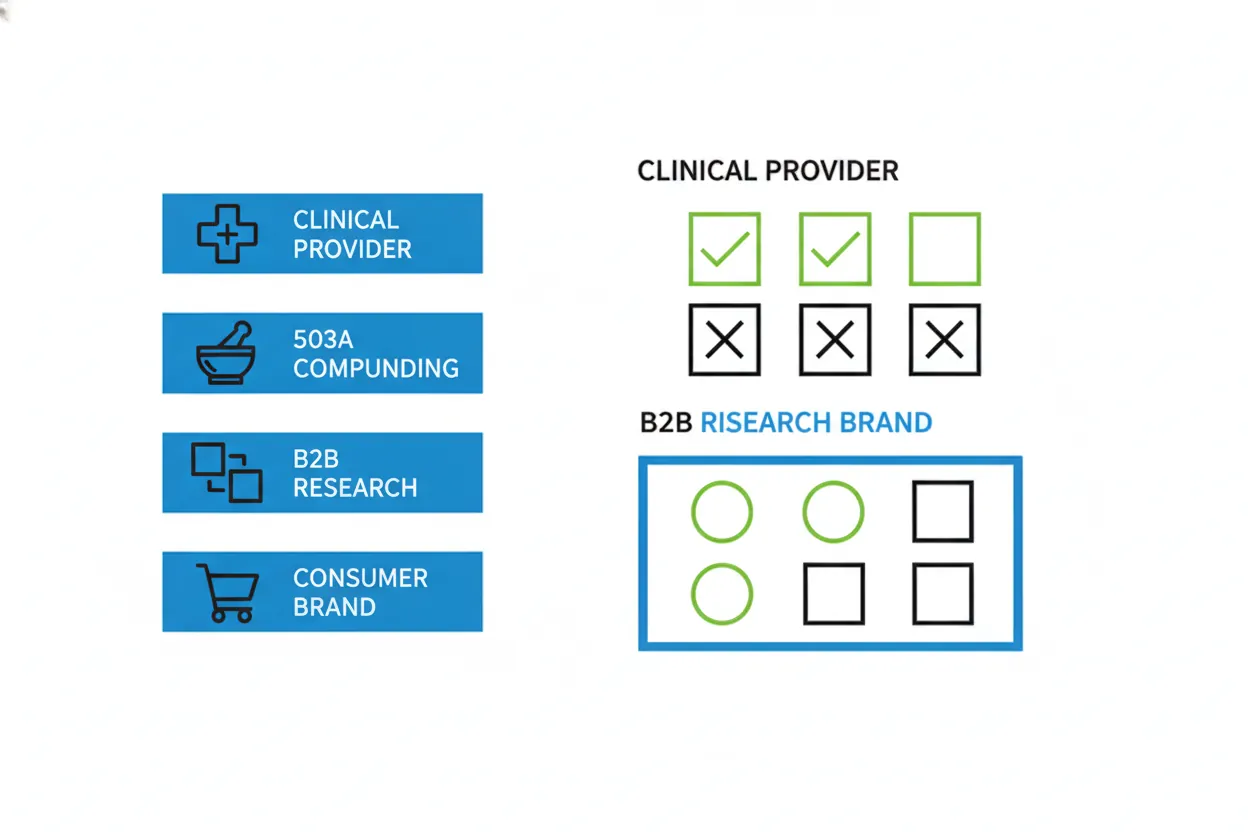
A licensed clinical provider sees patients, prescribes, and may operate telehealth across several states. A state-licensed compounding pharmacy or physician compounder prepares patient-specific products under Section 503A of the Food, Drug and Cosmetic Act. A commercial laboratory or B2B research supplier sells reference materials to institutional buyers. A consumer brand sells lawful supplements or cosmetics with no prescribing relationship at all.
The distinction has operational teeth. The HHS enforcement discretion policy for certain peptide bulk drug substances applies to qualifying 503A pharmacies and physician compounders, and also matters to businesses that facilitate prescribing, sale or dispensing through those compounders, including telehealth providers; 503B outsourcing facilities are not covered (LegitScript).
That is why the first call usually needs the owner, the medical director or pharmacist in charge, and whoever signs off on claim language. Two companies can advertise the same word and sit on opposite sides of the line, so naming the model correctly is the first useful output of any peptide industry marketing engagement.
Legality, certification and channel permission are three gates
Lawful sale does not produce advertising permission, and certification does not produce platform approval.
Google states that some healthcare content cannot be advertised at all, while other content can be advertised only in certain locations by advertisers who have applied and been approved.
Under its unapproved substances rules, Google does not allow the promotion of certain products regardless of any claims of legality, including items on its non-exhaustive list of unapproved pharmaceuticals and supplements, non-government approved products marketed as safe or effective for preventing, curing or treating a disease, and products subject to government or regulatory action or warning.
Promotion of speculative or experimental medical treatments is also not allowed. Separately, Google restricts services related to online prescribing, dispensing and sale of prescription drugs, advertisers must apply to run those ads, and location-specific restrictions apply (Google Ads healthcare and medicines policy).
In the United States, that policy requires online pharmacies and telemedicine providers to be certified by LegitScript or accredited by the National Association of Boards of Pharmacy, and advertisers must also be certified with Google.
Certification is a separate gate again. LegitScript states that it does not control the policies of advertising platforms, payment processors, acquirers or card brands, and advises businesses to confirm each platform's current requirements independently (LegitScript). Our general approach to regulated acquisition work sits on the healthcare marketing agency page.
What the 2026 compounding enforcement discretion policy changed
On October 28, 2026, HHS filed a Federal Register notice announcing the availability of its enforcement discretion policy regarding 503A compounding using certain peptide bulk drug substances.
It describes conditions under which FDA intends to refrain from specified enforcement action against qualifying compounders using six named substances, and sets out 10 conditions for eligibility, including sourcing from an FDA-registered facility with a valid certificate of analysis, a single active pharmaceutical ingredient, defined labeling and reporting.
Enforcement discretion does not approve the compounded products or remove other applicable legal requirements (LegitScript).
LegitScript updated its certification review approach, effective November 2, 2026, to reflect the policy's conditional allowances, and says review will consider the specific ingredient, formulation, route of administration, compounding facility and supply chain compliance. It also advises businesses to review labels, marketing and patient communications so they do not suggest that enforcement discretion means FDA approval (LegitScript).
Read that last point as a marketing instruction, because it is one. Landing page copy, patient email subject lines and service names all sit inside the same review.
Free Audit
Want a straight read on where your budget is leaking?
How the acquisition system works for eligible businesses
Once the model and the gates are established, the work looks like accountable demand generation rather than compliance theater.
It starts with research and positioning: which audience the offer can legally serve, what can be said about it, and what the competitive claim environment looks like. Paid search follows only where platform rules allow that offer in that location, with ad copy and landing pages written to the claim limits rather than retrofitted after a disapproval. Organic content and technical SEO carry the weight paid media cannot, particularly for research suppliers and clinical categories with narrow ad permissions.
Conversion infrastructure matters as much as traffic: intake routing, call handling, form logic and a site built to convert qualified inquiries rather than collect volume. Marketing Powered works in Google's sensitive healthcare vertical, where retargeting is not permitted, and tracks attribution to admission, not just lead. The founder previously ran Google Ads across 11+ behavioral and mental health accounts and is a court-certified expert witness in advertising strategy.
Capability detail sits on the paid media and analytics and attribution pages, and the full list of sectors we serve is published separately.

How an engagement is scoped and who owns what
Scope follows evidence, in a fixed order.
You bring the facts: entity structure, state licensure, pharmacy or compounder relationships, product and formulation detail, certification status, current claim language, payment processor standing, and the history of any restricted ad accounts. That documentation does double duty, since LegitScript tells applicants and certified businesses to be prepared to provide supporting information about their offerings and pharmacy relationships (LegitScript).
Your qualified legal, clinical and regulatory advisors own the conclusions in their domains. Marketing Powered does not substitute for them or issue legal and clinical determinations.
The agency work focuses on research, channel assessment, creative and landing pages, media operations and analytics. Policy is treated as a live condition, because platform and certification requirements change and should be confirmed before launch.
Account and data ownership terms are a fair question to put to any agency, and we expect to discuss them early; the security overview and the healthcare marketing compliance checklist cover how we handle data and documentation.
Before you shortlist anyone, ask for documented service scope and staffing, verified work samples in regulated categories, and a written eligibility read before a proposal. Certification mechanics are covered in the LegitScript certification resource.
Choose the route that fits your position
The fit review looks at whether a business is better served by an eligibility assessment, remediation work on a suspended or restricted account, or growth work on an offer that already clears its gates. New entrants and businesses changing their offer usually need the first.
A suspended account or declined processor starts with reconstructing what was promoted, against which policy, on which pages, since correcting the offer and claims comes before any appeal. Cleared businesses with documented eligibility move to research, paid media, content, conversion infrastructure and attribution built as one system aimed at peptide business growth.
Illustrative routing logic, not an eligibility determination. The table describes, for each business model, what usually governs the offer, the channel question to answer first, and the documents a fit review begins with.
- Licensed clinic or telehealth practice. What usually governs the offer: State licensure, scope of practice, prescribing rules. Channel question to answer first: Does the account qualify under prescription drug services and certification rules. Where the review starts: Licensure map and current ad account status.
- 503A pharmacy or physician compounder. What usually governs the offer: Section 503A conditions and state pharmacy law. Channel question to answer first: Does this formulation and route sit inside the stated policy conditions. Where the review starts: Formulation, sourcing records and certification position.
- Commercial laboratory or B2B supplier. What usually governs the offer: Research-use-only labeling and buyer verification. Channel question to answer first: Is there any consumer-facing promotion at all. Where the review starts: Catalog structure, claim language and buyer verification.
- Consumer supplement or cosmetic brand. What usually governs the offer: Supplement and cosmetic labeling and claim rules. Channel question to answer first: Do the claims cross into preventing or treating disease. Where the review starts: Claim inventory and landing page review.
If the model cannot support the acquisition work, the fit review says so. You can book that review with your documents in hand.
Email Us
Prefer to send the context directly?
Questions buyers ask before the first call
What types of peptide businesses can you evaluate?
Licensed clinical providers and telehealth practices, 503A compounding pharmacies and physician compounders, legitimate commercial laboratory and B2B research suppliers, and lawful consumer supplement or cosmetic brands. Evaluation is not acceptance. Each business is assessed on its offer, documentation, certification position and channel permission.
Can every legally sold product be advertised?
No. Google does not allow the promotion of certain products regardless of any claims of legality, and it maintains a non-exhaustive list of unapproved pharmaceuticals and supplements as examples under that policy (Google Ads). Legality, certification and ad eligibility are assessed independently of each other.
Do you work with genuine B2B research suppliers?
Yes, with a hard boundary: research-use-only products are not promoted for human use, and consumer-facing positioning of research material is out of scope. That status does not by itself create channel eligibility. LegitScript lists research-use-only chemical businesses, including peptides, among those generally not eligible for Healthcare Certification because they do not perform an activity the program covers (LegitScript). These businesses typically grow through SEO, catalog architecture, technical content and B2B demand generation rather than consumer paid search.
Can you promise account reinstatement?
No, and no agency can. For violations Google classes as egregious, such as offering prescription drugs without a prescription, Google states that suspension occurs upon detection without prior warning and that accounts are only reinstated in compelling circumstances (Google Ads). Recovery work focuses on correcting the offer, claims and destination pages, then presenting an accurate appeal.
What documents should we bring to the first call?
Entity and licensure records, pharmacy or compounder agreements, formulation specifications with certificates of analysis where applicable, current certification status, live claim language, payment processor standing, and the disapproval or suspension history for every ad account involved. Incomplete documentation does not end the conversation, but it does determine how far the first call can go.
Ready to see where your marketing can improve?
Request a free audit of your paid media, landing pages, attribution, and measurement setup. You'll get a straight assessment of where the opportunities are.
or email us at info@marketingpowered.ai