Capabilities
Performance Max Agency: Specialist Governance for Regulated Search
Selecting a qualified performance max agency requires moving past surface-level promises of machine learning efficiency. Google automated campaign formats aggregate inventory across multiple networks, which can accelerate customer acquisition or quietly erode margins through low-intent traffic and cannibalized brand demand. Deploying these budgets effectively demands rigorous negative controls, structured first-party data inputs, and disciplined conversion tracking.

What a Performance Max Agency Delivers Beyond Automated Bidding
Hiring an external partner to manage automated Google inventory should never mean paying a management fee for a hands-off account. According to Google Ads Help, Performance Max serves across YouTube, Display, Search, Discover, Gmail, and Maps from a single campaign structure. Because the bidding algorithm seeks the fastest route to register a designated conversion action, unguided automation will naturally pursue low-friction, low-cost impressions rather than high-value commercial prospects.
A specialized agency builds an operational barrier between algorithmic automation and unvetted lead generation. That work begins with creative and structural asset group segmentation. Rather than dumping mixed creative assets into a generic bucket, an operator organizes asset groups around distinct search intents, service lines, or regional facilities. Each asset group receives tailored creative copy, specific long headlines, verified imagery, and curated audience signals designed to point Google machine learning toward real prospects.
Beyond asset deployment, agency management centers on continuous query governance. Automation does not eliminate the need to audit search terms. Through custom reporting scripts and placement reviews, media managers monitor where ad impressions surface, identifying non-converting display placements, low-quality video networks, and mismatched search queries. Specialists review these query distributions weekly, adding exclusions at the campaign and account levels to protect working media spend.
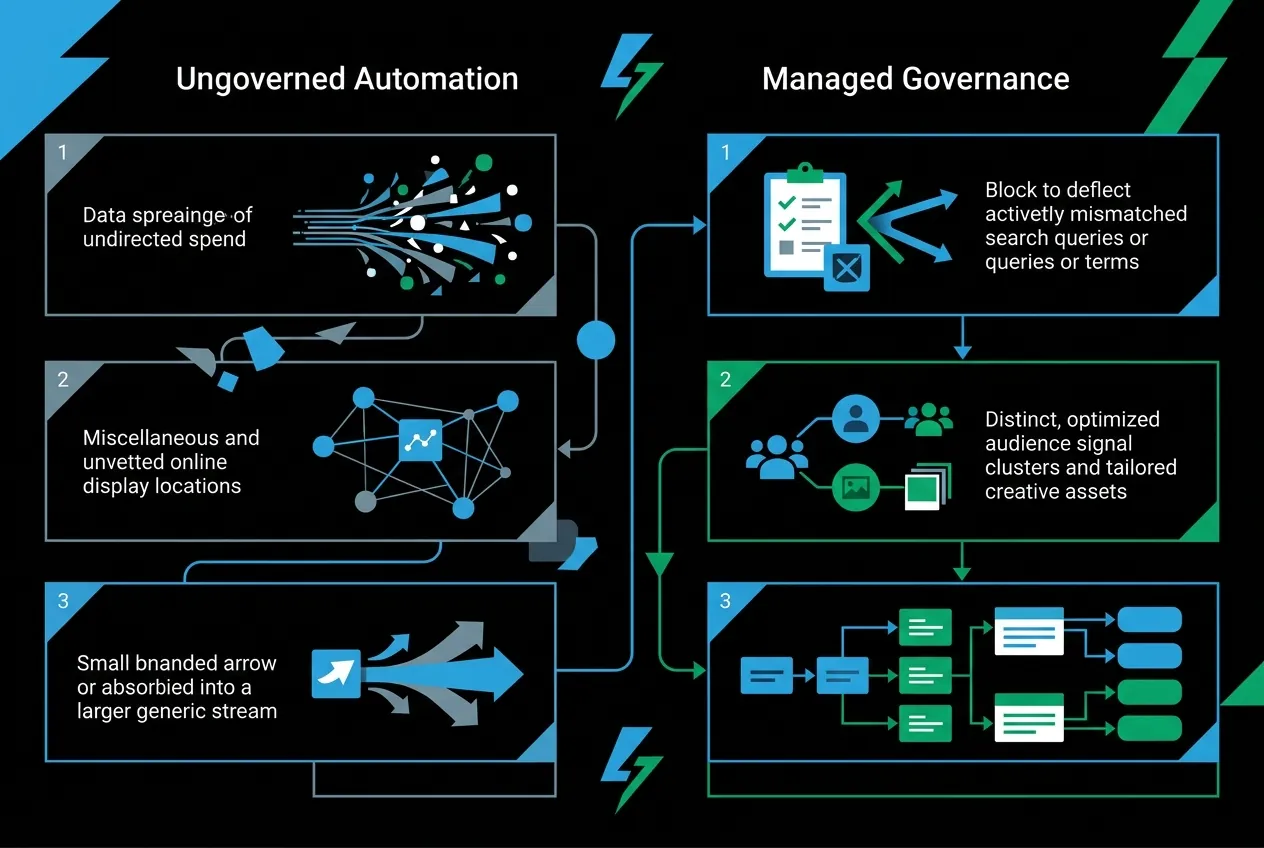
How Performance Max Google Ads Campaigns Distribute Spend Across Channels
Understanding performance max google ads requires recognizing how the bidding engine interacts with the broader ad auction. When an advertiser launches performance max campaigns, Google evaluates every available placement across its network to fulfill the set target cost-per-action (Target CPA) or target return on ad spend (Target ROAS). If the account does not establish hard boundaries, the algorithm frequently prioritizes cheap inventory on the Google Display Network or mobile apps, where accidental clicks and bot interactions easily register as apparent traffic spikes.
This dynamic creates an illusion of efficiency. Marketing dashboards may report lower average costs per click and surging conversion volumes, yet sales intake teams report an influx of disconnected phone numbers, spam form submissions, or confused consumers. Without explicit constraints, automated campaigns also harvest existing brand awareness by bidding aggressively on the company's own branded terms, taking credit for transactions or inquiries that would have arrived via organic search or standard brand campaigns.
To keep performance max campaigns disciplined, media operators implement structural controls. They pair generic search campaigns with automated campaigns to capture exact-match commercial intent first. They also configure custom audience signals using first-party customer lists, in-market segments, and competitor search terms. These signals inform the machine learning models during the initial learning phase, preventing the system from spending weeks testing broad demographic categories that have no history of converting into revenue.
Hidden Traps of Running Performance Max in Regulated Sectors
In complex commercial environments such as healthcare, addiction treatment, legal services, and financial advisory, running performance max google campaigns without strict governance introduces substantial operational and regulatory risk. In these sectors, a conversion is never just a digital form submission; it represents a qualified patient, a retained corporate client, or an insured admission.
The primary trap in regulated marketing is unvalidated lead scaling. Automated bidding engines optimize strictly toward the conversion signals they receive. If a campaign is set to maximize primary form fills, and the website intake form lacks spam filters, the machine will identify bot activity or spam submissions as positive signals. It will then double down on the placements that generated that fraudulent activity, rapidly draining media budgets on non-viable inquiries while legitimate commercial demand goes uncaptured.
The second critical challenge involves compliance and privacy boundaries. Under Google Advertising Policies, personalized advertising and retargeting are strictly prohibited in sensitive categories, including physical and mental health conditions. While standard commercial advertisers might lean on dynamic remarketing lists to re-engage past site visitors through Display or YouTube, regulated advertisers cannot. Performance Max models in sensitive verticals must rely entirely on contextual relevance, localized asset alignment, and clean conversion pipelines. Deploying automated campaigns in these fields requires a partner who understands regulatory boundaries, LegitScript certification requirements, and strict health data privacy standards. For structured guidance on search architecture in complex clinical verticals, review the approach outlined in Healthcare PPC: structuring paid search for qualified patient demand.
Free Audit
Want a straight read on where your budget is leaking?
Five Technical Questions to Vet Any Performance Max Company
Evaluating an external partner requires looking past generalized case studies and interrogating operational workflows. When interviewing a potential performance max company, use these five technical questions to determine whether they possess the systems needed to govern automated campaigns:
- How do you isolate branded search traffic from generic expansion?
If an agency allows Performance Max to bid on your brand name, campaign conversion metrics will look exceptional while incremental business growth stalls. The agency must demonstrate how they apply brand exclusions at the campaign level or use account-level negative keywords as outlined in Google Ads Help to ensure automated budgets capture net-new commercial demand.
- What specific first-party data signals will you feed into asset groups?
Algorithmic targeting improves when guided by rich audience data. Ask the agency how they curate and upload Customer Match lists using Google Ads Help standards. They should explain how they segment historical buyers, high-value accounts, or past patients into distinct privacy-compliant lists to serve as optimization signals.
- What mechanisms do you implement to stop form spam from corrupting the bidding model?
A qualified partner should not rely on standard Google reCAPTCHA alone. Ask whether they implement hidden honeypot fields, multi-step lead qualification forms, email verification APIs, or time-to-submit validation. Preventing invalid leads from firing conversion tags is the only way to keep the machine learning model from optimizing toward junk data.
- Do you optimize bids to raw form fills or downstream revenue milestones?
Optimizing to top-of-funnel leads is the fastest way to misallocate media spend. A capable firm will describe how they integrate your customer relationship management (CRM) platform or electronic health record (EHR) system with Google Ads, importing qualified opportunities, signed contracts, or completed admissions back into the auction.
- Who maintains administrative ownership of the Google Ads account, scripts, and first-party assets?
You must own your data, your conversion history, and your campaign structures. Never engage an agency that runs media through a proprietary master account or refuses to grant direct administrative access. If you part ways, your historical optimization data must stay inside your organization.
Teams comparing specialized service scopes across different paid search channels can evaluate additional operational standards in our guide on Healthcare ppc services: what a specialist partner delivers and how to vet one, as well as our review of core competencies in Google ads agency: what a specialist partner delivers and how to vet one.

Closed-Loop Attribution: Offline Conversions and Pipeline Milestones
The dividing line between mediocre media management and elite account performance is conversion architecture. Feeding unvalidated web inquiries directly back into Google Ads distorts the entire bidding engine. When a target CPA bid strategy receives twenty form fills, it treats every submission equally, even if fifteen of those leads contain invalid phone numbers and only one turns into a paying client.
To build an accountable advertising system, an agency must configure Offline Conversion Imports via Google Ads Help. This technical connection bridges the gap between digital ad interactions and real-world commercial outcomes:
- Capture Click Identifiers: The web architecture captures the unique Google Click Identifier (GCLID) or session data upon initial form submission or call tracking connection.
- Store Identifiers in the CRM: The lead record stores the click identifier alongside intake notes, lead qualification statuses, insurance verifications, or sales pipeline stages.
- Filter Qualified Milestones: When a lead transitions from a raw inquiry to a qualified prospect, scheduled consultation, signed contract, or patient admission, the milestone is recorded with an assigned commercial value.
- Automated Data Return: The agency's data pipeline passes that milestone back to Google Ads on an automated schedule, matching the transaction to the originating click.
Once offline conversion data flows consistently, the campaign bid strategy can transition from simple conversion volume to value-based bidding (Maximize Conversion Value or Target ROAS). Instead of hunting for the cheapest form fills across low-quality inventory, Performance Max algorithms adjust bids dynamically based on the likelihood of a click generating downstream revenue or verified admissions.

Account Governance and Paid Media Management at Marketing Powered
Marketing Powered manages complex advertising programs through an operator-led model designed specifically for regulated verticals, healthcare organizations, and multi-location businesses. Our leadership brings verifiable scale: our background includes a former healthcare CMO who ran marketing for a treatment network that grew from 3 to 24 locations, direct management of $1.5 to $2M per month in Google Ads across 11+ behavioral and mental health accounts, and service as a court-certified expert witness in advertising strategy.
Our operational approach does not treat automated advertising as an outsourced mystery. We are AI-native since 2022, operating owned, local AI infrastructure for HIPAA-aware inference. This allows our team to analyze complex search term patterns, process multi-location reporting, and audit creative assets within a secure, privacy-conscious data environment.
We are LegitScript-aware and HIPAA-aware, purpose-built for Google's sensitive healthcare vertical, where retargeting is not permitted. Because remarketing lists cannot be used in sensitive health categories, we focus media execution on intent capture, location-specific targeting, robust asset construction, and rigorous offline conversion feedback. For healthcare providers, our attribution is tracked to admission, not just lead, ensuring that marketing capital is judged on verified patient volume rather than vanity engagement metrics. Advertisers seeking end-to-end management can review our integrated Google and Meta paid media management services to inspect our deployment standards across paid search, automated campaigns, and social channels.
Questions, Answered.
No. Performance Max should complement, not replace, structured search campaigns. Standard Search campaigns with exact and phrase match keywords allow precise control over search queries and budget allocation for core commercial keywords. Performance Max should be deployed alongside Search, using brand exclusions to discover incremental reach across YouTube, Display, and Maps without cannibalizing proven search demand.
Google automated campaigns typically require a learning period of two to six weeks, depending on conversion volume. The algorithm needs sufficient conversion density (ideally 30 to 50 verified conversions per month per campaign) to optimize its bidding parameters. Running low-budget campaigns with sparse conversion data extends the learning phase and reduces targeting stability.
Negative keywords prevent ads from showing on irrelevant queries. While Performance Max previously restricted negative keywords, advertisers can now apply account-level negative keyword lists or submit campaign-level brand exclusion lists. A professional agency uses these tools to block competitor names, job searches, customer support queries, and non-commercial searches from consuming ad spend.
This issue occurs when campaigns optimize toward shallow, top-of-funnel micro-conversions (such as page views or basic form submissions) without lead validation filters. Spambots and low-intent users easily complete simple web forms. Without offline conversion tracking to inform the algorithm which leads actually convert into paying clients or admitted patients, the bidding engine continues to buy cheap, unqualified traffic. Request an acquisition audit
Ready to see where your marketing can improve?
Request a free audit of your paid media, landing pages, attribution, and measurement setup. You'll get a straight assessment of where the opportunities are.
or email us at info@marketingpowered.ai