Capabilities
Intelligent Document Processing With Reviewable Outputs
Most teams drowning in recurring paperwork do not need a smarter reader. They need a defined path from an incoming document to a validated field, with a person positioned at every point where the system is uncertain. That is the job of intelligent document processing services built around reviewable output rather than demo accuracy.

Map the document intake before choosing any tool
Start with what actually arrives. Who sends it, through which channel, in what condition, and how much the volume swings between a quiet Tuesday and the first week of the month. An intake coordinator receiving faxed referrals, a billing lead pulling PDF invoices out of a shared inbox, and an admissions clerk scanning handwritten forms are three different automation problems, even when the destination field is the same.
Catalogue the formats, the languages, the page counts, the scan quality, and above all the sensitive fields: identifiers, financial data, anything restricted. Mapping intake is not administrative warm-up. It determines whether automated document classification is feasible at all, and which documents should never leave a controlled environment.
Define the output contract before any model runs
The output contract is the real design artifact. It specifies the schema, the required fields, the allowed values and formats, the fallback when a field is absent, and the provenance record that ties each extracted value back to a page and region of the source document.
Most document automation failures are not extraction failures. They are missing-contract failures: nobody decided what a valid field looked like before a model was asked to produce one. A date field that accepts any string will accept an invented one. A contract that constrains type, range and required status turns a plausible guess into a flagged exception. This is the same discipline described in how configurable AI workflows are scoped.
Separate extraction, validation and review into auditable steps
Vendors often present document-to-data automation as one capability. It is at least five. IBM frames the core activities as document classification, data extraction, and data output, where extraction identifies key and value pairs and output applies formatting and enrichment before anything feeds a downstream workflow (IBM).
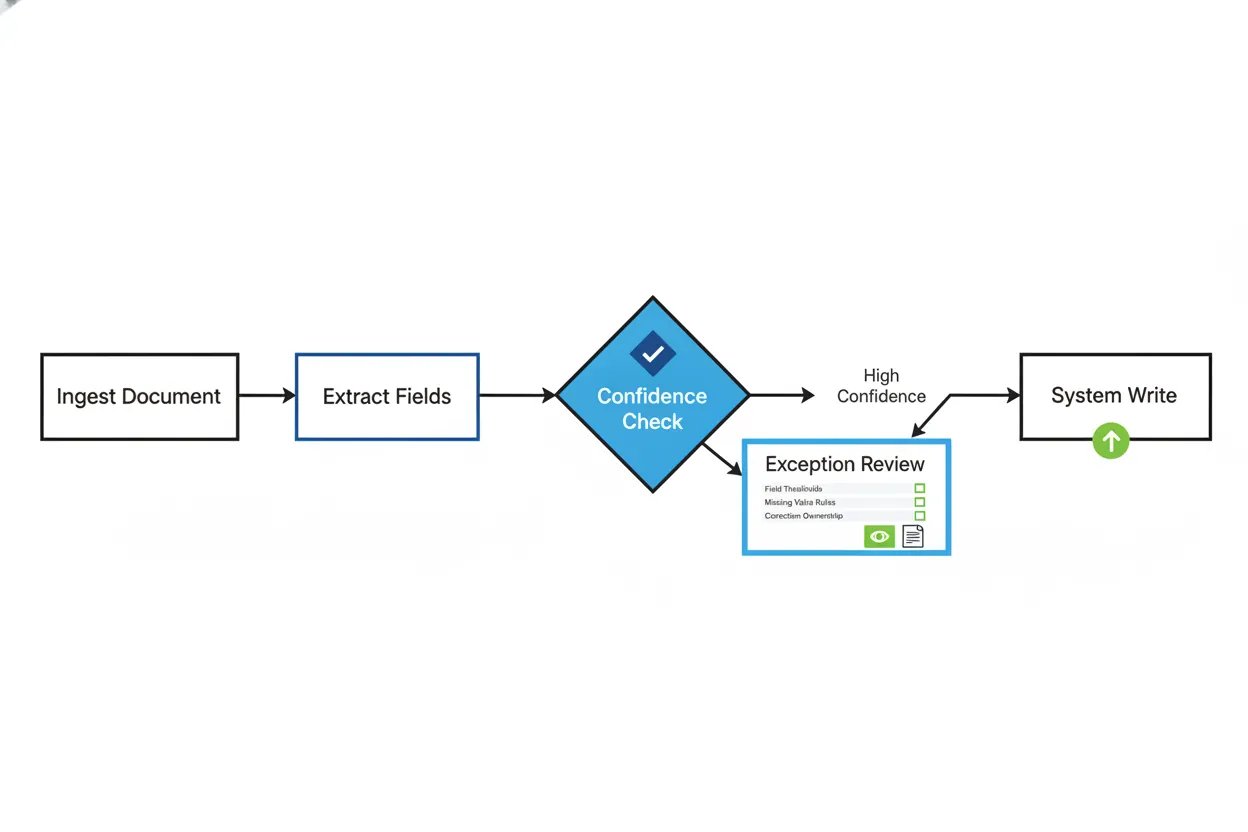
Treat each stage as separately observable: OCR produces text with page coordinates, classification assigns a document type, extraction proposes field values with confidence, deterministic checks test those values against the contract, and review resolves what fails.
Deterministic checks are unglamorous and they carry the load: checksum rules, date and currency validators, cross-field arithmetic, lookups against existing records. IBM notes that configurable validators can cover date and currency fields with custom validators for unique field types (IBM). Field mapping into downstream systems is handled as part of workflow integration and tracking.
Free Audit
Want a straight read on where your budget is leaking?
Route exceptions to named people, not a shared queue
This is where the fear gets answered. A convincing demo on clean samples tells you nothing about what happens at 2% uncertainty across 4,000 documents a month.
Exception routing needs three decisions documented in advance. First, the confidence threshold per field, set higher for fields that touch billing, clinical records or regulatory filings than for a reference note. Second, the handling rule for missing or conflicting values, which should hold the record rather than populate a default.
Third, named correction ownership by field type, so a finance reviewer sees amount mismatches and an intake supervisor sees identity fields. Reviewers should see the cropped source region next to the proposed value, which makes correction a glance rather than a re-read. Deployment boundaries for the review environment are covered in owned AI systems and deployment boundaries.
Integrate with business records under controlled writes
Extraction that writes freely into a system of record is a liability. Writes should be explicit, mapped field by field, idempotent, and reversible, with duplicate detection on document hash and business key, bounded retries, and an audit trail recording who or what approved each value and when.
Where documents contain restricted information, processing location matters as much as processing quality. Marketing Powered operates owned, local AI infrastructure for HIPAA-aware inference, and work in regulated settings is scoped LegitScript-aware and HIPAA-aware. Private deployment is a control, not a compliance finding on its own; ownership, retention, hosting, access and approved data flows are documented per engagement. See supported local processing for how that is configured.
Measure against a baseline you recorded first
Record the baseline before anything is automated: minutes of review per document, field-level error rate found downstream, rework volume in billing or records, and cycle time from receipt to posted record. Without that, every improvement claim is a story.
After launch, compare the same four measures on the same document type. Expect the exception rate to be high early and to fall as the contract tightens.
Published general benchmarks for accuracy or speed are not meaningful here, because results depend on scan quality, handwriting, format drift and how strict your contract is; figures are measured per engagement against your own baseline.
For governance structure, NIST's AI Risk Management Framework is intended for voluntary use and for incorporating trustworthiness considerations into the design, development, use and evaluation of AI systems, released January 26, 2023, with a Generative AI Profile added July 26, 2024 (NIST).
Related detail sits in AI governance and approval controls, data custody and processing boundaries and specialized marketing agents.
Email Us
Prefer to send the context directly?
Questions operations teams ask before scoping
Can the system process scanned or handwritten documents?
Scanned documents are routine. Handwriting is viable but accuracy varies sharply with legibility, form design and scan resolution, so handwritten fields should be tested against a representative sample and typically carry lower confidence thresholds and higher review rates than printed text.
How are uncertain fields reviewed?
Each field has a confidence threshold and a validation rule. Anything below threshold, outside allowed values, or missing is held and routed to the reviewer who owns that field type, with the source region shown beside the proposed value. Corrections are logged and used to tighten the contract.
Will extraction automatically update our business systems?
Not by default. Writes happen only through an approved mapping with defined duplicate handling, retry limits and an audit trail. Many workflows start in a staging state where a person releases records, then move to automatic writes for field groups that have proven stable.
What information and access are needed to scope this work?
A representative redacted document set covering normal and messy cases, a description of intake channels and volume variation, the destination system's field schema, and the names of people who currently correct errors. Platform access comes later, after the mapping is agreed.
What will our organization own at the end?
The output contract and field schema, the validation and routing rules, the exception and field-level accuracy reporting, and the extracted data itself, in exportable formats. Retention, hosting and processing boundaries are set in writing before documents move, as outlined in data custody and processing boundaries.
Bring one recurring document type and a stack of real examples, and we will work through where the contract and the exception path need to sit in your process.
More Services
Ready to see where your marketing can improve?
Request a free audit of your paid media, landing pages, attribution, and measurement setup. You'll get a straight assessment of where the opportunities are.
or email us at info@marketingpowered.ai