Capabilities
Healthcare Local SEO for Multi-Site Practices
At ten, twenty, or fifty sites, an organization can appear in Maps at one campus and still have no reliable way to say which locations produce qualified inquiries. Healthcare local seo is visibility for location-intent searches, including Google Maps results, supported by site structure, accurate profiles, and measurement through intake. This page is for marketing, growth, and operations leaders at behavioral health, mental health, and hospital organizations.

Who needs healthcare local SEO
A regional director updates hours after a clinic move. A marketing manager changes the primary category. A front-desk supervisor adds a phone number that never reaches intake. All three can edit the same campus listing, and none of them owns the result.
Outside help is worth bringing in when location count has outrun that informal ownership. Typical points are growth or acquisition with no named owner for each profile and page; names, addresses, phones, or service categories that differ across the website, Google, and directories; reports that show brand impressions and calls rather than results by site; a vendor handoff that left listings in unknown condition; and local versus national spend set without location-level evidence. If two or more of those are true, the constraint is operating discipline. More activity will not fix an ownerless asset.

Where multi-site programs break down
Ownership and governance
The failure is a profile or page edited by marketing, operations, and site staff with no approval path. The check is direct: for every location, name who can change each asset and who must approve the change.
Location architecture and technical crawl quality
Thin, duplicated, or deeply buried location pages send weak location signals. The check is a crawl. Each location should have one indexable page with unique, accurate content, a clear service list, and a working path from the location finder. Page-level tactics are covered in the guide to location page SEO for healthcare.
Listing and profile accuracy
Mismatched names, phone numbers, hours, and categories confuse patients and families and weaken the data other sites display. The check is a comparison of each location across the website, the Google Business Profile, and the directories that matter in that market, recorded against one source of truth.
How should a provider manage local SEO at 20 locations?
Assign one accountable owner for each location page and profile. Build every location from one template. Set regional campaign controls for what local teams may change and what needs central or compliance approval. Review healthcare location reporting on a fixed cadence, and use those reports, not brand totals, to decide local versus national spend.
- Inventory every location asset: pages, profiles, listings, tracking numbers, and forms, each with an owner.
- Standardize the template: one page structure and one profile standard, with room for genuine local detail such as hours, services, and access notes.
- Set regional campaign controls. Separate local edits, regional edits, and edits that need central or compliance sign-off.
- Report by location. Keep discovery, calls, forms, and downstream outcomes attached to the site that produced them.
- Govern the budget on a set schedule, and move effort or spend based on what each site produces. The paid side of multi-site budget governance is covered in scaling multi-location campaigns.
Free Audit
Want a straight read on where your budget is leaking?
What the local program covers
The working unit is a location record, not a brand checklist. A coordinator should be able to open one campus and see one page URL, one Business Profile, one primary phone, one category set, one review path, and one owner. That record is what the program maintains.
Work focuses on five areas, scoped to location count and the systems already in place:
- Google Business Profile management. Categories, services, attributes, hours, photos, and ongoing edits under a named owner.
- Location architecture. Page structure, internal linking, and technical crawl quality so each site has a distinct, indexable presence.
- Reviews. A practical path for patients and families to describe a genuine visit, without incentives and without sending only satisfied people to Google.
- Directory accuracy. Cleanup and monitoring against one source of truth for name, address, phone, and services.
- Local measurement. Location-level reporting built only on data the organization authorizes.
Under Google's Maps user-contributed content policy, a business may ask for a review of a genuine experience, and may not offer incentives such as payment, discounts, or free goods or services in exchange for a review, discourage negative reviews, or selectively solicit positive reviews. The FTC's Rule on the Use of Consumer Reviews and Testimonials prohibits fake reviews and incentives conditioned on a particular sentiment. Advertising agencies and reputation firms are not exempt.
Broader healthcare seo, including national and service-line content, is scoped separately. Local seo for healthcare, the subject of this page, is location intent, Google Maps visibility, listing accuracy, and location-level measurement.
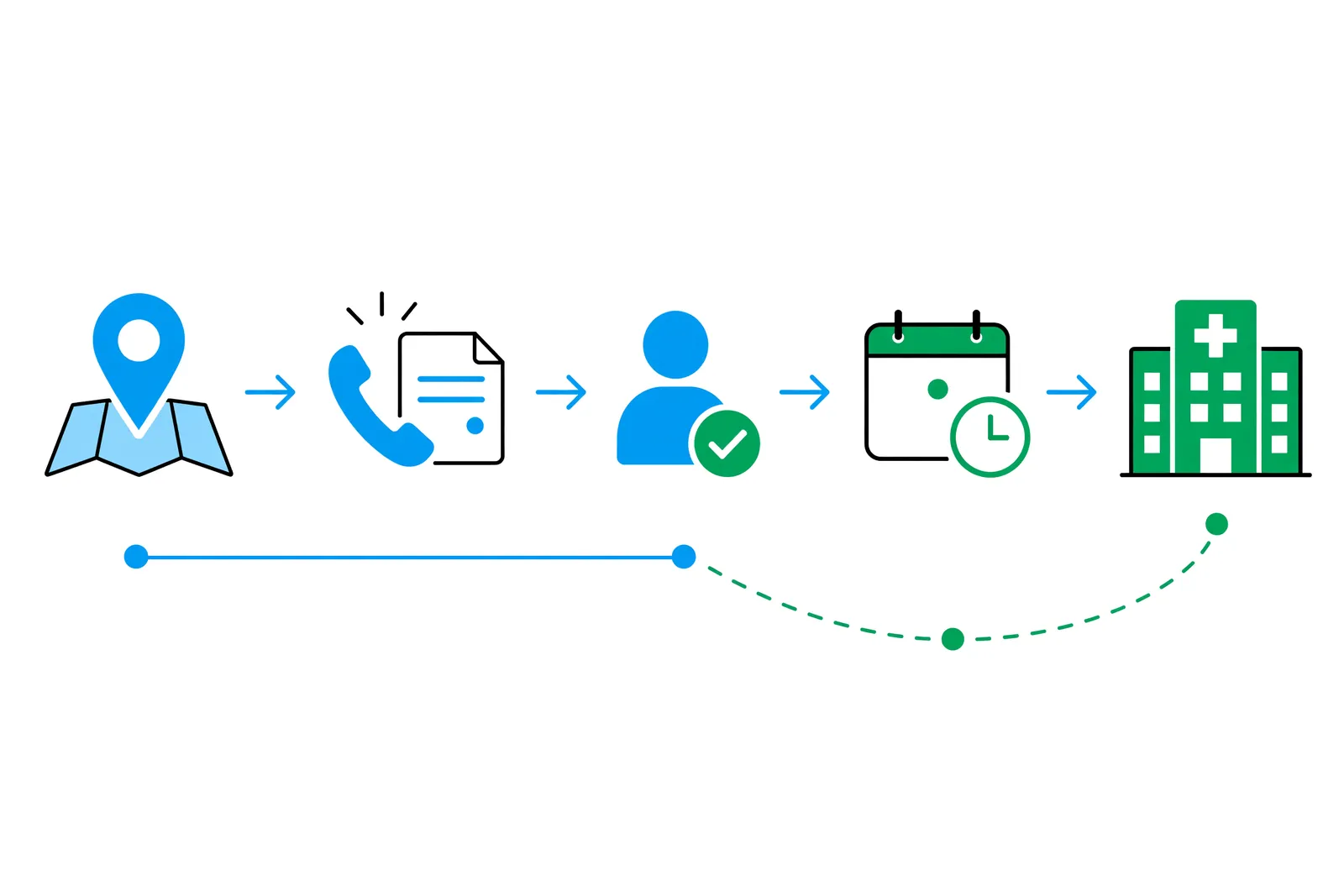
How should healthcare local SEO be measured against admissions?
Track each location from discovery, such as Maps views, calls, and form submissions, to qualified inquiry, then to a scheduled appointment or admission, and report that chain by location. Rankings are a diagnostic input. They are not the outcome.
Three conditions have to be in place. Call and form tracking must identify the location and source of each inquiry. Intake or scheduling data must record whether the inquiry was qualified and what happened next. The organization must permit use of that data under its privacy and compliance policies.
Platform-reported views and calls are measured within each platform's definitions. A link from inquiry to admission is measured only where authorized intake data supports it. Modeled figures are labeled as estimates. A hospital scheduling desk and a behavioral health admission team will not share the same fields. In both settings, a call is not an admission unless the authorized record says so.
Governance and policy dependencies
Local changes have to move without bypassing review. Plan for a privacy review of tracking, call recording, and any data shared; a regulated-claim review of page copy, profile text, and review responses; and a change path that states who signs off at local, regional, and central level. Copy should avoid diagnosis or treatment-efficacy implications and should use non-stigmatizing language.
The work does not come with a privacy certification. Handling depends on the organization's agreements, systems, and policies, and the work stays inside them.
Email Us
Prefer to send the context directly?
What the acquisition audit covers
The audit is a decision document, not a score. A reviewer compares three views of the same campus: what the website says, what the Business Profile says, and what intake can attribute. The gaps between those views are the findings.
The review focuses on a page map and sample crawl of location pages, indexability, and internal links; profile and listing ownership, consistency, and gaps; the location-intent searches patients and referrers use; the measurement path from first contact through intake; and prioritized recommendations with owners, dependencies, and sequence. Scope follows location count and the data the organization can authorize.
Questions, Answered.
When location count outpaces internal ownership, when reporting cannot attribute inquiries to sites, or when profiles and listings are in unknown condition after a vendor change.
It centers on location intent, Google Maps visibility, profile and listing accuracy, and location-level measurement, with privacy and claim review in regulated settings. General healthcare seo covers broader organic demand and is scoped on its own.
Where the organization authorizes the data and intake systems support it, location-level inquiries can be connected to scheduled appointments or admissions. Without that data, reporting stays with what can be measured, and modeled figures are labeled as estimates. Request an acquisition audit
Ready to see where your marketing can improve?
Request a free audit of your paid media, landing pages, attribution, and measurement setup. You'll get a straight assessment of where the opportunities are.
or email us at info@marketingpowered.ai