Capabilities
Healthcare Conversion Rate Optimization for Qualified Intakes
Healthcare conversion rate optimization improves the rate at which treatment center websites turn visitors into verified calls, insurance-checked inquiries, and admitted patients. Treatment centers that already pay for search demand lose operating capacity when the handoff from interest to intake breaks.
Who needs conversion rate optimization
An admissions coordinator at a clinical desk, with call starts on one screen and scheduled intakes on the other, can see the problem before a report does. CEOs, COOs, CMOs, and admissions leaders need this work when traffic is already arriving and inquiry volume is not filling the locations, levels of care, or hours the team can staff.
Read the path as a linear funnel with four distinct stages: traffic, inquiry, verification, and admission. Drop-off arrows between those stages highlight the operating issue. The fit is strongest for multi-location operators, and the same handoff logic applies in hospitals and other regulated practices where scheduling sits between a click and a booked service. Behavioral health is a core setting, but not the only one. Search volume for specialized healthcare conversion terms is often low but highly intent-driven. Low search volume does not shrink the capacity problem; it indicates that few buyers name the work precisely.

Common drop-off points before admission
The acquisition funnel usually fails in places that look like creative problems until someone listens to the calls. A page can win the click and still hide the phone number, omit staffed hours, or open with a clinical history form. That slows the inquiry and pulls health detail forward before a person has chosen to speak with admissions.
Call starts that ring out, route to a general mailbox, or arrive after admissions has left are not admission-ready calls. A qualified intake is one a trained person can screen for fit, payer, and timing. Verification stalls when the site asks for the wrong member data, or when the caller repeats facts the form already captured. Appointment requests that ignore level of care and open capacity create a queue the team cannot honor. Treatment center CRO starts by naming the largest break before anyone rewrites a headline.
Measuring success beyond lead volume
Measure the stages admissions already uses to decide whether a person can be seen: call starts, connected conversations, insurance checks, appointment requests, qualified healthcare leads, and scheduled intakes. A verified inquiry that never reaches verification is an upstream event.
Cost per admitted patient is the commercial comparator when finance can join marketing cost to an admission record under the organization's data rules. Where that join is not authorized, report the furthest reliable stage and state the limit. Attribution is tracked to admission, not just lead, where the available data supports that connection. The reporting design for that join aligns closely with analytics and attribution. Set the denominator as visitors to the relevant location or service, and set the numerator as the outcome that consumes capacity.
Free Audit
Want a straight read on where your budget is leaking?
Privacy-aware design for sensitive categories
In a private office, two clinicians can review a tablet that shows two intake variants and no patient names. One variant offers a different field order, placing all attention on the workflow rather than patient faces. That is the right setting for behavioral health landing page optimization.
Test the phone number placement, the order of insurance questions, form length, and the wording of the next step. Keep clinical detail out of URLs, event names, and fields that sync to advertising tools. Healthcare marketers must ensure that any tracking technologies used on intake pages comply with current HIPAA guidance regarding patient identifiers and sensitive health information. Intake and scheduling flows require a privacy review before any tag sees what a person types. Accessibility standards require clear labels and instructions for all form inputs to ensure usability for all visitors. Method notes and test briefs are available in our resources.

Connecting test hypotheses to operating capacity
A hypothesis that only says a shorter form will increase submissions ignores capacity-aware demand. If residential beds are full and outpatient evenings are open, a higher form rate into the full program adds work for a team that must decline.
Write each hypothesis against a capacity fact the operator can confirm: location, level of care, payer constraints, and the hours admissions can answer. The useful shape is specific. If the evening line is staffed and the page hides the number under a long clinical form, moving the number and stating hours should increase staffed connections during open hours, without increasing calls the team cannot take. That is how a test stays tied to cost per admitted patient rather than to a submission count.
What an acquisition audit examines
An acquisition audit compares the path a visitor is offered with the path admissions can finish. Put two test variants next to each other. One collects clinical detail on the first screen and treats the form submit as success. The other leads with staffed hours, a labeled phone path, and insurance fields only after the person opts into verification. Both carry the same privacy controls with checkmarks for compliance: no condition in the URL, no health answers in an ad tag. The outcome arrows point to connected calls and scheduled intakes, not to raw submits.
The review focuses on traffic to call, form to scheduled intake, insurance verification, and whether admission status returns to reporting. It is a diagnosis of the current funnel, focusing on where volume stopped matching capacity, and which handoff hid the reason.

Email Us
Prefer to send the context directly?
Governance and platform requirements
Google and other platforms have strict requirements for promoting sensitive healthcare services, including certification mandates such as LegitScript and restrictions on audience targeting. Advertisers must verify their account eligibility and compliance with current platform policies before launching campaigns. Certification status belongs to the provider, and campaign setup does not replace it.
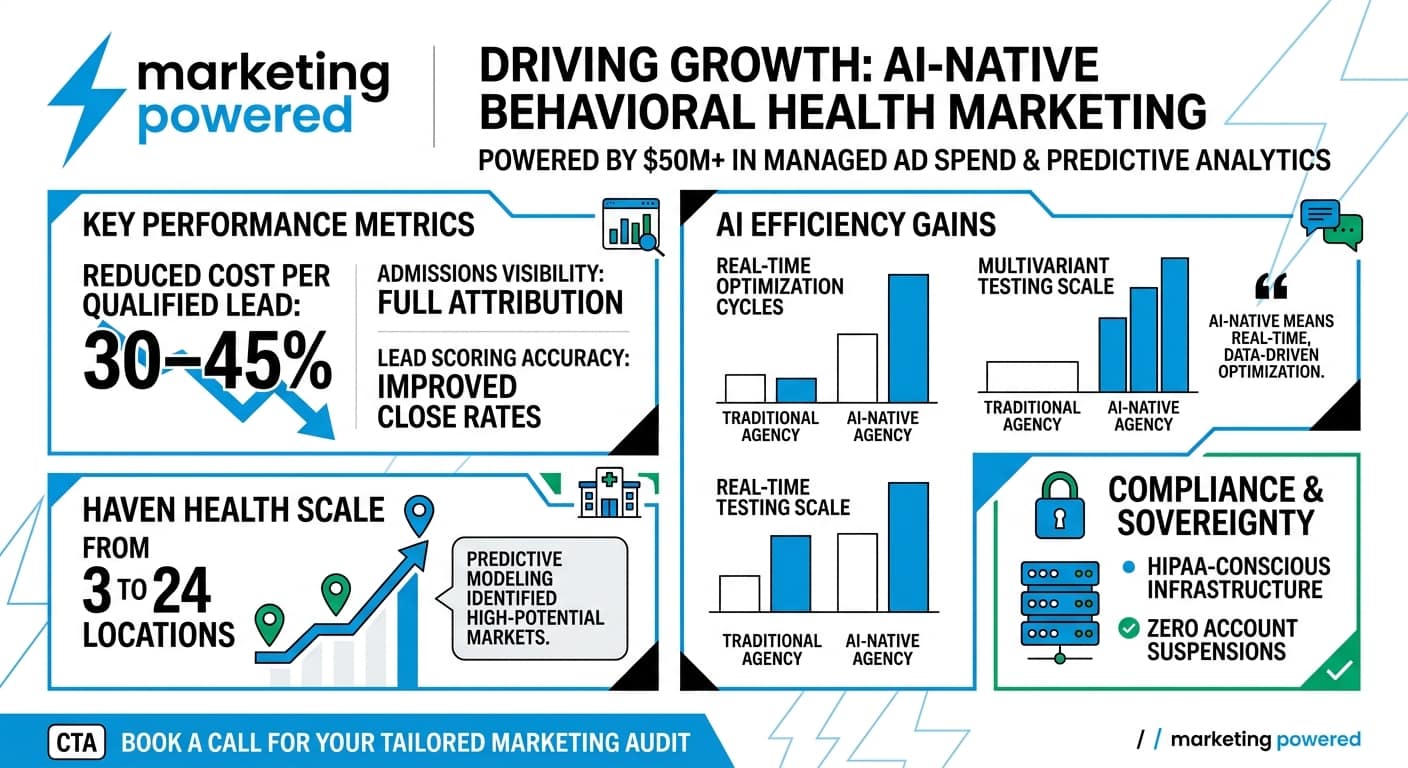
Marketing Powered has been AI-native since 2022, is LegitScript-aware and HIPAA-aware, and is built for Google's sensitive healthcare vertical, where retargeting is not permitted. Selected experiment readouts can use owned, local AI infrastructure for HIPAA-aware inference. That is a control for specific analysis, not a certification, and it does not change who owns provider data. The founder is a former healthcare CMO who ran marketing for a treatment network that grew from 3 to 24 locations, managed Google Ads across 11+ behavioral and mental health accounts, and is a court-certified expert witness in advertising strategy.
Questions, Answered.
Expect a review of the path from visit to admission-ready call, then tests on pages, forms, and call prompts that respect privacy and accessibility limits. Expect reporting that separates raw inquiries from insurance-checked, scheduled, and admitted outcomes. Expect the work to name the stage that is losing people, and to stop when a change would only add volume the program cannot take.
Count the stages in order: call starts, connected calls, insurance checks, appointment requests, scheduled intakes, and admitted patients. Use cost per admitted patient when cost and admission records can be joined under the provider's data rules. If admission data is not available, name the furthest reliable stage. Do not average a residential screen and an outpatient booking into one rate.
No. A form rate can rise while verification failures, after-hours abandons, or full units stay the same. Efficiency shows up when more of the existing traffic reaches a scheduled intake the team can staff, and when cost per admitted patient moves in the direction leadership defined. Volume without a capacity match is still a cost.
The advertiser holds LegitScript and Google certification where those programs apply. An agency can align pages, claims, and campaign setup with the published rules and can flag eligibility gaps. It cannot substitute its own status for the provider's certification, and a workflow should not be described as a privacy certification. Evaluating your current drop-off between inquiry and admission is the first step toward aligning marketing spend with operational capacity. Request an acquisition audit
Ready to see where your marketing can improve?
Request a free audit of your paid media, landing pages, attribution, and measurement setup. You'll get a straight assessment of where the opportunities are.
or email us at info@marketingpowered.ai