Capabilities
Addiction Treatment Website Design for Admissions
I will check current Google Ads, LegitScript, and accessibility rules that this page can cite, then write the landing page in one pass.Meta title: Addiction Treatment Website Design for Admissions

Who needs addiction treatment website design
Addiction treatment website design has one commercial job: move a qualified inquiry into a scheduled assessment or admission without creating an intake bottleneck or a policy problem. A site that looks current and still drops every caller into one queue is an admissions failure, not a branding gap. In a sensitive healthcare category, where advertiser-curated retargeting is not available, the page has to finish the work remarketing cannot.
The buyers are CEOs, COOs, CMOs, and admissions leaders who are accountable for inquiry-to-admission results, at one site or across a network. The working picture is concrete. An operations lead sits at a shared workstation before the day shift, reading overnight call notes, while two admissions coordinators sort insurance questions the site never answered. The phone number was visible. The level of care was not.
Engage a specialized partner when volume arrives faster than the team can sort it, when location and service pages disagree with what is licensed, or when paid destinations keep failing review. Detox admissions, residential programs, and outpatient sites fail in different ways, but the commercial cost is the same: staff time spent on calls the site could have routed. Treatment center growth from a few locations to a regional footprint stays manageable only if each location page states what that building actually offers.
The founder is a former healthcare CMO who ran marketing for a treatment network that grew from 3 to 24 locations, and a court-certified expert witness in advertising strategy. That operating history is why this page is written for admissions leadership, not for a visual redesign brief. Operators in substance use disorder can see the adjacent market context on substance use disorder marketing.

Read the site the way admissions does
Diagnosis starts with the first three minutes of a real call, not with a design score. Admissions usually needs four facts before a conversation is worth staffing: which location, which level of care, which payer, and whether the person is asking about detox, residential treatment, or outpatient care. If those answers live only in a phone script or a PDF, the site is adding handle time.
Read the mobile page the way a family member does at night. Is the number usable before the page finishes loading? Does after-hours contact have a defined route, or does it land in a voicemail no one owns? Does the form ask for clinical history the team does not need in order to schedule an assessment? Rehab call quality is an operating question. A long call can be a qualified residential inquiry or a vendor. Duration will not tell you which.
Semrush US figures collected November 15-16, 2026 put "addiction treatment website design" at about 390 searches a month with a keyword difficulty of 2. "Behavioral health website design services" was about 50 searches a month with a difficulty of 0. Search volume that low does not mean a template will survive certification review or admissions reporting. Related phrases such as website design for treatment centers are not treated here as measured demand.
What the commercial build focuses on
This is a commercial web build judged by the conversion path, not by a launch date. The work focuses on service accuracy, credible facility claims, certification-related content review, intake capture, and speed on the phones people actually use. Broader engineering sits with web development. The acceptance test on this offer is whether a qualified person can reach the right location and level of care.
LegitScript's addiction treatment certification standards require a conspicuous disclosure of the physical address where services are rendered and of the specific services provided. Photographs must truthfully depict the applicant's facilities, and content must not misrepresent scope or location. LegitScript Those rules are a design constraint. A stock exterior, a borrowed address, or a service menu copied across every location is a credibility problem before it is a layout problem.
Clinical language gets the same review. Google does not allow ads promoting or selling prescription opioid painkillers. A limited exception includes certified addiction treatment providers in the United States, and violations of that policy are treated as egregious, with suspension upon detection and without prior warning. Google Ads policy Medication copy on a treatment site is not decorative. It is reviewed against what the program is licensed to offer.
Free Audit
Want a straight read on where your budget is leaking?
Routing, verification, and level of care
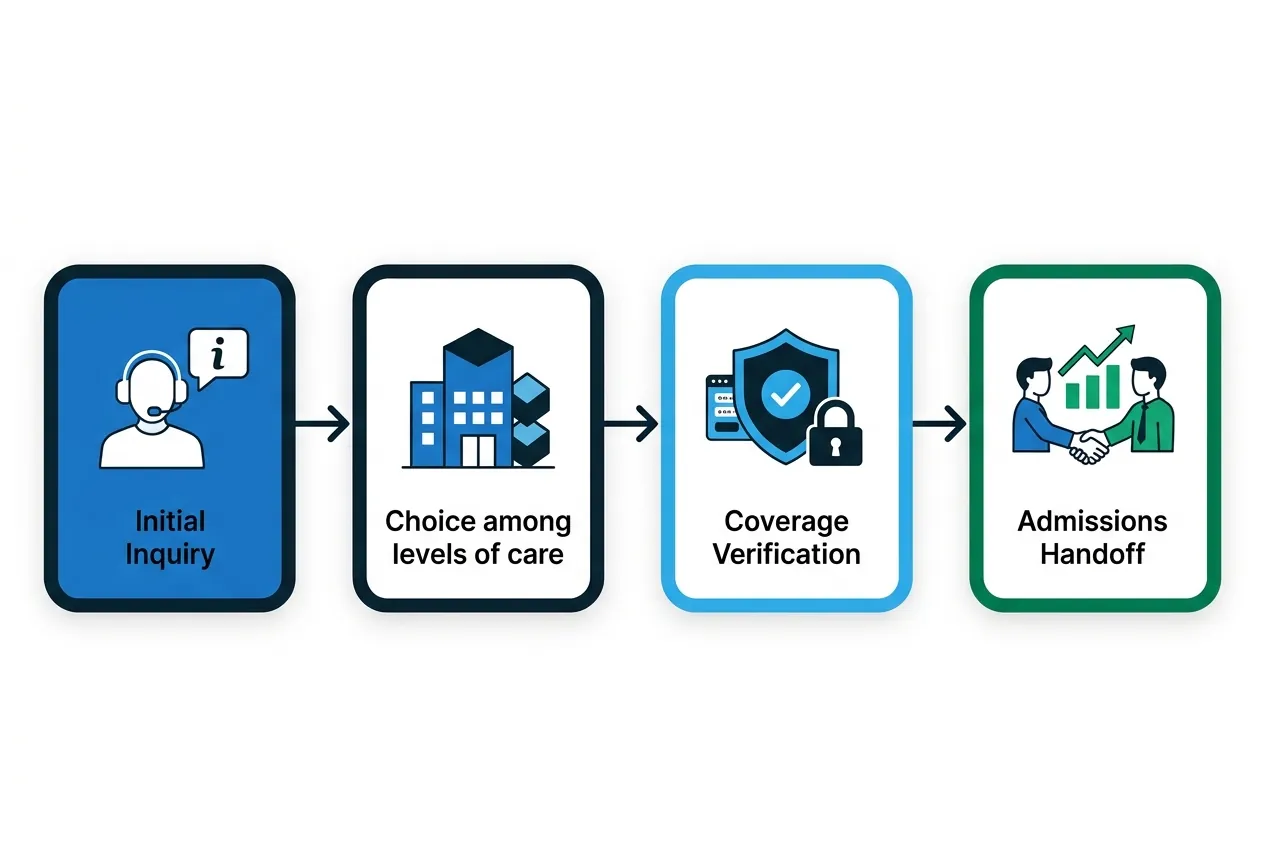
A usable path is short enough to follow while upset: inquiry, enough detail to route, verification of what can be checked before a clinical conversation, then a scheduled assessment. Detox, residential treatment, and outpatient care should not share one unlabeled button if the buildings, hours, and payer rules differ. Level-of-care acquisition depends on that split. Residential treatment marketing that hides the residential page under a generic "programs" label forces the call to do the sorting.
Insurance verification is usually a form problem, not a branding problem. Ask for the plan name and member ID when the team needs them to schedule, and stop there. Patient intake website design that collects a clinical history on a public page slows the person who is ready to talk and widens the data the organization must protect. After-hours routing needs an owner. A 24-hour number that rings a desk closed at 5 p.m. is not a contact strategy. It is a missed admission window.
Compare two structures before choosing one. A single national form is easier to maintain and worse at routing. Location pages with a shared pattern, local facts, and a defined handoff are harder to govern and easier for admissions to staff. Multi-location operators should prefer the second when census, licensure, or payer mix differs by site.
How addiction treatment website design is measured
Measure from qualified inquiry to scheduled assessment or admission. A qualified inquiry, in admissions language, is the right location, the right level of care, a reachable person, and a reason the team can act on. Form fills and click-to-call counts are inputs. They are not the result leadership can staff against.
Attribution that stops at the lead hides the only comparison that matters: which pages and locations contribute to a scheduled assessment, and which produce calls the team cannot use. Marketing Powered tracks attribution to admission, not only to the lead, where the organization authorizes that join. The founder managed $1.5 to $2M per month in Google Ads across 11+ behavioral and mental health accounts. That scale is why measurement is specified with the site, not bolted on after the pages are live.
Set the definitions with admissions before any experiment. A hypothesis might be that a location-specific number reduces misrouted detox calls, or that cutting clinical fields raises completed scheduling requests. The hypothesis is useful only if the outcome is defined the same way in the call report and in the admissions record. Do not treat a vendor dashboard as that record.
Policy, consent, and data limits
Google restricts the promotion of recovery-oriented drug and alcohol addiction services. Advertisers who have applied and been approved may promote those services in listed locations, including the United States. Examples include clinical treatment providers, some recovery support services, lead generators or referral agencies, and crisis hotlines. Services for impulse control, behavioral addiction, or nicotine addiction sit outside that policy. Google Ads policy
In the United States, advertising those services requires certification as an addiction services provider by LegitScript, plus certification with Google. Not every service is eligible. Services that are not eligible are not allowed to advertise on Google. Google Ads policy LegitScript states that lead generators, call centers, or marketers who refer patients to other providers for compensation are explicitly disallowed from its addiction treatment certification. LegitScript A treatment center site should not be built as a referral storefront.
Health content is a sensitive interest category. Google's examples include counseling for addiction, including alcohol addiction. Advertiser-curated audiences, including Customer Match and remarketing lists, cannot be used for that category. Google Ads policy The site has to carry the next step, because a remarketing list is not an available recovery tool.
Privacy rules shape the form. LegitScript's standards require compliance with applicable privacy law, and they state that US applicants who collect, store, or transmit protected health information must comply with applicable HIPAA requirements. LegitScript HHS describes the minimum necessary standard as requiring reasonable steps to limit protected health information to what is needed for the purpose, with exceptions that include treatment disclosures between providers and uses the individual authorizes. HHS guidance Public forms should collect what scheduling needs. Clinical detail belongs in systems built to hold it.
Google's Call Ads Supplemental Terms, currently noted as applicable to advertisers in the United States, state that Google does not intend those communication features to create HIPAA obligations and makes no representation that they satisfy HIPAA requirements. A covered entity that would use them in a way involving protected health information is directed not to accept the terms and to request exclusion from monitoring and recording. Google Ads policy Call tracking choices are a privacy decision, not a default setting.
Accessibility is part of the same path. WCAG 2.2 is a W3C Recommendation dated 12 December 2024. Its criteria include labels or instructions, consistent help, and a minimum target size, which matter on intake fields and call buttons. www.w3.org Marketing Powered is LegitScript-aware and HIPAA-aware. That is not a certification, and it is not a claim that a workflow satisfies HIPAA. Where model-assisted review is used, inference can run on owned local infrastructure. That does not transfer ownership of client data.

Email Us
Prefer to send the context directly?
What the acquisition audit covers
Onboarding starts with the people who own the number. Picture a small leadership group, CEO, COO, and CMO, in a conference room with admissions, reviewing the current site the way they review a census report: wireframes on the table, call notes beside them, disagreement about which page a night caller actually sees.
The acquisition audit focuses on whether pages, calls, and forms support qualified inquiries and scheduled assessments, and on the policy dependencies that can block paid media. After that review, scope is set around location and level-of-care structure, business-hours and after-hours routing, form fields and consent language, accessibility of the contact path, mobile performance, and how inquiry data joins to admission status where that join is authorized. It does not replace legal review, a LegitScript application, or clinical sign-off on service descriptions. Those stay with the organization and its advisors.
Behavioral health website design services that skip that handoff tend to publish copy the clinical team will not defend. Website design for treatment centers is useful when the build is judged by admissions operations, not by a template gallery.
Questions, Answered.
A phone path that works at the hour people call, location and level-of-care pages that match what is licensed and offered, and routing so detox, residential, and outpatient inquiries do not share one unanswered queue. The intake path should ask for what scheduling needs, with consent language matched to the data actually collected. Labels, help, and tap targets should meet WCAG 2.2 so the form is usable without a mouse and without guessing which field failed. www.w3.org
Against qualified calls and against scheduled assessments or admissions, using definitions admissions already applies. Click-to-call counts and form completions are inputs. Where data use is authorized, join the inquiry to the scheduled assessment or the admission so leadership can see which locations and levels of care the site supports. A page that increases calls and lowers the share admissions can schedule has not improved acquisition.
A general redesign optimizes appearance and navigation for a broad audience. This work is judged by admissions operations, certification-related disclosures, and the limits on personalized advertising in health. Google will not supply remarketing lists for this category, so the page has to complete the route. Google Ads policy
No. LegitScript certification, licensure, and the privacy program remain with the organization. In the United States, Google requires LegitScript certification and Google certification before recovery-oriented drug and alcohol addiction services can be advertised, and ineligible services are not allowed to advertise. Google Ads policy The design work focuses on accurate disclosures, consent, and collecting less on public pages. It does not replace those certifications. Request an acquisition audit
Ready to see where your marketing can improve?
Request a free audit of your paid media, landing pages, attribution, and measurement setup. You'll get a straight assessment of where the opportunities are.
or email us at info@marketingpowered.ai