Resources
Private AI vs Public AI: Compare the Actual Boundaries
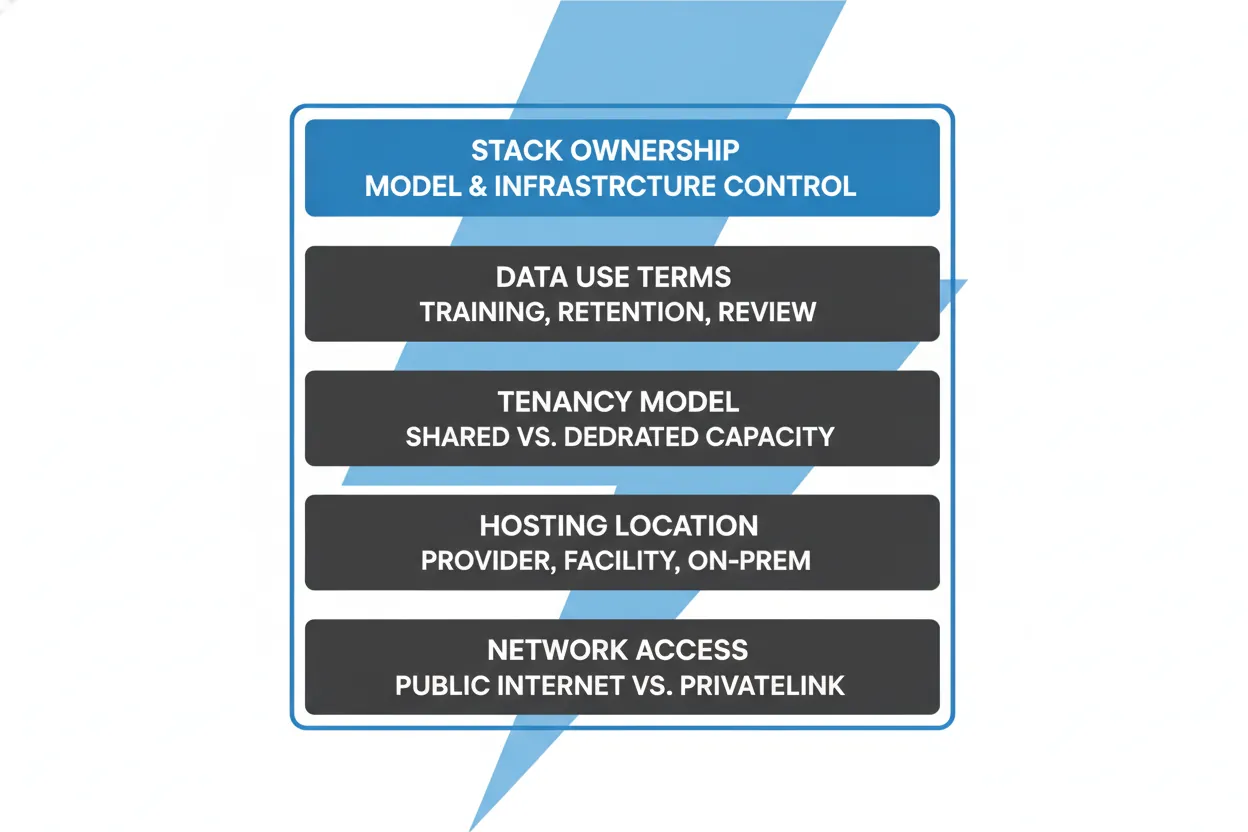
Four vendors can all say "our AI is private" and mean four incompatible things. The private AI vs public AI question is not one switch, it is five independent decisions about network access, hosting, tenancy, contract terms and ownership. This guide gives you the vocabulary, a deployment map, two data-flow walkthroughs and a checklist you can take into a vendor call.
By Mike Hulick, Founder, Marketing Powered

Define the terms carefully before you compare anything
"Private" in an AI proposal usually compresses five separate variables. Separate them and most procurement arguments resolve quickly.
Network access. Whether traffic to the model crosses the public internet. AWS documents that an interface VPC endpoint built on PrivateLink lets you reach Amazon Bedrock as if it were inside your VPC, with no internet gateway, NAT device, VPN or Direct Connect, and with no public IP addresses required on your instances (AWS Bedrock VPC endpoints).
That is a real and useful property. It says nothing about who owns the model or what happens to your prompts after they arrive.
Hosting location. Whether inference runs in a provider's region, in a facility you contract for, or on hardware in your own building. Example: a clinical intake summarizer running on a server in a practice's own network closet.
Tenancy. Whether your workload shares physical or logical resources with other customers. Example: a shared managed API versus a dedicated capacity reservation that only your account can call.
Contractual data use. What the agreement says about training on your inputs, retention windows, human review and subprocessors. Example: a term stating that prompts and outputs are not used to train foundation models, with a defined retention period.
Ownership. Who holds legal and operational control over the infrastructure and the model weights. Example: a self-hosted open-weight model you can run after a vendor relationship ends.
These axes are independent. A deployment can be network-private and contractually permissive at the same time. It can be locally hosted and badly governed. Treat network privacy, contractual protection and ownership as three distinct concepts, because they fail in different ways and are fixed by different people.
Map the deployment options on a single comparison table
Four categories cover most of what buyers evaluate. The table below is an illustrative planning matrix prepared in November 2026. It describes typical configurations, not any specific vendor's current terms, and assumes a U.S. business buyer with standard commercial agreements rather than negotiated enterprise addenda. Verify every cell against the contract in front of you.
- Public consumer tool. Network path: Public internet. Tenancy: Shared. Typical data-use terms: Consumer terms, may permit training by default. Infrastructure ownership: Provider. Who operates it: Provider.
- Enterprise cloud AI service. Network path: Private endpoint available. Tenancy: Shared service, isolated account. Typical data-use terms: Business terms, training exclusions common. Infrastructure ownership: Provider. Who operates it: Provider, with customer configuration duties.
- Dedicated or private cloud hosting. Network path: Private endpoint or private network. Tenancy: Dedicated capacity or instances. Typical data-use terms: Negotiated, often stricter retention limits. Infrastructure ownership: Provider or hosting partner. Who operates it: Shared, more customer responsibility.
- Locally operated model. Network path: Internal network only. Tenancy: Single tenant by definition. Typical data-use terms: Governed by internal policy, not a vendor contract. Infrastructure ownership: Customer. Who operates it: Customer entirely.
What each category typically controls is narrower than its marketing suggests. A public consumer tool controls nothing on your behalf beyond the account settings exposed in the interface. An enterprise cloud service controls infrastructure security and model isolation while leaving configuration to you.
Dedicated hosting controls tenancy and sometimes region, while leaving patching and identity partly or fully with you. A locally operated model controls everything, which is the point and also the cost. For the operating economics behind that last column, see AI infrastructure: owned versus rented AI economics. This page is the vocabulary layer, not an argument for a posture.
Compare data handling end to end, not at the entry point
Most privacy reviews stop at the network diagram. The interesting failures happen downstream, in retention, logs, backups and administrator access.
Start with the provider's own division of labor. AWS states that under the shared responsibility model it protects the global infrastructure, while you maintain control over your content hosted on that infrastructure and remain responsible for security configuration and management of the services you use (AWS Bedrock data protection).
The same documentation recommends least-privilege identities through IAM or IAM Identity Center, multi-factor authentication, TLS for transport with 1.2 required and 1.3 recommended, encryption, and API and user activity logging through CloudTrail (AWS Bedrock data protection).
Two details from that page are worth carrying into any vendor conversation. First, AWS strongly recommends never placing confidential or sensitive information into tags or free-form text fields such as a Name field, because data entered there may be used in billing or diagnostic logs (AWS Bedrock data protection).
Metadata is a data path, and it is the one teams forget. Second, Bedrock uses per-region model deployment accounts owned and operated by the service team, and because model providers have no access to those accounts they have no access to Bedrock logs or to customer prompts and completions (AWS Bedrock data protection).
That is a meaningful architectural boundary between the platform operator and the model vendor, and it is the kind of specific, documented statement you should be asking every provider to produce.
Then ask the questions the documentation cannot answer for you: how long inputs and outputs persist, whether logs are separable from content, whether backups inherit the same retention rules, which administrators can read stored interactions, and which subprocessors touch the pipeline. The ownership perspective on those answers is in AI ownership: why we chose to own our AI stack.
Free Audit
Want a straight read on where your budget is leaking?
Compare operating responsibilities and who gets the call
Every boundary you move inward moves work with it. This is the axis buyers underprice.
Picture the actual roles. In an enterprise cloud deployment, the provider patches the serving stack and keeps the region running. Your team still owns identity, endpoint policies, encryption keys, logging and the quarterly access review.
AWS notes that the default VPC endpoint policy allows full access to Bedrock through that endpoint, and that restricting it requires attaching a custom endpoint policy specifying principals, actions and resources (AWS Bedrock VPC endpoints). A private network path with a permissive policy is a private road with an unlocked gate.
If your obligations include validated cryptography, note that AWS publishes FIPS endpoint services for Bedrock in a limited set of regions, including us-east-1, us-east-2, us-west-2, ca-central-1, us-gov-east-1 and us-gov-west-1 (AWS Bedrock VPC endpoints).
In a locally operated deployment, there is no provider on call. Someone on staff handles driver and runtime updates, model version upgrades, capacity when three teams run jobs at once, hardware failure, offsite backup, and the audit trail showing who ran what. That person needs a documented runbook, not goodwill. The honest framing is that local hosting relocates responsibility rather than retiring it.
Vendor dependence belongs in the same column. Ask what happens if pricing doubles, a model is deprecated mid-quarter, or the provider exits a region. Portability is an operating property: open weights, exportable prompts and evaluation sets, and a tested fallback path. We cover how those obligations are structured in practice in owned AI systems and deployment boundaries.

Apply the tradeoffs to three illustrative scenarios
The following scenarios are illustrative composites built to show reasoning, not client work or results.
Scenario one: internal drafting, low sensitivity, high volume. A marketing team drafts outlines and ad variants from public positioning material. No customer records, no regulated data. A public or business-tier tool is defensible here, provided an administrator disables training on inputs where that control exists and the team has a written rule about what never gets pasted in. The main risk is drift, where someone eventually pastes a customer list into the same window.
Scenario two: customer-record search, moderate sensitivity, moderate volume. A professional services firm wants semantic search across engagement history and contracts. Content is confidential but not statutorily regulated. An enterprise cloud service with a private endpoint, a restrictive endpoint policy, customer-managed encryption keys, defined retention and activity logging is usually proportionate. Dedicated hosting adds cost that is justified mainly by tenancy or residency requirements, not by general discomfort.
Scenario three: regulated document handling, high sensitivity. A healthcare organization processes intake documents containing protected health information. Here the controlling facts are regulatory and contractual, not technical preference. The questions become which vendor will execute an appropriate data-protection agreement for the workload, where processing occurs, what persists after processing, and whether a locally operated model removes a transfer the organization cannot otherwise justify.
Marketing Powered runs owned, local AI infrastructure for HIPAA-aware inference for exactly this class of workload, and is LegitScript-aware and HIPAA-aware in how that work is scoped. No deployment type establishes compliance by itself; documentation, contracts and controls do. The custody questions are laid out in data custody and processing boundaries.
Choose with a decision checklist tied to evidence
Work the checklist per workflow, not per company. Most organizations end up with more than one answer.
- What data actually enters the system? Classify it before you shop. Include metadata, filenames and free-form fields, not just the main payload.
- What does the contract say about training, retention and human review? Request the current terms in writing. A sales assurance is not a term.
- What network path is in place, and what policy sits on it? A private endpoint plus a default-allow policy is weaker than it looks.
- Who holds operational responsibility for identity, patching, monitoring and recovery? Name the person or the vendor for each line.
- Which regulatory obligations apply, and what evidence would an auditor ask for? Build the evidence file while you deploy, not afterward.
- What is the exit path? Model portability, data export and a tested fallback.
- What remains unresolved? Some answers depend on contract terms, subprocessor lists and regional availability that only the vendor can confirm. Write those down as open items rather than assuming the conservative or the convenient answer.
Three related references if you are extending this evaluation: supported local processing, AI governance and approval controls, and open-source selection and licensing.

Email Us
Prefer to send the context directly?
Questions buyers ask during AI procurement
Is locally hosted AI automatically more secure?
No. Local hosting removes a network transfer and a third-party contract, and it adds full responsibility for identity, patching, logging, backup and physical access. An unmanaged local server with shared credentials is less defensible than a well-configured cloud deployment with least-privilege identities and activity logging. Security follows the controls that are actually implemented and evidenced.
Is an enterprise cloud service the same as public consumer AI?
Not in the dimensions that matter for procurement. Enterprise services typically carry different commercial terms and expose controls consumer tiers do not, including private connectivity. AWS documents PrivateLink interface endpoints for Bedrock and account-level endpoint policies that restrict principals, actions and resources (AWS Bedrock VPC endpoints). The difference is contractual and configurable, so confirm which tier and which terms apply to your account.
Can private AI still use outside services?
Frequently, yes. A deployment described as private may still call external services for authentication, embeddings, vector storage, OCR, telemetry, error reporting or content moderation. Ask for the full subprocessor and dependency list, and ask specifically whether any auxiliary call carries content rather than metadata. This is the most common gap between a diagram and a running system.
How should a small team adapt this approach?
Scale the checklist, not the axes. A five-person firm still needs a data classification rule, written vendor terms, an administrator who owns settings, and a short list of what never gets pasted into a general tool. Dedicated infrastructure is optional; documented boundaries are not.
What evidence would change the recommended approach?
A named regulatory obligation attached to a specific workflow, vendor contract terms obtained in writing, or a confirmed data classification that differs from the assumption. This page is a framework for asking better questions. It is not a determination about your environment, and any serious decision should rest on documents you have in hand.
More Resource Topics
Ready to see where your marketing can improve?
Request a free audit of your paid media, landing pages, attribution, and measurement setup. You'll get a straight assessment of where the opportunities are.
or email us at info@marketingpowered.ai