Resources
Local SEO for Rehab Centers: Entity Accuracy Before Rank
Local seo for rehab centers is the work of making each real, staffed treatment facility accurately findable in Google Maps and local search, then measuring that visibility against qualified calls and admissions. A facility can appear in the local pack and still miss the admission when the profile sends people to a generic page, the call lands on an untagged number, or intake never records whether the caller was a fit. Rankings lag; the leading signals are one accurate description of a real place and an intake record that shows whether the caller qualified.
By Mike Hulick, Founder, Marketing Powered

What local SEO for rehab centers covers
Picture a parent in a parked car after a shift, phone in hand, searching for detox in a named city. Three map pins appear. The first number rings a line nobody monitors. The second opens a page listing every level of care the organization has ever offered, including programs that site does not run. The third pin is a shared office where outreach staff sit two days a week, presented as if a family could drive there tonight and be admitted. That scene is the commercial problem: visibility without an accurate place, and without a path into intake, does not fill a bed.
Four surfaces have to describe the same facility:
- Google Business Profile. The Maps and local-pack presence; often the first thing a family sees, and where calls, direction requests, and website clicks start.
- Location pages. Website pages that confirm a staffed facility is real, state what that site actually offers, and give a clear next step into intake.
- Citations. Directories and data aggregators repeating the name, address, and phone. Their job is consistency, not extra keywords.
- Intake instrumentation. Source tags on calls and forms, plus a disposition code from admissions, so a search visit can be tied to a qualified conversation and, where authorized, an admission.
Broader seo for rehab centers also covers condition and service content, technical site health, and authority. This page owns the place-based layer: local search for treatment centers, Google Maps visibility, and the intake link. Do not treat any published "ranking factor weight" as fact; the mechanism is relevance to a specific query from a specific location. Complete, accurate business information makes a profile more likely to show for relevant nearby searches; inaccurate information can keep it from showing.

When this applies to treatment programs
This work fits programs with a physical, staffed location where patients or families search by place: residential, partial hospitalization, intensive outpatient, outpatient, and detox. It fits multi-location operators especially, because a wrong phone number or a copied page multiplies across sites.
It is a weaker fit for telehealth-only programs. Google requires in-person contact with customers during stated hours for Business Profile eligibility, with narrow exceptions that do not cover a typical online-only treatment brand; online-only businesses are listed as ineligible. Business eligibility and ownership guidelines A program that meets people only by video should not invent a map pin to look local. Referral-heavy admissions, where most volume comes from hospitals, courts, or alumni rather than search, get less from a pin than from the referral operation itself.
Searches in this category are often urgent. A wrong facility, a closed line, or a listing that implies a level of care you do not provide is not a wasted click; it is a person in a hard moment who was misled. Accuracy is the ethical baseline and the commercial strategy at the same time. The same operating problem shows up in hospitals and other regulated multi-location providers: fragmented location data and intake that marketing cannot trace. That wider scope is covered in healthcare local SEO for multi-location providers.
Who owns each local search asset
Local search fails when every asset is "marketing's job" and nobody owns a specific outcome. Assign one owner and one measure per row.
- Google Business Profile. Owner: Marketing or web manager. Accountable for: Name, address, hours, categories, services, photos, verification, review responses. Measure: Accuracy audit and profile actions.
- Location pages. Owner: Web manager with a clinical or program lead. Accountable for: Unique, factual content for each real facility. Measure: Indexation and tracked calls from the page.
- Citations. Owner: Marketing manager. Accountable for: Name, address, phone match across directories. Measure: Match rate after each audit.
- Call tracking and forms. Owner: Marketing operations. Accountable for: A source tag on every number and form. Measure: Tracked inquiries by source.
- Intake disposition. Owner: Admissions director. Accountable for: A code on every inquiry: qualified, not a fit, wrong service, no answer. Measure: Qualified inquiry rate.
- Privacy and compliance review. Owner: Compliance officer or counsel. Accountable for: Tracking, recording, public responses. Measure: Documented sign-off.
The admissions director owns the row most vendors leave blank. Without a disposition code, "calls" is a volume number, not a demand number. Marketing can own the listing; admissions has to own whether the caller was a fit.
Free Audit
Want a straight read on where your budget is leaking?
Pages only for staffed facilities
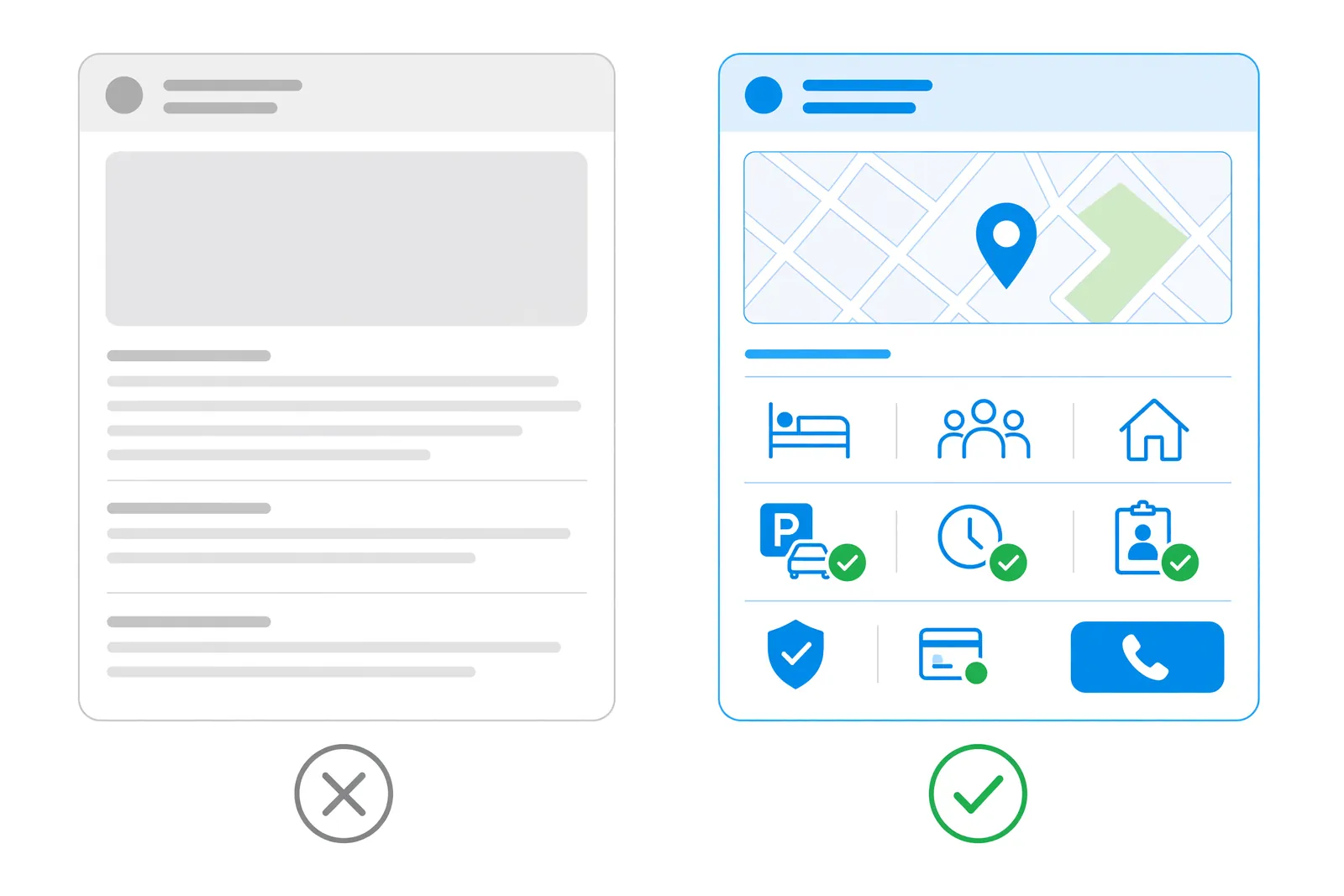
A location page earns its place with facts a competitor cannot copy by swapping a city name. Before a page goes live it should include the real address, a map, hours that match how intake actually answers, and a phone number that reaches that site. It should list the levels of care offered at that facility, not the whole organization's menu. Licensure or accreditation lines should be ones the facility can document, with compliance approval before publish. Arrival details matter: parking, what to bring, how an assessment starts. Staff descriptions need facility approval; insurance notes need a current check from intake. Language should be specific and non-stigmatizing, and the page should not promise treatment results.
A page should not exist when there is no staffed facility at the address. That includes a virtual office, a mailbox, a referral-only market, or a "coming soon" site. Google's representation guidelines say a virtual office (a rented mailing address the business does not operate from) is not eligible for a Business Profile; P.O. boxes and remote mailboxes are not acceptable addresses. A co-working office is eligible only with clear signage, customer visits during stated hours, and staffing by your own team. Businesses that show an address should keep permanent signage of the business name at that address. Guidelines for representing your business on Google
Use a labeled hypothetical, not a client result: an operator has three staffed sites and a fourth market covered only by outreach staff. The audit finds three mismatches. Site B's profile still lists a phone number that rings an unmonitored line. Several location pages repeat the same paragraphs with only the city changed. The fourth market has a street-address page and a pin on a shared office. The fix follows the standard: correct and verify the profile, rewrite each staffed-site page around facts unique to that building, and retire the fourth market's address-based listing. If that market is served without a facility, say so on a service-area explanation that does not claim a street address. No admissions outcome is implied; this is a worksheet for the logic, not a case study.
On markup, schema.org defines MedicalBusiness as a more specific type under LocalBusiness. Google's local business structured data documentation says you can add LocalBusiness markup to a page, that required properties must be present for eligibility, and that you should use the most specific subtype that fits. Local business structured data Match the markup to what the page visibly states; do not mark up a virtual office as a visitable clinic. Markup does not replace an accurate profile or a unique page. Link each location page to the level-of-care pages that site actually offers, and link back from those pages. Condition and service content sits in the broader organic program covered in organic search for treatment programs.
Connect the listing to intake
Start with one source-of-truth record per facility: public name, address, primary phone, hours, levels of care actually offered, licensure the site can document, and how an assessment starts. Every profile, page, and citation is checked against that record. If two leaders disagree about what a site offers, settle that before editing a profile.
Claim and verify each real facility. Only an owner or an authorized representative may verify and manage the profile; a representative needs the owner's express consent. Business eligibility and ownership guidelines Google chooses the verification method, some businesses need more than one, and review can take up to five business days after submission. Verify your business profile Current public eligibility and verification pages do not describe a separate addiction-treatment verification track; follow the general rules and expect Google to decide the method from the business type, region, and hours.
The profile name must match the real-world name used on signage, the website, stationery, and with customers. Extra keywords, city names that are not part of the name, taglines, and phone numbers in the name are not allowed; unnecessary information in the name can lead to suspension. Guidelines for representing your business on Google Use the fewest categories that describe the core business. There should be one profile per business location, not a second pin for the same building, and not a pin in a city where you have no staffed site. Google may suspend or disable profiles that do not follow its guidelines. Fix suspended or disabled profiles
On phone numbers, Google's rules are stricter than a typical call-tracking pitch. The number must connect to that individual location and be under the business's direct control; do not use a number or URL that redirects or refers people to a different business. Prefer a local number over a central helpline when you can; premium-rate numbers are not acceptable. Additional numbers are allowed: a primary plus up to two more, mobile or landline, not fax. Guidelines for representing your business on Google For authorized representatives, the phone and website should be the single authoritative ones, verifiable by the owner. Business eligibility and ownership guidelines A tracking number can be used only if it still meets those rules; a number that forwards callers to another brand or to a helpline that does not reach that facility conflicts with the redirect rule. Keep the canonical intake number on the website, in schema, and in citations unless you have a deliberate, documented plan to change it everywhere.
Then instrument the path. Give each channel a source tag and require admissions to code every inquiry. Recording rules vary by state; what you pass into analytics from a healthcare conversation needs legal review before launch. Have privacy and legal counsel review tracking and CRM configuration. Marketing Powered is HIPAA-aware; that is not a certification, and no tool makes a setup compliant by itself. If the program is appointment-only, do not publish walk-in hours. Google says businesses that operate only by appointment should not provide hours. Guidelines for representing your business on Google Publish the hours that match when a caller can actually reach intake, or follow the appointment-only guidance and say how to request an assessment.
Measure visibility against admissions
Use a ladder, and be honest about which rungs you can see.
- Impressions and local visibility. How often the profile and pages appear; use a fixed query set or geographic grid because results change with the searcher's location.
- Profile actions. Calls, direction requests, and website clicks from the Business Profile.
- Tracked calls and forms. Inquiries tied to local search by number or form source.
- Qualified inquiries. Inquiries admissions coded as a fit for the service offered at that site.
- Verified admissions. Intakes that converted, where privacy rules and consent allow that outcome to be tied back to the source.
Each step down is closer to census and harder to see. Marketing often should not see clinical detail; a practical compromise is a minimal disposition code and a source field with access controlled by the organization. Define it with counsel before go-live. The standard on this page matches how Marketing Powered tracks attribution: to admission, not just to the lead, and only where the organization authorizes that link.
Worksheet: 12 checks per facility
Copy this list for each site; it is the working audit.
- A source-of-truth record exists and is approved.
- The Business Profile is claimed and verified.
- The profile name matches real-world branding, with no added keywords.
- Categories describe the core service, using the fewest that fit.
- Address, hours, and phone match the source record and Google's rules.
- A unique location page exists for each staffed facility.
- No street-address page or pin exists for a market without a staffed facility.
- Page facts, including licensure lines, are approved before publish.
- Citations match; duplicates and closed locations are removed.
- Each number and form carries a source tag that counsel has reviewed.
- Admissions applies a disposition code to every inquiry.
- Privacy and legal review of tracking and CRM is documented.

Email Us
Prefer to send the context directly?
Mistakes and what the data cannot prove
Put the CMO and the admissions director in the same Monday meeting. Marketing's slide shows a number-one map pin for a city query; the admissions whiteboard shows last week's calls with no source and no fit code. Those two pictures are not a contradiction until someone connects them: they are two different systems. Rehab center SEO that stops at the pin will keep producing this meeting.
Common mistakes:
- Stuffing the profile name with services or cities, or listing a virtual address. Google says unnecessary name information can lead to suspension, and a virtual office is not eligible. Guidelines for representing your business on Google
- Offering payment, discounts, or free services for a review, or asking only happy families while screening out others. Google does not allow incentives for any review and does not allow merchants to discourage negative reviews or selectively solicit positive ones. merchants may ask for reviews of a genuine experience without incentives and without trying to shape the rating or wording. Prohibited and restricted content.
- Replying to a review in a way that confirms someone was a patient. Google does not allow posting another person's medical information or other personal information without consent. Prohibited and restricted content Set a response policy with counsel before anyone replies.
- Reporting rankings without calls, or calls without dispositions.
- Leaving the profile untouched after hours, services, or the intake number change.
What the data cannot prove:
- A better rank does not prove more admissions. distance is measured from the searcher and results vary by location and what Google knows about that person. Tips to improve your local ranking on Google.
- Profile actions are not demand: a call may be a repeat, a family member, a vendor, or a wrong number.
- Attribution is partial; people search more than once and on more than one device, so last-touch undercounts local search.
- Small samples mislead; at low inquiry volume, week-to-week swings in qualified calls are noise.
Questions, Answered.
Keep one verified profile per real, staffed facility. Match the name to real-world branding and publish a page only where a staffed facility exists, making that page specific to the site. A city-swapped page or a pin on an unstaffed office creates suspension and trust risk; it is not a ranking method.
Use the ladder: visibility, profile actions, tracked calls and forms, qualified inquiries, and verified admissions where privacy rules and consent allow the link. The step that changes the Monday meeting is the disposition code admissions applies to every inquiry. Marketing Powered tracks attribution to admission, not just to the lead, where that link is authorized.
The mechanics are similar: one real place, consistent listings, and a page that matches the profile. The differences are the sensitivity of the search, the cost of a wrong listing to someone seeking care, and the limit on what marketing should see once a call becomes an intake record.
It depends on the starting condition of the profiles, pages, and intake process. This page does not forecast a timeline or lead volume; a baseline audit is the point where a timeline becomes a plan rather than a guess. If last month's local calls cannot be tied to a source and a qualification code, start with an entity-accuracy review before touching rankings. That check verifies whether profiles, location pages, call tracking, and intake disposition describe the same facility and connect visibility to qualified demand. Request an acquisition audit
Ready to see where your marketing can improve?
Request a free audit of your paid media, landing pages, attribution, and measurement setup. You'll get a straight assessment of where the opportunities are.
or email us at info@marketingpowered.ai