Resources
Franchise SEO: Balancing Brand Control with Local Visibility
Effective franchise seo requires balancing centralized brand authority with the geographic signals needed to win competitive local search results. Multi-location systems often struggle when corporate marketing teams impose rigid, identical templates or when independent operators launch rogue websites that fracture search equity. Building a defensible strategy requires a clear operational division between corporate technical architecture and point-of-service local activation.
By Mike Hulick, Founder, Marketing Powered

What is franchise SEO and why multi-location systems fail
Franchise SEO is the discipline of optimizing a multi-unit business network so individual locations rank in local map packs and organic search results while preserving the central brand authority of the parent organization. Unlike single-location local search optimization, franchise networks manage dozens or hundreds of distinct physical locations across diverse geographic territories. Each branch requires distinct local relevance signals, yet all branches share a single brand identity, overarching technical domain, and regulatory framework.
Multi-location marketing networks typically break down across two opposing failure modes. In the first failure mode, the corporate marketing department attempts to control every element of search performance from a centralized headquarters. The corporate team builds automated, boilerplate location pages on the primary website, populating them with identical sales copy across 50 different cities. These pages swap only the city name, postal code, and phone number. Search engines identify these pages as low-quality doorway experiences, leaving local branches invisible against independent local competitors who maintain authentic, content-rich websites.
In the second failure mode, frustrated local operators take search optimization into their own hands. Blocked by corporate IT departments or slow brand approval queues, regional franchisees hire independent agencies to register external domains, create disconnected microsites, and claim rogue local directory listings. A single brand ends up with four competing websites in one metropolitan region, confusing prospective customers and splitting inbound backlink equity across multiple unverified domains. In healthcare networks, urgent care clinics, and specialized clinical franchises, this fragmentation creates severe brand compliance liabilities and search engine confusion.
Resolving this tension requires treating franchise search as an operational governance system rather than a purely technical exercise. Enterprise leadership must establish the technological floor: hosting, site architecture, canonical tag rules, and programmatic schema markup. Simultaneously, regional teams must be empowered to supply verified operational data, locally relevant community resources, and immediate customer feedback directly from the facility floor.

Franchise marketing strategy: corporate governance and local execution
A successful franchise marketing strategy establishes strict operational boundaries between centralized platform governance and decentralized field execution. When multi-unit brands fail to delineate these roles, marketing budgets are spent on duplicate tools, conflicting agency retainers, and contradictory advertising campaigns.
Corporate leadership must retain absolute ownership of the foundational technical and legal infrastructure:
- Core Domain Architecture: Managing root domain hosting, security headers, canonicalization frameworks, and core technical web performance metrics.
- Structured Data and Schema Deployment: Designing enterprise-wide programmatic schema markup (MedicalBusiness, LocalBusiness, PostalAddress, and geo-coordinate attributes) that updates automatically across the network.
- Brand Standards and Regulatory Review: Ensuring all website copy, disclaimers, insurance disclosures, and clinical credentials meet federal and industry-specific regulations.
- Master Directory and Syndication Protocols: Maintaining primary ownership of master data syndication feeds across national mapping platforms, data aggregators, and healthcare directories.
Conversely, individual franchise operators and regional clinic directors possess on-the-ground knowledge that corporate copywriters cannot replicate. Local teams should retain direct ownership over physical customer touchpoints and unique operational details:
- Operational Ground Truth: Providing real-time updates for clinic hours, emergency closures, accepted regional insurance networks, and changes in facility leadership.
- Community Context: Documenting local partnerships, regional sponsorships, patient support groups, and localized community outreach initiatives.
- Point-of-Service Reputation Capture: Equipping front-desk receptionists, intake specialists, and clinic personnel with physical workflows to collect authentic patient reviews at the moment care is delivered.
Shared co-op marketing funds bridge this division. A defensible co-op model pairs corporate matching capital with mandatory compliance benchmarks. Local operators who adhere to the centralized URL architecture, keep their directory profiles verified, and capture compliant customer reviews receive enterprise co-op matching for localized search ad campaigns. This incentivizes local compliance while amplifying regional market visibility.
Franchise local SEO: managing Google Business Profiles at scale
To execute sustainable franchise local seo, multi-unit networks must align their profile operations directly with the core signals used by search platforms. As detailed in Google Business Profile Help, local ranking calculations rely on three primary factors: relevance, distance, and prominence. Distance is determined by the physical proximity of the searcher to the facility. Relevance and prominence, however, are governed directly by how the franchise maintains its operational data and reputation signals.
Relevance requires strict uniformity across primary business categories and profile data. Franchise organizations managing more than ten locations should utilize Google Business Profile location groups and enterprise bulk verification. Bulk verification establishes corporate ownership across all listings, preventing unauthorized third parties or rogue local contractors from claiming profiles. The primary category across all profiles in a given service tier must match exactly; secondary categories should reflect site-specific clinical or technical specializations.
A widespread failure point in multi-location networks is name-field manipulation. Local operators frequently append geographic descriptors, services, or neighborhood names to their official profile name to game proximity algorithms. Under the Google Business Profile Guidelines, business names must reflect the real-world name of the business as displayed on physical exterior signage, official legal filings, and branded storefronts. Inserting extraneous keywords or geographic modifiers violates these policies and creates severe suspension risks that can wipe out an entire market's organic call volume overnight.
Prominence evaluates how well-known and trusted a business appears across the broader web ecosystem. Google determines prominence through directory citations, inbound backlinks to the associated location landing page, and consumer review metrics. Corporate teams must enforce a single canonical URL on each Google Business Profile, pointing directly to the hyper-local landing page hosted on the primary corporate domain rather than the homepage or a disconnected microsite.
Free Audit
Want a straight read on where your budget is leaking?
Website architecture: subdirectories versus independent local domains
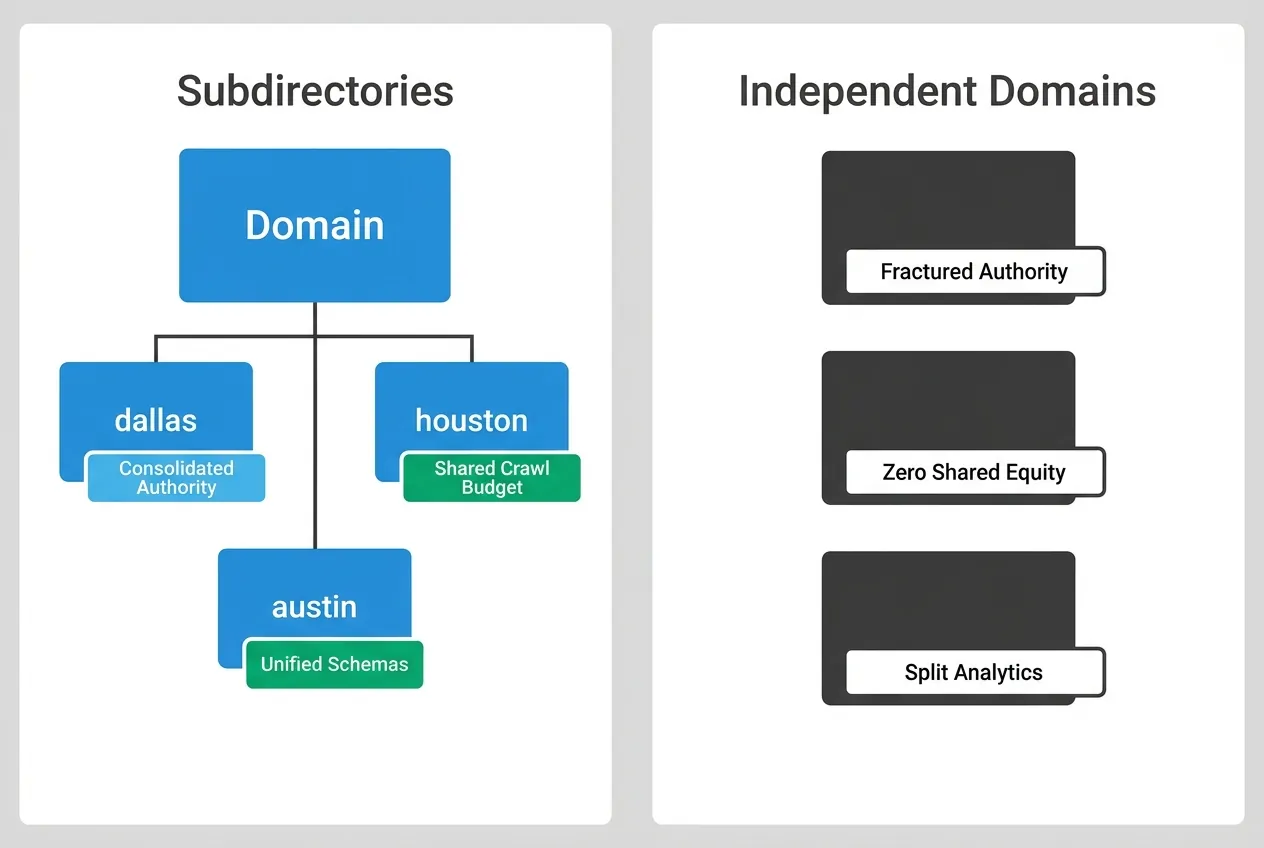
A foundational architectural decision in franchise search is how to structure location URLs. Organizations routinely debate whether to place regional locations on individual subdomains (dallas.brand.com), separate brand domains (brand-dallas.com), or structured subdirectories (brand.com/locations/texas/dallas/).
Independent local domains are almost always an expensive strategic error. Launching distinct external domains for every franchise location forces each operator to build domain authority from zero. An independent domain cannot leverage the accumulated backlink profile, brand equity, or crawl budget of the enterprise root domain. Furthermore, when franchisees exit the system, transfer territories, or rebrand, the central organization loses control of those external web assets.
Subdirectories offer the most resilient framework for enterprise search visibility:
- Consolidated Authority: Every inbound backlink earned by corporate PR, national marketing campaigns, or regional partnerships contributes to a single, high-authority domain.
- Crawl Efficiency: Search engine bots crawl nested directory structures far more effectively, ensuring rapid indexing of newly added branch locations.
- Centralized Analytics and Governance: Corporate engineering teams can roll out global privacy updates, consent management platforms, and structured data schemas instantly across thousands of pages without managing separate server environments.
The challenge of subdirectory architecture is avoiding thin, duplicated content across locations. Corporate marketers must reject generic, spun landing pages. Instead, deploy programmatic templates populated with granular, operational ground truth.
A high-performing location page includes the verified National Provider Identifier (NPI) numbers of practicing clinicians, detailed parking and public transit directions, accepted regional insurance plans, high-resolution photography of the actual local staff and interior facility, and embedded local customer reviews. For a comprehensive breakdown of technical page architecture, review the framework outlined in Multi-location SEO: how to rank every location without duplicate content.
Review acquisition at scale: turning visits into local ranking signals
Prominence signals are heavily weighted by the volume, velocity, and authenticity of customer reviews. A location with an immaculate technical website will consistently lose map pack positions to a local competitor with hundreds of recent, high-scoring reviews. For franchise networks, building a sustainable review acquisition engine requires moving away from outdated digital email blasts and embedding review collection directly into physical customer interactions.
Post-service email and text message surveys suffer from diminishing open rates and delayed engagement. When a healthcare patient or commercial client leaves a location, their likelihood of completing a public review drops precipitously with each passing hour. Point-of-service tools solve this friction by capturing feedback during the final moments of a physical visit.
Using dedicated hardware, such as branded tap-to-review Powered Cards, front-line clinic teams and customer service staff can present an integrated NFC and QR card directly to the client at the front desk or discharge counter. Tapping a smartphone against the card opens the verified Google Business Profile review interface in under three seconds, bypassing the friction of manual search queries, account lookups, or delayed SMS links.
Review operations must operate within strict legal and platform boundaries. The Federal Trade Commission explicitly prohibits deceptive consumer endorsements, fake testimonials, and the selective suppression of negative feedback under the FTC Consumer Review Guidance. Similarly, Google bans review gating (the practice of pre-screening customers with a survey and directing only positive ratings to Google) and prohibits any form of financial incentive, discount, or gift in exchange for public feedback, as detailed in the Google Maps User Contributed Content Policy.
Franchise networks must train local operators to invite feedback neutrally. Staff should invite every customer to share their honest feedback rather than asking exclusively for five-star ratings. Implementing structured physical review tools is explored thoroughly in Google review cards: using NFC and QR cards to collect reviews at the point of service.
Franchise digital marketing: connecting paid media and local organic search
A mature franchise digital marketing framework does not isolate organic search from paid media channels. Instead, it coordinates Google Ads, local service ads, and organic map pack optimization into a unified territory acquisition model.
When launching a new franchise location or entering a competitive metropolitan market, organic search signals take time to accumulate. Paid search provides immediate visibility while the new location establishes review velocity and directory citations. By aligning the search terms that drive paid conversions with the on-page content strategy of the local landing page, marketing teams gather clear search intent data that informs local content development.
In regulated markets, healthcare verticals, and sensitive services, paid media requires rigorous compliance. Platform restrictions frequently prohibit standard remarketing and behavioral audience targeting. For example, Google Ads limits audience tracking in sensitive health categories, requiring operators to rely on contextual intent, clean first-party data, and rigorous location-radius targeting.
Furthermore, multi-unit advertising budgets require unified conversion tracking. Franchise brands frequently waste marketing spend because corporate tracks top-of-funnel form fills, while local operators care only about completed sales, booked appointments, or patient admissions. A digital marketing system must integrate call tracking, CRM records, and local scheduling software. Connecting paid and organic click data directly to completed client intake allows operators to calculate precise customer acquisition costs by location, eliminating internal friction over co-op marketing fund allocations.

Email Us
Prefer to send the context directly?
How Marketing Powered delivers multi-location search systems
Marketing Powered is an operator-led marketing agency and technology firm designed to solve the commercial, operational, and technical challenges of scaling multi-location networks. We do not treat multi-unit discovery as a superficial checklist of automated directory listings. We build accountable, fully integrated local growth systems.
Our operational perspective is informed by hands-on leadership. Marketing Powered is led by a former healthcare Chief Marketing Officer who directed marketing for a treatment network that expanded from 3 to 24 locations, managing $1.5 to $2M per month in Google Ads across 11+ behavioral and mental health accounts. We understand the precise friction points that emerge between corporate brand oversight, regulatory legal constraints, and local field operators hungry for immediate phone calls. In addition, our leadership includes court-certified expert witness credentials in advertising strategy.
Our multi-location delivery model integrates three core disciplines:
- Governed Platform Architecture: We build enterprise-grade, high-performance location landing pages hosted on subdirectories of your primary domain. We deploy custom programmatic schema markup and coordinate bulk-verified Google Business Profiles to maintain unassailable relevance and distance signals across every territory.
- Physical Reputation Systems: Through Powered Cards, we deploy durable, branded physical review hardware directly to your clinic, storefront, or office locations. We supply staff training frameworks that maximize review velocity while strictly adhering to FTC rules and Google content policies.
- Accountable Attribution: AI-native since 2022, we utilize owned, local AI infrastructure for HIPAA-aware inference and secure data handling. We configure end-to-end attribution models that track qualified search visibility through to confirmed patient admissions, completed consultations, and verified revenue rather than unvalidated web leads.
To evaluate external partners for your network, review our guide on Multi location seo services: what a specialist partner delivers and how to vet one.
Questions, Answered.
Local SEO focuses on optimizing a single physical location for geographically relevant search queries within a single market. Franchise SEO manages local search optimization across dozens or hundreds of distinct locations simultaneously. It requires enterprise governance models, scalable URL architectures, bulk profile verification, and systems to prevent corporate duplicate content while supporting individual local market discovery.
No. Creating independent websites for individual franchise locations fragments domain authority, splits backlink equity, and significantly increases technical overhead. Hosting all locations on structured subdirectories of the primary enterprise root domain (for example, brand.com/locations/city/) allows every branch to benefit from the cumulative domain authority of the master brand while keeping compliance, security, and tracking centralized.
Brands with ten or more locations of the same business can apply for bulk verification within Google Business Profile. Bulk verification verifies all existing locations and streamlines the addition of future facilities, placing them within managed location groups that prevent unauthorized third-party ownership and maintain centralized administrative control.
No. Google's listing guidelines strictly require that the business name on your profile matches the real-world, legal name of the business as shown on physical signage, business cards, and official filings. Adding city names, zip codes, or keyword phrases to the name field is a policy violation that can trigger profile suspensions, removing your location from Google Maps entirely.
Franchise systems must ensure review solicitation is completely neutral, non-incentivized, and ungated. Do not offer discounts, gifts, or entries into contests in exchange for reviews, and do not use software to filter negative reviews away from public profiles. Deploy physical touchpoint tools, such as NFC and QR review cards at customer checkout or discharge, inviting every customer to provide honest feedback directly on Google. Get a multi-location visibility audit from Marketing Powered
Ready to see where your marketing can improve?
Request a free audit of your paid media, landing pages, attribution, and measurement setup. You'll get a straight assessment of where the opportunities are.
or email us at info@marketingpowered.ai