Resources
Conversion Rate Optimization Examples: Tests Worth Copying and Why They Worked
Studying practical conversion rate optimization examples reveals a clear pattern: high-performing digital campaigns rarely depend on aesthetic tweaks like button colors or stock photography. Real performance gains come from resolving operational friction, clarifying the value exchange, and structuring downstream qualification so inbound interest translates into actual revenue.
By Mike Hulick, Founder, Marketing Powered

The Flaw in Common CRO Tests: Why Front-End Wins Often Fail

What Is Conversion Rate Optimization in Practice?
Conversion rate optimization (CRO) is the systematic discipline of identifying operational friction within a customer journey, testing behavioral hypotheses, and increasing the percentage of qualified visitors who complete a high-value commercial action. It is an engineering and behavioral process, not a checklist of superficial user-interface enhancements.
In high-intent, regulated sectors such as healthcare, hospital networks, legal practices, and commercial professional services, conversion optimization carries unique stakes. Marketing leaders in these industries often operate under tight advertising constraints. For example, Google's personalized advertising policies explicitly prohibit retargeting, remarketing lists, and audience-building based on personal hardships, health conditions, or sensitive clinical categories. When an acquisition campaign cannot fall back on retargeting audiences across the web, first-touch conversion efficiency must do the heavy lifting.
A comprehensive conversion rate optimization guide approaches every page as an intake mechanism. It evaluates how quickly a visitor understands the offer, whether the user feels secure sharing sensitive details, and how smoothly the initial interaction connects to your sales or intake pipeline.
The objective is never simply to collect an email address or generate a raw form submission. The objective is to produce an interaction that moves an qualified prospect into an active evaluation or intake workflow without inflating operational overhead.
Most conversion testing programs stall because they measure success at the wrong checkpoint. Agency teams celebrate a 30 percent lift in form completions without verifying what happens after the lead enters the customer relationship management (CRM) platform.
Lowering front-end friction indiscriminately is the easiest way to generate false wins. If an intake form requires seven fields—including insurance provider, treatment history, or commercial budget—removing five of those fields will almost certainly increase submission volume.
However, stripping critical qualification fields shifts the filtering burden directly onto your admissions coordinators or sales development representatives. The intake team spends hours chasing incomplete phone numbers, unqualified inquiries, and mismatched buyers. The cost per raw lead drops, but the cost per admission or closed contract climbs.
True conversion rate optimization focuses on net marketing economics. When testing adjustments to landing pages, intake flows, or scheduler tools, the primary metric must be qualified commercial outcomes rather than top-of-funnel submissions. Teams must track attribution through to the signed contract or clinical admission, ensuring that front-end interface changes do not degrade backend operational throughput.
Conversion Rate Optimization Examples That Improved Economics
The following conversion rate optimization examples illustrate how addressing user psychology and operational friction creates real business leverage across complex customer journeys.
Example 1: Multi-Step Progressive Intake vs. Single-Page Form Walls
A common conversion failure point in professional services and medical intake is the single-page form wall. When a visitor with high intent reaches a landing page and encounters a single form containing nine open input fields, cognitive intimidation triggers immediate abandonment.
Usability research from the Nielsen Norman Group on website form design confirms that perceived complexity drives abandonment, whereas progressive disclosure helps users manage complex tasks by staging information logically. Dividing an extensive intake sequence into a multi-step progressive workflow reduces initial cognitive strain.
In this framework, Step 1 asks for non-threatening, low-friction micro-commitments, such as selecting a service category, clinical concern, or geographic region via clickable cards. Once the visitor completes this initial action, they have established psychological momentum.
Step 2 introduces the specific qualifying questions (such as insurance carrier or timeline). Step 3 captures direct contact information (name, direct phone number, and verified email address). Breaking the interaction into discrete steps lowers visual intimidating factors while preserving comprehensive data collection for the intake team.
Example 2: Intentional Friction for Intake Triage
In high-value business-to-business environments and specialized clinical verticals, adding intentional friction often yields superior economic outcomes compared to removing it.
Consider an organization receiving hundreds of inbound inquiries each week, where intake coordinators spend half their working hours evaluating individuals who do not meet clinical criteria or service minimums. By introducing a mandatory qualifying dropdown—such as requiring prospective clients to confirm primary insurance coverage, program type, or commercial budget parameters—the total volume of submissions may decline by 10 to 15 percent.
Despite the drop in raw submissions, downstream commercial metrics improve substantially. Intake staff stop wasting time on non-viable submissions and make contact with qualified individuals within minutes rather than hours. The overall conversion rate from qualified lead to actual admission increases, lowering the total blended cost of customer acquisition.
Example 3: Click-to-Call Prioritization for Urgent Mobile Traffic
High-intent mobile visitors facing acute challenges rarely want to fill out static text fields. In behavioral healthcare, emergency facilities, and urgent legal services, mobile visitors seek immediate, direct human contact.
A proven testing framework for mobile landing pages involves replacing traditional inquiry forms above the fold with prominent click-to-call direct routing. Coupling this direct call prompt with essential trust elements—such as 24/7 staff availability, confidentiality notices, and direct routing indicators—aligns directly with user urgency.
For visitors who prefer not to speak immediately, secondary progressive text-based options remain accessible below the primary call trigger. Aligning the conversion path with the physical device and situational urgency consistently produces higher engagement than forcing desktop form patterns onto mobile viewports.
Free Audit
Want a straight read on where your budget is leaking?
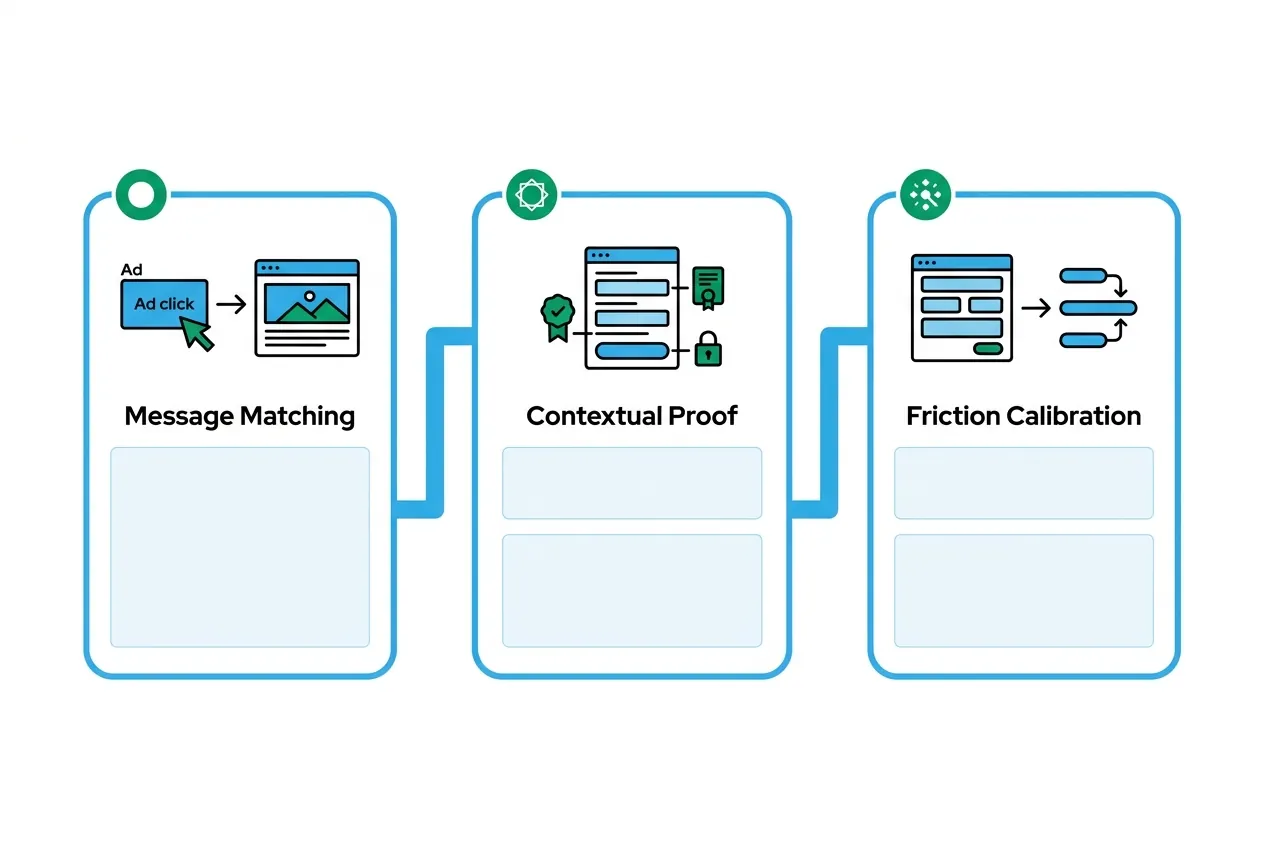
Core Conversion Rate Optimization Techniques Worth Deploying
Replicating successful tests requires mastering the conversion rate optimization techniques that govern decision-making under uncertainty.
Rigorous Message Matching
Message matching requires that the core value proposition, phrasing, and primary intent displayed in an advertisement carry over seamlessly to the landing page headline and hero section.
If a Google Ads search query focuses on "inpatient medical detox programs," directing that click to a generic corporate homepage discussing "comprehensive wellness solutions" introduces immediate cognitive disconnect. Visitors bounce within seconds because the page fails to validate their specific intent.
Exact structural alignment between query, ad copy, page headline, and call to action stabilizes conversion baselines.
Contextual Trust and Proof Placement
Trust is not established by dumping arbitrary client logos or stock badges into a website footer. Contextual proof placement positions relevant credentials precisely where hesitation occurs—directly adjacent to the conversion action zone.
If your conversion asset is an intake form, placing privacy statements, state licensing seals, independent accreditations (such as LegitScript or clinical board certifications), and data handling notices directly under the final submission button mitigates abandonment at the exact point of decision. The user receives clear reassurance precisely when parting with sensitive personal details.
Friction Calibration and Cognitive Load Reduction
Friction is not inherently negative; it simply requires deliberate calibration. Extraneous visual noise, competing navigation links, redundant form fields, and ambiguous button labels generate unproductive friction that degrades conversion rates. Productive friction, by contrast, establishes clear expectations and screens for qualified intent. Audit your acquisition paths to remove unnecessary form fields and navigation exits, while keeping the fields that your sales or clinical operations team requires to deliver an informed, rapid response.
Evaluating Conversion Rate Optimization Tools for Regulated Workflows
Selecting appropriate conversion rate optimization tools involves technical, analytical, and regulatory considerations. While consumer brands prioritize rapid interface testing, organizations handling sensitive consumer data or clinical intake must account for data privacy and regulatory compliance.
Under federal privacy rules, including the HHS guidance on online tracking technologies, covered entities must avoid transmitting protected health information or identifying user behaviors to unauthorized third-party tracking scripts. Many conventional client-side A/B testing scripts and heatmapping platforms continuously capture end-user screen sessions, keystrokes, and form inputs. If an unconfigured third-party script captures an individual's identifying information paired with specific health conditions or inquiries, it exposes the organization to significant regulatory risk.
When evaluating testing software, technical teams should prioritize:
- Server-Side Experimentation: Running split tests at the edge or server level rather than relying on heavy client-side JavaScript snippets reduces page load latency, prevents layout shifts, and keeps data transmission within controlled parameters.
- Keystroke and Field Masking: Session recording tools must provide strict client-side field masking, ensuring that names, phone numbers, email addresses, and form interactions are never captured, stored, or transmitted to external vendor databases.
- First-Party Analytics Infrastructure: Utilizing modern first-party data structures allows teams to run statistically valid conversion tests while preserving data sovereignty and visitor confidentiality.
CRO Best Practices for High-Value and Regulated Verticals
Executing conversion rate optimization within hospitals, healthcare systems, professional services, and regulated commercial sectors demands higher operational rigor than conventional consumer retail.
First, align every test with downstream intake workflows. If an optimization changes the type of data collected on a landing page, coordinate directly with intake directors and sales management before launch. Verify that your CRM, electronic health records (EHR), or patient management software correctly maps new custom fields and triggers immediate staff alerts.
Second, respect the principles of statistical power and run tests to completion. A common pitfall among mid-market marketing teams is ending an A/B test after four days because one variant shows an early 40 percent improvement. Early sample sizes are highly volatile. Use rigorous statistical power calculations, account for weekly business cycle variances, and allow tests to gather sufficient sample volume before declaring a conclusive winner.
Finally, integrate CRO directly into your full-funnel marketing architecture. A conversion page cannot compensate for poorly targeted paid media or weak search intent. Conversion rate optimization, landing page design, and conversion optimization, landing pages, and CRM and intake automation must function as an integrated engine alongside your paid acquisition strategy. When your search intent, positioning, landing page architecture, and intake routing operate synchronously, marketing efficiency compounds across the entire organization.

Email Us
Prefer to send the context directly?
How Marketing Powered Engineers Conversion Systems
Marketing Powered treats conversion optimization as an accountable engineering discipline. We reject superficial cosmetic updates in favor of structured systems designed to improve downstream business metrics.
Our approach is built on executive operating experience. Marketing Powered's founder is a former healthcare CMO who led marketing operations for a treatment network that expanded from 3 to 24 locations, managing $1.5 to $2M per month in Google Ads across 11+ behavioral and mental health accounts. Additionally, our founder serves as a court-certified expert witness in advertising strategy. We know firsthand that vanity conversion metrics do not pay operational overhead; actual admissions, retained clients, and revenue do.
Being AI-native since 2022, we utilize owned, local AI infrastructure for HIPAA-aware inference. This allows our team to run sophisticated language analysis, message-matching evaluations, and data processing without exposing sensitive records to third-party public models. We design end-to-end attribution architectures that track performance past the initial digital lead through to the final admission or signed engagement.
For organizations navigating complex digital acquisition, explore our foundational framework on conversion rate optimization for lead generation: a system, not a list of tests. If you are evaluating outside expertise to accelerate your optimization roadmap, review our guide on conversion rate optimization agency: what a specialist partner delivers and how to vet one, or evaluate landing page infrastructure via our breakdown of landing page optimization agency: what a specialist partner delivers and how to vet one.
Questions, Answered.
Conversion rate optimization is the process of improving the percentage of website or landing page visitors who take a specific high-value action. This involves analyzing user behavior, diagnosing friction points in the conversion funnel, formulating behavioral hypotheses, and testing alternative experiences to increase qualified inquiries and commercial outcomes.
Conversion rates vary significantly by industry, audience intent, and transaction value. While consumer ecommerce conversion rates often hover around 2 to 3 percent, focused B2B and healthcare lead generation landing pages targeting high-intent search queries frequently achieve conversion rates between 6 and 14 percent. However, the absolute percentage matters less than the qualification level of the leads generated and the downstream cost per acquisition.
To achieve statistically valid results, testing pages generally require several hundred conversions per variation. In lower-traffic or highly specialized B2B environments where waiting months for statistical significance is impractical, teams should prioritize radical structural redesigns, usability audits, and progressive profiling rather than micro-testing subtle design variations.
Standard client-side session recorders often capture sensitive text entered into form fields, including contact details, private medical inquiries, or financial information. In regulated industries, transmitting this information to unauthorized third-party analytics servers can violate federal privacy standards and create severe legal liability. Always ensure testing tools offer robust keystroke masking and privacy safeguards before deployment. Schedule a strategy call with Marketing Powered
More Resource Topics
Ready to see where your marketing can improve?
Request a free audit of your paid media, landing pages, attribution, and measurement setup. You'll get a straight assessment of where the opportunities are.
or email us at info@marketingpowered.ai