Resources
Google Ads Audit: A Checklist That Finds Wasted Spend
Every dollar committed to paid search should buy qualified commercial demand, but uninspected accounts routinely siphon significant marketing capital into irrelevant search queries, phantom conversions, and automated platform defaults. Performing a rigorous google ads audit is the fastest path to reducing customer acquisition costs without suppressing qualified volume. Rather than grading cosmetic account scores, this evaluation begins where money is lost: tracking data integrity, query relevance, network distribution, and bidding feedback loops.
By Mike Hulick, Founder, Marketing Powered

Why Conventional Paid Search Audits Look at the Wrong Metrics
Most digital agency audits start in the wrong place. They inspect Quality Scores, ad copy variations, and campaign symmetry, assigning letter grades to account hygiene while ignoring whether reported conversions actually generate pipeline. An account can show a 10 out of 10 Quality Score and a low cost per acquisition on paper while funneling budget into wrong numbers, spam submissions, or billing inquiries from existing clients.
A commercial paid search account is an automated economic engine governed by machine learning. When conversion tracking records low-intent actions as primary successes, Google's Smart Bidding models treat that data as target signals. The bidding algorithm actively seeks out more users likely to complete those exact low-value actions. Optimizing ad copy or adjusting bids on a corrupted conversion setup simply helps the system buy flawed conversions faster.
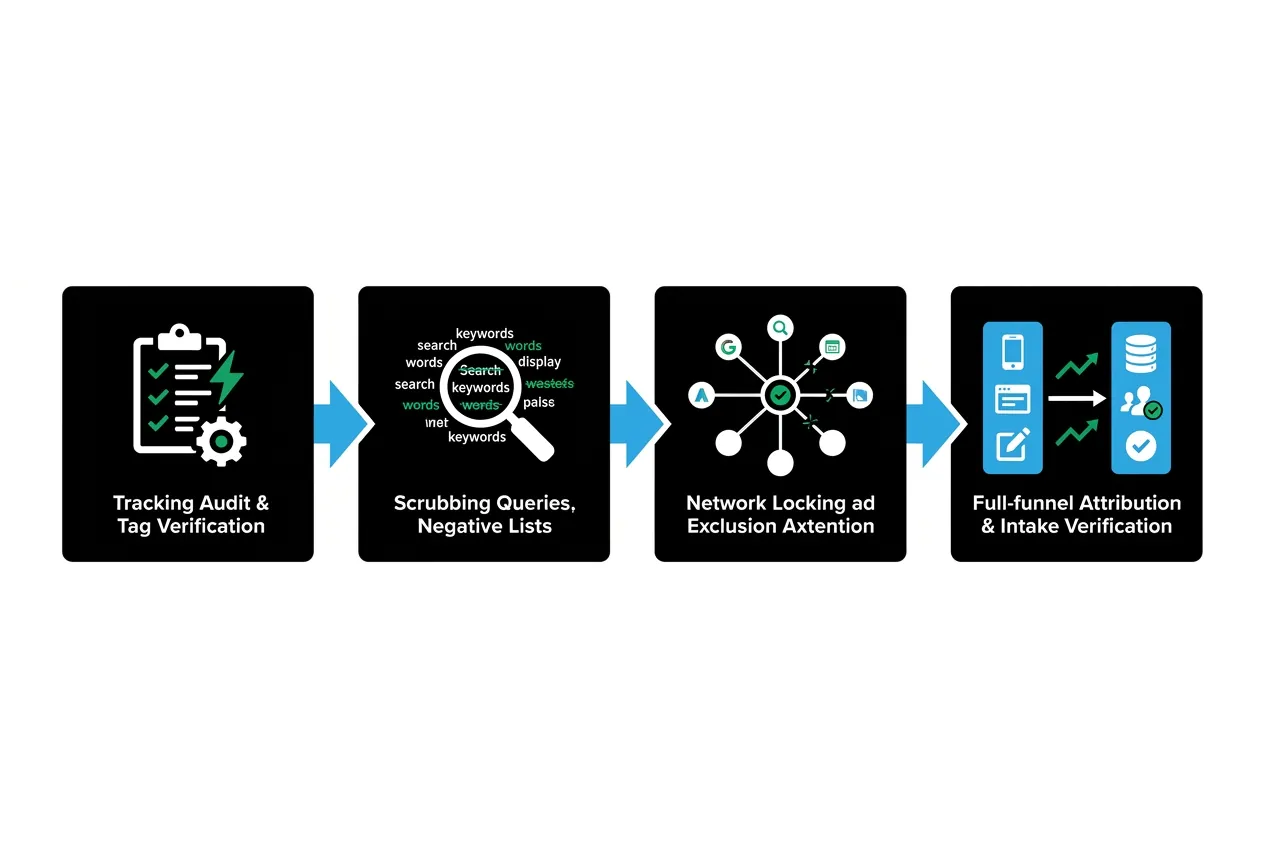
An effective ppc audit works in reverse order. It begins at revenue generation and intake records, verifies tracking tags, audits search query intent, strips away silent network distribution waste, and inspects ad groups only after the data pipeline is secure.
Inspect your operating accounts using this reverse sequence. Operators review the raw ledger of ad spend alongside verified CRM records rather than accepting platform dashboards at face value. When marketing leaders reconcile intake logs against ad platform conversion tags, the discrepancy reveals the true financial health of the media buy.

Step 1: Conversion Tracking Integrity and Attribution Verification
The primary source of financial waste in Google Ads is corrupted conversion data. If your bid strategies rely on Maximizing Conversions, Target CPA (Cost Per Acquisition), or Target ROAS (Return on Ad Spend), the algorithm requires accurate signals to bid effectively.
Primary Versus Secondary Conversion Actions
Inside the conversion goals settings, check whether primary conversion actions are reserved strictly for high-intent customer actions. Primary actions are factored into Smart Bidding optimization and reported in the main "Conversions" column. Secondary actions should be observational only.
Accounts frequently bleed capital when routine web interactions are classified as primary conversions. Ensure none of the following are marked primary unless they directly correlate with a qualified transaction:
- Page views or session durations (such as viewing a contact page)
- Automated smart goals imported from Google Analytics without lead qualification
- Newsletter signups on bottom-funnel acquisition campaigns
- Unfiltered button clicks (such as clicking an unverified mailto link)
Phone Call Tracking and Duration Thresholds
Relying on default Google forwarding numbers without qualification rules introduces silent waste into your bidding engine. A five-second misdial, a wrong number, or a call from an existing customer asking for customer service should never trigger a conversion event.
Audit your call tracking setup to verify that call duration minimums are established (typically at least 60 to 90 seconds depending on intake workflows). Integrate dynamic number insertion platforms with your intake systems. This ensures that only phone calls that progress to a completed screening, intake assessment, or qualified sales conversation register as primary conversion events.
Offline Conversion Tracking
Form fills alone do not reflect revenue. In lead generation and healthcare environments, form submissions routinely include spam bots, service solicitations, and unqualified users.
Examine whether the account uses Offline Conversion Tracking (OCT) to upload hashed conversion events tied to the Google Click Identifier (GCLID) or through Enhanced Conversions for Leads. When your CRM feeds closed sales, qualified consultations, or verified admissions back into Google Ads, Smart Bidding trains itself on commercial pipeline rather than raw form submissions.
For teams managing sensitive health environments, this infrastructure must be designed carefully. Attribution tracked to admission, not just lead volume, provides the bidding algorithm with true commercial targets while maintaining strict patient data boundaries.
Step 2: Search Query Intent and Negative Keyword Architecture
Advertisers do not buy search queries; they bid on keywords that match against queries. Over the past several years, platform changes have broadened keyword match behavior. Broad match and phrase match terms now match against broad conceptual associations, semantic variations, and loose synonyms.
A thorough google ads audit checklist demands an exhaustive review of the Search Terms Report to determine what percentage of spend goes toward actual intent versus peripheral noise.
The Search Terms Gap
According to the Google Ads Search Terms Report Documentation, Google only displays search terms that meet privacy and search volume thresholds. A portion of your search query spend may remain obscured in aggregate reporting.
Because you cannot review every single query that triggers an impression, proactive negative keyword architecture is mandatory. Check whether the account maintains shared negative keyword lists applied across all relevant campaigns.
Negative Keyword Categories to Check
Verify that the account excludes predictable non-converting search themes:
- Employment and career queries: Terms containing jobs, hiring, salary, resume, certification, internship, application, and career.
- Navigational and support queries: Terms containing login, portal, phone number, customer service, headquarters, employee, and billing.
- Research and educational queries: Searches for pdf, definition, symptoms, statistics, examples, free, cheap, open source, and template.
- Mismatched commercial intent: Searches that indicate consumer intent when you offer commercial services, or pediatric searches when your facility only treats adults.
Look closely at single-word negative additions versus phrase-match negatives. Adding a multi-word negative often fails to block related variations, whereas adding clear root words on phrase or broad negative match stops unwanted traffic immediately.
Free Audit
Want a straight read on where your budget is leaking?
Step 3: Network Defaults, Broad Match Creep, and Auto-Apply Settings
Google Ads includes default configuration settings designed to maximize reach across its properties. For focused performance campaigns, these defaults dilute budget across poor-quality inventory.
Auditing this layer requires reviewing the campaign settings tab alongside historical placement reports. When media managers inspect placement distribution inside Search and Performance Max campaigns, they frequently uncover thousands of impressions distributed to casual mobile games and low-value content sites. Eliminating these allocations concentrates capital directly on qualified search intent.
Google Search Partners and Display Network Inclusion
Search campaigns frequently launch with the Google Display Network and Google Search Partners enabled by default.
- The Display Network opt-in: Checking the box to expand a Search campaign to the Display Network allows Google to spend unallocated search budget on banner placements across mobile apps and third-party sites. In almost every lead generation scenario, this generates low-intent accidental clicks. It must be turned off.
- Google Search Partners: The Search Partner network distributes ads across non-Google search engines, internal site search engines, and parked domains. Review the "Network (with search partners)" segment under your campaigns. If Search Partners yield higher cost-per-acquisition or lower lead-to-opportunity rates than native Google Search, remove the partner network.
Auto-Apply Recommendations
Google provides an automated management feature that applies platform recommendations without manual verification. Under the Google Ads Auto-apply Help framework, opting into these settings permits the platform to change match types, adjust keyword bids, expand target audiences, and create responsive search ad variants automatically.
Review the "Recommendations" section and click "Auto-apply" in the top right corner. For rigorous media management, every auto-apply toggle should be disabled. Allowing algorithms to convert phrase or exact keywords to broad match without human oversight strips away control over query matching and inflates non-converting click costs.
Historical AdWords Audit Protocols for Modern Match Types
In earlier iterations of search marketing, an adwords audit focused on precise match-type mirroring, such as Single Keyword Ad Groups (SKAGs) using broad match modified modifiers (+keyword). With modified broad match sunsetted and close variants matching against loose intent, accounts must now manage match types based on campaign intent.
If broad match is deployed, confirm it runs exclusively within dedicated campaigns running Smart Bidding supported by rich, verified offline conversion data. Running broad match on manual or legacy bidding strategies invites budget depletion.
Step 4: Geographic Precision and Multi-Location Budget Dilution
For multi-location practices, healthcare networks, and local service firms, location settings represent another critical area of financial waste. Bidding outside your service territory or letting budget bleed into distant zip codes directly inflates acquisition costs.
Presence Versus Interest Targeting
Inside the advanced location options of campaign settings, Google Ads provides two targeting options:
- Presence or interest: People in, regularly in, or who have shown interest in your targeted locations.
- Presence: People in or regularly in your targeted locations.
Google defaults to "Presence or interest." Under this default, a user located thousands of miles away searching for services in your market may trigger your ad if they include a city name.
For localized clinics, regional service operations, and brick-and-mortar facilities, change this setting strictly to "Presence." This prevents out-of-market users from consuming your click budget while ensuring intake staff do not spend hours fielding calls from individuals outside your service footprint.
Multi-Location Account Architecture
Review how multi-location businesses distribute budget across distinct geographic regions. Combining multiple facilities or clinics with different capacities and patient economics into a single national or regional campaign leads to budget cannibalization. Denser markets with high search volumes will consume the total budget, starving secondary locations of paid visibility.
Assess whether the account maintains isolated campaigns for separate operating regions. This allows budget caps, custom landing pages, distinct phone tracking numbers, and localized messaging matched directly to each facility's clinical capacity and market economics.

Step 5: Regulated Vertical Constraints and Policy Adherence
Operating paid search in regulated industries, including healthcare, legal, and financial services, requires navigating strict policy boundaries. Standard e-commerce and SaaS marketing tactics often violate advertising rules or privacy requirements in these environments.
Sensitive Healthcare Category Restrictions
Under the Google Ads Personalized Advertising Policy, advertisers are prohibited from using retargeting lists, remarketing pixels, or audience targeting based on personal hardships, physical or mental health conditions, and clinical treatments.
An audit of a healthcare account must confirm that remarketing lists are not attached to search or display campaigns for sensitive conditions. If an agency or marketing team attempts to run retargeting for addiction treatment, oncology, or behavioral health, the campaigns risk account suspension.
Because retargeting is prohibited in sensitive healthcare verticals, the account architecture must focus on high-intent search capture, localized landing page clarity, and frictionless first-touch intake systems.
Certification and Policy Verification
For specialized categories such as behavioral health and addiction treatment, confirm that LegitScript certification is active and properly mapped to the Google Ads account. Operating without proper credentials limits ad distribution and risks permanent campaign disruption. Verify that the account adheres to all state-level licensing rules and Google healthcare advertising requirements.
To understand how high-intent search structures operate without relying on prohibited remarketing, review our comprehensive framework on Healthcare PPC: structuring paid search for qualified patient demand.
Email Us
Prefer to send the context directly?
Step 6: How Marketing Powered Executes a PPC Account Audit
A meaningful ppc account audit requires technical rigor, platform policy literacy, and commercial experience. Marketing Powered audits paid media accounts from an operator-led perspective, examining tracking infrastructure, media spend allocation, and intake performance to expose waste.
Our founder is a former healthcare CMO who ran marketing for a treatment network that grew from 3 to 24 locations, personally managed $1.5 to $2M per month in Google Ads across 11+ behavioral and mental health accounts, and serves as a court-certified expert witness in advertising strategy. We understand the specific economic pressures of scaling high-stakes, regulated accounts.
When conducting an evaluation, we deploy owned, local AI infrastructure for privacy-aware inference, ensuring confidential marketing data remains protected without cloud exposure. We evaluate:
- Conversion integrity, eliminating unverified phone calls, form bot spam, and phantom micro-conversions
- Full-funnel attribution, aligning platform conversion reporting with offline CRM records and verified admissions
- Search intent efficiency, stripping out search partner leaks, display cannibalization, and negative keyword oversights
- Platform default mitigation, systematically auditing auto-apply recommendations and broad match over-expansion
To see how specialized media management stabilizes customer acquisition costs, explore our guide on Healthcare ppc services: what a specialist partner delivers and how to vet one, or review our analysis on selecting a Google ads agency: what a specialist partner delivers and how to vet one.
Our team approaches media reviews as an operational exercise: finding capital leaks, tightening attribution, and establishing accountability between ad platforms and customer admissions.
Step 7: Structuring Ad Groups and Responsive Search Ads
Only after conversion tracking, query architecture, network settings, and regulatory policies are verified should an audit inspect ad group mechanics and ad creative.
Ad Group Thematic Relevance
Examine ad group density. Ad groups containing 50 to 100 keywords across distinct themes degrade ad relevance and lower Quality Scores. High-performing accounts use tightly themed ad groups with 5 to 15 closely related keywords pointing to dedicated landing pages.
Confirm that ad group themes reflect clear commercial intent:
- Does the landing page headline mirror the keyword theme?
- Does the ad copy directly address the user's explicit problem?
- Are geographical differentiators highlighted for local searchers?
Responsive Search Ad (RSA) Asset Optimization
Review the construction of Responsive Search Ads. An effective RSA does not simply provide 15 generic headlines; it gives Google distinct message components to test without producing awkward phrasing combinations.
- Asset diversity: Ensure headlines are not minor variations of the exact same phrase. Combine call-to-action headlines, social proof statements, service descriptions, and location qualifiers.
- Pinning discipline: Evaluate whether headlines are pinned strategically. Pinning every headline to position 1 destroys machine learning utility; unpinning critical regulatory disclaimers risks policy non-compliance. Pin only when mandatory messaging or regulatory disclosures require a fixed location.
- Ad assets (extensions): Confirm sitelinks, callouts, structured snippets, and call assets are fully populated. Campaigns using comprehensive ad assets achieve higher click-through rates and claim larger visual real estate on search engine results pages.
Questions, Answered.
A full structural audit should be conducted quarterly, or immediately upon inheriting an underperforming account. Weekly and monthly management handles search term additions, negative keyword scrubbing, and budget pacing. A deeper quarterly audit evaluates conversion tracking integrity, placement reports, offline attribution matches, and network expansion settings that slow-moving drift can corrupt.
To conduct an effective evaluation, an auditor needs standard read-only access to Google Ads, Google Tag Manager, Google Analytics 4, and relevant call tracking platforms. Access to intake CRM or pipeline reporting is critical to reconcile platform conversions against real business inquiries, verified appointments, or signed clients.
An impression simply means your ad rendered on a user's screen. It does not measure interest, attention, or commercial relevance. Accounts with broad match expansion and display network defaults often accumulate hundreds of thousands of low-cost impressions that generate zero phone calls or intake assessments. An audit strips away unqualified impressions to protect click budgets for high-intent searchers.
Yes. Regulatory rejections often stem from policy-triggering keywords, misconfigured landing page disclaimers, missing certifications (such as LegitScript for addiction treatment), or unpermitted remarketing lists. An audit reviews ad copy and landing page infrastructure against current vertical policies to clear compliance flags and prevent account suspensions. Request an acquisition audit
More Resource Topics
Ready to see where your marketing can improve?
Request a free audit of your paid media, landing pages, attribution, and measurement setup. You'll get a straight assessment of where the opportunities are.
or email us at info@marketingpowered.ai