Resources
First Party Data vs Third Party Data: What Changes for Advertisers
Digital advertising performance increasingly depends on direct data ownership rather than fragile third-party tracking scripts. When marketing teams evaluate first party data vs third party data, the central challenge is no longer theoretical privacy compliance, but the survival of automated bidding models. Without high-fidelity conversion signals fed directly back into ad networks, algorithmic buying degrades and customer acquisition costs climb.
By Mike Hulick, Founder, Marketing Powered

First party data vs third party cookies: why legacy tracking broke

What is first party data vs third party data?
Understanding the architectural distinction between data types begins with collection mechanisms and legal provenance. First-party data is information collected directly from prospects and customers through owned digital touchpoints. This includes form submissions on your landing pages, call center records, customer relationship management (CRM) pipeline stages, point-of-sale transactions, email engagement, and authenticated portal activity. Because the data originates from a direct relationship, your organization maintains direct governance, verifiable consent records, and high confidence in data hygiene.
Third-party data consists of behavioral, demographic, or contextual records gathered by an outside entity that has no direct relationship with the user. Aggregators and data brokers harvest these signals across thousands of independent websites, compile them into packaged audience segments, and sell them through demand-side platforms and ad exchanges. While third-party audiences offered convenient scale in previous programmatic buying eras, the underlying information degrades rapidly, lacks transparent consent trails, and suffers from low accuracy.
Second-party data operates as a clean subset between these two poles: it is essentially another organization's first-party data, shared through a direct, transparent commercial partnership. In high-trust sectors like healthcare, hospital systems, and professional services, relying on broad third-party aggregators introduces compliance risks and inaccurate targeting. Modern media buying demands first-party records captured at point-of-intent and structured for downstream activation.
Marketers frequently conflate data assets with the mechanisms used to transmit them. First-party data is an enduring asset class; third-party cookies were merely a browser transport vehicle. For over two decades, digital advertising relied on third-party cookies dropped by external advertising networks to observe browsing activity across distinct web domains, map cross-device journeys, and fire conversion pixels.
That client-side measurement environment deteriorated as browser developers prioritized user privacy and platform defense. Apple implemented WebKit Tracking Prevention (formerly Intelligent Tracking Prevention) in Safari, capping the lifespan of client-side cookies to as little as 24 hours to seven days and blocking known tracking domains entirely. Mozilla followed by deploying Enhanced Tracking Protection by default in Firefox. Simultaneously, mobile operating systems introduced strict opt-in frameworks for cross-app tracking.
These technical restrictions broke legacy multi-touch attribution models. When a user conducts research on Safari, revisits a site eight days later via paid search, and converts two weeks after that through an organic search, client-side scripts treat each touchpoint as a distinct, disconnected session. Conversion credit defaults entirely to the final touchpoint or gets classified as direct unassigned traffic. Third-party cookies did not just lose tracking fidelity; they blinded marketing teams to the actual customer journey.
How third-party signal loss degrades automated ad bidding
The most dangerous consequence of signal loss is not reporting blindness; it is the algorithmic degradation of automated bidding systems. Modern advertising platforms, such as Google Smart Bidding and Meta Advantage+, no longer rely on human media buyers adjusting manual keyword bids. Instead, machine learning models analyze millions of real-time signals to predict which impressions will yield a defined conversion event.
These machine learning models require high-frequency, high-integrity feedback loops. When third-party tracking breaks, ad platforms stop receiving clean conversion data. If an analytics pixel loses half of its attribution signals because of browser storage caps or script blockers, the ad platform treats those lost conversions as non-existent.
This triggers an algorithmic failure pattern:
- Signal Deprivation: The ad network algorithm fails to see verified downstream conversions (such as scheduled consults, qualified intake calls, or completed sales).
- Proxy Optimization: To maintain spend and satisfy bidding thresholds, the algorithm shifts delivery toward superficial, high-volume proxy actions, such as cheap link clicks or low-intent form fills.
- Quality Decay: The volume of raw leads may stay level while customer acquisition cost based on actual revenue surges.
- Capital Misallocation: The marketing budget gets channeled into targeting pools that generate platform-level conversions but zero balance-sheet revenue.
Restoring performance requires rebuilding the feedback loop with verified, first-party business records instead of superficial browser pings.
Free Audit
Want a straight read on where your budget is leaking?
Implementing first party data in Google Ads and paid media
Transitioning away from third-party tracking requires deploying first-party data directly into ad platform bidding engines through privacy-preserving protocols. In Google Ads, three technical implementations form the foundation of resilient attribution: Enhanced Conversions, Customer Match, and Offline Conversion Imports.
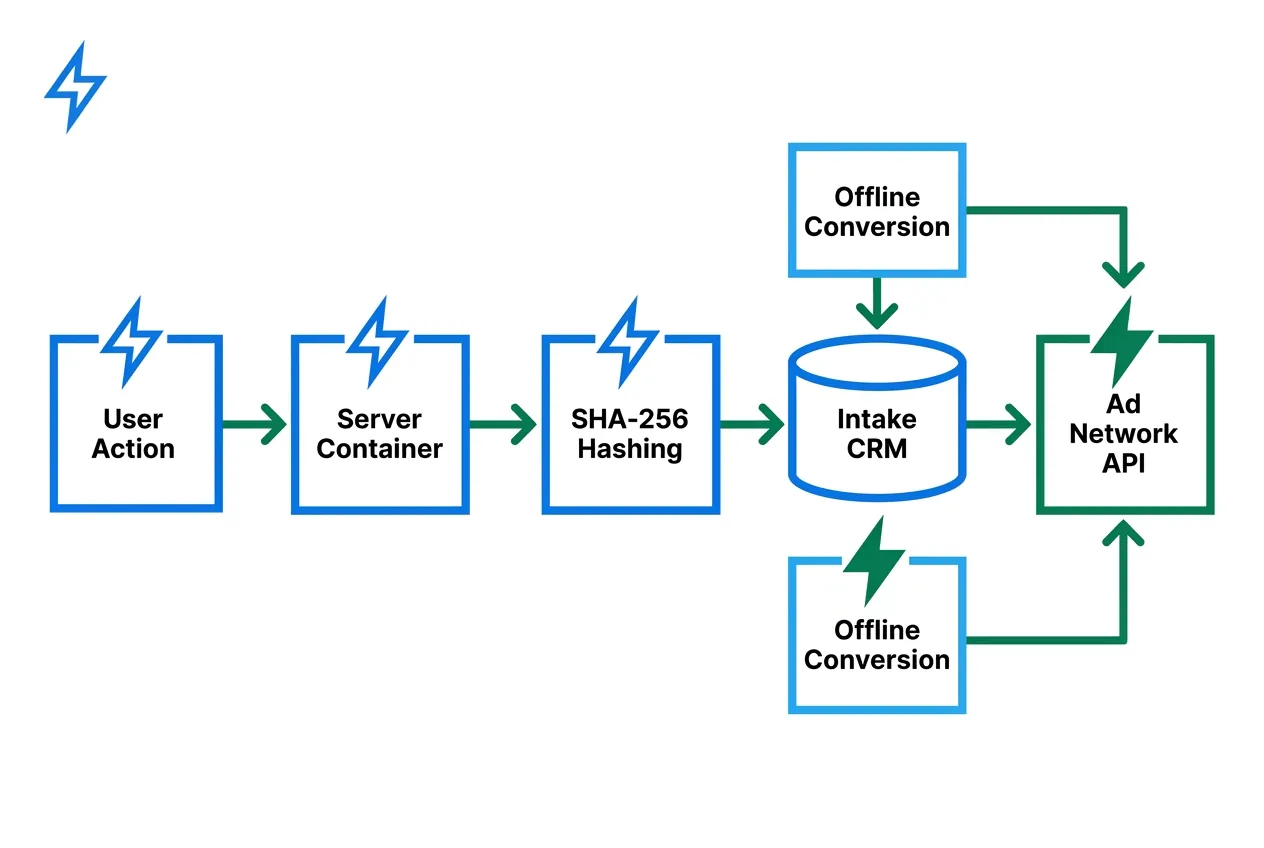
Enhanced Conversions bridges tracking gaps by capturing first-party data that users enter into conversion forms (such as email addresses, phone numbers, or physical addresses). The browser or server hashes this data using the one-way SHA-256 algorithm before transmitting it to Google. Google then matches the hashed string against its own signed-in user accounts to associate previously uncredited ad clicks with the completed conversion.
Customer Match allows advertisers to upload hashed first-party customer lists directly to Google. According to the Google Ads Customer Match Policy, accounts must meet strict account history and policy compliance requirements to utilize these lists. Once approved, advertisers can leverage first-party lists to build qualified audience segments and refine Smart Bidding signals.
Offline Conversion Imports (OCI) provide the highest level of measurement defense. Instead of relying on client-side pixels, the advertiser captures the unique click identifier (such as the Google Click ID, or GCLID, WBRAID, and GBRAID) at the moment of initial form fill or call tracking session and stores it alongside the lead record in a secure CRM.
When that lead progresses down the funnel to a qualified opportunity, signed agreement, or completed intake, the CRM automatically uploads the conversion timestamp, identifier, and exact dollar value back to Google via API.
In regulated verticals where the Google Ads Personalized Advertising Policy prohibits retargeting or interest-based targeting, Offline Conversion Imports allow advertisers to train automated bidding algorithms without violating user profiling rules.
Data privacy and governance in regulated sectors
Transitioning to first-party data is not an automatic shield against regulatory enforcement. In high-trust sectors like healthcare, banking, and professional services, handling direct consumer information introduces strict legal obligations. Marketing teams cannot simply pipe sensitive customer data into third-party advertising tools without governance.
In healthcare marketing, federal oversight has tightened around digital tracking tools. The HHS Bulletin on Tracking Technologies outlines that deploying unmanaged client-side tracking pixels on websites can inadvertently disclose protected health information (PHI) to third-party technology vendors, potentially violating HIPAA rules. Transmitting IP addresses alongside health-related search terms or appointment requests creates substantial liability.
To resolve this challenge, enterprise organizations are moving away from traditional client-side tag managers toward server-side tagging architectures. In a server-side setup, the website transmits data directly to an owned cloud or local server container. The server strips away private parameters, anonymizes IP addresses, removes identifiable health details, and routes only privacy-safe, hashed conversion signals to ad networks. Server-side architecture gives the advertiser absolute control over the data stream, preventing third-party vendors from scraping unapproved user behavior.
How Marketing Powered builds data and analytics architecture
Connecting digital media spend to operational revenue requires an engineering discipline that typical creative agencies cannot support. At Marketing Powered, our practice in Data and analytics architecture: attribution, call tracking and first-party data is built to solve signal loss, eliminate tracking vulnerabilities, and establish defensible conversion reporting across complex organizations.
Our leadership is shaped by operational experience: our founder is a former healthcare CMO who ran marketing for a treatment network that grew from 3 to 24 locations, managing $1.5 to $2M per month in Google Ads across 11+ behavioral and mental health accounts, and is a court-certified expert witness in advertising strategy.
That background informs an architecture built for high-scrutiny environments. Marketing Powered is LegitScript-aware and HIPAA-aware, designed specifically for Google's sensitive healthcare vertical where retargeting is strictly prohibited and third-party tracking scripts present compliance threats.
Our measurement infrastructure deploys owned, local AI infrastructure for HIPAA-aware inference, operating native AI systems since 2022. We engineer server-side data pipelines that capture click identifiers, route inbound phone calls through compliant call tracking, and match downstream CRM milestones directly back to media channels. Attribution is tracked to verified admission or closed revenue, not just unvalidated form leads.
Teams seeking a deeper evaluation of their attribution models can review our foundational guide, Marketing attribution: a practical guide for teams that need real answers. To evaluate how specialist agencies structure these measurement environments, explore Marketing attribution agency: what a specialist partner delivers and how to vet one, or review technical call routing strategies in Call tracking services: what a specialist partner delivers and how to vet one.
Questions, Answered.
First-party data in Google Ads refers to customer information collected directly through your owned properties (such as email addresses, phone numbers, physical addresses, and unique click IDs) that is hashed and used to train bidding algorithms. It powers features such as Enhanced Conversions, Customer Match, and Offline Conversion Imports, allowing ad networks to optimize for verified pipeline milestones rather than simple browser clicks.
No. Server-side tagging is an architectural tool, not an automatic compliance credential. While it allows an organization to inspect, filter, and redact sensitive personal information before routing data to third-party vendors, compliance depends entirely on governance, consent collection, business associate agreements, and strict policy execution.
Yes. Automated bidding performs more reliably without third-party cookies if the advertiser feeds clean, first-party conversion data directly into the ad platform via APIs. Ad network machine learning models optimize based on conversion value and verified transaction signals, which first-party pipelines supply with higher fidelity than legacy cookies.
The fundamental difference lies in ownership, collection origin, and reliability. First-party data is gathered directly from your audience through owned touchpoints with verifiable consent, offering high integrity and deep utility for conversion tracking. Third-party data is aggregated by outside brokers across unrelated web properties, sold without direct user relationships, and faces aggressive technical blocking across modern browsers. Request an acquisition audit
More Resource Topics
Ready to see where your marketing can improve?
Request a free audit of your paid media, landing pages, attribution, and measurement setup. You'll get a straight assessment of where the opportunities are.
or email us at info@marketingpowered.ai