LLM Advertising
Unlock the Power of LLM Advertising for Your Practice
AI-native advertising strategies built for behavioral health providers who need qualified admissions, not just clicks.
Why LLM Advertising is a Game-Changer
Traditional digital advertising relies on static keyword targeting and demographic assumptions. You set parameters, launch campaigns, and hope your message resonates with the right people at the right time. LLM advertising operates differently. Large language model technology processes and generates human-like text based on patterns learned from vast datasets, enabling ad content that adapts to user context in real time.
For behavioral health providers, this shift matters. Your prospective patients and their families search with specific, often emotionally charged queries. They need answers that feel relevant to their exact situation, not generic treatment center copy that could apply to any facility. LLM-powered advertising can match that specificity by generating contextually appropriate messaging that speaks to the searcher's actual concern.
The technology also changes how campaigns scale. Instead of creating dozens of ad variations manually and testing each one for weeks, AI advertising systems can generate and optimize messaging variants continuously.
According to Google's AI advertising documentation, machine learning now powers significant portions of ad delivery optimization across their platform. Marketing Powered has operated as an AI-native agency since 2022, building infrastructure specifically designed to capitalize on these capabilities for healthcare verticals.
Integrating AI in Behavioral Health Marketing
Adding generative engine advertising capabilities to your existing marketing stack does not require rebuilding from scratch. The integration path starts with your current data: intake patterns, geographic performance, seasonal trends, and the messaging that has historically converted. AI tools layer on top of this foundation, finding optimization opportunities that human analysts would miss.
The practical benefits show up quickly. Campaign managers spend less time on manual bid adjustments and ad copy rotation. Attribution becomes more granular as AI systems track touchpoints across the patient journey. Budget allocation shifts automatically toward high-performing placements without waiting for weekly review meetings.
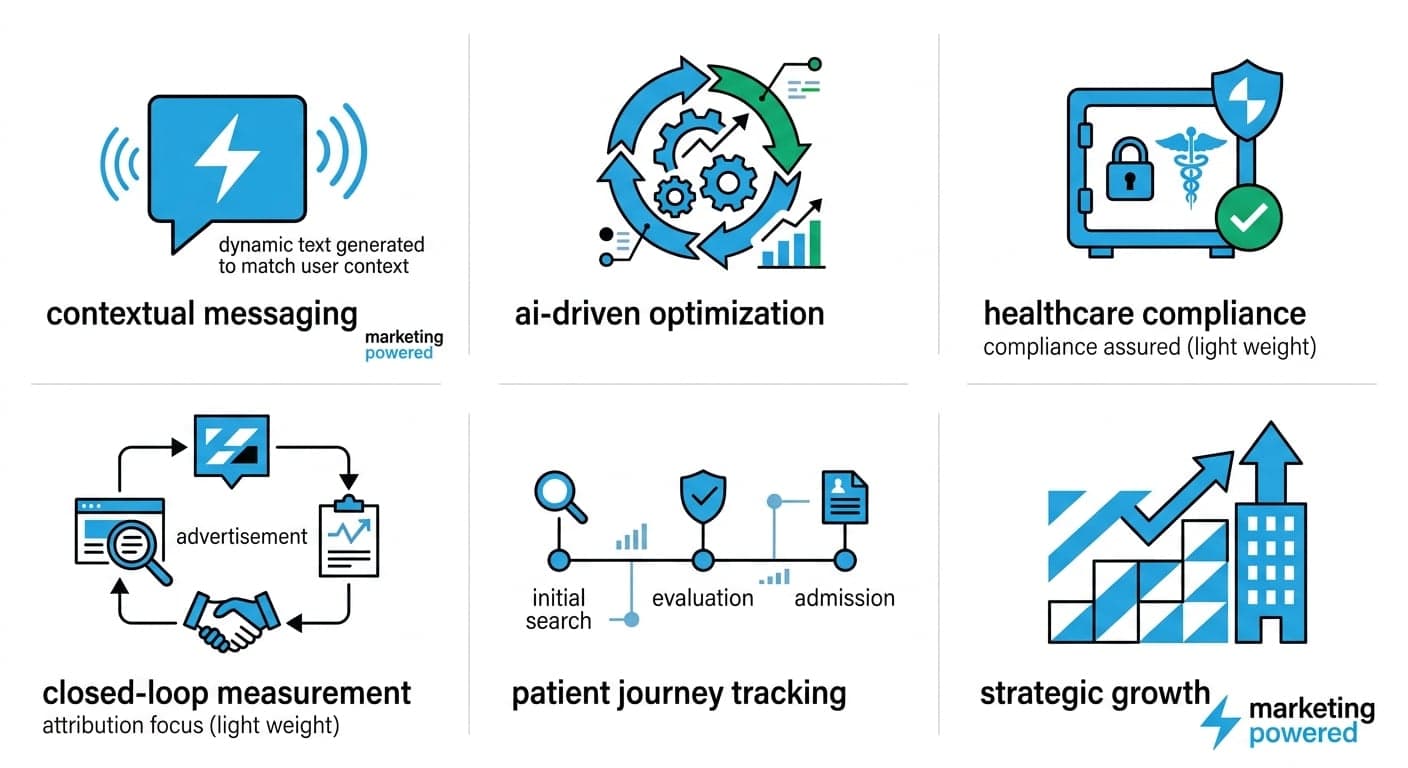
Marketing Powered manages $1.5M to $2M monthly in Google Ads across behavioral health accounts. That scale provides the data density AI systems need to learn effectively. We have tracked attribution through to admission for clients operating inpatient treatment and dual diagnosis programs, connecting front-end ad spend to back-end census impact. This closed-loop measurement is where ai advertising delivers its clearest value: knowing which campaigns actually fill beds, not just which ones generate form submissions.
Compliance and AI Advertising
Healthcare advertising operates under constraints that most industries never face. Google's healthcare and medicines policy restricts targeting options for addiction treatment advertising. Retargeting is prohibited. Certain claims require LegitScript certification. HIPAA governs any patient data that touches your marketing systems.
LLM advertising does not bypass these requirements. It operates within them. The technology generates compliant messaging variations, not prohibited claims. AI systems can be trained to avoid outcome guarantees, cure language, and the specific phrasing that triggers policy violations. The key is working with a partner who understands both the technical capabilities and the regulatory boundaries.
Marketing Powered maintains LegitScript awareness and HIPAA-conscious infrastructure across all client accounts. Our AI Edge approach includes proprietary systems running on controlled hardware with data sovereignty protections. Protected health information does not flow through third-party commercial APIs.
This architecture matters when you are generating AI-driven advertising content for a sensitive vertical. According to HHS guidance on HIPAA and marketing, any use of PHI for marketing requires specific authorizations. Our systems are designed to optimize campaign performance without requiring access to protected patient information.
Case Studies: Success with LLM Advertising
A multi-location behavioral health organization came to Marketing Powered, operating three treatment locations. Through AI-native campaign optimization, attribution discipline, and continuous creative testing, they scaled to a larger multi-market footprint. The growth was not accidental. It was built on advertising systems that connected spending to admissions and reallocated the budget accordingly.
Across our portfolio of $50M+ managed in behavioral health and mental health advertising, we see consistent patterns. Facilities that adopt large language model advertising typically see improvements in lead quality before they see cost efficiency gains. The AI identifies which messaging resonates with patients who actually complete intake, not just those who click. Over time, that quality signal compounds: better leads mean higher admission rates, which fund expanded campaigns, which generate more data for the AI to learn from.
You can explore additional performance data on our case studies page. Each example includes the attribution methodology, compliance considerations, and measurable outcomes that drove the results.
Questions, answered.
LLM stands for large language model, a category of artificial intelligence that processes and generates human-like text based on patterns learned from extensive datasets. In advertising, LLM technology enables dynamic content generation, real-time message optimization, and contextually relevant ad copy that adapts to user intent. For behavioral health providers, this means advertising that speaks directly to the specific concerns prospective patients and their families express during their search.
LLM advertising improves targeting precision by generating messaging that matches specific patient needs and search contexts. Behavioral health providers typically see improvements in lead quality first, as AI systems learn which messaging attracts patients who complete intake rather than those who simply click. Over time, this quality signal drives higher admission rates and more efficient budget allocation across campaigns.
AI advertising can be fully compliant when implemented correctly. The technology operates within existing regulatory frameworks, including HIPAA requirements and Google's healthcare advertising policies. Compliance depends on proper system architecture (ensuring PHI does not flow through unauthorized channels), training AI systems to avoid prohibited claims, and maintaining LegitScript certification awareness. Marketing Powered builds compliance boundaries into our AI infrastructure from the foundation.
Start with an audit of your current advertising infrastructure, including conversion tracking, CRM integration, and attribution gaps. AI systems require data feedback loops to optimize effectively. If you want expert guidance on readiness assessment and implementation planning, schedule a discovery call with Marketing Powered to discuss your specific situation and compliance requirements.
Ready to see what AI-native marketing can do for your treatment center?
Request a free audit of your paid media, landing pages, attribution, and compliance posture. You'll get a straight assessment of where the opportunities are.
or email us at info@marketingpowered.ai