Resources
Treatment Center Marketing: An Operator Guide
Treatment center marketing is the disciplined system that connects compliant paid media, first-party data controls, and admission-level attribution for behavioral health and addiction treatment providers. It moves beyond raw lead counts to measure actual intake economics. This guide breaks down the operational mechanics required to build a defensible acquisition engine in a regulated environment where retargeting is restricted and data sovereignty is paramount.
By Mike Hulick, Founder, Marketing Powered

Why Lead Volume Alone Fails to Predict Admissions
The most common failure mode in addiction treatment marketing is optimizing for volume rather than value. When a marketing team reports 50 new leads per day, the immediate reaction is often celebration. However, if only five of those calls result in a qualified conversation and two become admissions, the cost per admission is significantly higher than the cost per lead suggests. This disconnect creates a dangerous blind spot for CEOs and COOs who rely on top-of-funnel metrics to justify budget allocations.
In sensitive healthcare verticals, the path from impression to admission is fractured by compliance constraints. Unlike standard e-commerce or B2B SaaS marketing, you cannot simply retarget users who viewed your landing page but did not call. Google’s policies for sensitive verticals restrict these capabilities, meaning every touchpoint must be designed with finality in mind. The user either engages immediately or drops off without the safety net of a remarketing campaign to bring them back weeks later.
This creates a high-stakes environment where the quality of the initial interaction determines success. A "lead" that is merely a form submission from an unqualified source, such as a spam bot or a person seeking information for a distant relative, consumes operational resources without contributing to revenue. The data cannot prove intent until it is verified through human interaction and clinical screening. Therefore, the metric that matters is not how many people raised their hands, but how many of those hands were qualified enough to hold.
To address this, operators must shift their definition of success from lead generation to admission acquisition. This requires tracking the specific friction points between a cold call and an intake decision. Where does the conversation stall? Is it pricing sensitivity, location preference, or insurance verification? Without granular data at each stage of this funnel, marketing spend remains disconnected from clinical outcomes. The goal is to build a system where every dollar spent can be traced back to a specific admission event, providing a clear line of sight into true customer acquisition costs.

Mapping Compliant Acquisition Channels to Intake Outcomes
Selecting the right channels for rehab marketing requires understanding which platforms allow sensitive healthcare advertising and how those permissions align with your intake process. Google Ads remains a primary driver for detox referral demand due to high-intent search behavior, but it operates under strict policy frameworks. Advertisers in this space must navigate LegitScript requirements and other regulatory standards that govern what can be shown and to whom.
The operational challenge is not just getting approved; it is executing within those boundaries while maintaining conversion efficiency. For example, if your primary value proposition relies on personalized treatment plans, you cannot use dynamic creative optimization that serves different promises to different users without risking policy violations or brand inconsistency. You must map each channel’s capabilities against your actual intake workflow.
Consider the following alignment between common channels and their specific constraints in this vertical:
- Google Search Ads: High intent, immediate action required. Works best when landing pages load instantly and offer clear next steps like a phone number or secure form. Compliance is strict; claims must be substantiated.
- Local SEO: Builds long-term trust for facility-specific queries. Requires accurate business listings, consistent NAP (Name, Address, Phone) data, and genuine review profiles. This channel often captures users who are in the research phase rather than crisis mode.
- Content Marketing: Addresses informational queries about symptoms, treatment options, or insurance coverage. Useful for establishing authority but rarely drives immediate admissions without a clear call to action that respects user privacy.
Each of these channels serves a different role in the patient journey. Search ads capture those ready to act now. Local SEO supports those comparing local options. Content provides the educational foundation that builds trust over time. The mistake many operators make is treating these as interchangeable volume generators rather than distinct stages in a compliant acquisition funnel. You need to know which channel drives qualified calls and which merely generates noise.
This mapping exercise should be documented in your rehab marketing plan. It forces you to define what "success" looks like for each channel before you spend money on it. If a channel does not have a clear path to a measurable intake outcome, it may need re-evaluation or removal from the mix. This discipline ensures that your budget is allocated based on proven value rather than assumed potential.
Building First-Party Data and Attribution That Reaches Admission
The backbone of effective treatment center marketing is an attribution model that connects the first digital touchpoint to the final clinical admission. Standard web analytics tools are often insufficient for this task because they track sessions, not outcomes. A user might click on a paid ad, leave their phone number, but never call back. Without connecting that initial interaction to the eventual admission recorded in your patient management system, you have no way of knowing if the marketing investment was effective.
To solve this, operators must implement first-party data strategies that bridge the gap between digital interactions and clinical records. This involves integrating your CRM or intake software with your marketing platforms so that every admitted patient can be traced back to their source channel. This is not just a technical exercise; it is an operational one. It requires collaboration between marketing teams, admissions staff, and IT departments to ensure data flows correctly and securely.
The process typically involves three key steps:
- Unique Identifier Creation: Assigning a unique identifier to each digital lead that persists through the intake process. This could be a UTM parameter, a call tracking number, or a custom field in your CRM.
- Data Integration: Connecting this identifier to the patient record system so that when an admission is logged, the source channel is automatically recorded.
- Reporting Alignment: Creating dashboards that display attribution data alongside clinical metrics, allowing leaders to see the true cost per admission for each channel.
This approach respects privacy and compliance requirements by using first-party data rather than relying on third-party cookies or retargeting pixels. It also provides a level of granularity that aggregate lead reports cannot match. You can see which specific campaigns, keywords, or content pieces are driving qualified admissions, not just generic leads.
The value of this system becomes apparent when making budget decisions. If you know that a particular keyword has a high volume of clicks but a low admission rate, you can adjust your bidding strategy or improve the landing page experience. Conversely, if a lower-volume channel drives a higher percentage of qualified admissions, it may deserve increased investment despite its smaller scale. This data-driven approach eliminates guesswork and aligns marketing spend with actual business outcomes.
Free Audit
Want a straight read on where your budget is leaking?
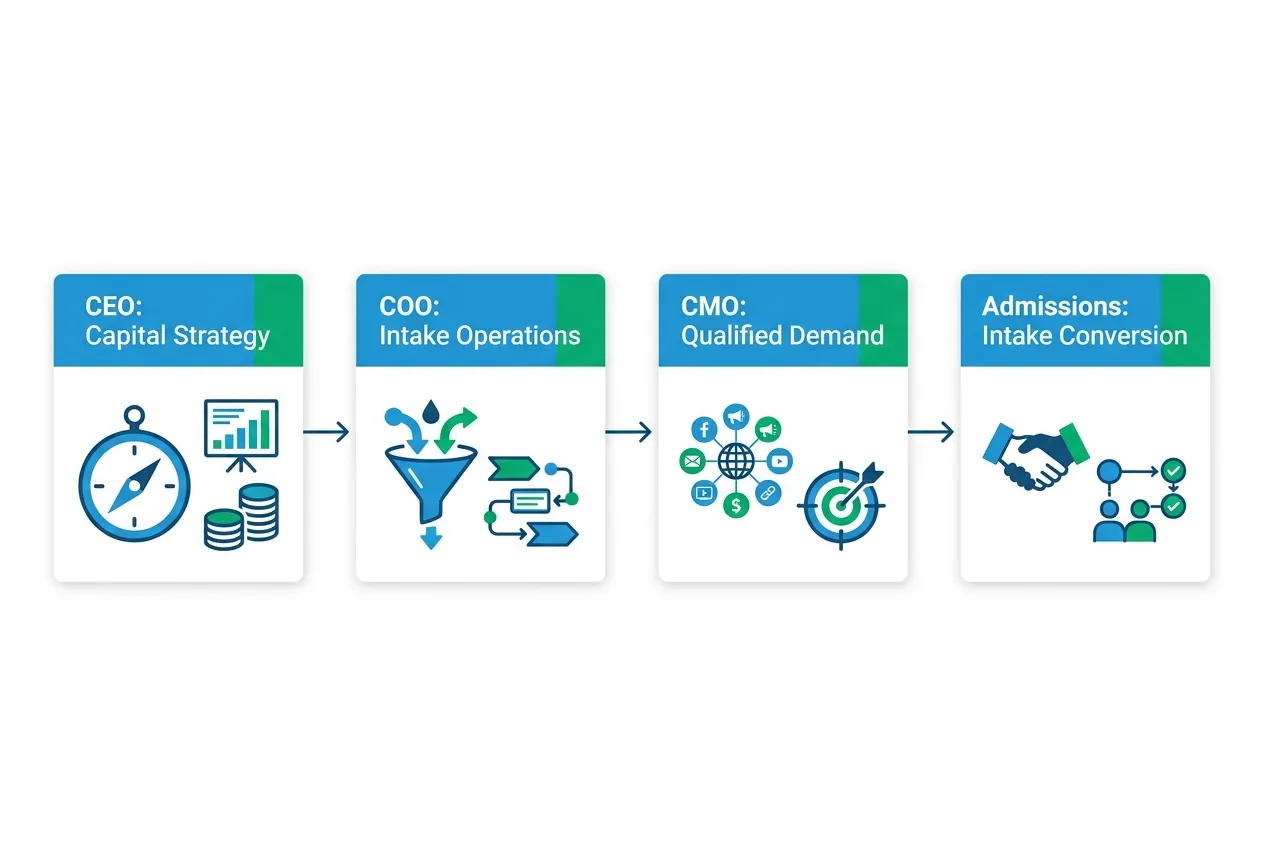
Role Ownership: CEO, COO, CMO, and Admissions Director Responsibilities
Successful treatment center marketing is not solely the responsibility of the marketing team. It requires clear role ownership across leadership to ensure that strategic goals are aligned with operational realities. When responsibilities are blurred, it leads to misaligned priorities, missed opportunities, and wasted resources. Each leader must understand their specific contribution to the acquisition process.
The CEO sets the strategic vision for growth and allocates capital toward marketing initiatives that support long-term business objectives. They must ask the right questions: Are we acquiring patients in our target demographics? Is our cost per admission sustainable? Do we have a competitive advantage in our local market? The CEO’s role is to ensure that marketing is viewed as an investment in patient acquisition rather than a discretionary expense.
The COO oversees operational efficiency and ensures that the intake process can handle the volume of qualified leads generated by marketing efforts. They must work with admissions staff to remove friction points, such as slow response times or complex scheduling processes, that prevent leads from converting into admissions. The COO also plays a critical role in implementing the data integration systems needed for accurate attribution reporting.
The CMO is responsible for developing and executing the marketing strategy that drives qualified demand. This includes selecting the right channels, creating compelling messaging, managing budgets, and analyzing performance data to optimize campaigns. The CMO must collaborate closely with clinical teams to ensure that marketing materials are accurate, compliant, and respectful of patient dignity. They also serve as the bridge between marketing technology and business operations, ensuring that tools like CRM systems and analytics platforms are used effectively.
The Admissions Director is on the front line of converting leads into patients. Their role is to understand the pain points and concerns of prospective patients and provide timely, compassionate responses. They must also feed real-world insights back to the marketing team about why certain leads convert while others do not. This feedback loop is essential for refining messaging and targeting strategies based on actual patient behavior rather than assumptions.
Clear ownership prevents duplication of effort and ensures that everyone is working toward the same goal: efficient, compliant patient acquisition. Regular cross-functional meetings should be held to review performance data, discuss operational challenges, and align on strategic priorities. This collaborative approach creates a unified front that maximizes the impact of marketing investments.
Budget Allocation and Measurement Checkpoints for Multi-Location Programs
For organizations operating multiple treatment centers, coordinating marketing efforts across locations adds another layer of complexity. Each facility may serve different demographics, offer distinct service lines, or face unique local competition. A one-size-fits-all approach to drug rehab marketing often fails because it does not account for these regional variations. Instead, a centralized strategy with localized execution is required.
Centralized management allows for consistency in branding, messaging, and compliance standards across all locations. It also enables the aggregation of data from multiple sites, providing a broader view of what works and what does not. However, this must be balanced with the need for local relevance. A message that resonates in one city may fall flat in another due to cultural differences, insurance landscape variations, or competitive dynamics.
The treatment center marketing budget should be allocated based on performance data rather than historical spend patterns. This means regularly reviewing attribution reports to identify which channels and locations are delivering the best return on investment. Budgets can then be shifted toward high-performing areas while reducing spending on underperforming ones. This dynamic approach ensures that resources are always directed toward their most effective uses.
Measurement checkpoints should be established at regular intervals, such as monthly or quarterly, to review performance against key metrics. These checkpoints should include:
- Cost Per Admission by Channel: To identify the most efficient acquisition sources.
- Lead-to-Admission Conversion Rate by Location: To spot operational inefficiencies in specific facilities.
- Time to Response: To ensure that leads are being contacted promptly, which is critical for high-intent users.
- Compliance Audit Results: To verify that all marketing activities adhere to current regulations and platform policies.
These checkpoints create a feedback loop that drives continuous improvement. They allow leaders to make informed decisions about resource allocation, strategy adjustments, and operational enhancements. By treating budget allocation as an ongoing optimization process rather than a fixed annual exercise, organizations can maintain agility and responsiveness in a changing market.
Common Constraints and What the Data Cannot Prove
Even with robust systems in place, there are inherent limitations to what marketing data can reveal. Understanding these constraints is crucial for setting realistic expectations and avoiding misinterpretation of results. One key limitation is the inability to track organic referrals or word-of-mouth recommendations that do not involve a digital touchpoint. A patient who hears about your facility from a friend or doctor may never interact with your online presence before calling, making it impossible to attribute their admission to marketing efforts.
Another constraint is the lag time between initial contact and final admission. In behavioral health, the decision-making process can be lengthy, influenced by insurance approval, family discussions, or personal readiness. This means that a campaign launched today may not show its full impact on admissions for weeks or even months. Attributing recent performance solely to current campaigns can lead to inaccurate conclusions about their effectiveness.
Additionally, data cannot fully capture the qualitative aspects of patient experience. While you can track whether someone called back, you cannot easily measure the quality of that interaction or how it influenced their decision to choose your facility over a competitor. This requires direct feedback from patients and staff, which should be incorporated into your evaluation process alongside quantitative metrics.
Compliance also imposes limits on data collection and usage. In sensitive healthcare verticals, restrictions on retargeting and tracking mean that you cannot follow users across multiple sessions or devices with the same precision as in less regulated industries. This necessitates a greater focus on immediate conversion optimization and strong first impressions, as you have fewer chances to engage hesitant prospects.
Finally, external factors such as seasonal trends, economic conditions, and changes in insurance coverage can significantly impact demand in ways that are difficult to isolate from marketing performance. A drop in admissions may not indicate poor marketing execution but rather a shift in broader market dynamics. Contextualizing data with these external variables is essential for accurate interpretation.
Recognizing these limitations helps leaders approach marketing metrics with appropriate skepticism and nuance. It encourages a more holistic view of acquisition performance that includes both measurable outcomes and qualitative insights, leading to more informed decision-making.

Email Us
Prefer to send the context directly?
Implementation Checklist and Next-Step Audit Request
Turning strategy into action requires a structured implementation plan that addresses each component of the treatment center marketing system. This checklist provides a starting point for organizations looking to build or refine their acquisition capabilities:
- Audit Current Channels: List all active marketing channels and assess their compliance status, performance history, and alignment with intake goals.
- Define Attribution Model: Determine how you will track leads from first contact through admission, including the specific tools and data integrations required.
- Establish Role Ownership: Assign clear responsibilities to CEO, COO, CMO, and Admissions Director for each stage of the acquisition process.
- Allocate Budget Dynamically: Set initial budget allocations based on historical performance and adjust regularly using attribution data.
- Implement Measurement Checkpoints: Schedule regular reviews of key metrics such as cost per admission, conversion rates, and compliance status.
- Document Constraints: Identify known limitations in your data collection and reporting processes to avoid misinterpretation of results.
This checklist serves as a foundational framework that can be tailored to your specific organizational structure and market conditions. It provides a clear roadmap for building a defensible marketing system that drives qualified admissions while maintaining compliance and operational efficiency.
If you are looking to assess the current state of your acquisition systems against these standards, an external audit can provide valuable insights into areas of strength and opportunity. This review examines your channel mix, attribution capabilities, role alignment, and measurement processes to identify gaps and recommend improvements.
Ready to see where your marketing can improve?
Request a free audit of your paid media, landing pages, attribution, and measurement setup. You'll get a straight assessment of where the opportunities are.
or email us at info@marketingpowered.ai