Resources
Healthcare Marketing Analytics Beyond Platform Leads
Healthcare marketing analytics tracks performance from initial inquiry through qualified calls, intake handoff, and verified admissions rather than stopping at platform lead counts. For treatment centers, hospitals, and regulated service providers, the gap between a reported click and a completed admission is where budget decisions are actually made. This guide outlines how to build an event-level measurement system that connects paid media spend to business outcomes you can defend in front of a board or compliance team.
By Mike Hulick, Founder, Marketing Powered

What Healthcare Marketing Analytics Must Measure After the Lead
Platform dashboards report impressions, clicks, form submissions, and call durations. These metrics confirm that traffic reached your funnel, but they do not confirm whether that traffic converted into revenue. In healthcare acquisition, a lead is only valuable if it results in an admission, an appointment, or a service engagement. Therefore, the core function of marketing analytics for healthcare is to map the journey after the initial contact point.
The primary failure mode in most organizations is treating "lead" as the final state. A form submission on a landing page does not indicate whether the patient called back, whether the intake team qualified them, or whether they were admitted within 30 days. Without downstream data, you cannot determine which campaigns drive high-value patients versus low-intent inquiries. This distinction is critical for multi-location networks where each facility has different capacity constraints and service line mixes.
Effective analytics must capture three states after the lead:
- Qualified Call: A conversation that meets predefined criteria for intent and insurance eligibility.
- Intake Disposition: The specific outcome of the intake interaction, such as admitted, waitlisted, referred out, or disqualified.
- Verified Admission: Confirmation that the patient actually arrived and began treatment, linking the marketing source to a realized revenue event.
This progression transforms marketing data from a volume metric into an efficiency metric. It allows you to calculate cost per admission rather than just cost per lead, providing a clearer picture of return on investment. For organizations managing significant budgets across multiple locations, this level of granularity is necessary to allocate funds based on performance rather than habit. The goal is not to count more leads, but to identify which sources generate the patients who actually stay and engage with your services.

Inquiry-to-Admission Event Schema and Data Ownership
To track performance beyond the lead, you need a standardized event schema that captures each stage of the customer journey. This schema defines what data points are recorded at each interaction and how they connect to one another. A robust schema includes unique identifiers for each inquiry, timestamped events for calls, forms, and intake steps, and final status flags for admission outcomes.
Data ownership is a critical consideration in regulated healthcare environments. When you use third-party platforms or external vendors for tracking, you must understand where the data resides, who has access to it, and how long it is retained. In sensitive verticals like behavioral health, this requires strict adherence to privacy standards. Marketing Powered operates with LegitScript-aware and HIPAA-aware practices, ensuring that measurement systems respect patient confidentiality while still providing actionable insights.
The schema should be built around first-party data wherever possible. This means capturing data directly from your website, call tracking system, and CRM rather than relying solely on platform-reported cookies or pixels. First-party data is more reliable because it remains under your control and is less susceptible to browser changes or third-party deprecations. It also supports better attribution models because you have direct visibility into the user’s path rather than an inferred one.
Implementing this schema requires coordination between marketing, IT, and admissions teams. Marketing defines the campaign parameters and landing page events. IT ensures that data flows securely from web servers to the CRM without exposing protected health information (PHI). Admissions staff record accurate dispositions in the system of record. When these three groups align on a single event model, you create a closed loop where every dollar spent can be traced to a specific business outcome. This foundation supports more advanced analytics, such as cohort analysis and lifetime value modeling, but it starts with clean, consistent data collection at each step.
Qualified Call Definition and Call-to-CRM Mapping
Not all calls are equal. A 10-second voicemail is fundamentally different from a 20-minute consultation that results in an insurance verification and admission scheduling. Marketing analytics for healthcare must distinguish between these types of interactions to provide accurate performance data. This requires defining what constitutes a "qualified call" before you begin measuring it.
A qualified call typically meets specific criteria:
- Duration above a minimum threshold (e.g., 60 seconds)
- Verification of insurance coverage or ability to pay
- Expression of intent for the specific service line advertised
- Scheduling of an intake appointment or admission
Once defined, these calls must be mapped into your Customer Relationship Management (CRM) system. This process, known as call-to-CRM mapping, ensures that every qualified interaction creates a record in your central database. Without this mapping, you lose the ability to track conversion rates from call to admission because the data remains siloed in telephony logs or spreadsheets.
Marketing Powered’s approach includes dedicated services for call tracking and intake attribution, which automate this mapping process. The system links the marketing source (e.g., specific Google Ads campaign, keyword, or landing page) to the call record in the CRM. This creates a direct line of sight between paid media spend and qualified opportunities.
The value of this step is twofold. First, it provides accurate conversion rates for each channel, allowing you to see which sources generate high-quality conversations versus low-intent noise. Second, it enables predictive modeling by analyzing which call characteristics correlate with successful admissions. For example, if calls from a specific campaign consistently result in higher admission rates, that signal should inform future budget allocation and creative strategy. Without this mapping, you are making decisions based on incomplete data, risking overinvestment in channels that drive volume but not value.
Free Audit
Want a straight read on where your budget is leaking?
Intake Handoff Process and Disposition Tracking
The intake handoff is the critical bridge between marketing efforts and clinical outcomes. This is where a qualified lead becomes an admitted patient or is determined to be unsuitable for your services. Disposition tracking records the specific outcome of each intake interaction, providing the final data point needed to calculate true acquisition costs.
Common dispositions include:
- Admitted: Patient accepted into program and completed admission process.
- Waitlisted: Patient qualified but no bed/program slot available; placed on hold list.
- Referral Out: Patient required services not offered or referred to another provider.
- Disqualified: Patient did not meet clinical criteria, insurance requirements, or geographic constraints.
- No Show: Scheduled for intake but failed to appear without rescheduling.
Each disposition carries different implications for marketing performance. An admission represents a successful conversion. A waitlist indicates demand that may convert later if capacity opens up. A referral out suggests a mismatch in service line targeting. A no-show highlights potential issues with communication or scheduling processes. By tracking these outcomes, you can identify patterns that inform both marketing strategy and operational improvements.
For multi-location networks, disposition tracking allows for facility-level performance analysis. You may find that one location has a higher admission rate from the same campaign as another, indicating differences in intake team effectiveness, local demand, or service line fit. This insight enables targeted interventions, such as additional training for intake staff at underperforming locations or adjusting targeting to better match local demographics.
Effective disposition tracking requires standardized terminology and consistent data entry practices across all locations. If one facility uses "Admitted" while another uses "Accepted," the data becomes unusable for cross-facility comparison. Standardization ensures that analytics reflect true performance differences rather than recording inconsistencies. This discipline is essential for building a trustworthy measurement system that stakeholders can rely on for strategic planning and budget justification.
Attribution Model Choices for Multi-Location Healthcare
Attribution models determine how credit for conversions is assigned to different touchpoints in the customer journey. In healthcare, where decision cycles can be long and involve multiple stakeholders (patient, family, insurer), simple last-click attribution often misrepresents channel performance. However, complex multi-touch models may be too granular or difficult to implement without robust data infrastructure.
For most treatment centers and hospitals, a hybrid approach works best:
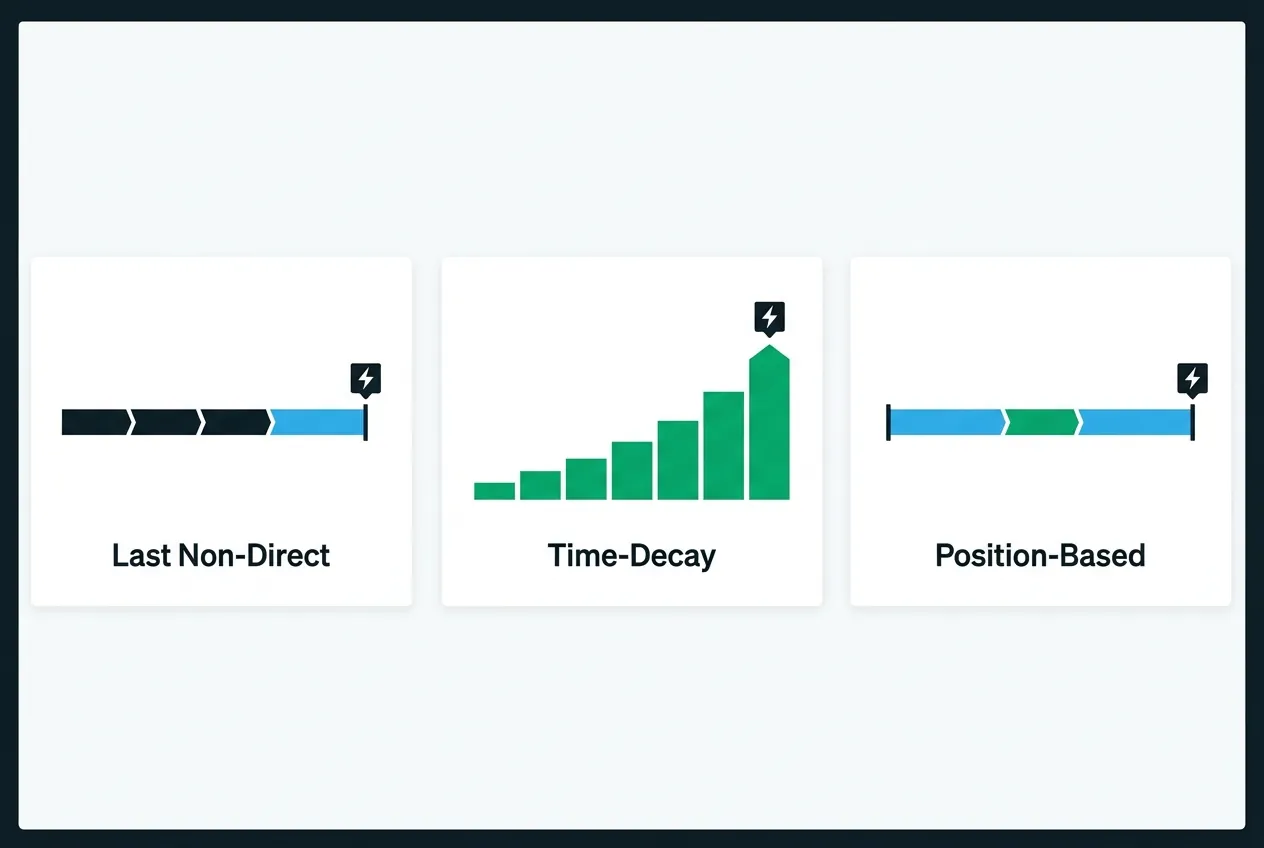
- Last Non-Direct Click: Credits the last paid media interaction that brought the user to your site before conversion. This captures the influence of specific campaigns while filtering out organic traffic from direct navigation.
- Time-Decay Model: Assigns more credit to touchpoints closer to conversion, acknowledging that recent interactions often have stronger influence.
- Position-Based Model: Gives 40% credit to first and last touches, with 20% distributed among middle touches. This balances awareness-building efforts with closing actions.
The choice of model should align with your business goals and data maturity. If you are just starting to build attribution capabilities, begin with last non-direct click to establish baseline performance by channel. As your event schema and CRM integration mature, move toward time-decay or position-based models for more nuanced insights.
Marketing Powered provides analytics and attribution services that help organizations select and implement the right model for their specific context. This includes analyzing historical data to understand typical decision cycles, testing different models against actual admission outcomes, and building dashboards that visualize performance by location, service line, and channel. The goal is not to find a single "correct" model, but to choose one that provides consistent, actionable insights that align with your business logic and operational reality.
Attribution in healthcare also requires consideration of external factors such as seasonality, regulatory changes, or competitive activity. These variables can impact conversion rates independently of marketing efforts, so attribution models should be interpreted within a broader context. Regular reviews of model performance against actual revenue outcomes help ensure that your analytics remain relevant and trustworthy over time.
Common Measurement Gaps and What the Data Cannot Prove
Even with a robust event schema and consistent disposition tracking, there will always be gaps in measurement. Understanding these limitations is crucial for interpreting data accurately and avoiding false confidence in your analytics. Some common gaps include:
- Offline Conversions: Patients who see an ad but convert through word-of-mouth or direct referral may not be captured in digital attribution models. This can understate the true impact of brand awareness campaigns.
- Cross-Device Behavior: Users who start their journey on a mobile device and complete it on a desktop computer may appear as separate sessions, breaking the attribution chain unless robust identity resolution is used.
- Intentional Avoidance: Some patients may deliberately avoid tracking technologies due to privacy concerns, leading to incomplete data for those users.
- Data Entry Errors: Human error in recording dispositions or call details can introduce noise into the dataset, affecting accuracy and reliability.
These gaps mean that your analytics provide an estimate of performance rather than a precise measurement. This is acceptable if you understand the limitations and build decision-making processes that account for uncertainty. For example, instead of making binary go/no-go decisions based on small differences in cost per admission between two channels, consider broader trends over time and qualitative feedback from admissions staff.
Additionally, healthcare marketing data cannot prove causal relationships with absolute certainty. Correlation does not equal causation; a campaign may correlate with increased admissions but other factors such as seasonal demand, insurance plan changes, or competitive actions could be the true drivers. Always seek to validate insights through A/B testing, market research, or operational feedback before making major strategic changes based solely on attribution data.
Finally, remember that analytics are a tool for informed decision-making, not a substitute for clinical judgment and business intuition. The best marketers combine data-driven insights with deep understanding of their patients, services, and market to make decisions that drive sustainable growth.
Email Us
Prefer to send the context directly?
Implementation Roles and Checklist for Admissions-Focused Analytics
Building an effective healthcare marketing analytics system requires clear ownership and coordination across multiple departments. Without defined roles, gaps in data collection or interpretation can undermine the entire measurement framework. The following outline identifies key stakeholders and their responsibilities:
- CEO/Executive Sponsor: Provides strategic direction, approves budget for technology and staffing, and champions the importance of data-driven decision-making across the organization.
- CMO/Marketing Director: Defines marketing goals, selects channels and campaigns, oversees creative strategy, and ensures that analytics align with business objectives.
- Admissions Director: Sets qualification criteria, trains intake staff on consistent disposition recording, and provides feedback on lead quality to inform marketing adjustments.
- Analytics Lead/Data Analyst: Builds and maintains the event schema, configures tracking systems, develops dashboards, and interprets data to provide actionable insights.
- IT/Security Officer: Ensures compliance with privacy regulations (HIPAA, LegitScript), manages data security infrastructure, and oversees vendor relationships for third-party tools.
To facilitate implementation, use the following checklist to assess your current state and identify gaps:
- Define Qualified Call Criteria: Are you using consistent definitions across all locations?
- Map Call-to-CRM Flow: Do all qualified calls create records in your CRM with marketing source data?
- Standardize Disposition Terminology: Is there a single set of outcome categories used by all intake staff?
- Verify Event Schema Completeness: Are you capturing timestamps, user identifiers, and campaign parameters at each step?
- Audit Data Ownership: Do you know where your data resides and who has access to it?
- Select Attribution Model: Have you tested different models against actual admission outcomes?
- Establish Review Cadence: How often do you review performance by channel, location, and service line?
This checklist serves as a starting point for organizations looking to build or improve their analytics capabilities. Each item represents a specific action that contributes to a more comprehensive measurement system. Addressing these areas systematically will help you move beyond basic lead counting toward true admissions-focused analytics that drive better business decisions.

Next Steps
Building a robust healthcare marketing analytics system is an ongoing process that requires continuous refinement as your organization grows and market conditions change. The key is to start with clear definitions, consistent data collection, and regular review cycles. By focusing on admissions rather than just leads, you create a measurement framework that aligns marketing efforts with actual business outcomes.
If you are ready to move beyond platform-reported metrics and build an attribution system that connects paid media spend to verified admissions, Request an acquisition audit. This assessment will identify gaps in your current tracking infrastructure, define qualified call criteria specific to your services, and outline a roadmap for implementing event-level analytics that support defensible budget decisions.
Ready to see where your marketing can improve?
Request a free audit of your paid media, landing pages, attribution, and measurement setup. You'll get a straight assessment of where the opportunities are.
or email us at info@marketingpowered.ai