Resources
Mental Health Google Ads: Patient-Centered Campaigns
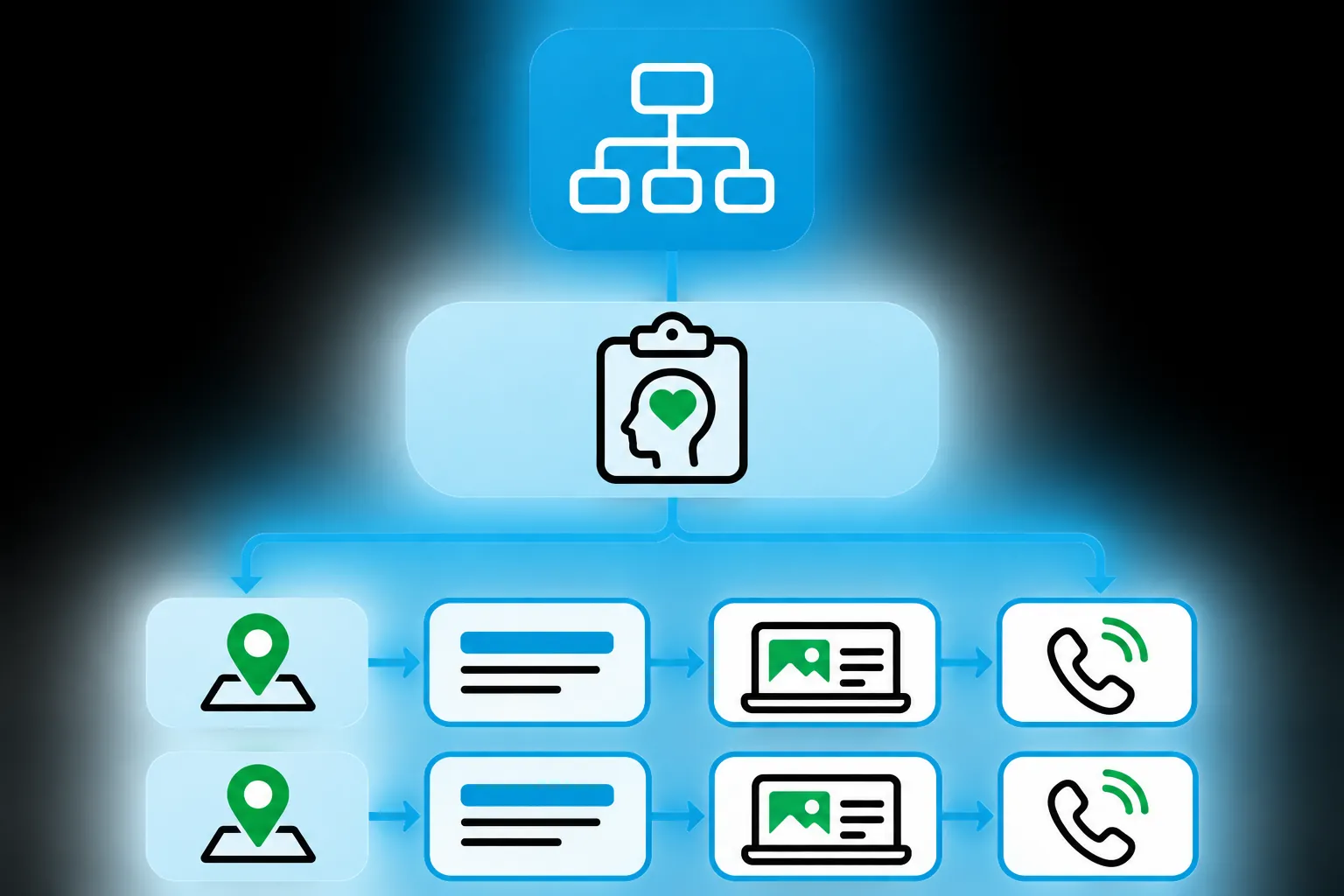
Mental health google ads are Search ads that appear when someone looks for therapy, psychiatry, or related outpatient care. Treat the account as one chain, from the query to the ad, the landing page, the first call, and the scheduled intake. A weak campaign can lose value after the click through missed calls, mismatched landing pages, or scheduling friction.
By Mike Hulick, Founder, Marketing Powered

When Google Ads fit a clinic
Picture a group practice on a weekday morning. The intake coordinator has the adult-therapy calendar open. One caller wants medication management and can be seen this week. Another call, labeled only by the campaign on the tracking screen, is a student asking about counseling jobs. The clinician who sees adolescents is booked for several weeks. Paid search does not create that open slot, and it does not sort those callers by itself.
Search campaigns are text ads on search results that can reach people while they are searching for the products and services a business offers. Google Ads: Choose the right campaign type For a mental health clinic, that reach is useful only when the operating basics are already true.
Ads tend to fit when:
- New patients can be seen inside a window the practice can name.
- Service lines are distinct and staffed, such as adult therapy, psychiatric medication management, child and adolescent care, or couples counseling.
- The payment model is stated in plain language, whether in-network plans, self-pay, or both.
- Someone answers or returns calls during the hours the ads run.
- Calls and forms can be tied back to a campaign, not only to a general office number.
Ads need to wait when no clinician has open capacity, when calls are not tracked to a campaign, or when intake has no shared definition of a qualified inquiry and no record of what happened next. Demand sent to a full calendar spends money and leaves the caller without a useful next step. Fix the downstream steps before, or alongside, any campaign build.
This page is the system view for group practices and outpatient clinics. Solo and small-practice therapist accounts need a narrower setup than a multi-clinician clinic. Healthcare PPC is the wider category, covering hospitals, specialty practices, and other providers. Google Ads for mental health is one application, with its own query mix and policy limits. Costs quoted for broad healthcare PPC are not a prediction of mental health click costs.

How to structure Search campaigns
Build separate Search campaigns for service lines you can staff, and use separate campaigns where locations need independent budgets or geographic targeting. Give each campaign tightly themed keywords, ads, and a landing page that name the same service. Location-themed ad groups can organize messaging inside shared campaign settings. Add negative keywords from the search terms you can see, and do not treat one campaign per service as a platform rule.
Google Ads location targeting lets ads appear in the geographic locations you choose, including areas inside a country, a radius, or location groups. Google Ads: How do I set up location targeting Budgets and location settings live at campaign level, so a site that needs its own spend or its own map should not share a campaign with a site that does not. A location-themed ad group is a way to keep the city, neighborhood, or campus in the ad and on the page when those sites can share settings.
Segment by service line and location
A person searching for a psychiatrist and a person searching for couples counseling need different answers, different clinicians, and often different intake questions. Mixing them in one campaign forces one budget and one message across unlike needs. A workable pattern is one campaign per staffed service line, with budgets set by capacity and priority rather than split evenly. If one line has a long wait, reduce that budget or pause the campaign. Assign a person to update campaign status when clinician availability changes, and put that review on a recurring calendar.
Match the query, the ad, and the page
In a Search campaign, each ad group should relate to what people are searching for, with keywords and ads that match and a final URL that continues the same topic. Google Ads: Create a Search campaign That is the practical test for keyword-to-call relevance. If you cannot write one ad that fits every keyword in the group, split the group. The landing page should confirm the service, the location, and how payment works, with a visible phone number and a short form that works on a phone.
Where available, show intake staff the campaign and the advertised service. Do not assume tracking reveals each caller's actual search. The search terms report lists searches that a significant number of people used and that triggered impressions or clicks. Some search terms without enough activity are omitted to protect privacy. Google Ads: About the search terms report Use the terms you can see. If a term is not a service you offer, Google's own guidance is to add it as a negative keyword so the ad stops showing for that search. Common leaks include job seekers, students researching careers, free-resource searches, and services the clinic does not provide. Review the report on a set schedule, not only after a bad month.
Review policy before launch
Treat policy review as a gate, not as a creative strategy. Read the ad and the landing page together before launch and after significant edits. Use plain, specific, person-first copy, then evaluate relevance and inquiry quality. Do not imply a diagnosis, and do not imply a clinical result.
Content related to health is a sensitive interest category. Google's examples include counseling services for mental health issues such as depression, anxiety, and addiction. For that category, advertiser-curated audiences cannot be used, including Customer Match, your data segments, audience expansion, and lookalike segments. Predefined Google audiences, such as in-market and affinity segments, can still be used because Google excludes sensitive user signals from them. Custom segments that use sensitive ads or landing pages are limited, and users under 18 are not eligible for personalized advertising. Google: Health in personalized advertising Plan the account to win on the query. Do not build it around website-visitor lists.
A separate rule covers recovery-oriented drug and alcohol addiction services. Google restricts those promotions. Advertisers who have been approved can run them in listed locations, including the United States. Google: Addiction services In the United States, advertising those services requires certification as an addiction services provider by LegitScript and certification with Google. Not every addiction service is eligible, and services that are not eligible are not allowed to advertise those services. Google: Healthcare and medicines Outpatient counseling for anxiety or depression is not the same policy category. A clinic that advertises both needs to read both policies rather than assume one certification, or the absence of one, covers every ad. Marketing Powered's paid-media work is built for this sensitive healthcare vertical and is LegitScript-aware where those certification rules apply.
Policies change. Confirm the live pages before launch. This article does not restate every rule, and it does not assess your practice's insurance, licensure, telehealth, or state advertising obligations.
Five handoffs and who owns each
Use the table below to review all five handoffs, not only query-to-ad performance. Each link has a different owner. A report that only shows clicks cannot tell you which link failed.
- 1. Query to ad; What has to be true: The ad names a service the search theme supports; Typical owner: Paid media manager
- 2. Ad to landing page; What has to be true: The page confirms the same service, location, and payment model; Typical owner: Paid media manager with the web owner
- 3. Landing page to first contact; What has to be true: The call or form is easy, tracked to the campaign, and usable on a phone; Typical owner: Web owner
- 4. First contact to qualified inquiry; What has to be true: Someone responds to a written standard and screens the same way each time; Typical owner: Intake lead
- 5. Qualified inquiry to scheduled, attended intake; What has to be true: Capacity exists and follow-up is defined; Typical owner: Practice manager or clinical director
When results disappoint, check intake response alongside targeting, bidding, landing pages, and tracking before assigning a cause. A slow callback can look like a bidding problem in the ad platform. It may be an intake-capacity problem, a tracking gap, or both.
Free Audit
Want a straight read on where your budget is leaking?
Measure against qualified inquiries
Count qualified inquiries and scheduled intakes, not raw form fills. Define "qualified" in writing with the intake team, record an outcome for each inquiry, and report cost per qualified inquiry next to cost per scheduled and attended intake. We recommend cost per qualified inquiry as a working diagnostic, checked against attended intakes and available capacity.
A setup that tracks only calls and forms does not establish appointment quality. Google Ads: About offline conversion imports Offline import is a technical method for recording later events. It is not, by itself, permission to send mental health intake outcomes to an ad platform.
Write the definition before the report
Agree on criteria before anyone looks at a dashboard. A workable definition covers a person seeking a service you offer, in an area you serve, with a payment path you can work with, who is willing to schedule. Another clinic's definition will differ. Write yours down, keep it stable, and change it on purpose, not mid-month to improve a number.
Use the worksheet with your own counts
For each campaign and period, record ad spend, total inquiries from calls and forms, inquiries reached, qualified inquiries, scheduled intakes, and attended intakes. Divide spend by each count. The shape of that funnel is the management view: a low cost per raw inquiry can sit next to a much higher cost once people the clinic cannot serve are removed.
The figures below are hypothetical arithmetic only. They are not a benchmark, a client result, or a market estimate.
- Spend; Count: 6000; Cost at this stage: n/a
- Inquiries; Count: 60; Cost at this stage: 100
- Qualified inquiries; Count: 30; Cost at this stage: 200
- Scheduled intakes; Count: 18; Cost at this stage: about 333
- Attended intakes; Count: 12; Cost at this stage: 500
In this illustration, half of the inquiries do not qualify, and 12 of 60 attended intakes is one-fifth of the original count. Use the same division on your numbers. Compare periods only after the qualified definition has stayed the same. When inquiry counts are small, avoid drawing conclusions from weekly changes. Review relevance and call quality first, then assess intake outcomes as records mature.
A useful screen, built from the practice's own records and labeled as such, shows spend, inquiries, qualified inquiries, scheduled and attended intakes, callback time, and open clinician capacity by service line and location. Capacity belongs next to spend because it explains when a relevant campaign should be slowed.
Keep patient-level outcomes in the intake system
Keep patient-level qualification, scheduling, and attendance records in your controlled intake system. Use aggregate reporting for management decisions. Google prohibits sensitive health conversion information in enhanced conversions. Google: Customer data policies Do not assume a technically available upload method is permitted for mental health outcomes.
That policy says you may not upload conversion information related to sensitive categories, and that conversions related to those categories cannot be used for measurement in enhanced conversions or store sales uploads. Health or medical information is on the list, with purchases of medical services given as an example. Divorce counseling is named separately. Enhanced conversions for leads can use user-provided data such as an email address to match an offline event back to an ad click. Google Ads: About offline conversion imports A hashed email from a person seeking mental health care is still information about that person. Hashing changes the format. It does not decide whether the upload is allowed.
HHS tells HIPAA-regulated entities not to use tracking technologies in a way that impermissibly discloses protected health information. The same bulletin notes that, on June 20, 2024, a federal court vacated the portion that treated an IP address plus a visit to an unauthenticated public webpage about a health condition or provider as triggering HIPAA by itself. Other parts of the bulletin remain on the page, including the warning about disclosures of PHI to tracking vendors for marketing without a valid authorization. HHS: Use of online tracking technologies Document what leaves your systems. Have counsel review it. A workflow does not make a process compliant.
Measurement work at Marketing Powered focuses on attribution through admission, not only the lead, where the practice's own authorized records support that link. That is a measurement focus, not a promised result.
Intake-stage checklist
Use this with the practice manager or intake lead. It is a working list, not a downloadable file.
- A written definition of a qualified inquiry exists and is shared with intake staff.
- Every ad phone number and form is tracked to a campaign.
- A callback standard is set, and response times are recorded.
- Intake staff log an outcome for each inquiry: qualified, not qualified with a reason, scheduled, or attended.
- Reasons for "not qualified" are reviewed on a set schedule and used to update negative keywords and ad copy.
- Campaign status is checked against clinician capacity on a set schedule.
- Ads and landing pages pass a policy review before launch and after major edits.
- Advertising-platform data flows have been documented; prohibited sensitive health information is excluded, and applicable privacy requirements are addressed. Google: Customer data policies HHS: Use of online tracking technologies

Mistakes and what data cannot prove
Set two accounts side by side. In the first, one campaign called "mental health" mixes therapy, psychiatry, and couples queries. The landing page says "comprehensive care." The person answering the phone cannot tell which service the ad offered. In the second, adult therapy, medication management, and child and adolescent care each have a campaign, a page, and a short call script. The second account does not prove better clinical care. It makes a broken handoff easier to find.
Judging only by cost per lead rewards whatever produces the most form fills, including people the clinic cannot serve. Mixing service lines hides which line is working. Ignoring capacity produces waiting lists and abandoned callers. Fear of a disapproval can push a practice toward vague ads. Specific, person-first copy still has to pass review, and then it has to be judged on relevance and inquiry quality.
Call tracking, form tracking, and intake logs each miss some activity. People search on one device and call from another. Some will see an ad and book through a directory or a referral. Treat the numbers as directional evidence tied to your intake records, not as a complete cause-and-effect account. The data also cannot tell you about clinical outcomes, and the ads should not imply any. Borrowed benchmarks from other markets, other service lines, or broad healthcare PPC do not set your baseline. Build that baseline from your own periods.
Questions, Answered.
Separate campaigns by service line you can staff. Use separate campaigns where locations need independent budgets or geographic targeting, and use location-themed ad groups when sites can share settings. Match the ad, the landing page, and the call script to the same service. Review the search terms you can see and add negative keywords for queries you cannot serve. Google Ads: About the search terms report
Use cost per qualified inquiry as a working diagnostic, and check it against scheduled and attended intakes and against open capacity. Define "qualified" in writing, record an outcome for each inquiry, and keep that definition stable. Keep patient-level records in the intake system and use aggregate figures for management. Do not upload sensitive health conversion information into enhanced conversions. Google: Customer data policies
Healthcare PPC is the broader category. Google Ads for mental health is one application, with its own search behavior and the sensitive-interest limits described above. Structure and measurement ideas can transfer. Costs and certification rules do not transfer automatically, especially if ads promote recovery-oriented drug and alcohol addiction services.
Do not use website-visitor remarketing lists or Customer Match to promote mental health services covered by Google's sensitive-interest policy. Predefined Google audiences are treated differently. Google: Health in personalized advertising Build the account so it does not depend on following people after they leave the site.
That depends on inquiry volume, how fast intake outcomes are recorded, and whether capacity changed during the period. Review relevance and call quality first, then assess intake outcomes as records mature. Set the review dates before you start, and do not change the qualified definition in the middle of the comparison. Request an acquisition audit to discuss campaign relevance, intake handoffs, and measurement gaps. Our work focuses on qualified demand, conversion systems, and attribution. The form is a strategy-call request: describe the audit request there, and do not include patient information. Request an acquisition audit
Ready to see where your marketing can improve?
Request a free audit of your paid media, landing pages, attribution, and measurement setup. You'll get a straight assessment of where the opportunities are.
or email us at info@marketingpowered.ai