Who We Help
Enterprise Private AI With Procurement-Ready Boundaries
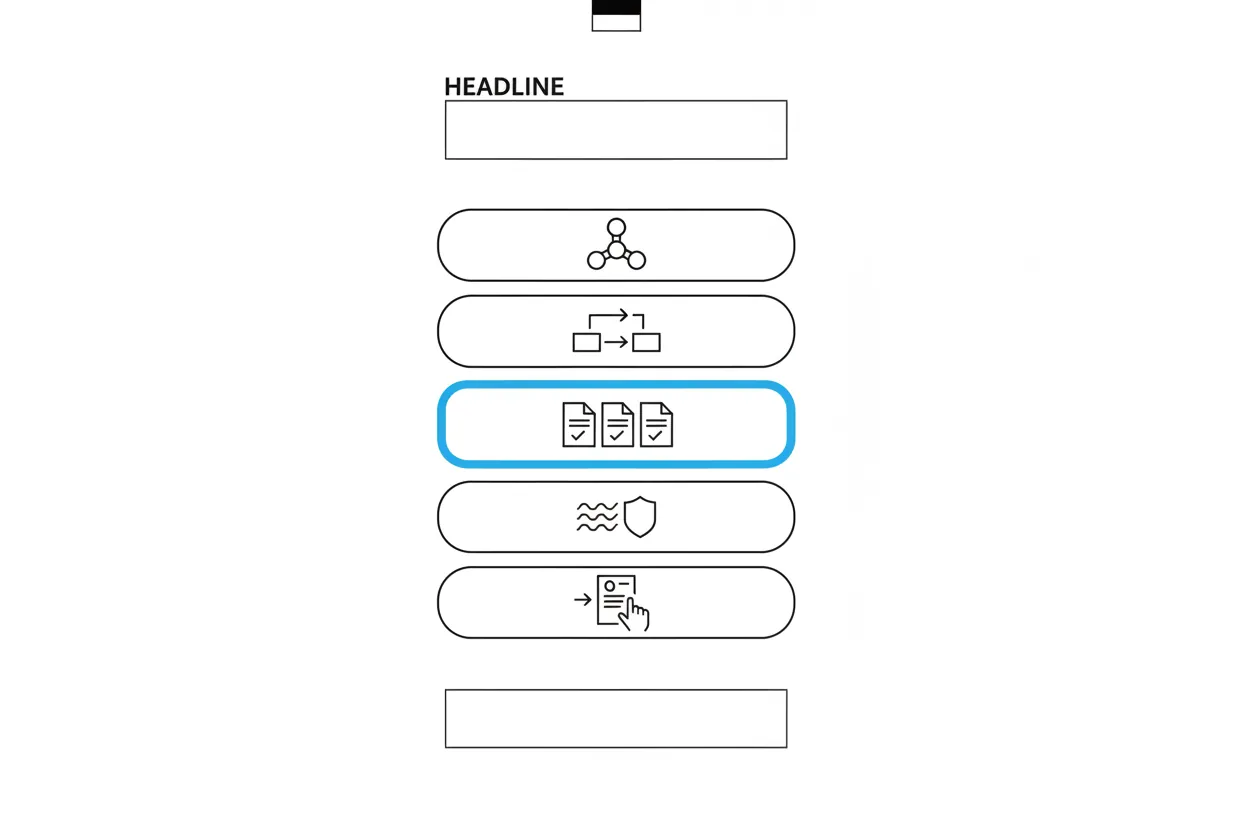
Enterprise private AI work often runs into security review and procurement questions that a model demo does not answer. Five decision areas usually settle those questions: identity, architecture and integration, data authorization, reliability, and procurement evidence. This page sets out how each one gets scoped, in the order the decisions tend to arrive.

Start with the sponsor, the control owners and the use case
Scoping typically needs five perspectives at the table before any technical conversation: the business sponsor who owns the budget and the outcome, the security owner who signs off, the data governance lead who owns classification and retention, the procurement or legal owner who negotiates terms, and the operations lead whose team will run the system after launch.
That conversation should settle three things. First, the use case stated as a business decision rather than a demo: which workflow, which users, which documents, which systems of record. Second, risk appetite, including what data is in scope, what is excluded, and what requires human review before an action is taken. Third, approval authority, meaning who can say yes, who can halt the work, and what triggers escalation.
As an illustrative example, a multi-site organization might limit a first deployment to internal policy retrieval for a single business unit, with no customer or patient records in scope. That boundary is cheap to set at the start and expensive to retrofit once integration work is underway.
Marketing Powered approaches this as an operator. Its founder is a former healthcare CMO who ran marketing for a treatment network that grew from 3 to 24 locations and managed $1.5 to $2M per month in Google Ads across 11+ behavioral and mental health accounts, which is where the habit of writing down approval authority before building anything comes from.
Map the enterprise architecture before anyone picks a model
The next step documents the environment the system has to live inside: the identity provider and group structure, the content repositories and their permission models, the applications that will host the interface, the network paths and egress rules, and every provider dependency sitting underneath the deployment.
Readiness is organizational, not only technical. Thoughtworks structures its enterprise AI readiness assessment across six dimensions, including foundational architecture, operating model and ready data, rather than a single technical checkpoint (Thoughtworks AI readiness). A model selected before that map exists usually gets reversed once the permission model of the source repository is understood.
The map also names what is not supported. Enterprise private AI consulting is only useful if the vendor says plainly which deployment patterns it can deliver and which it cannot. Marketing Powered has been AI-native since 2022 and operates owned, local AI infrastructure for HIPAA-aware inference; the practical boundaries of that are described in owned AI systems and deployment boundaries. It works as an implementation and operating partner, not as the manufacturer of a packaged enterprise AI platform.
Specify data and authorization controls in writing
Retrieval is a common place for authorization gaps. If a system reads a repository through a single service account, it can surface content a given user was never entitled to see, and the interface will present it with full confidence.
A control specification covers role definitions and group mapping, document-level authorization at both ingestion and query time, retention and deletion rules for prompts, outputs and logs, and administrative access, including who can read conversation history and under what approval.
Capability has to be checked against current product documentation rather than assumed. Microsoft documents document-level access control in Azure AI Search enforced from ingestion through query execution, and notes that SharePoint ACL ingestion with query-time permission filtering, ADLS Gen2 ACL and RBAC, and standard blob container RBAC are generally available with the 2026-10-01 data plane REST API, while Purview sensitivity label enforcement remains in preview (Azure AI Search document-level access).
Preview status is a real procurement constraint, not a footnote. Marketing Powered's published security practices are the reference for what is documented today.
- Identity. Question to put to the vendor: Which identity providers and group structures are supported in production?. Evidence that settles it: Named integration pattern and a test account exercising group membership. Likely owner after launch: Customer IT, with vendor configuration support.
- Integration. Question to put to the vendor: Which repositories and applications are in scope, and which are excluded?. Evidence that settles it: Written integration list with exclusions and provider dependencies. Likely owner after launch: Shared, defined per system.
- Governance. Question to put to the vendor: How are permissions, retention and administrative access enforced?. Evidence that settles it: Configuration records, access review output, retention settings. Likely owner after launch: Customer data governance.
- Reliability. Question to put to the vendor: What happens at peak load, during maintenance and after failure?. Evidence that settles it: Load test results, recovery objectives, escalation contacts. Likely owner after launch: Shared, defined in the engagement.
- Procurement evidence. Question to put to the vendor: What is contractually owned, portable and deletable at exit?. Evidence that settles it: Security questionnaire responses, IP split, export format, termination duties. Likely owner after launch: Customer legal and procurement.
Illustrative evaluation table. Assumptions: one business unit in scope, an existing enterprise identity provider, and repositories that already carry permissions. Each cell is an evaluation prompt, not a published capability claim.

Free Audit
Want a straight read on where your budget is leaking?
Set nonfunctional requirements that survive a security review
Secure enterprise AI deployment is judged on behavior under load and under failure. The requirements worth writing down are concurrency at peak, acceptable response latency for each interaction type, availability expectations and maintenance windows, backup and recovery objectives, monitoring and alerting ownership, and support coverage hours with named escalation paths.
Hosting location does not settle any of this. AWS states that it protects the global infrastructure while the customer remains responsible for maintaining control over their content and for the security configuration and management tasks of the services they use, and its guidance recommends individual user identities through IAM or IAM Identity Center, multi-factor authentication, TLS in transit and activity logging through CloudTrail (AWS Bedrock data protection).
In private or on-premises deployments, the operator typically carries more of these responsibilities, which is a judgment worth testing against your own architecture.
Marketing Powered does not publish a uniform uptime commitment, concurrency figure or response-time number, because those depend on workload, hardware and the integration surface. Those numbers belong in signed engagement documents, not in marketing copy. Where data must stay inside defined handling boundaries, data custody and processing boundaries explains how that is scoped.
Prove the pilot, then settle procurement and ownership
A pilot is only useful if it can fail visibly. Acceptance tests worth agreeing in advance include retrieval accuracy against a labeled question set, authorization tests confirming that a restricted user cannot reach restricted content, latency measured at realistic concurrency, logging completeness, and a human review step for any action with external consequences. Evidence artifacts matter as much as results: test output, configuration records, access reviews, incident notes and change approvals should exist as documents a security team can read.
NIST offers a voluntary structure for that work. Its AI Risk Management Framework is intended for voluntary use and to improve the ability to incorporate trustworthiness considerations into the design, development, use and evaluation of AI products, services and systems, with a Generative AI Profile released on July 26, 2024 as an additional resource, and NIST notes that AI RMF 1.0 is being revised as part of the White House AI Action Plan (NIST AI RMF).
Where a workload needs to stay on controlled hardware during the pilot, supported local processing sets out what that covers.
Then compare two contracts for the same enterprise AI implementation. In the first, the vendor holds the configuration, the prompt library, the evaluation set and the integration code, and the buyer holds a login.
In the second, the buyer owns its data, its evaluation sets and its documented configuration, with licensing for anything the vendor brings, a portable export format and a written handoff plan. Only the second one can be left.
Procurement documentation should name the processing and hosting arrangement, subprocessors, approved data flows, retention periods, access rules, resilience and escalation responsibilities, and termination duties covering data return and deletion.
Private deployment by itself does not establish security or legal compliance. Documented controls, tested evidence and clear shared responsibility do. Related material covers AI governance and approval controls, open-source selection and licensing, and how configurable AI workflows are scoped.
Questions, Answered.
Identity provider integration and customer-tenant deployment are evaluated during architecture mapping, and supported options are confirmed in writing before scope is set. Authentication, group mapping and document-level authorization belong in the same specification, because single sign-on without permission-aware retrieval still exposes content.
Marketing Powered operates owned, local AI infrastructure for HIPAA-aware inference and has been AI-native since 2022. Controls offered for any engagement are confirmed in writing during scoping and matched to the actual configuration of that deployment. Marketing Powered does not claim HIPAA certification or any other certification on this page; certification status is stated only where it is documented.
Scoping should define who owns configuration, identity administration, content and permission accuracy, monitoring, incident response, change approval and user support. Platform providers apply their own shared responsibility terms underneath that arrangement, which is why the customer side is written out rather than assumed.
Typically identity and group administration, source content accuracy and permissions, internal approval of changes, and the business decisions the system informs. Those sit with people who hold standing authority inside the organization, and moving them to a vendor weakens the control rather than removing the work.
Acceptance test results against the agreed criteria, authorization test results, logging and monitoring records, a completed security review, documented support and escalation paths, and a signed change approval covering the new data or user population. A discovery conversation is the cheapest place to find out that a deployment pattern will not pass your security review. Bring the use case, your identity and repository constraints, and the questions your procurement team always asks. Scope an enterprise AI discovery
Ready to see where your marketing can improve?
Request a free audit of your paid media, landing pages, attribution, and measurement setup. You'll get a straight assessment of where the opportunities are.
or email us at info@marketingpowered.ai